Shout out to subscriber Kathy H. who said “I feel a blog about being silenced is in your future.” Now, Kathy knows I love to chat. We Facetime, Viber or Magic Jack call each other a lot. What do we talk about? I haven’t a clue, but for about a week the chatting stopped.
Run Dorothy Run!
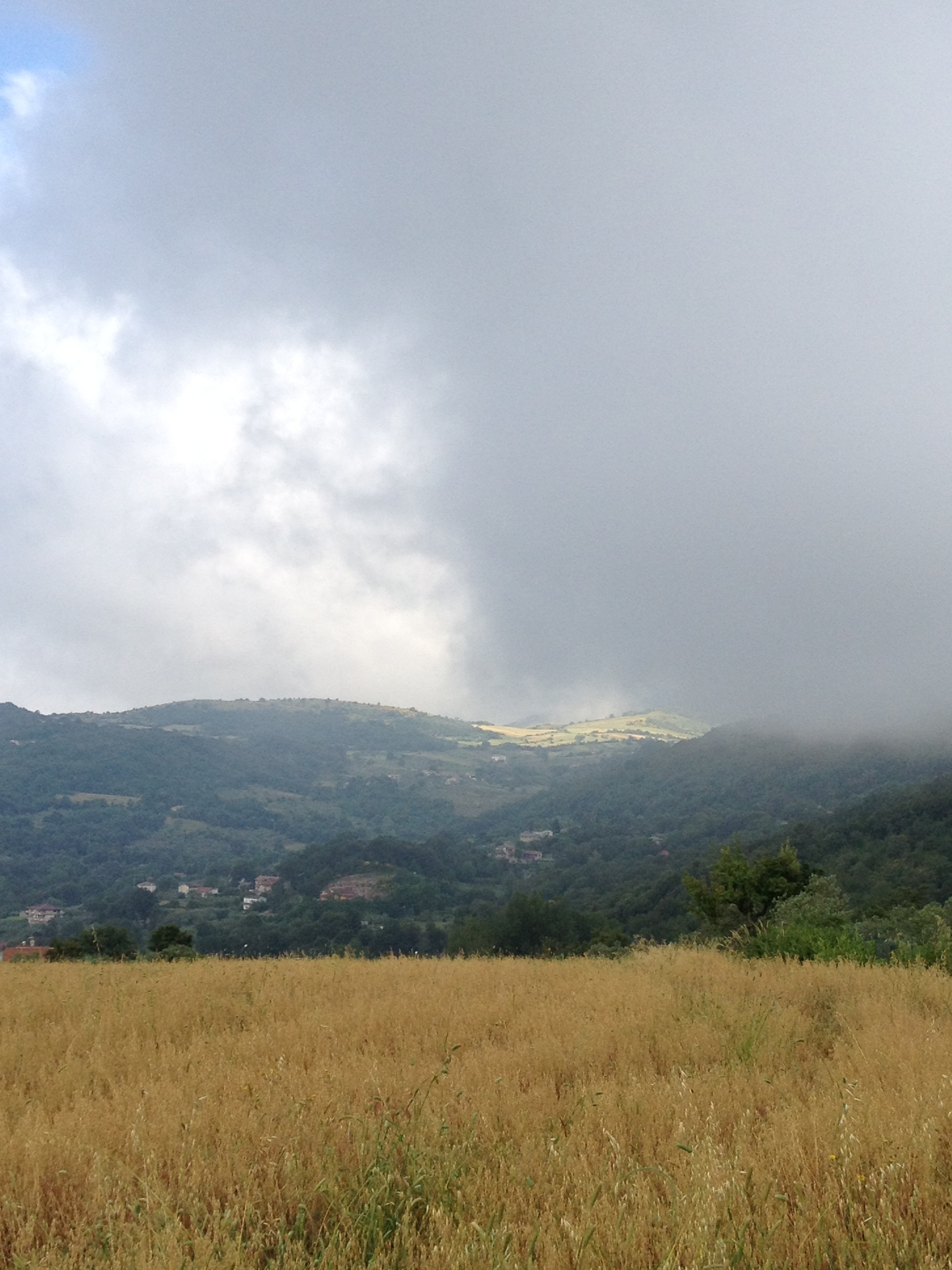
On those chatless days we were plagued with thunder, lighting, whooshing rain and turn your umbrella inside out wind. The internet went kaput. No Internet no chatting.
What? No Magic Jack or Viber?
Suddenly I was silenced!
Yeah, yeah I know – I could still e-mail from my smart phone but it ain’t the same as voice to voice chatting. For one whole week I couldn’t verbally reach out to family and friends in the USA. WHAT!
It was a great opportunity to read books, sit in the caffè and gossip and maybe even play at writing something. It also made me realize that my blabbing about our great cheap ways to communicate with folks in other parts of the globe needed a revision. Here in the hills we have one communication tragic flaw – storms knock out the internet.
Our internet is provided through an antennae on our house and a signal sent from an even bigger antennae somewhere in the hills. When the wind is whoooooooooossssshhhhhhhing the signal starts swirling and may be providing internet to Saturn.
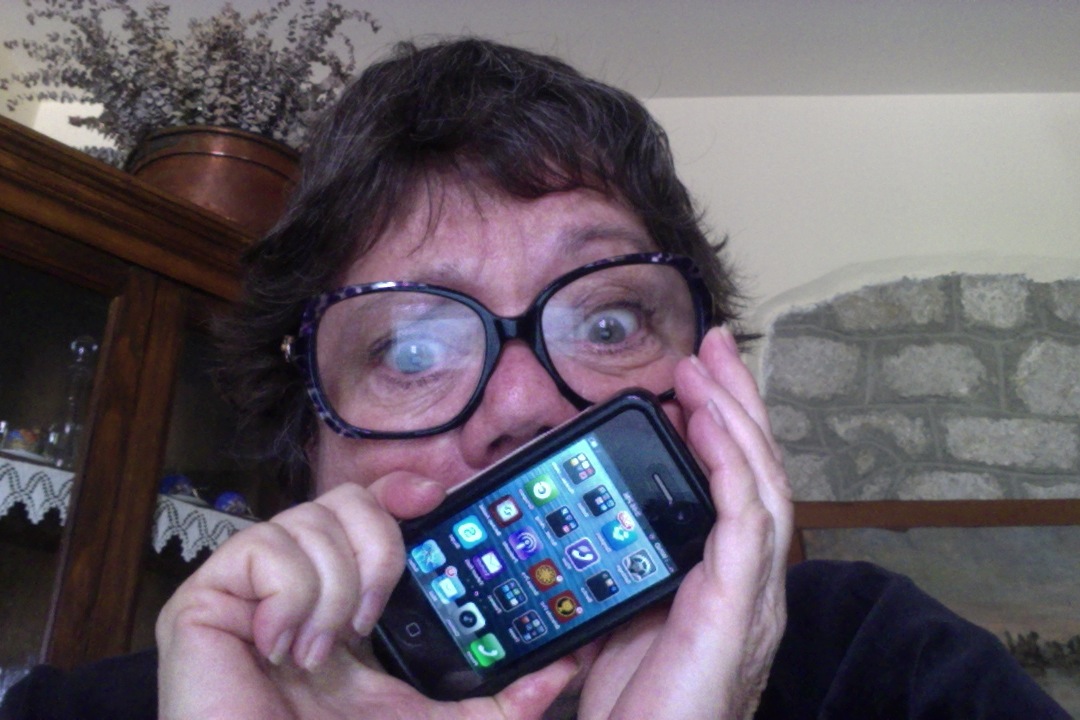
How does one overcome this dilemma? First, make sure you have a good cellular telephone provider. We use WIND and pay ten Euro a month for 200 minutes of calls, 200 texts and UNLIMITED data. Second, make sure you have a phone that can become a wi-fi hotspot. I have an iPhone 4s that works well as a hotspot.
I will caution you, there were times when the storms also limited our ability to use our cell phones but not often.
To make quick calls to the USA – really quick because the more you use the unlimited data the slower it becomes – I would turn the cell phone into a hot spot and call through my iPad or Macbook Air. Apple doesn’t send me dime for saying what I’m about to say (though I would gladly accept the latest iPhone.) Apple products all work incredibly well together.
I’ve installed Viber and Skype on my iPad. Facetime comes with the iPad and Macbook. Magic Jack also now has an application for smart phones a well as your computer. Our New Jersey phone number is our Magic Jack number so folks can easily call us and/or leave a message. (Though I wish telemarkerters would stop calling at 6:00 PM Eastern Standard Time which is MIDNIGHT here.)
Bottom line – I may not be able to sip Campari Soda and talk about nothing with pals in America for an hour but thanks to a good cellular provider and the hotspot on my iPhone we can still get our words out.
December 15th the best Christmas present this blogger could ever want came from Kristen Ross. Kristen posted a comment asking for help finding out more about her friend Nancy’s family. I e-mailed her, then she e-mailed me and soon we were chatting on the phone like old chums. The surnames in her pal’s family can also be found in my family! Rinaldi, Fusco, Mancini – wow – my bis-nonna was Mariantonia Rinaldi who had a brother Francesco. Nancy’s grandmom, Maria Rinaldi, was the daughter of Francesco Rinaldi ! Could this Californian’s family tree intersect with mine?
Those of you who grew up in or live in Pontelandolfo may know the family – if you do please leave a comment on the blog. Nancy’s dad – Domenic Mancini was born in the Minicariello section of Pontelandolfo. His dad was Antonio Mancini and mom was Maria Rinaldi. Antonio’s father is Angelo Mancini and his mother is Catterina Fusco. Maria Rindaldi’s father was Francesco Rinaldi and her mother was Antonia Rinaldi.
This is Kristen’s Story –
Kristen, Domenic & Nancy Mancini
Un Miracolo Di Natale
By Kristen Ross
Domenic Mancini was born on a small farm in Pontelandolfo, Italy. During World War II, nine year old Domenic was the first one in his family to discover that his father, Antonio, was killed in Bardia, East Africa. His mother’s inability to read meant that this little boy had to personally deliver the devastating news to the family. As I began to hear more about Domenic’s early childhood, I was deeply affected by the tragedy of it all…images of Domenic being held back by his Mother as the only father he knew left for lands and battles unknown, the longing of a little boy for an absentee father, and the courage he had to support his grief-stricken mother.
To compound the sadness of war, he never knew where his father was buried. He was told that Antonio was buried somewhere in Africa, but no one had been able to locate any information, and Domenic (now 82) had begun to come to terms with the idea that he might never be able to pay his respects to the father he lost and have closure.
After hearing him tearfully tell this story, I could not imagine what is was like to not know where his dad was after all these years. I was determined to do some research of my own. I felt the sense that nothing is impossible and nothing is ever lost, it just hasn’t been discovered.
Having taken only one Italian class, after traveling to Italy several times, I used my broken Italian to make numerous phone calls, emails, and research Italian websites. Having looked at almost two thousand names, a thousand war memorial sites, and spent countless hours of translating Italian handwriting from the 1940’s I was coming up with nothing. It was like searching for a needle in a haystack, an Italian haystack for that matter.
I needed un miracolo; a miracle. Every time I find myself helpless, I turn to something higher. I simply prayed for this right intention to manifest itself. For a father to be reunited with his son, even 72 years later, is still possible. Having lost my father too, I knew how much this would mean to Domenic to have some sense of unity, closure, full circle ect… I kept ricerca; searching.
Before I went to sleep that miraculous night, I checked one last Italian website. I typed in the letters of his last name and there he was. Antonio Mancini had been found. I started scrolling down to make sure I was actually seeing straight.
Luogo Sepoltura means Place of Burial. He was back home in Italy. From previous research that I had done, I knew the bodies of the Italian Soldiers who died overseas, were sent back to Italy in December of 1967 and placed in a beautiful memorial museum in Bari, off the coast of the Adriadic Sea. Dominick’s father has been honored there.
I called Nancy, and she quickly made the phone call to Domenic! He was in total shock and was filled with so much joy. He told us that this was the best gift he’d received in his entire life. As his voice teared up on the phone, he told us he would travel back to Italy to see his father. This summer, we will be traveling with him on this beautiful journey to witness this father and son reunion.
Unconditional Love is the best gift in the world.
This is the true meaning of Christmas to me.
**********
The Sacrario Militare dei Caduti d’Oltremare (Military Memorial to the Fallen Overseas) was opened on 10 December 1967 on the outskirts of Bari, on the way to Brindisi. The structure houses the remains of more than 70,000 Italians who died in foreign lands. These lands include Greece, Albania, Algeria, Morocco, Tunisia, Libya, Somalia, Ethiopia, Eritrea, Germany and the Mediterranean Sea, in the First and Second World Wars.
Time to tell Zia Caterina’ s tale of Eleanor and Franklin Delano Roosevelt –
It’s presidential!
Franklin D. Roosevelt and Eleanor Roosevelt in Warm Springs, Georgia – NARA – 195635 (Photo credit: Wikipedia)
This is the tale of my dad’s older sister, Caterina Guerrera’s, journey on the rocky road to the American dream. You may remember my Aunt Cat from the earlier blog about my family’s Ellis Island experience – https://nonnasmulberrytree.com/2013/09/18/nonna-comes-to-america/.
Two-year old Caterina Guerrera was racing over the hills of Pontelandolfo talking as fast as the village’s babbling brooks. Then the world stopped. This peasant child was stricken with polio. Her mother put hot stones on her limbs, massaged and massaged. One of the reasons the family came to America was that my nonna, Maria Rosaria Solla, was afraid that Caterina would end up in an institution for the insane and deformed. Caterina was smart and fought hard and seven years later was able to board the ship in Naples for America.
Charcoal Drawing done in Italy. Maria Rosaria Solla, Savatore, Caterina, Francesco and Nicola Guerrera
When nine-year old Caterina entered her first American school she discovered just how quick a learner she was. In those days immigrant kids didn’t have the benefit of bi-lingual education or ESL – it was total immersion. On the happy little girl’s first day of school the teacher said something – Caterina looked at her and smiled – the other kids put their heads on their desks. Suddenly the teacher’s yard stick whacked Caterina on the back of the head. Aunt Cat figured out immediately what the English phrase “put your head down” meant.
Polio left her with a short right leg, “baby sized” arm and marked limp. Because of her jaunty walk – step and drag the dead leg, kids would call her 1 and 2 and. She swore to me it didn’t phase her – that they were just teasing. Bottom line, she remembered and replayed the story tape for me.
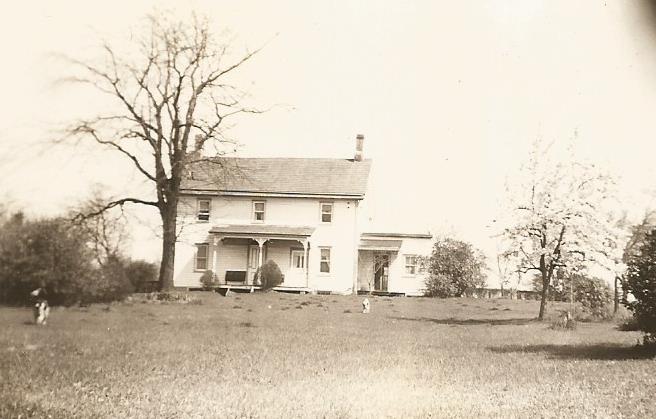
At that point in time, folks who were disabled were often hidden away. Well no one was hiding Caterina Guererra – “Guerrera” does mean female warrior. She was a fighter, often protecting herself and her younger brother, Salvatore, by tossing rocks squarely at all taunters. Eventually, the family moved to a small farm in the Flagtown, section of Hillsborough Township, New Jersey. A number of other Italian families had settled in Flagtown – this was the depression and members of this tight knit community helped each other.
Fifteen acres for nonna to farm with Catherine’s help.Grandma and Aunt Cat tend the garden to feed us all.
She graduated from Somerville High School in June of 1933 and then attended Drake College (business course – 6 months). Catherine wasn’t going to let anyone hold her back. After attending secretarial school and pounding the pavements looking for work, the only job she could get was in a sewing factory in Bound Brook – cleaning. With her shriveled right arm that hung like a dead branch and a right leg that didn’t work at all, she picked up dropped pieces of cloth so the ladies sewing wouldn’t have to take the time to bend down. Catherine took the train every day, angry that her active brain was mildewing in a sweatshop. There had to be something better – mannaggiathis was America!
The President during this period of American history was, Franklin D. Roosevelt, also a victim of polio – something he hid well. Roosevelt overcame his affliction and Catherine felt she would too. He had helped all kinds of folks during the great depression. Including her brother, Salvatore, who traveled across America improving our park lands with the the other poor young men of the Civilian Conservation Corp. The CCC was just one of the programs that were instituted under the “New Deal” moniker. The Works Progress Administration was one of my favorite programs. Jobless Americans built buildings, bridges, schools. More importantly artists, writers, musicians and theatre professionals were included in the WPA. WPA art can still be seen in public spaces around the country.
CCC Camp in Hackettstown, NJ 1935 – Uncle Sal is 6th from the left – front row!
“It is only in recent years that we have come to realize the true significance of the problem of our crippled children. There are so many more of them than we had any idea of. In many sections there are thousands who are not only receiving no help but whose very existence has been unknown to the doctors and health services.” Radio Address on President Franklin D. Roosevelt’s First Birthday Ball for Crippled Children January 30, 1934
Aunt Cat saw that Roosevelt also was instrumental in raising funds for polio treatment and creating the innovative use of hydrotherapy with polio patients in Warm Springs, Georgia. This plucky young lady sat down and penned a letter to the Roosevelts.
This is how my Aunt Cat told the story to me:
I wrote to Eleanor Roosevelt. My friend Libby (Elizabeth Quick) thought I was pazzo – why would the president’s wife listen to a “guinea” from Flagtown, NJ? My father and Mr. De Angelis started the Democratic Club here. All the Dutch farmers were Republican. I wrote 20 different letters and finally got it right. I sent it.
One day – I was giving Mary the horse some hay – and then a big black car pulled in the yard and sent the chickens running. This woman got out of the car and showed me some papers. She came from the state and she said that she was going to take me to see a doctor who could maybe help me walk better. My father was working and my mother was at Mrs. Gallo’s – Julie’s mother – I told my brother, Tony, to tell mama I was going to see a doctor and I got in the car. If someone could help me walk without dragging my leg like a mail sack than I was going. What I didn’t know was that the doctor was in Newark – in those days you only had Route 28 and it took 2 hours to get to Newark. She took me to Beth Israel Hospital – Dr. Henry H. Kessler himself saw me and asked me if I was strong. He said it would take 8 surgeries but he could make me walk better and my bad arm wouldn’t just hang like a dead branch. He laughed when I told him that I milked the goats and cows, plowed the field following Mary the horse and dragged my leg the ½ mile to the train stop to go work in the sewing factory – strong – I was strong. I was old enough to sign the papers and the next thing I knew I was in a huge room lined with beds – in those days you slept in a bed in a ward with 40 other beds. I wasn’t even afraid. Dr. Kessler had this way about him – he cared – like the Roosevelt’s. Dr. Kessler fixed my arm first. I had 9 surgeries. After the first surgery, Dr. Kessler asked the nurse why no one ever came to visit me. Even then he knew that you had to treat the whole person – not just be an orthopedic mechanic. He asked me if I had any family. I told him my family lived in Flagtown – which to him was like living in Appalachia. I had left with the social worker and never went home. I thought she told my mother.
Dr. Kessler asked me if I wanted to use the telephone and call them. You didn’t have a phone in the depression unless you were rich. So I wrote them a letter and told them where I was – the boys could read in English – as soon as they got the letter they came. Mama was furious that I would not let them take me home – but after all the surgery and I could walk she stopped being angry.
I have never voted for a Republican.They still are for the rich – look at Bush and the oil people. Bush wouldn’t send someone to help a girl with polio unless he could get something. What did Mr. Roosevelt get? A thank you letter from me, a girl whose father laid railroad ties and whose mother kept us eating by her garden and animals.
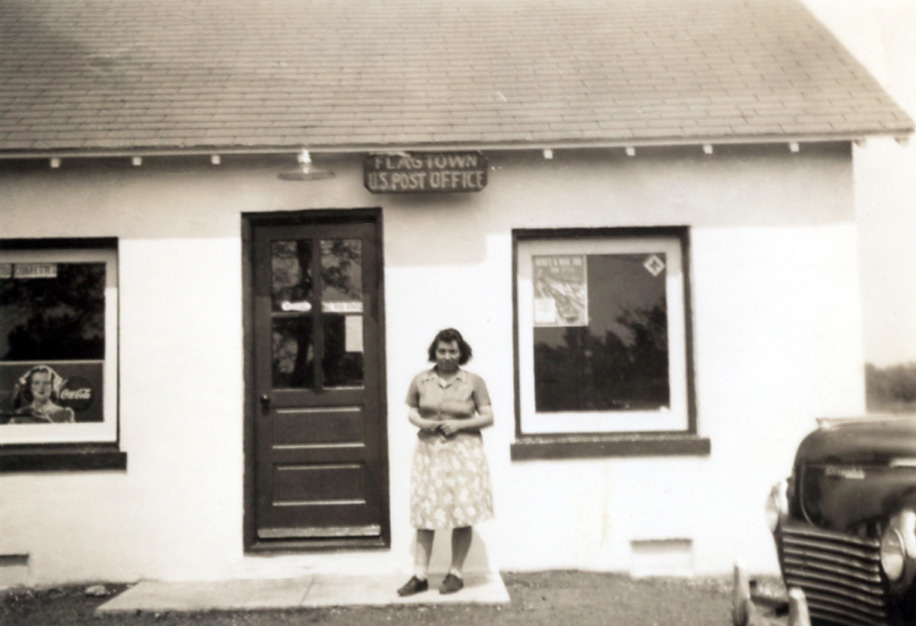
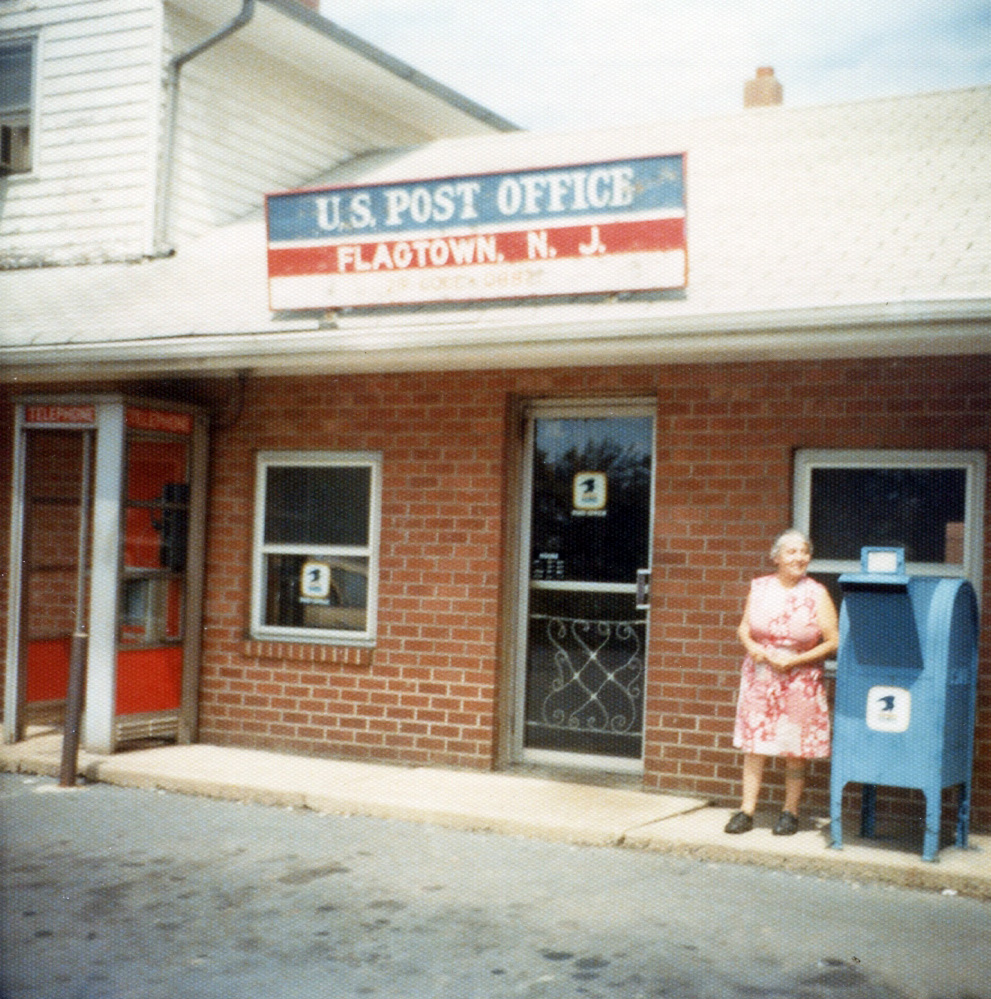
She was soon – well not that soon – I mean nine surgeries is a big deal – back in the fields, passing her driving test on the first try – her macho brothers couldn’t do that – and looking for work. Then a miracle happened – the federal government decided that a post office was to be set up in Flagtown. Whoever ran it wouldn’t get a salary but a commission on what postage was sold. (Damn, an entrepreneurial helping hand at no cost to the government – who’d have thought!) The whoever – thanks again to the helpful Roosevlet hand – was Catherine (AKA Caterina) Guerrera. At first she didn’t want to do it – a commission – who wants to work on commission. Her dad, Francesco convinced her to take the new position. In Italy it was an honor to be the postmaster.
On March 26, 1943, Frank C. Walker Postmaster General of the United States of America appointed Catherine Guerrera Postmaster at Flagtown in the County of Somerset, State of New Jersey. Originally she worked out of a shack near the rail road tracks. Then her entrepreneurial brain started twirling. Due to her personality, more people were buying stamps and the little postal stop was growing. Why not own the building? She got a parcel of ground from her dad and with her brothers help built a post office that she rented to the government. To this day my cousins rent the newer version to the postal service.
She also ran a small lending library and smaller general store out of the space.
She then marketed the hell out of that little rural post office and by the time she retired in 1980 – at a vital aged 69 – had built it up to a first-class post-office. (This designation is no longer used by the postal service.) The building also grew. From that one room rural oasis to a solid facility with an accompanying luncheonette and two apartments. She had a vision and watched it grow. Cha- ching!
From one room to many! That is my Aunt Cat.
Every story has a moment of sadness. Catherine Guerrera had been Post Master for forty years and hated that forced retirement. In 1984 – four years after retiring – the dreaded polio returned – post polio syndrome. I blamed the forced retirement – she was no longer lifting and chucking huge mail bags, standing and sorting mail, bending to talk to children. This time she had the resources to get the best of care at NYU’s Institute of Rehab Medicine under the guidance of Dr. Kristjan Ragnarsson. It took a while, but after a good number of months in New York learning how to deal with a wheel chair, take in the sights of the city from a little bit lower perspective and outfitted for new braces she was back to her “give ’em hell” self.
This great American Dream story demonstrates to all those non-believers – that a little bit of government assistance can jump start a life. And – for those of you who are died in the wool conservatives – her estate taxes more than paid off Uncle Sam for all his – I mean Roosevelt’s – help.
My fabulous Aunt Cat taught me that hard work, hope and being a Democrat was the American thing to do.
Whoa – all I can think about are drugs! With the air waves bombarded with the shut down of the American Government and all that debate over the Affordable Health Care Act – who wouldn’t think of drugs. Medicine to keep us healthy. Medicine to keep us sane. Time to look into the meds that keep us sane and send some to the USA Congress. It makes me crazy to think that a country still exists where some retired folks stop taking medicine when they find they are in the Medicare Part D donut hole of higher profit for big pharma. I am hoping that the Affordable Care Act – if allowed to live on and grow – addresses that too. OK, enough politics – let’s get down to what it is like for an expat to go to the pharmacy here in Pontelandolfo.
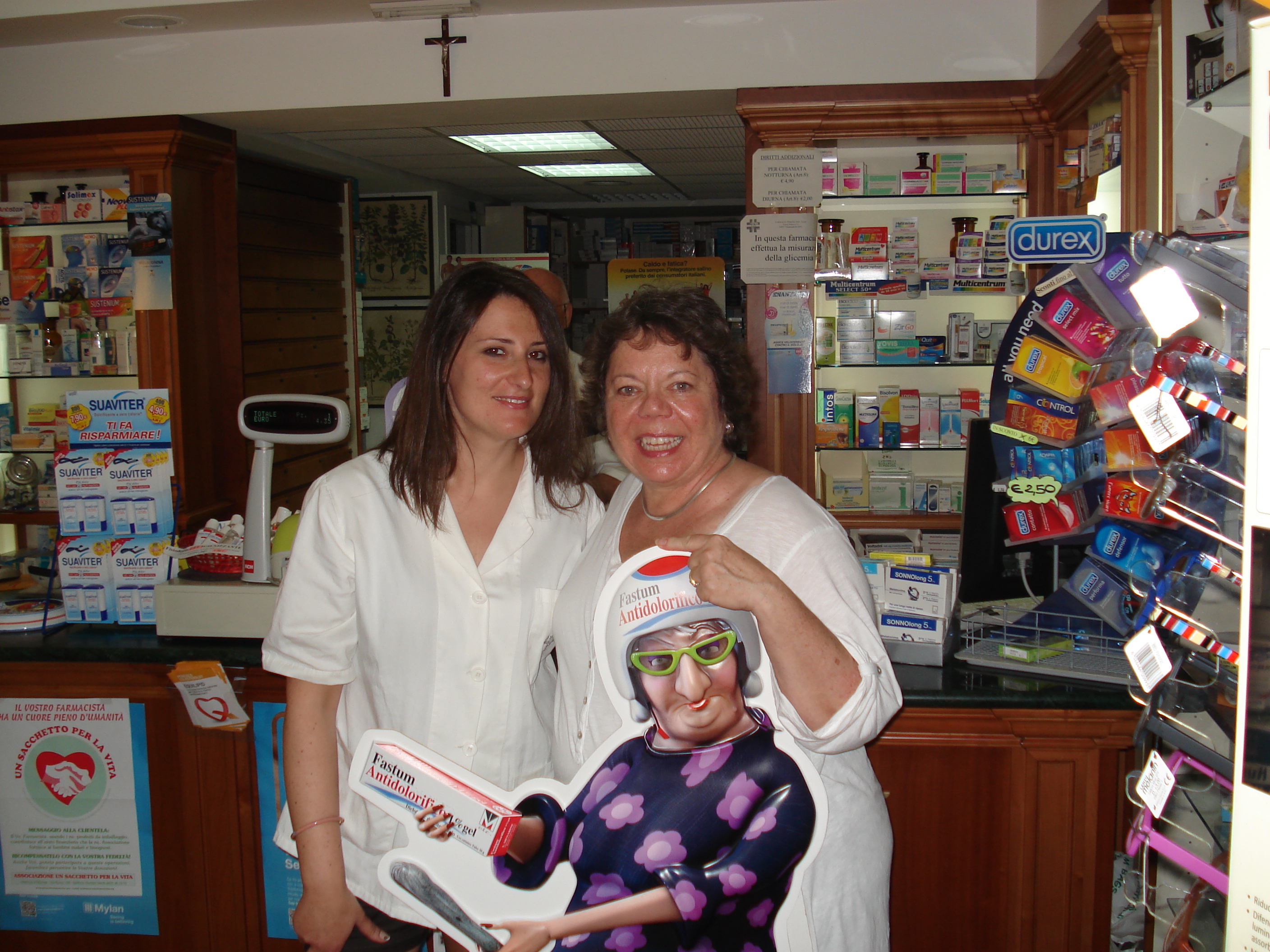
There is only one pharmacy in our village – the sign says Farmacia. It is not Waldgreens or CVS or any big box monolith run by employees who will never remember your name. It is simply La Farmacia – a family owned and operated small space on the Piazza Roma. No, they do not sell soda, bread, flip flops, books or toys – there is however a condom dispenser on the nearby exterior wall. How clever – condoms in a machine available 24/7 right out there in public!
Before we leave for extended Italian stays we always try to stockpile medicines for my husband. I’m lucky – I just take a blood pressure med and I made sure to get a thousand samples. Jack takes a suitcase full of heart, cholesterol and who knows what else stuff. What I do know is that when Jack’s Medicare Part D falls into the donut hole of death for the poor, his monthly tab for meds can be $2,000. Damn, my first car cost less than that. Rats, Jack just edited this and said I am lying about the $2,000. Ptblahhhh ( that is me sticking my tongue out at him.) I got the breakdown for what Jack’s co-pays were before we left for Italy in April – $1718.49. So I exaggerated a little but hey – some people don’t have $1718.49 – and that is still more than my first car.
Jack knew, before we hit the Italian hills, we couldn’t afford to buy multi-month’s worth of pills in the USA . So, we spoke to Michelle and Michael our fabulous local – non corporate – pharmacists at Raritan Apothecary. They said – buy them in Italy – they will be a hell of a lot cheaper.
Blatant Plug – Buy Local
Raritan Apothecary
25 West Somerset Street Raritan, NJ 08869
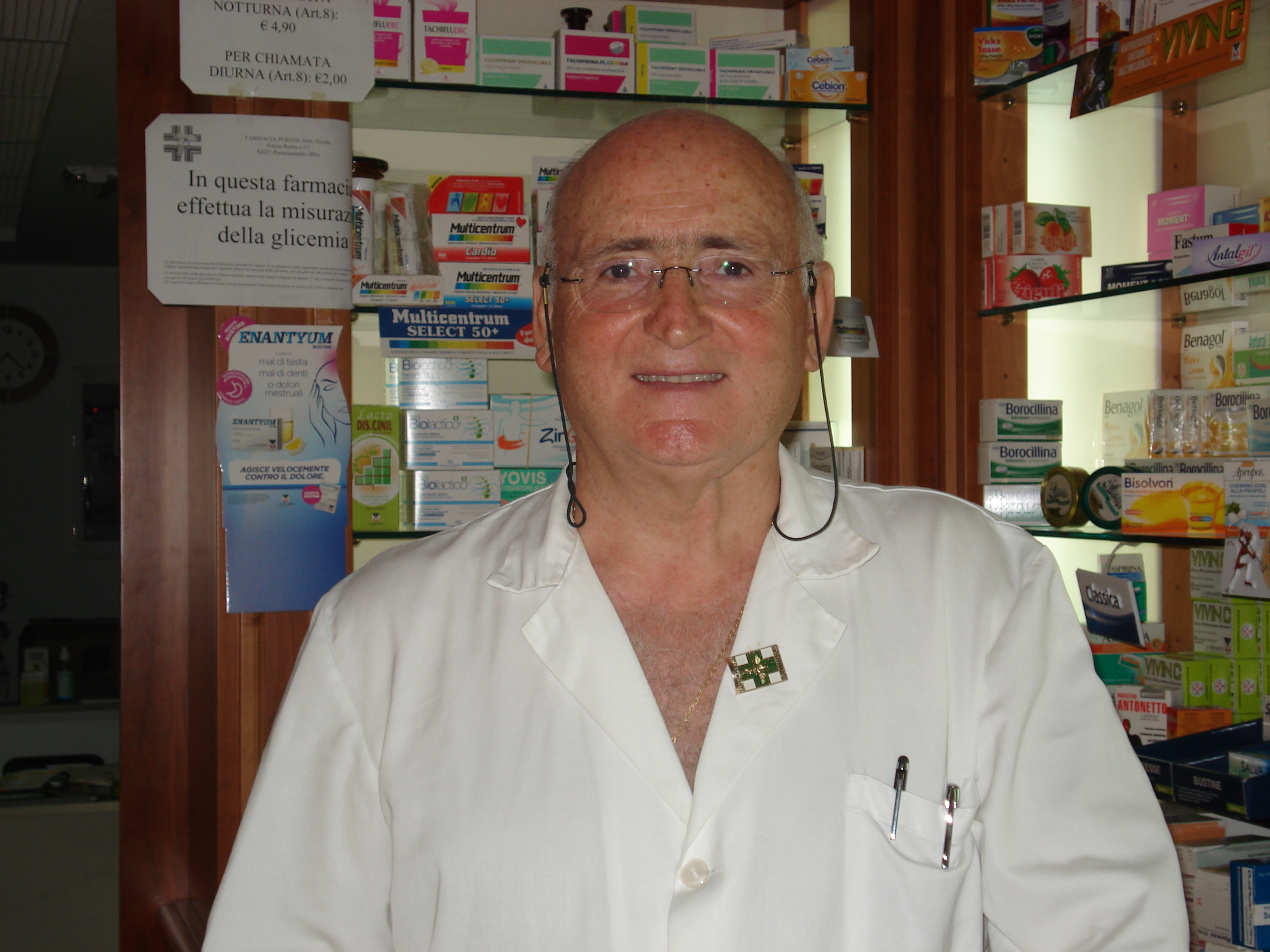
I will admit, my drama queen worry mamma surfaced. What if we couldn’t get Jack all the stuff he needed? Would I have to send him home? Get in touch with my wild women roots and make drugs from monkwart? The first time Jack ran out of a medicine, I brought the empty bottle to la farmacia and introduced myself to the Perone family team of Nicola and Tina, the father/daughter pharmacists who keep Pontelandolfo on a healthy path. (Yes, I did remember the Italian courtesy of saying Buon Giorno as soon as I entered the store.)
Tina Perone – who always said “Ciao Midge”. That doesn’t happen at CVS.
Dott. Tina Perone recognized me as Carmella’s cousin – the American who dances two nights a week with her mother. Small villages create the art and activity they need. Carmella had organized a bi-weekly line dancing excersize and get together gab fest at the indoor bocce courts. I love to dance, need excersize and wanted to meet the village women. It was a win – win – win since it gave Tina and I an immediate connection.
Even without that connection, Jack and I would have been treated like people not numbers. Dott. Nicola Perone took the empty bottle and then proceeded to research for an incredibly long time the formula and ingredients. When he had the Italian perfect match he provided Jack with his meds. We do not have health insurance for Italy. We are not part of the Italian health care system. We paid full retail. Full retail that was freakin’ less than Jack’s bloody co-pay in the USA! How the hell can that be?
Over the course of months we visited the pharmacy often. Jack’s meds were always researched and supplied. The one thing that cost more in Italy was Advil – ibuprofen – one euro a pill! Of course they only sell 400 mg of Ibuprofen – not our 200 mg bottles. Jack needs to pack his Costco Ibuprofen or start using the Italian Spedifen! Interesting that vitamins weren’t pushed – apparently most people only take those vitamins that docs prescribe – like vitamin D. That made me pause and think about how much I spend a month on supplements.
Poor Jack, he loves to walk in the noon day sun up and down the hills. Too bad the soft corn between his toes hurt like a son of a bitch. We went into the pharmacy to get the name of a podiatrist and the first thing Dott. Nicola said was take off your shoe. Jack took off his shoe and Dott. Nicola looked at the giant thing between his toes. Damn, I wouldn’t even do that and I love the guy. He gave Jack some rubber things to put between his toes and some gunk to put on the ugly thing. Did you catch that, the pharmacist got on his knees and checked out my husband’s toes. You don’t see that at Walmart.
Dott. Nicola Perone – our fabulous pharmacist!
I am uncomfortable sharing the meds my husband takes so I will only give you one example of price point differentials. Before we left for Italy Jack got Nexium 40mg – 90 pills – for a $311.95 co-pay or $3.47 co-pay per pill. In Italy for the generic exomeprazolo it cost .73 per pill retail – not co-pay. I just checked on line and the exomeprazolo 40 mg for 90 days co-pay at CVS on line comes to .55 per pill. Retail is less than or a wee bit more than the USA co-pay. Huh?!!! What?!!!!
Interested in learning more about Italian pharmacies and brushing up on your Italian –
Le farmacie sono luoghi organizzati dallo stato ma operati da professionisti medici che vendono medicinali solitamente dietro ricetta medica. Con l’istituzione delle parafarmacie è possibile acquistare medicinali equivalenti senza ricetta medica.
Pharmacies are places organized by the state but operated by medical professionals who sell medicines usually with a prescription. With the establishment of drugstores you can buy generic medicines without prescription. Are big box drugstores coming to Italy? I hope not. We did see pharmacy concessions with a separate check out in big grocery stores – kind of a grocery/Walmart store set up.
Just like I won’t shop in a Walmart in the USA and we only get medicine at a local pharmacy – Raritan Apothecary. When in Italy, I’ll stick with going to see Dott. Nicola and Dott. Tina in our little La Farmacia on the Piazza. La Farmacia where every “Buon Giorno” is greeted with a smile and you are served by people you can trust.
Mia nonna coraggiosa e zii. One woman alone with three kids in steerage.
Before we can talk about my nonna’s trip to America, I thought we’d take a peak at where she came from. There isn’t much left of il casolare in pietra – the stone cottage my nonna, Mariarosaria Solla left behind. I was going to say hut – stone hut – but it was a tad bigger than that. Imagine a stone one-car garage built when all cars where VW Beetles. When Rosaria (I never heard the Maria part of her name) left for America, she had been living in a one-room house of stone that dated back to the Middle Ages. Obviously, houses constructed of huge rocks were built to last. This one did until an earthquake took out most of the town.
Following sprightly nonagenarian Filamena as she scampered over rocks, past thistles and up the hill, my stomach gave a twitter. It might have been because I haven’t been able to scamper like a goat since I was ten and here was Filamena sporting the traditional kerchief, dark stockings, long dress and nun’s shoes laughing as she guided us to my nonna’s house. Or it could have been because with every step I took I felt more and more rooted in this community.
We found the house at the top of a hill in the section of Pontelandolfo called Brecciale. From the remains of the cottage, one can see the village center, tower and church steeple. The view is spectacular! The thought of walking down the hill through the valley and up the hill to the central piazza carrying goods to barter or sell brought tears to my muscles. It was my nonna’s parent’s home – Liberantonio Solla and Mariantonia Rinaldi. Story has it that my bisnonno, Liberantonio, was a musician! The vein of artists in my family obviously can be traced back to our beginnings. Accepting wages of wine, Liberantonio would play his concertina in the piazza. He’d make it down hill number one, across the small valley and be crawling by the time he was mid-way up hill number two. That’s when my bisnonno would bellow for bisnonna, Mariantonia, to drag him up the hill home. She’d ignore him. Good for her. I come from great stock!
Nonna did what the children of every other poor family did than and still do today, lived with her parents. As I explore the village that sprouted my family and meet cousins I didn’t know I had, I’m meeting families that still have two or three generations living under one roof.
Up a piece from nonna’s house was a patch of rock that the local farmers used to grind wheat. The marks from a heavy stone wheel are permanently imbedded in the rock. An oxen or mule was harnessed to a contraption that smacked on the grain. You can also still see the circular track of decades of animals walking round and round and round and round.
Living on the top of a hill, means to fetch water from the river or the nearest fountain Nonna Rosaria walked down steep paths. Easy for Jack and Jill to go down the hill – but with buckets full – it is up hill to home. Even though life was tough, nonna and her children loved living there. I understand now why my nonna’s farmhouse and land in New Jersey looked the way it did. She and my nonno, Francisco Guerrera, tried to remake their little piece of New Jersey into a little piece of Pontelandolfo.
Take a peek at the video of her house today – Nonna’s House
To find out more about my grandmother’s trek across the ocean to America, we took my Zia Caterina to see Ellis Island. She had made that journey with her mother and two brothers. When we walked into the great hall of the immigrant’s reception center her face turned grim and she started shaking. Like a soldier suffering Post Traumatic Stress Syndrome, residual fear racked her body. It was the same fear she felt when the line watchers at Ellis Island ripped her away from her mother and put her in quarantine. We passed a door and she shouted, “that’s the room – the room they put the sick ones in.” “They left us there and no one could speak our kind of Italian and tell me anything.” “I was scared but looked them in the eye and said sto bene – I’m well.”
Caterina’s Story:
When I was two in Italy I got polio – they didn’t know what to do then – not many got polio. My mother, put hot rags on me and massaged and massaged my leg and arm. She said I just cried all the time. I walked when I was 9 months old – I talked at 12 months. Then at 2, it was over. The priest wanted to send me away – he said cripples couldn’t stay. My mother wouldn’t let them take me. She kept rubbing my legs and rubbing my arms. She never wanted to come to America. My father came first and worked in the Patterson silk mills. Mamma was afraid that if we stayed in Pontelandolfo they would take me and put me away with the crazy people. The priest kept coming to look at me – he’d shake his head. When papa saved enough to rent a place to for us to live in, he sent for us. The Pontelandolfesi women told my mother to only pack her nicest clothes for America – in America everyone was rich. What nice clothes? They were contadini – kind of like sharecroppers. (Serfs – I told you I come from good stock.)
Mamma was a fool and listened. She left her good wool skirt, heavy wool shirt and shawls. Beh, those stupid women kept saying only peasants dressed in those. I think the other women wanted her warm clothes. On the ship it was so cold mamma couldn’t stop shaking. She didn’t have anything heavy to wear.
She promptly made a warm cape in NJ!
Mamma was shivering and had a fever. She just stayed in the bed – we were all way down in the bottom of the ship – hundreds of us. My brother Nick, Sal and me – mamma was so sick – we were kids. We didn’t know what to do. They didn’t give us good food only bread. We had a piece of cheese in our bag. An old man felt sorry for mamma and took care of her. He got coats from the other men and piled them on her. Somehow she lived.
When we got to Ellis Island because I had polio mamma was scared that they wouldn’t let me in America. She made me stand between her and Nick in the long line – close so you couldn’t see my little arm and shriveled leg. Men in white coats walked up and down the line and looked at us – even made some people open their mouths. A man stopped and took me. I could hear my mother screaming. They took me away to quarantine and she didn’t understand what was going on. None of us did. They kept me at Ellis Island for a couple of weeks. She and papa came every day to ask for me. They told her nothing. Finally they let me out – I thought I would never get out. My mother cried that day until there were no more tears inside her.
My nonna, Mariarosaria Solla, overcame her fear and was the rock that my family was built on. She learned English immediately – I was never spoken to in Italian by anyone – we were Americans. Also, I was born just as WWII was ending and even though young men like my dad served in the military – Italians had been persecuted in America – many put in interment camps and others sent back.
This woman of the country was now living in an industrialized part of New Jersey. The long shifts that my grandfather worked at the silk mills meant that she had to learn to be self-sufficient in a new place. Eventually, my grandfather and Great-uncle John bought a farm together in Neshanic, New Jersey. Later nonno and nonna bought their own fifteen acres in Flagtown – where I was raised with the sheep, chickens and goats. Nonna was an incredible farmer – my family continued to be subsistence farmers – just like they had been in Italy. Nonna and Zia Caterina could grow just about anything. Those skills came from Pontelandolfo. Yes, nonna did snap a chicken’s neck so we could have a roast and butchered goats, sheep etc. I only learned how to kill and clean fowl – not sure if I could even do a rabbit. But hey, life brings new adventures for all of us. I just hope that I have inherited a piece of her courage for my journey.
15 acres to farm – and just like what I see today in Pontelandolfo – the women are in the fields. Nonno worked for the railroad.
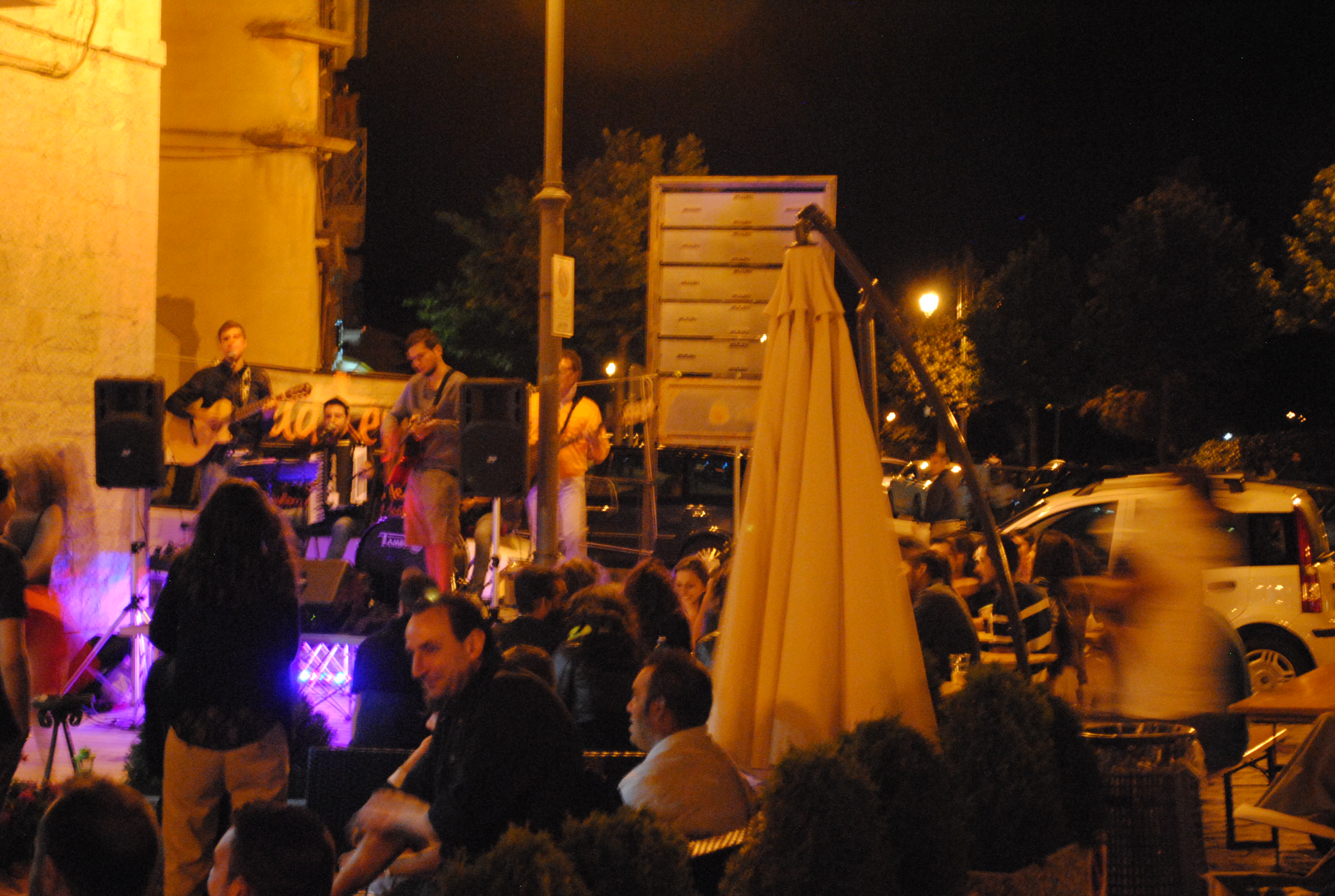
It was 10:00 PM and we had just finished dinner at Landulphi, a great space that resonates with its medieval heritage. Outside Piazza Roma was a buzz of activity. Picnic tables were crammed in front of Bar Elimar. A lit bandstand filled one section of the sidewalk. Tots in strollers, pre-school hellions chasing each other throughout the crowds, moms, grandmas, twenty and thirty-somethings and tweens edge closer to the action.
Crowds creep in closer to hear not Rock ‘n Roll but rocking traditional music.
Tonight, that action was a sweet group of young performers – I’m guessing music conservatory instead of university students – wailing out traditional Italian music on the accordion, all sorts of percussive instruments and electric guitars.
Curtesy Sud Terranea
There is a college age dancer – barefoot on the cobblestones – dancing her heart out in the style of my ancestors. Twirling, toes pointed and then flexed as she stamps, kicks and brings us back to a time in this village – even before the unification of Italy. The sounds of Sud Terranea – “music popolare mediterranea” – brought young people to their feet dancing not the bop of hip hop but the traditional footwork of their great grandparents. ( http://sudterranea.jimdo.com/)
Curtesy Sud Terranea
Boy was I happy I had on a white shawl. It gave me something to hold up as I too did my whirling dervish routine. Weeee – I almost but not quite worked off the calories I gobbled down at Landulphi.
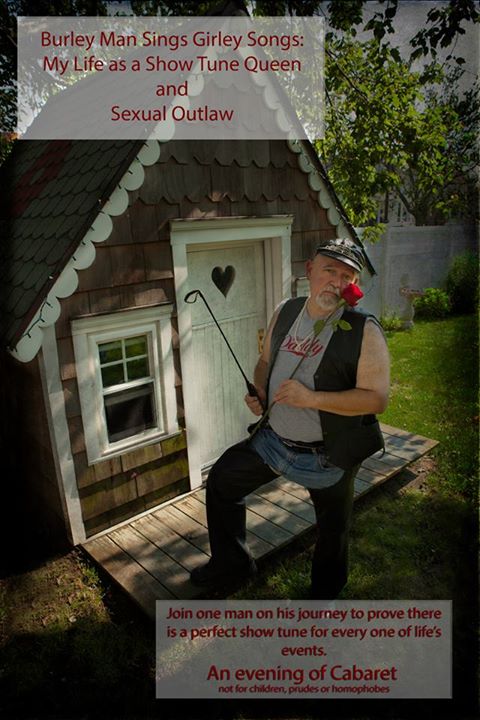
It was interesting that this bit of performance art popped out of nowhere on this particular day. Earlier – on a Skype call with my friend George Hansel about producing his new cabaret act, Burly Man Sings Girly Songs: My Life as a Show Tune Queen and Sexual Outlaw, (yes that was a plug) George raised a devastating question.
George has the greatest laugh in the world. See his show and laugh with him.
Could I really live in a small village with no easy access to the cultural richness of New York and Philadelphia? Hey, I bellowed back, I grew up in Flagtown, NJ – a small village with easy access to culture and an uncle who worked for the then New York Mirror and got free tix to stuff. Ask me how often we actually got to go????
George also, reminded me that I have the attention span of a gnat and boredom can easily weasel its evil sighs into my soul. I explained that during my last bout of boredom I realized that if I was bored it was my fault. All it took was a walk down to the village with my laptop in tow to chase the boredom away. Just sitting at a bar (cafe) surrounded by village life and listening, watching and being perpetually surprised at the instant art that pops up can get my creative juices flowing and the deeps sighs disappearing.
Living in New Jersey with easy access to my state’s professional theaters and being able to zip into both nearby cities, is indeed terrific. But how often do we really do it? Finances come into play. Tickets are expensive, add travel, or driving costs and suddenly an opportunity to experience art is fiscally out of the question. Here in Pontelandolfo, the fiscal crisis has folks pinching euros. Yet, art is accessible to them. They often create it themselves.
Site specific theatre produced by the town’s twenty-somethings took place in a variety of outdoor locations. The audience moved from scene to scene.
Sponsored by bars, community groups and Pontelandolphesi living in the USA and Canada, there seems to be music, dance, theatre and visual art happening weekly. Look for upcoming blogs on many of those events including a two part blog on Associazione Culturale Ri Ualanegli – our dance company – and the week long national folk dance festival.
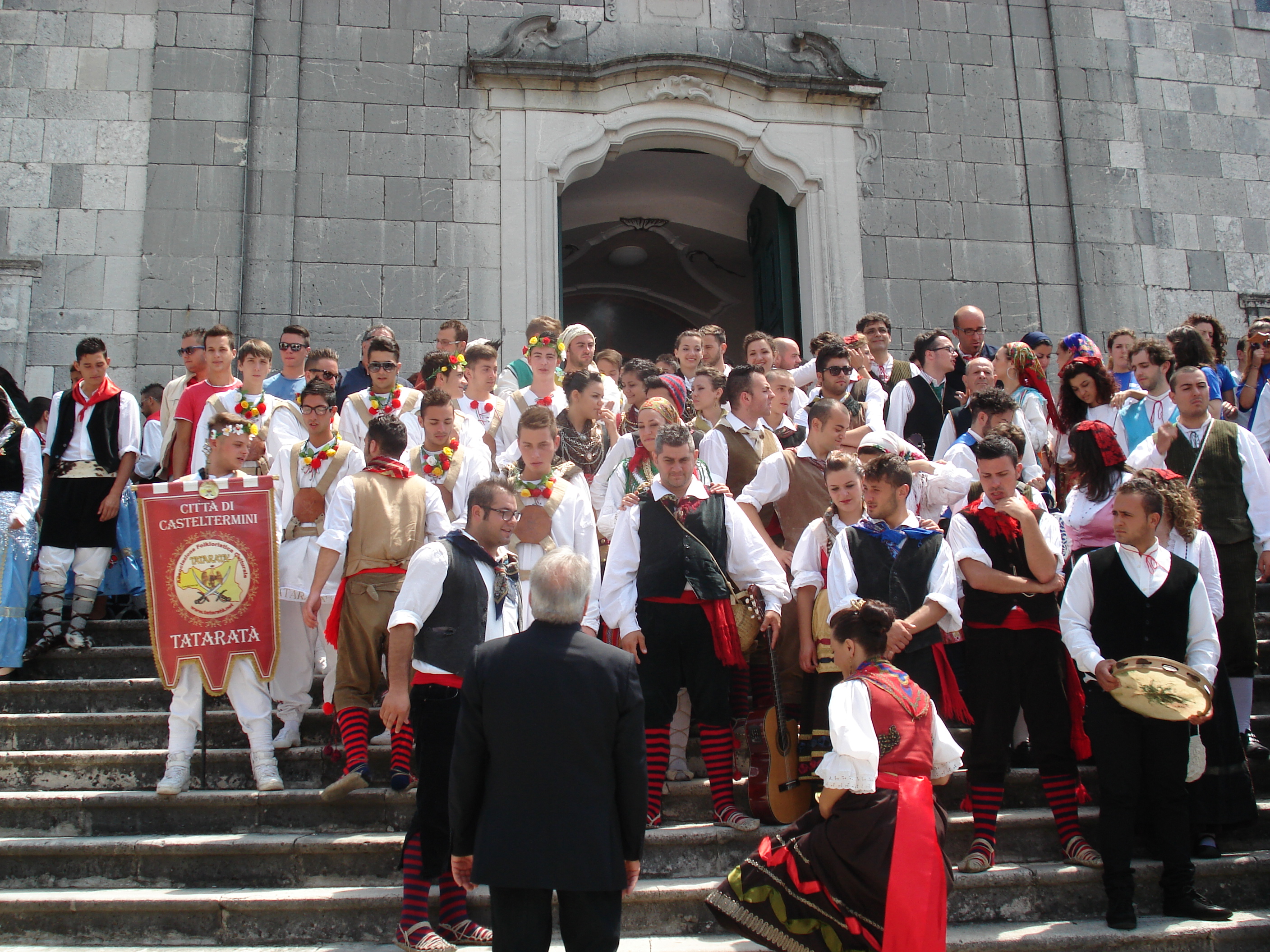
Folkloric dance companies from throughout Italy performed in the Piazza nightly for almost a week. Here they are on the church steps after mass.
A quick peek at http://www.eptbenevento.it/archivio_eventi_mostre_benevento.html – the EPT Benevento (ente provinciale per il turismo) events website – lets me know that other villages in the province also are bringing in art. Campania, the region we are in, even has an “art card” – http://www.campaniartecard.it/ – reduced rate admissions and listings.
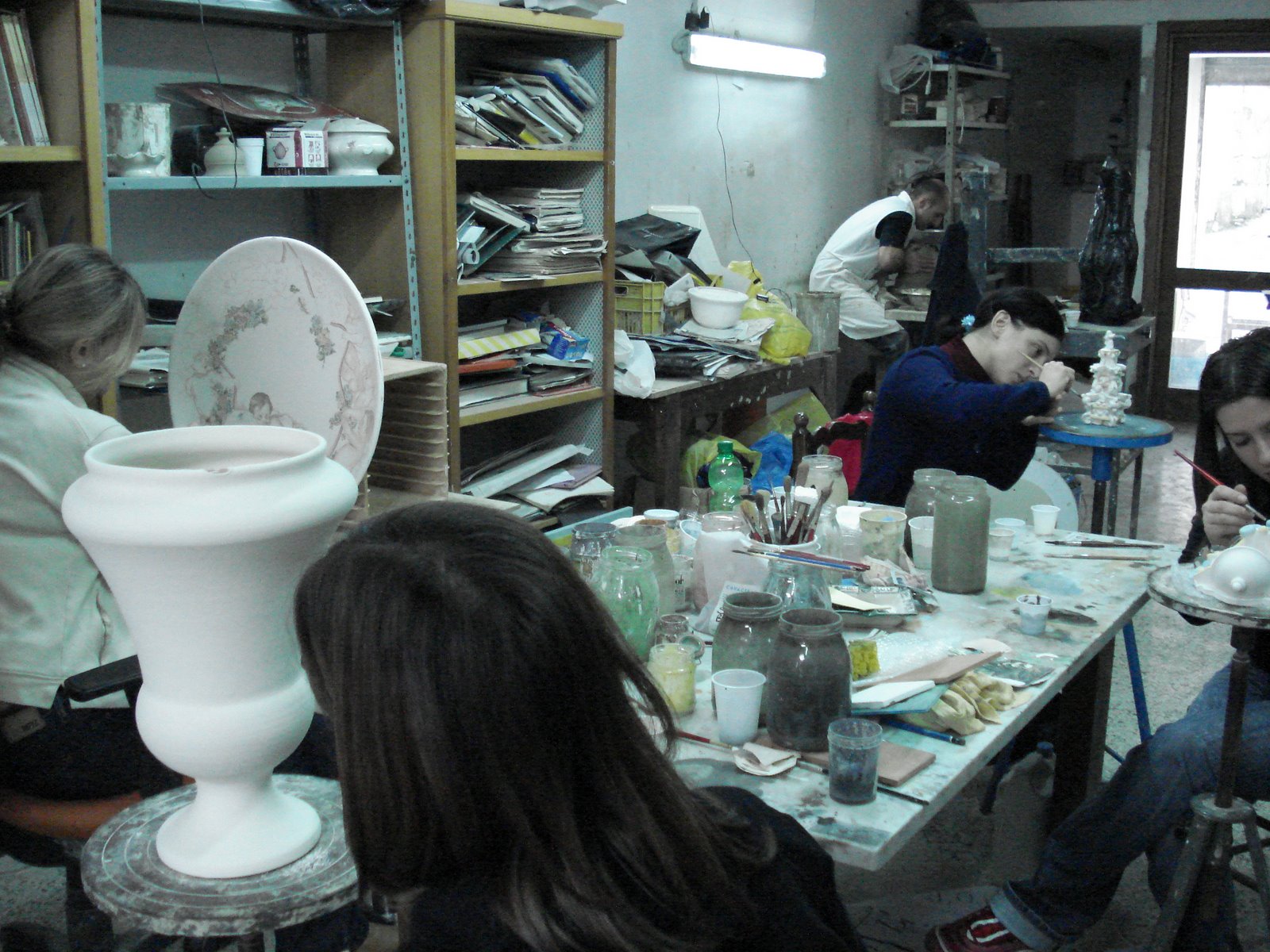
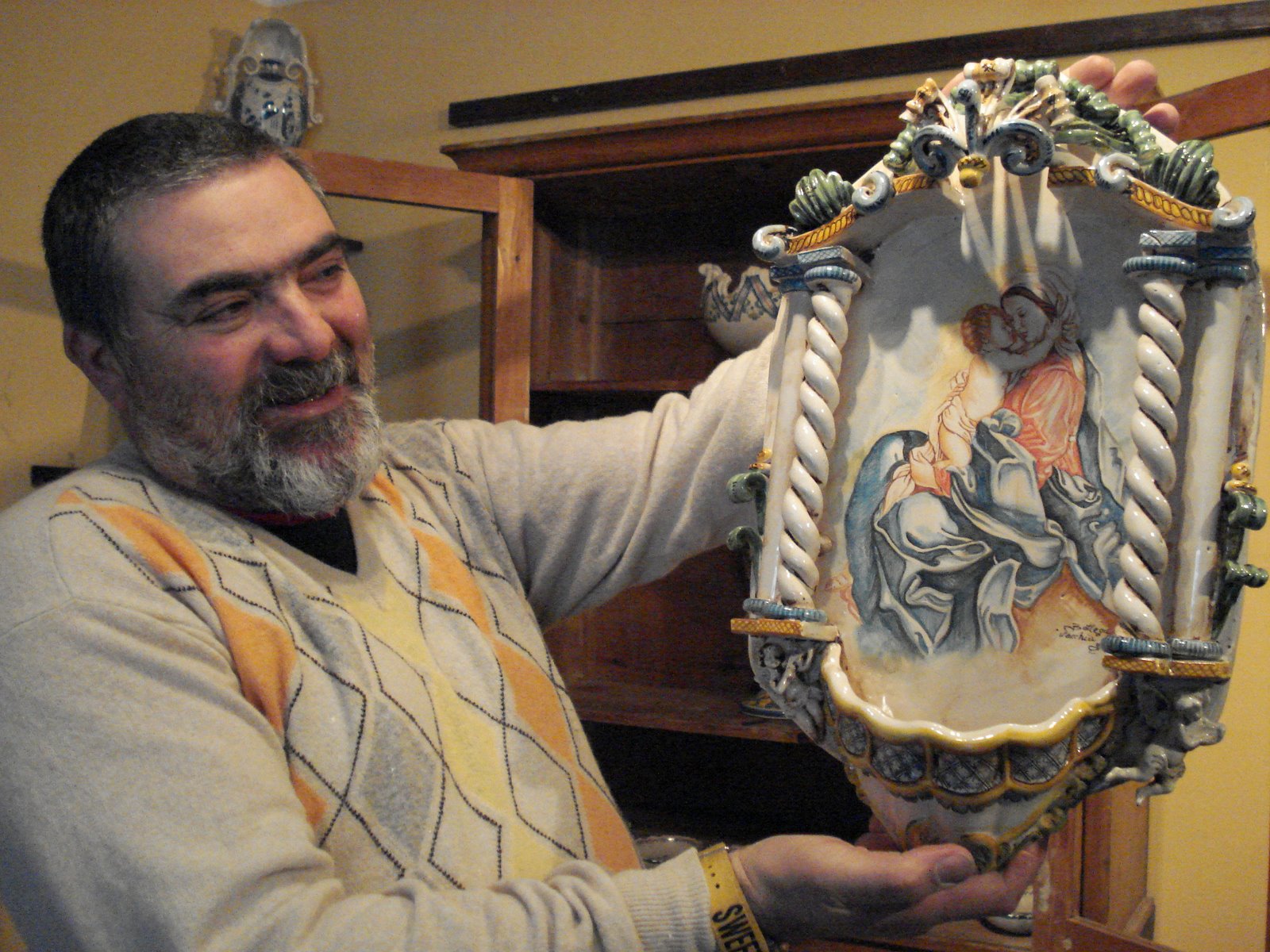
A short drive over the mountain takes us to Cerreto Sannita where di antica tradizione ceramica lives on. Artisans freely open their studios to folks like me to watch and learn the process – note FREELY.
We boldly knocked on a studio door and the artisan, Pietro, welcomed us into his space.Pietro is proud of the ceramic history of Cerreto Sannita. After touring his studio he literally opened the doors to the closed ceramics museum and shared that with us too.
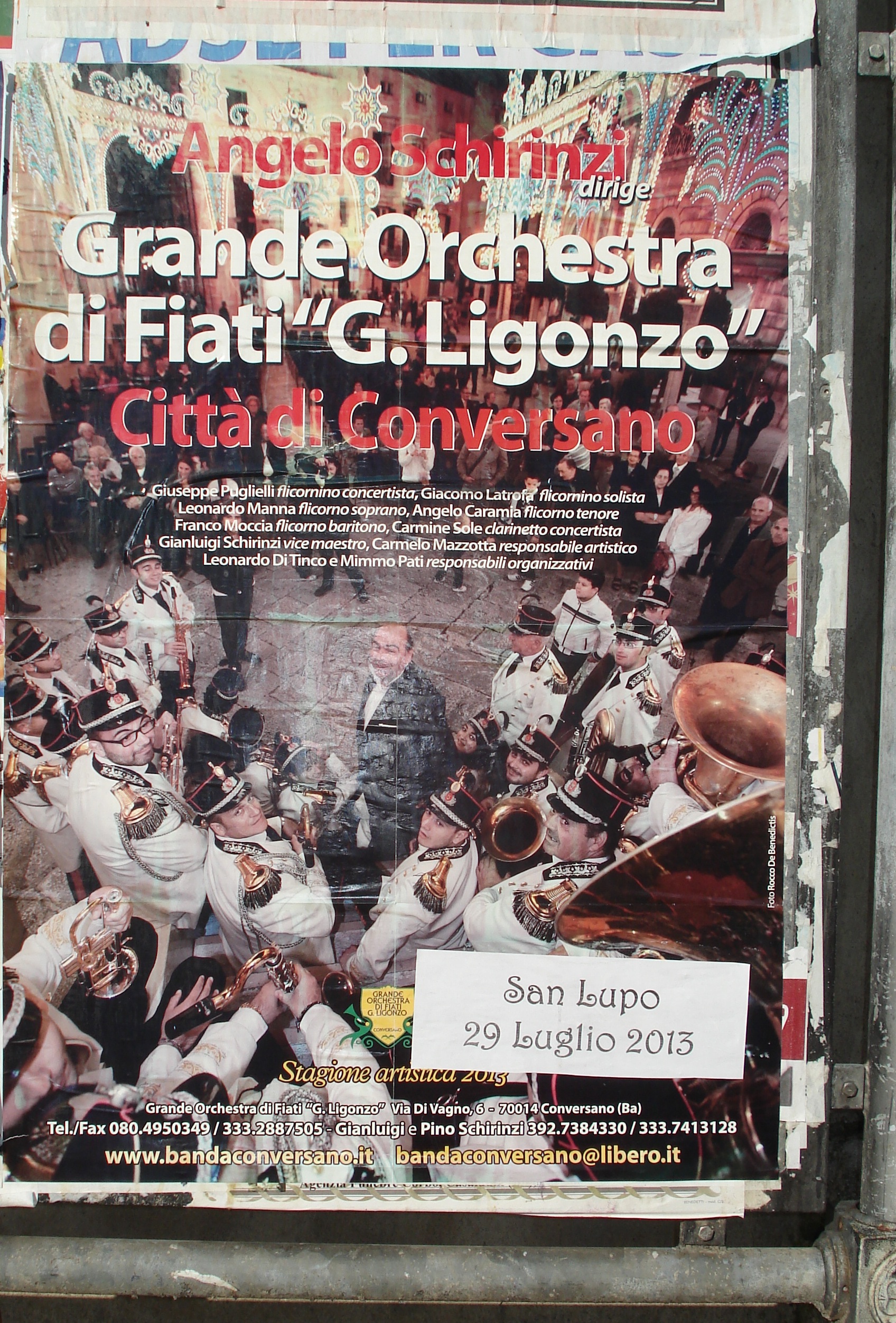
San Lupo – just a scant 10 minutes over curvey mountain roads – sponsors a annual classical music festival.
Music fills the hill top streets.
How much are the tickets? Nada!, Niente!, Bupkus!
Damn, we missed the theater festival in Amorosi – a 20 minute or so trek down the mountain. They do charge for tickets and bring in professional companies from as far away as the USA. (http://www.amotefestival.it/) Next year we absolutely will get tix to something and report back.
The bottom line is that art and culture is just a matter of everyday life in Italy – even in the smallest villages. There is public art everywhere – our village has three large installations. Of course, the remnants of Ancient Rome are everywhere too.
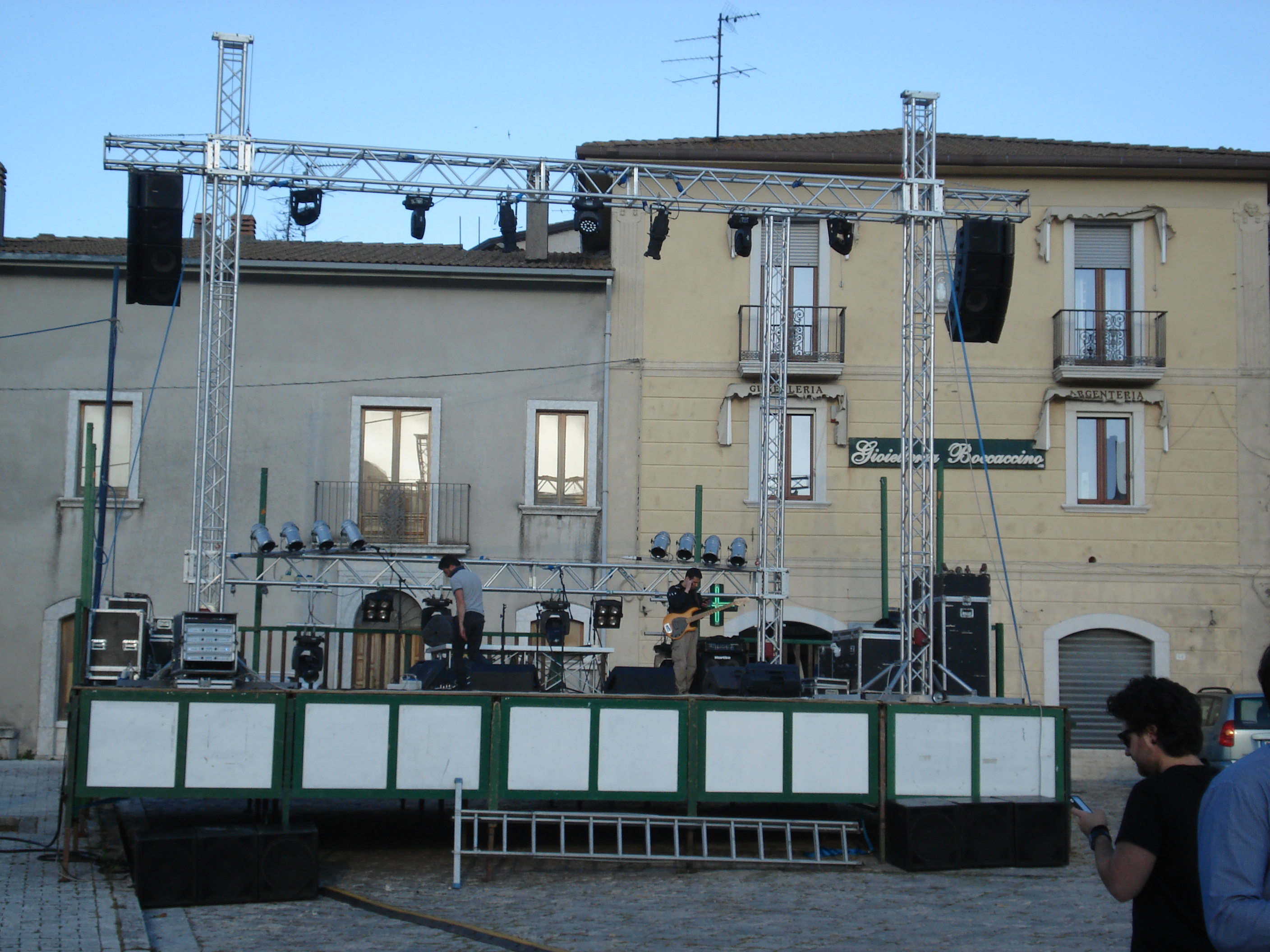
Band stand is getting set up. I wonder what will be happening.
Revisit some of my earlier stories – Circo acquatico, San Antonio Festival, Calcio – stuff just happens here and I don’t have to pay the tunnel tolls, gauging parking fees and high ticket prices to drink in all this culture! Like my New Jersey ArtPride pals say – Be a Culture Vulture – I am and I am loving every second.
So, dear George, I think I can really live in a small village with no easy access to the cultural richness of the tri-state area. Of course, we do have to figure out a way to get your one man cabaret act across the pond.
Whirling dervishes dance madly in the noon day sun as the wind whips
over the mountains of Campania.
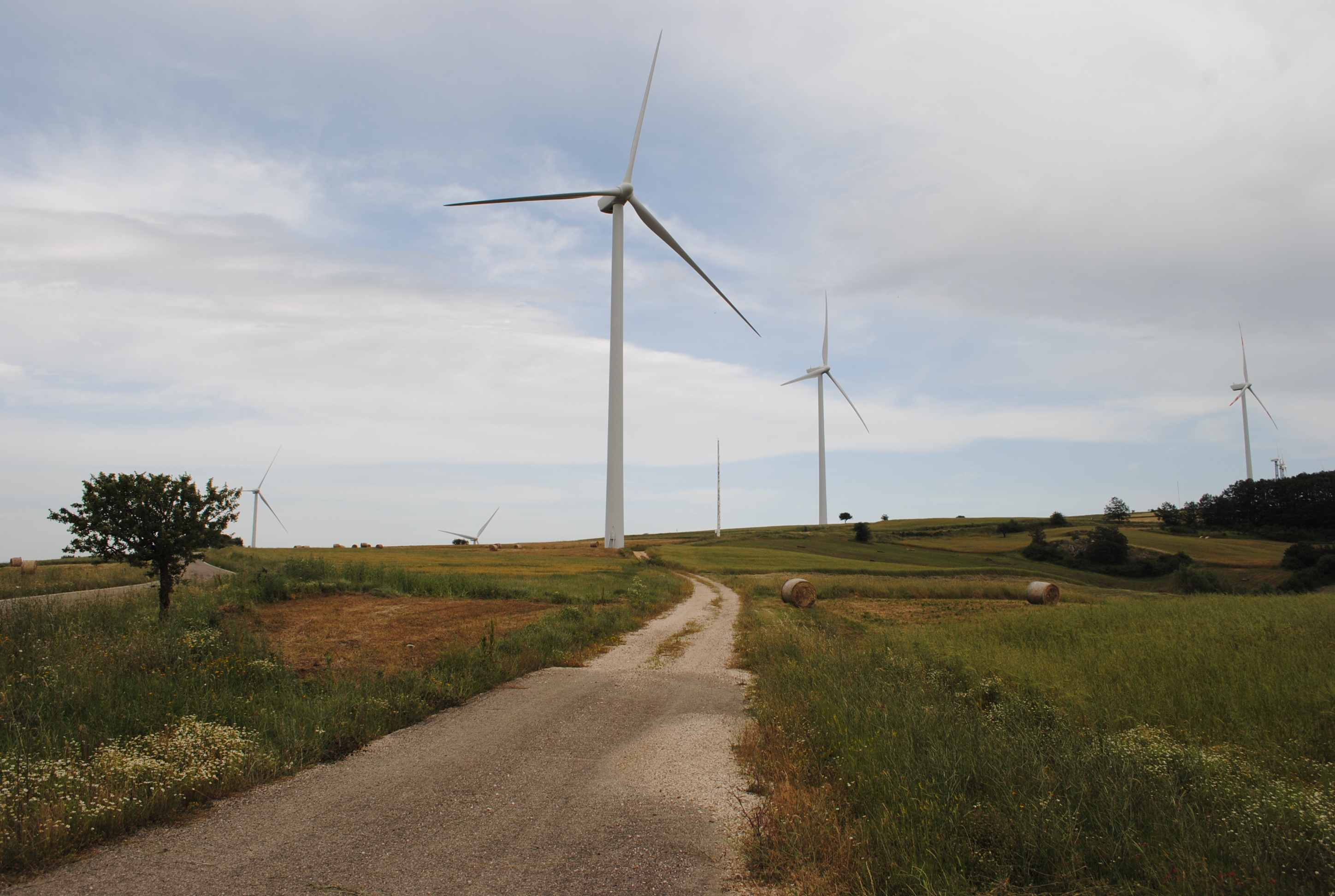
One morning, on our way to the Naples airport , I screeched at Jack to pull over. He raised an eyebrow and kept on driving. Rats, how would I really get a glimpse of the thousands of windmills that peppered the mountain ridge if he didn’t pull over? That was the first time I spied the windmills that are part of the onshore wind farms that earned Italy its 2012 standing as the world’s sixth largest producer of wind power. I have no idea how wind power works but the science guys at http://science.howstuffworks.com/environmental/green-science/wind-power.htm will absolutely explain it all.
Sentries posted on the tops of mountains
Sannino soldiers gaze down on the approaching Romans.
Tall, helmets pointed to the heavens – bodies still against the azure sky.
When I first saw them, I wasn’t thinking – “Gee, how green and save – the – planet this is.” I was thinking, “Hear the sounds of the marching feet as the Roman army emerges over the crest of the hill.” Seriously, from a distance they look like advancing ramrod straight soldiers with pointed hats. Up close they are more like super giant stick figures. Up close? H’mm did she really drive up the mountain to get closer? Yes, by gum we did! Why? Because we could! So why not. OK, if the truth be told, it was a chilly, dreary day and I was going to poke out my eyes with a pen if we didn’t get in the car and do something. Anything – as long as it didn’t cost a bundle of bucks and we didn’t have to change out of comfy clothes. Anything – never give me that option. My brain tumbles and rumbles and soon bizarre suggestions spew forth like Vesuvius. Anything meant – chasing windmills. Jack, knowing divorce was eminent if he didn’t get behind the wheel of the car, started the engine and let me navigate. Navigation was something like – “NO, NO – TURN RIGHT” – when ever I saw the top of a windmill. We were so intent on getting close to the windmills that I didn’t even shriek at the switchbacks along the way. What we didn’t do was record exactly how to get to the ridge. All I remember was from Colle Sannita take SS 212 and make a right on SP 55. I was too entranced to take notes but said into my video at least 10 times – we were on SP55!
http://www.thewindpower.net/zones_en_7_campania.php keeps a database of wind farms and their operators. You tech folks might find this interesting. I don’t know how often they update it. I swear I counted more windmills than are noted. Some may have been the third or fourth phases of a farm and not yet included.
According to http://www.ieawind.org/countries/italy.html, Installation of new wind farms in Italy continued its pace in 2011. Total online grid-connected wind capacity reached 6,878 MW at the end of the year, with an increase of 1,080 MW from 2010. As usual, the largest development took place in the southern regions, particularly in Apulia, Calabria, Campania, Sardinia, and Sicily. In 2011, 590 new wind turbines were deployed in Italy and their average capacity was 1,831 kW. The total number of online wind turbines thus became 5,446, with an overall average capacity of 1,263 kW. All plants are based on land, mostly on hill or mountain sites. The 2011 production from wind farms could provisionally be put at about 10.1 TWh, which would be about 3% of total electricity demand of the Italian system.
Electricity is expensive here so I was hoping the wind farms were producing a lot more than 3%. Well, this data is from 2011 and we know that Italy in 2012 was the 6th largest producer of wind power.
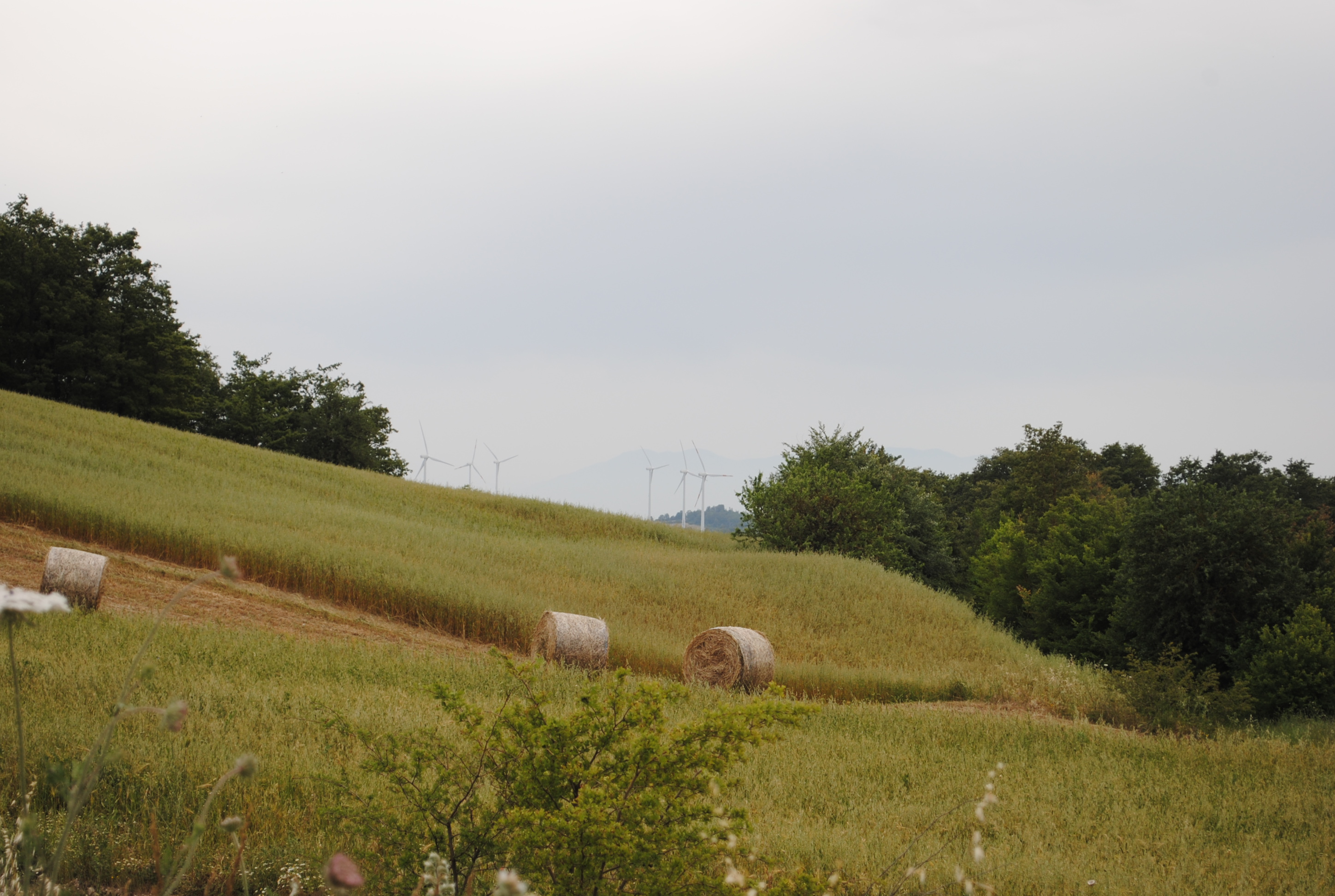
Hay fields surround the windmills.
What is interesting is that the farmers are still working the land around the windmills. As we wended our way around we passed beautiful new combines, tractors and balers . I am guessing that the income from the utility companies helps keep this area green and farmed. Windmills plus farm land sure beats the housing developments plus loss of farm land that are a blight on New Jersey.
Grey day washed away by the buzz of chasing windmills.
I learned something this grey day – chasing windmills is a guaranteed cure for boredom. Listen to the sound of the wind whistling on the ridge!












 Nonna's Mulberry Tree