Full Disclosure: I HATE THAT WE ARE BEHOLDEN TO COMCAST CABLE TO PROVIDE INTERNET SERVICE IN FLAGTOWN, NJ. Verizon never wired our street for FIOS – that makes Comcast/Xfinity the only show in town. What happened to choice? Oh yeah, we don’t have it.
Before we left for Italy I called Comcast to downgrade our account – we had the famous triple play package. Our monthly bill was close to $200. Since we wouldn’t be watching TV or using the phone I wanted to downgrade to simply internet. Easy. NOT.
Why is it that in this day of technology a kid at a computer can send a drone to pin point a target thousands of miles away, yet you still have to repeat all of your contact information a minimum of three times when you call the cable company?
Robot:
Please say or type into your keypad your cable account number or telephone number.
Me:
CCXXXXXXX – I had put on my good speech voice and said it slowly.
Robot:
Please say or type into your keypad your cable account number or telephone number.
Me: (Using the non-pretentious voice)
CCXXXXXXX
Robot:
Please say or type into your keypad your cable account number or telephone number.
Me: (With my hand over the phone.)
BITE ME!
I type the number into my keypad.
Robot:
Please say your address
Me:
Can’t you see that from my account number?
Robot:
Can’t you see is an unknown address. Please say your address.
I slowly said the my address.
Robot:
Please say the last four digits of your social security number.
Me:
Uugggggxx*&^%!
I carefully say the last four digits of my social security number and think I should play the number in the next big lottery.
Robot:
Please wait while we connect you to the next available operator
Operator:
Hello this is wp0e85rbv (name impossible to understand) may I have your Comcast account number or phone number please?
Me:
Excuse Me?!
Finally, I make her understand that I do not want to talk to anyone about another type of plan or upgrading my service or adding the ESPN package. All I want is internet – I can’t get it from anyone else. Just internet now costs us $52.48 that equals 38.81€. Remember that number!
After rehashing Comcast for you, I took some deep cleansing breaths and am now able to talk serenely about our Internet connectivity in Pontelandolfo.
We didn’t know how to begin. My family members use wireless USB devices. Jack and I thought that we needed something more permanent with unlimited access. The wonderful Annarita Mancini and I went on a search for alternative services. Annarita discovered LCR System and Emilio (the contact for Pontelandolflo.) She did the calling for me and asked all the right questions. Putting her hand over her phone she asked, “Is 25€ a month too much? I think it is too much – it is usually less but you are only here for 3 months and he doesn’t want to do it for 3 months.”
Do I think it is too much? That is 13.81€ less than I pay Comcast normally. Yes, yes, have them come, I shouted. (I don’t know what their normal rate is but I think it is 20€ per month.)
The system is incredibly brilliant. They have a WiFi tower somewhere in Pontelandolfo and installed an antennae on top of our house. The antennae was hard wired into a router that they placed in a room on the second floor. That means – without cable or FIos – you can have internet access even on the top of a mountain! They charged me 75€ for the installation. Comcast also charges for set-up and activation. I haven’t been able to do a price comparison. Some smart folks will note that we needed to amortize the fee over three months which shot our charges up. We are going back for 6 months in May and I am hoping the antennae is still on the roof.
Speed was fast. We never had a problem! Jack seamlessly uploaded library books to his iPad.
I could upload and download video and pix easily. We also used it for our Magic Jack phone and iPhones.
In our thick stone wall house it worked best on the second floor and the dining room/living room which was directly below the router. It also worked outside on both our upper terrace and patio.
IT COST LESS AND WORKED ALL THE TIME! I swear when all the kids are home from school the Comcast internet is a traffic jam of bits and bity bits.
Yes, you can leave home, move to Italy and still be wired!
Mia nonna coraggiosa e zii. One woman alone with three kids in steerage.
Before we can talk about my nonna’s trip to America, I thought we’d take a peak at where she came from. There isn’t much left of il casolare in pietra – the stone cottage my nonna, Mariarosaria Solla left behind. I was going to say hut – stone hut – but it was a tad bigger than that. Imagine a stone one-car garage built when all cars where VW Beetles. When Rosaria (I never heard the Maria part of her name) left for America, she had been living in a one-room house of stone that dated back to the Middle Ages. Obviously, houses constructed of huge rocks were built to last. This one did until an earthquake took out most of the town.
Following sprightly nonagenarian Filamena as she scampered over rocks, past thistles and up the hill, my stomach gave a twitter. It might have been because I haven’t been able to scamper like a goat since I was ten and here was Filamena sporting the traditional kerchief, dark stockings, long dress and nun’s shoes laughing as she guided us to my nonna’s house. Or it could have been because with every step I took I felt more and more rooted in this community.
We found the house at the top of a hill in the section of Pontelandolfo called Brecciale. From the remains of the cottage, one can see the village center, tower and church steeple. The view is spectacular! The thought of walking down the hill through the valley and up the hill to the central piazza carrying goods to barter or sell brought tears to my muscles. It was my nonna’s parent’s home – Liberantonio Solla and Mariantonia Rinaldi. Story has it that my bisnonno, Liberantonio, was a musician! The vein of artists in my family obviously can be traced back to our beginnings. Accepting wages of wine, Liberantonio would play his concertina in the piazza. He’d make it down hill number one, across the small valley and be crawling by the time he was mid-way up hill number two. That’s when my bisnonno would bellow for bisnonna, Mariantonia, to drag him up the hill home. She’d ignore him. Good for her. I come from great stock!
Nonna did what the children of every other poor family did than and still do today, lived with her parents. As I explore the village that sprouted my family and meet cousins I didn’t know I had, I’m meeting families that still have two or three generations living under one roof.
Up a piece from nonna’s house was a patch of rock that the local farmers used to grind wheat. The marks from a heavy stone wheel are permanently imbedded in the rock. An oxen or mule was harnessed to a contraption that smacked on the grain. You can also still see the circular track of decades of animals walking round and round and round and round.
Living on the top of a hill, means to fetch water from the river or the nearest fountain Nonna Rosaria walked down steep paths. Easy for Jack and Jill to go down the hill – but with buckets full – it is up hill to home. Even though life was tough, nonna and her children loved living there. I understand now why my nonna’s farmhouse and land in New Jersey looked the way it did. She and my nonno, Francisco Guerrera, tried to remake their little piece of New Jersey into a little piece of Pontelandolfo.
Take a peek at the video of her house today – Nonna’s House
To find out more about my grandmother’s trek across the ocean to America, we took my Zia Caterina to see Ellis Island. She had made that journey with her mother and two brothers. When we walked into the great hall of the immigrant’s reception center her face turned grim and she started shaking. Like a soldier suffering Post Traumatic Stress Syndrome, residual fear racked her body. It was the same fear she felt when the line watchers at Ellis Island ripped her away from her mother and put her in quarantine. We passed a door and she shouted, “that’s the room – the room they put the sick ones in.” “They left us there and no one could speak our kind of Italian and tell me anything.” “I was scared but looked them in the eye and said sto bene – I’m well.”
Caterina’s Story:
When I was two in Italy I got polio – they didn’t know what to do then – not many got polio. My mother, put hot rags on me and massaged and massaged my leg and arm. She said I just cried all the time. I walked when I was 9 months old – I talked at 12 months. Then at 2, it was over. The priest wanted to send me away – he said cripples couldn’t stay. My mother wouldn’t let them take me. She kept rubbing my legs and rubbing my arms. She never wanted to come to America. My father came first and worked in the Patterson silk mills. Mamma was afraid that if we stayed in Pontelandolfo they would take me and put me away with the crazy people. The priest kept coming to look at me – he’d shake his head. When papa saved enough to rent a place to for us to live in, he sent for us. The Pontelandolfesi women told my mother to only pack her nicest clothes for America – in America everyone was rich. What nice clothes? They were contadini – kind of like sharecroppers. (Serfs – I told you I come from good stock.)
Mamma was a fool and listened. She left her good wool skirt, heavy wool shirt and shawls. Beh, those stupid women kept saying only peasants dressed in those. I think the other women wanted her warm clothes. On the ship it was so cold mamma couldn’t stop shaking. She didn’t have anything heavy to wear.
She promptly made a warm cape in NJ!
Mamma was shivering and had a fever. She just stayed in the bed – we were all way down in the bottom of the ship – hundreds of us. My brother Nick, Sal and me – mamma was so sick – we were kids. We didn’t know what to do. They didn’t give us good food only bread. We had a piece of cheese in our bag. An old man felt sorry for mamma and took care of her. He got coats from the other men and piled them on her. Somehow she lived.
When we got to Ellis Island because I had polio mamma was scared that they wouldn’t let me in America. She made me stand between her and Nick in the long line – close so you couldn’t see my little arm and shriveled leg. Men in white coats walked up and down the line and looked at us – even made some people open their mouths. A man stopped and took me. I could hear my mother screaming. They took me away to quarantine and she didn’t understand what was going on. None of us did. They kept me at Ellis Island for a couple of weeks. She and papa came every day to ask for me. They told her nothing. Finally they let me out – I thought I would never get out. My mother cried that day until there were no more tears inside her.
My nonna, Mariarosaria Solla, overcame her fear and was the rock that my family was built on. She learned English immediately – I was never spoken to in Italian by anyone – we were Americans. Also, I was born just as WWII was ending and even though young men like my dad served in the military – Italians had been persecuted in America – many put in interment camps and others sent back.
This woman of the country was now living in an industrialized part of New Jersey. The long shifts that my grandfather worked at the silk mills meant that she had to learn to be self-sufficient in a new place. Eventually, my grandfather and Great-uncle John bought a farm together in Neshanic, New Jersey. Later nonno and nonna bought their own fifteen acres in Flagtown – where I was raised with the sheep, chickens and goats. Nonna was an incredible farmer – my family continued to be subsistence farmers – just like they had been in Italy. Nonna and Zia Caterina could grow just about anything. Those skills came from Pontelandolfo. Yes, nonna did snap a chicken’s neck so we could have a roast and butchered goats, sheep etc. I only learned how to kill and clean fowl – not sure if I could even do a rabbit. But hey, life brings new adventures for all of us. I just hope that I have inherited a piece of her courage for my journey.
15 acres to farm – and just like what I see today in Pontelandolfo – the women are in the fields. Nonno worked for the railroad.
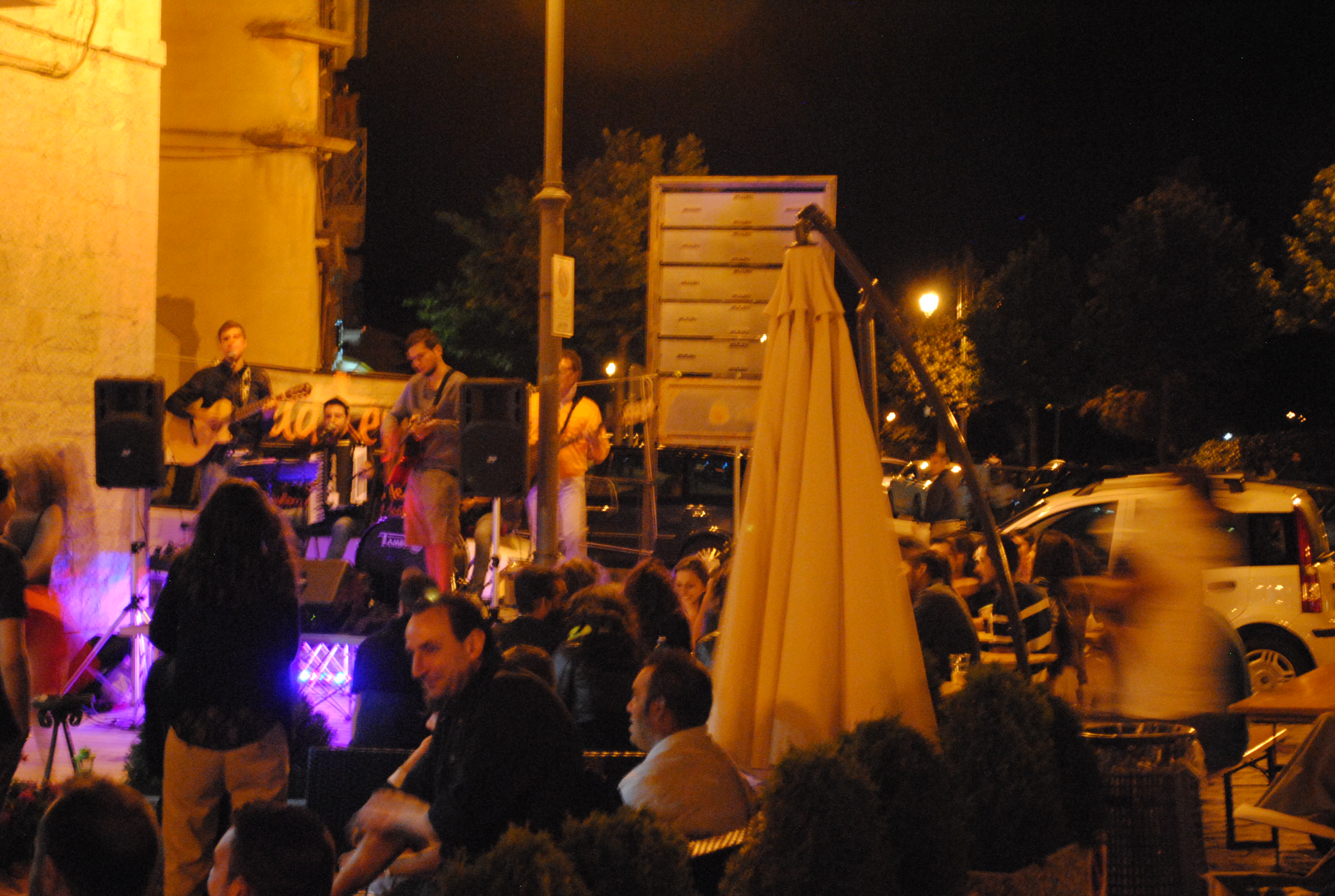
It was 10:00 PM and we had just finished dinner at Landulphi, a great space that resonates with its medieval heritage. Outside Piazza Roma was a buzz of activity. Picnic tables were crammed in front of Bar Elimar. A lit bandstand filled one section of the sidewalk. Tots in strollers, pre-school hellions chasing each other throughout the crowds, moms, grandmas, twenty and thirty-somethings and tweens edge closer to the action.
Crowds creep in closer to hear not Rock ‘n Roll but rocking traditional music.
Tonight, that action was a sweet group of young performers – I’m guessing music conservatory instead of university students – wailing out traditional Italian music on the accordion, all sorts of percussive instruments and electric guitars.
Curtesy Sud Terranea
There is a college age dancer – barefoot on the cobblestones – dancing her heart out in the style of my ancestors. Twirling, toes pointed and then flexed as she stamps, kicks and brings us back to a time in this village – even before the unification of Italy. The sounds of Sud Terranea – “music popolare mediterranea” – brought young people to their feet dancing not the bop of hip hop but the traditional footwork of their great grandparents. ( http://sudterranea.jimdo.com/)
Curtesy Sud Terranea
Boy was I happy I had on a white shawl. It gave me something to hold up as I too did my whirling dervish routine. Weeee – I almost but not quite worked off the calories I gobbled down at Landulphi.
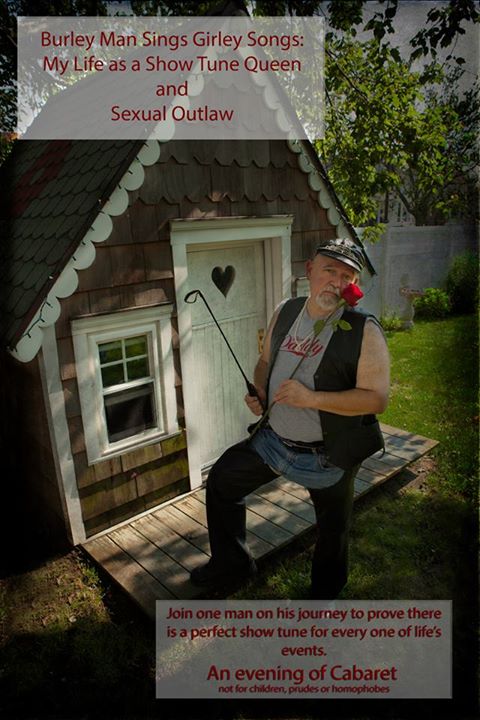
It was interesting that this bit of performance art popped out of nowhere on this particular day. Earlier – on a Skype call with my friend George Hansel about producing his new cabaret act, Burly Man Sings Girly Songs: My Life as a Show Tune Queen and Sexual Outlaw, (yes that was a plug) George raised a devastating question.
George has the greatest laugh in the world. See his show and laugh with him.
Could I really live in a small village with no easy access to the cultural richness of New York and Philadelphia? Hey, I bellowed back, I grew up in Flagtown, NJ – a small village with easy access to culture and an uncle who worked for the then New York Mirror and got free tix to stuff. Ask me how often we actually got to go????
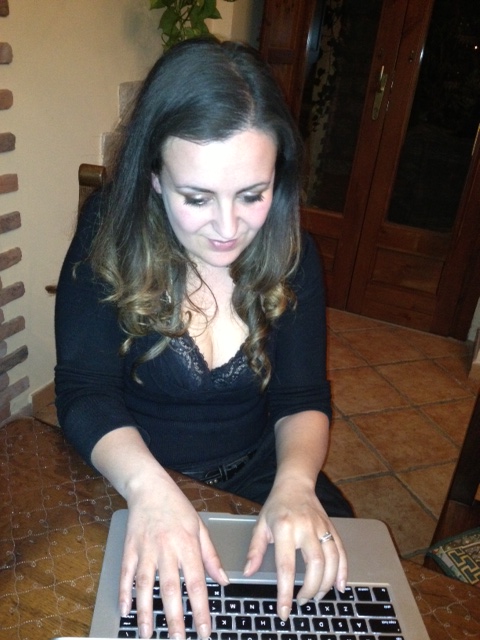
George also, reminded me that I have the attention span of a gnat and boredom can easily weasel its evil sighs into my soul. I explained that during my last bout of boredom I realized that if I was bored it was my fault. All it took was a walk down to the village with my laptop in tow to chase the boredom away. Just sitting at a bar (cafe) surrounded by village life and listening, watching and being perpetually surprised at the instant art that pops up can get my creative juices flowing and the deeps sighs disappearing.
Living in New Jersey with easy access to my state’s professional theaters and being able to zip into both nearby cities, is indeed terrific. But how often do we really do it? Finances come into play. Tickets are expensive, add travel, or driving costs and suddenly an opportunity to experience art is fiscally out of the question. Here in Pontelandolfo, the fiscal crisis has folks pinching euros. Yet, art is accessible to them. They often create it themselves.
Site specific theatre produced by the town’s twenty-somethings took place in a variety of outdoor locations. The audience moved from scene to scene.
Sponsored by bars, community groups and Pontelandolphesi living in the USA and Canada, there seems to be music, dance, theatre and visual art happening weekly. Look for upcoming blogs on many of those events including a two part blog on Associazione Culturale Ri Ualanegli – our dance company – and the week long national folk dance festival.
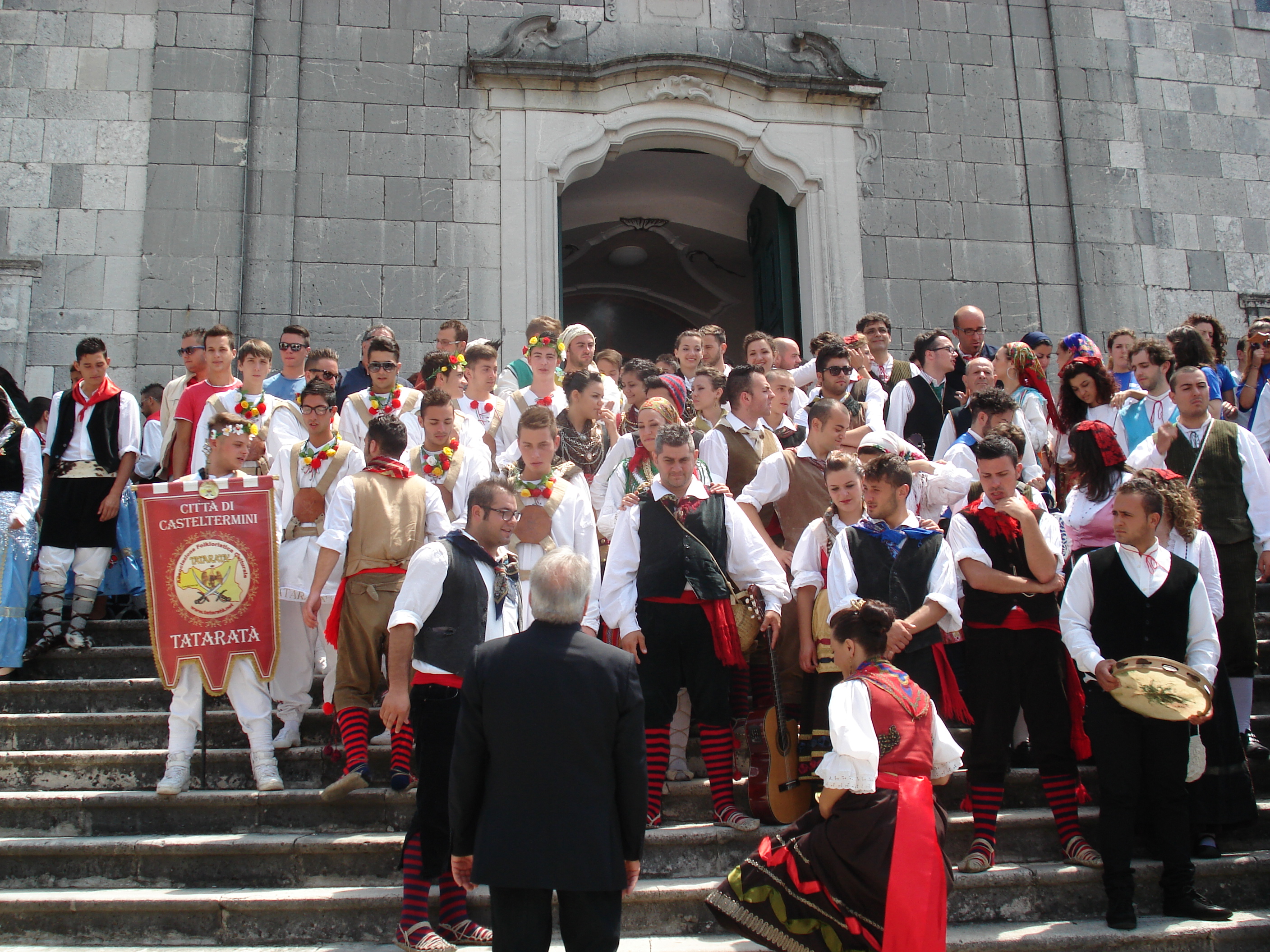
Folkloric dance companies from throughout Italy performed in the Piazza nightly for almost a week. Here they are on the church steps after mass.
A quick peek at http://www.eptbenevento.it/archivio_eventi_mostre_benevento.html – the EPT Benevento (ente provinciale per il turismo) events website – lets me know that other villages in the province also are bringing in art. Campania, the region we are in, even has an “art card” – http://www.campaniartecard.it/ – reduced rate admissions and listings.
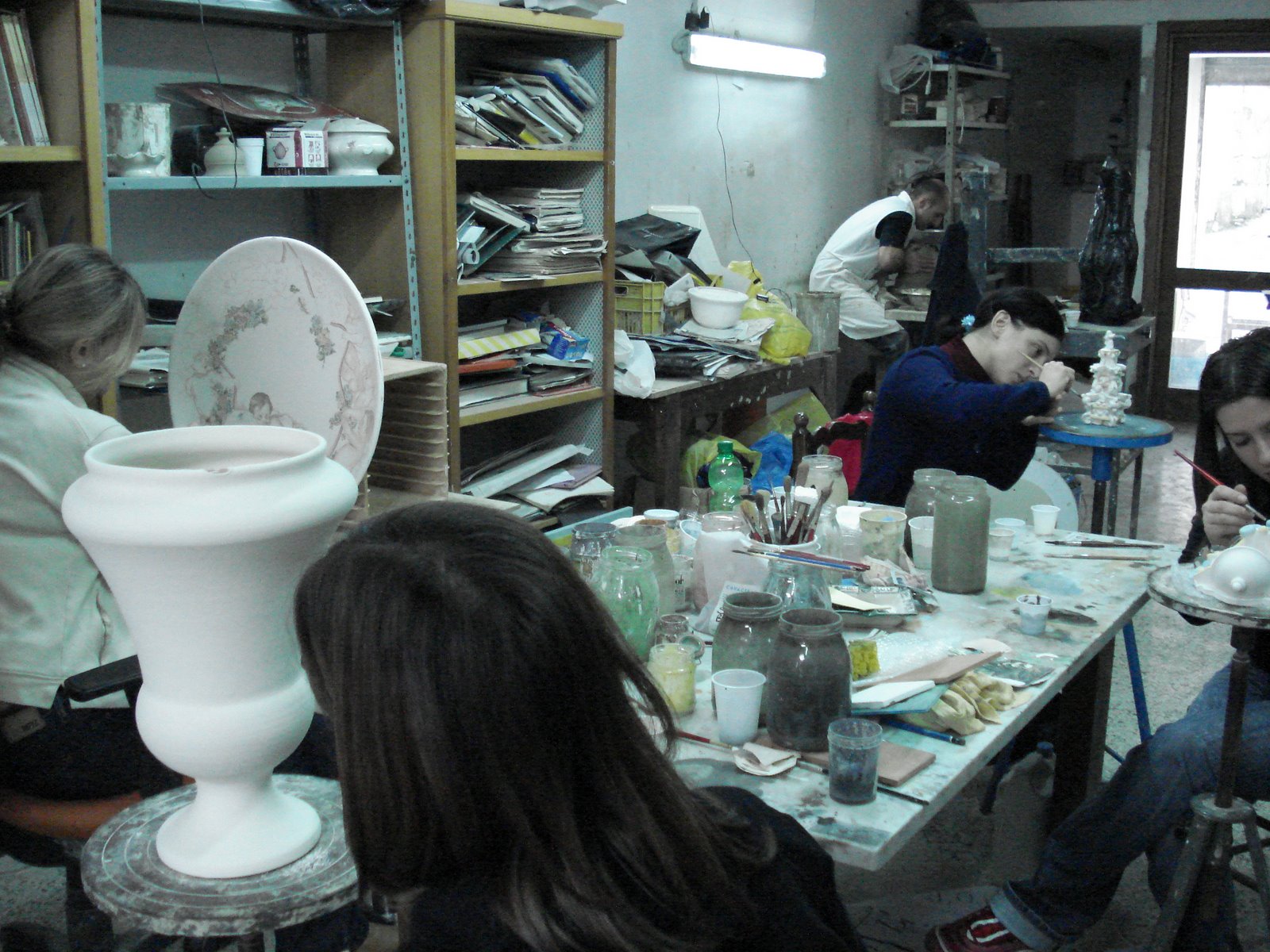
A short drive over the mountain takes us to Cerreto Sannita where di antica tradizione ceramica lives on. Artisans freely open their studios to folks like me to watch and learn the process – note FREELY.
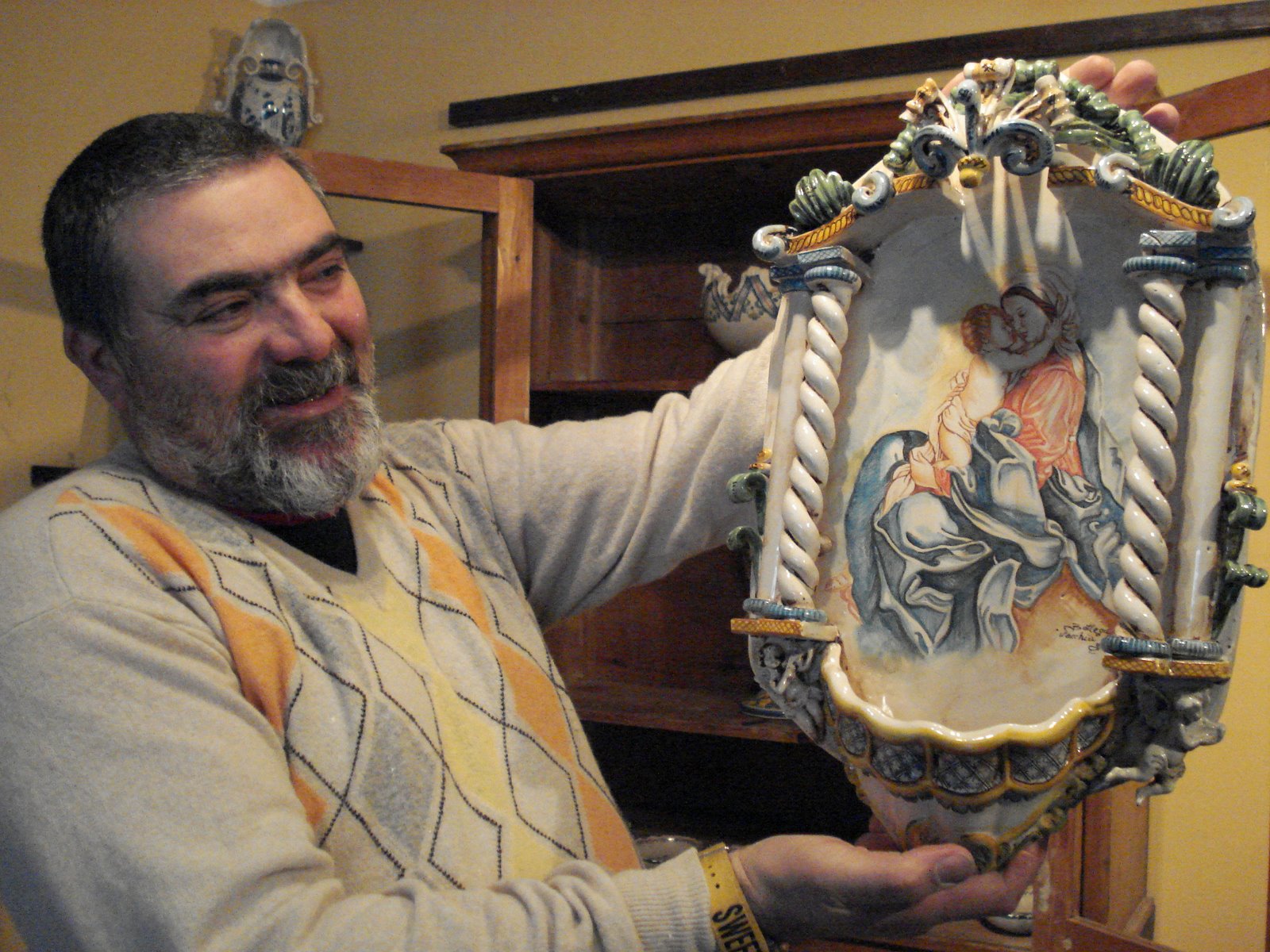
We boldly knocked on a studio door and the artisan, Pietro, welcomed us into his space.Pietro is proud of the ceramic history of Cerreto Sannita. After touring his studio he literally opened the doors to the closed ceramics museum and shared that with us too.
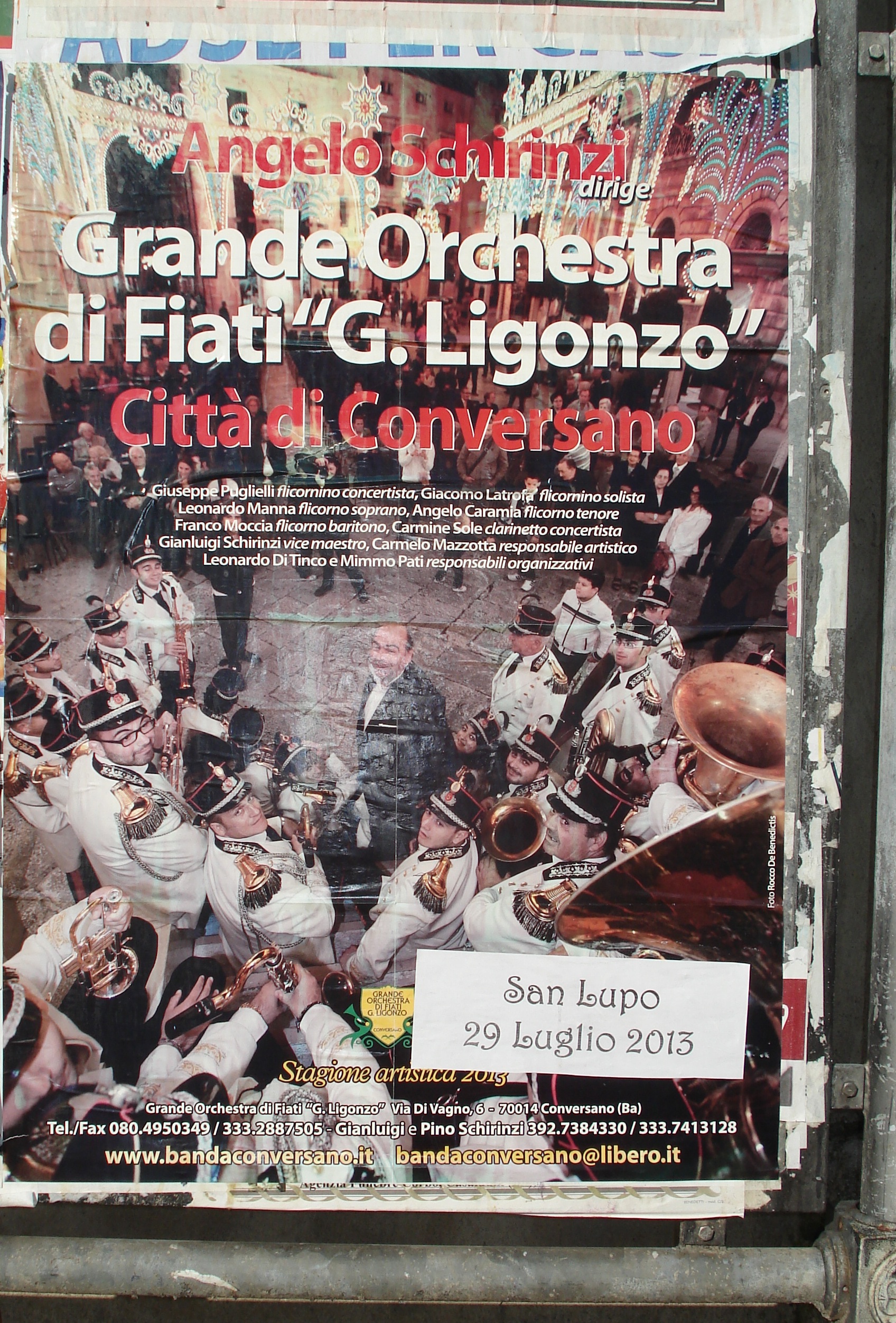
San Lupo – just a scant 10 minutes over curvey mountain roads – sponsors a annual classical music festival.
Music fills the hill top streets.
How much are the tickets? Nada!, Niente!, Bupkus!
Damn, we missed the theater festival in Amorosi – a 20 minute or so trek down the mountain. They do charge for tickets and bring in professional companies from as far away as the USA. (http://www.amotefestival.it/) Next year we absolutely will get tix to something and report back.
The bottom line is that art and culture is just a matter of everyday life in Italy – even in the smallest villages. There is public art everywhere – our village has three large installations. Of course, the remnants of Ancient Rome are everywhere too.
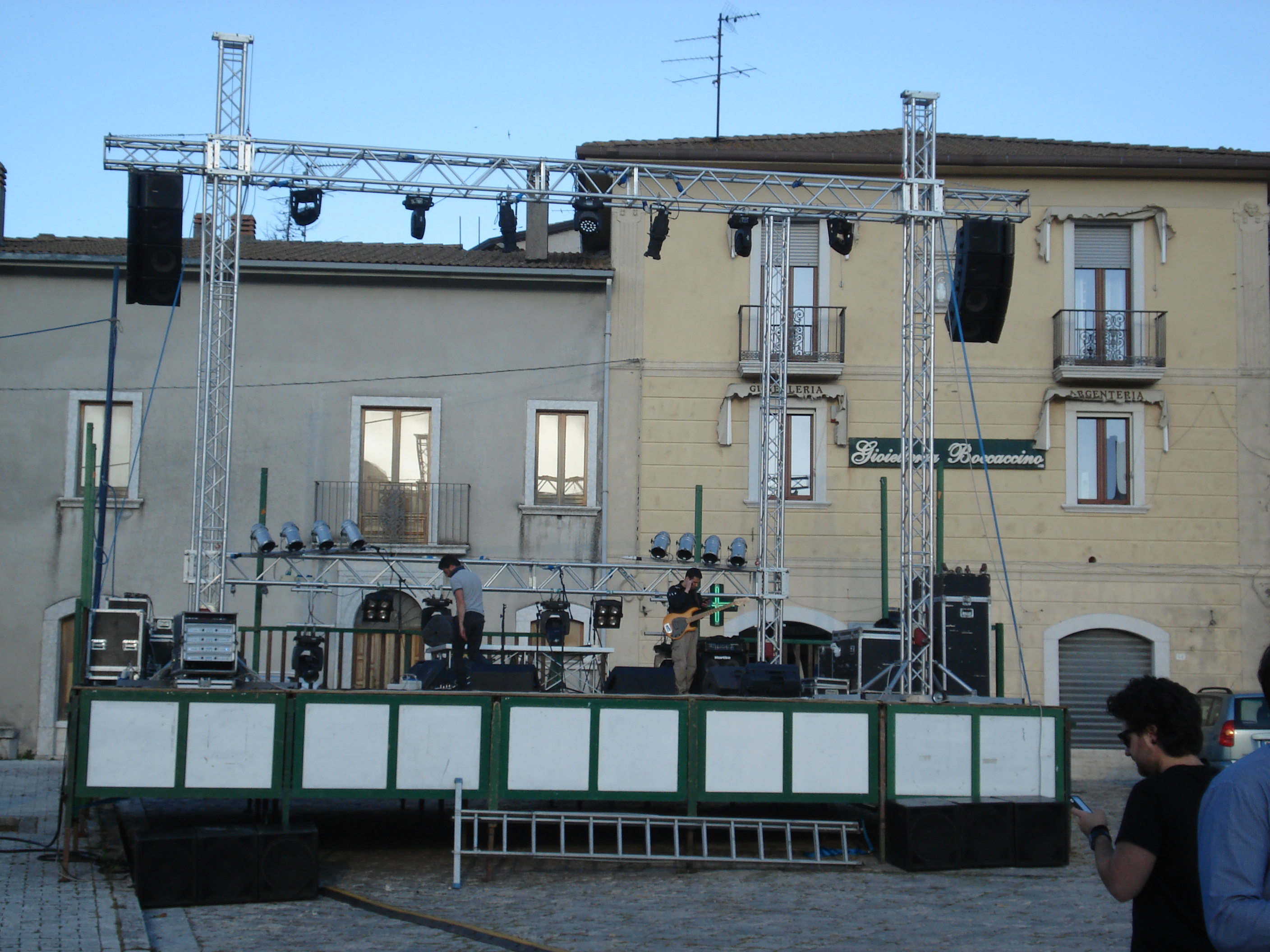
Band stand is getting set up. I wonder what will be happening.
Revisit some of my earlier stories – Circo acquatico, San Antonio Festival, Calcio – stuff just happens here and I don’t have to pay the tunnel tolls, gauging parking fees and high ticket prices to drink in all this culture! Like my New Jersey ArtPride pals say – Be a Culture Vulture – I am and I am loving every second.
So, dear George, I think I can really live in a small village with no easy access to the cultural richness of the tri-state area. Of course, we do have to figure out a way to get your one man cabaret act across the pond.
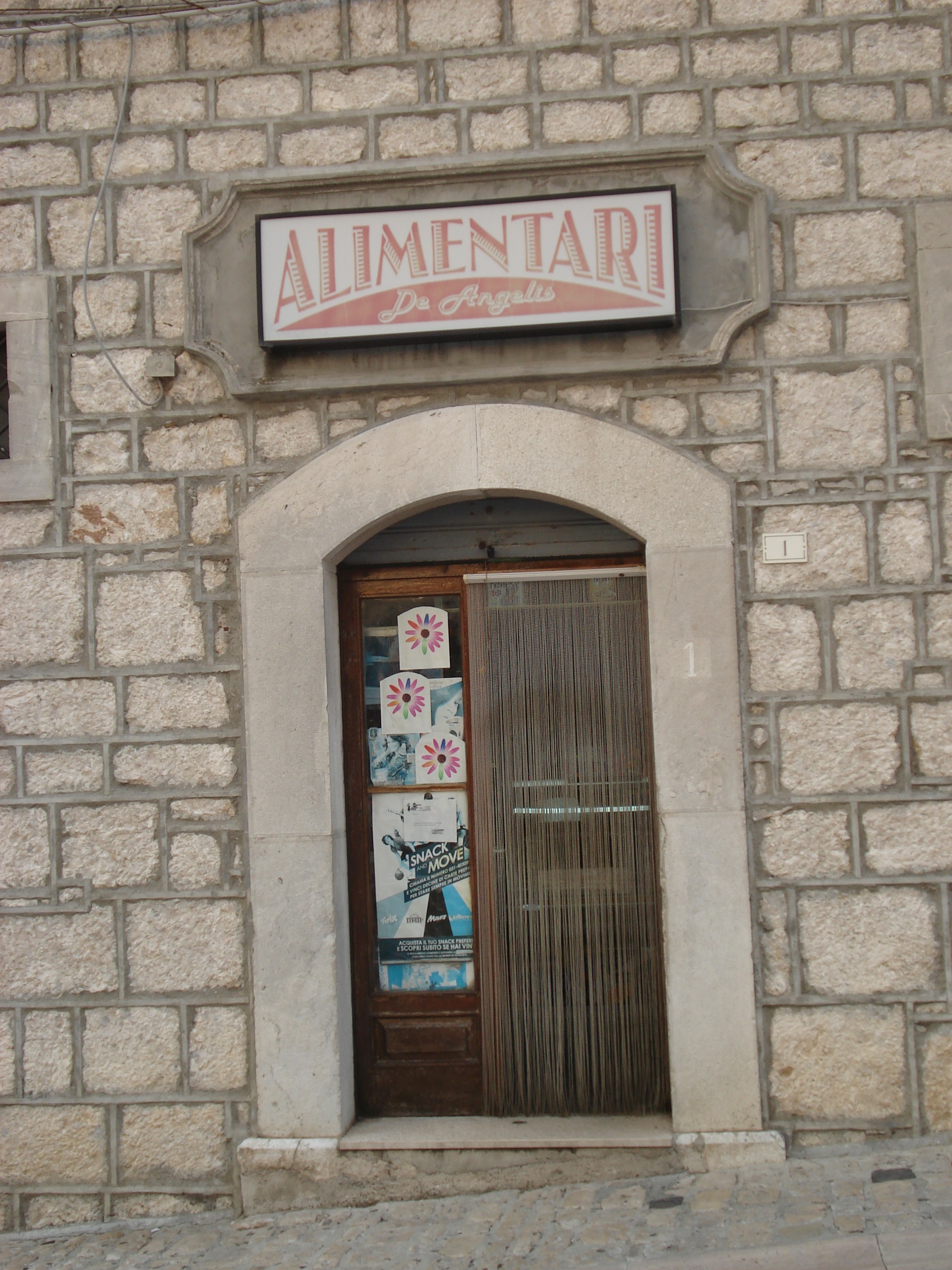
Before I ventured into Alimentari De Angelis, our local salumeria for the first time alone, I stood outside and took a breath. My heart was pounding. Would I remember all the Italian I needed to buy mortadella or prosciutto or – well anything? Etto? Cento grammi – was that close to 1/4 pound? Theatre training kicks in – I review my lines – visualize my actions – think about what I was doing before I went through the door and said, “Vorrei un etto di – – Un etto of what – eeeeeeech -here is where I point at the case and resist saying “that salami looking stuff”. I know these words. I eat these words – wait – I didn’t say that right.
Now you are thinking – it is just a store in a small Italian village – stop with the dramatics. You’re right. But in this village everyone knows everyone else. I can’t embarrass generations of Guerreras and Sollas. I notice the woman on the bench near the store staring at me. I go in. The small shop – about 8X10 – was crammed full of just about anything you needed to create a quick scrumptious meal. Packets of pasta, a few round loaves of bread, rice, canned good, juice, paper plates, – you get the picture.
The three people in front of the meat counter turned as I pushed aside the beaded curtain, entered and said “boun giorno.” (Everyone says boun giorno every time they enter a shop – most times the folks in the shop echo an answer.) While I was waiting for my turn, the other customers and I stood close together in the jammed packed shop. This was a good thing. I could see and hear how they interacted with the shop’s owner, Pierina De Angelis. After all, we were all here for what was found in the refrigerator case – mortadella, prosciutto, salami di Milano, salami di Napoli …..
Soon it was my turn – I noticed a price list taped to the refrigerated display case and had memorized it. How could everything be un euro or un euro e 20 centesimi per un etto? Cheap great meats – how did I know the cold cuts were great? My cousin and world’s greatest cook, Carmela Mancini, shopped here.
The friendly Pierina De Angelis and her husband Antonio Santo Pietro. (My nonna’s first husband was a Santo Pietro – wonder if we are kind of related?)
“Vorrei un etto di mortadella, per favore.” The blonde Pierina standing by the old fashioned counter smiled and asked me where I was from – in Italian of course. Damn, was my italian so bad that she pegged me right away as an outsider? That happens to me a lot. I told her I was from New Jersey and before I knew it we were having a simple conversation and she discovered where I was from, who I was related to and how long I was staying! She made me feel comfortable and not embarrassed by my accent. I wanted to be her friend for life! OK, now it is time to order – guess what – I forgot the entire product list that I had memorized. Ugggg. We started with the mortadella.
If you haven’t had great mortadella – but only the crap we get in the USA super markets – you haven’t tasted the cold cut that makes you keep coming back and buying more! As a matter of fact, even though my cholesterol rises when ever I think of mortadella, I bought the yummy meats about every other day.
Mortadella – so very very very good.
Starting in about 1899 Americans were calling anything made of pork parts and stuffed in a casing bologne/baloney. Maybe manufacturers thought they could trick folks with limited taste buds into buying the stuff thinking it was like Mortadella – a famous culinary tradition of Bologna, Italy.
Mortadella di Bologna starts with finely ground pork, usually the lesser cuts of meat that are not used for other types of sausage. In fact Mortadella is a testament to the resourcefulness of the Italian pig farmers as nothing edible on the pig is wasted. This ground meat is mixed with a high quality fat (usually from the throat) and a blend of salt, white pepper, peppercorns, coriander, anise, pieces of pistachio and wine. The mixture is then stuffed into a beef or pork casing depending upon the size of the sausage and cooked according to weight. After cooking mortadella is left to cool in order to stabilize the sausage and give it firmness.
It must be cocktail hour somewhere! I wrapped mortadella around grissini added olives and Campari soda. Now that is art.
After the first week of repeated stops at her shop, Pierina could almost guess my order. Un etto di mortadella for me and due cento grammi di salami for Jack. Jack experimented with the various types of salami and couldn’t decide which he liked best. Bottom line? It was all wonderful.
No it is NOT Boars Head. This one – whose name I have of course forgotten – was spicy.
Alimentari De Angelis has been in Pierina De Angelis’ family for generations. She and her husband Antonio Santo Pietro have run it for a long time. I was saddened to hear that they will be closing the shop this fall. They are moving on toward retirement. Boy, do I hope that someone as nice and who sells productsjust as good steps in to fill the gastronomic void.
Chased by the emotions welling from a simple e-mail subject line – Invio Ricerca Famiglie Rinaldi e Solla (Search for Families Rinaldi & Solla), – tears race down my cheeks. An incredible gift was soaring over the mystical internet highway. I took a breath, double clicked and read –
Come eravamo rimasti, finalmente posso inviarti la ricerca delle due Famiglie Rinaldi Mariantonia e Solla, spero che il tutto sia soddisfacente. (As we left it, finally I’m sending you the documents about the Rinaldi and Solla Familes – I hope this is satisfactory.)
Una caro saluto
Antimo Albini
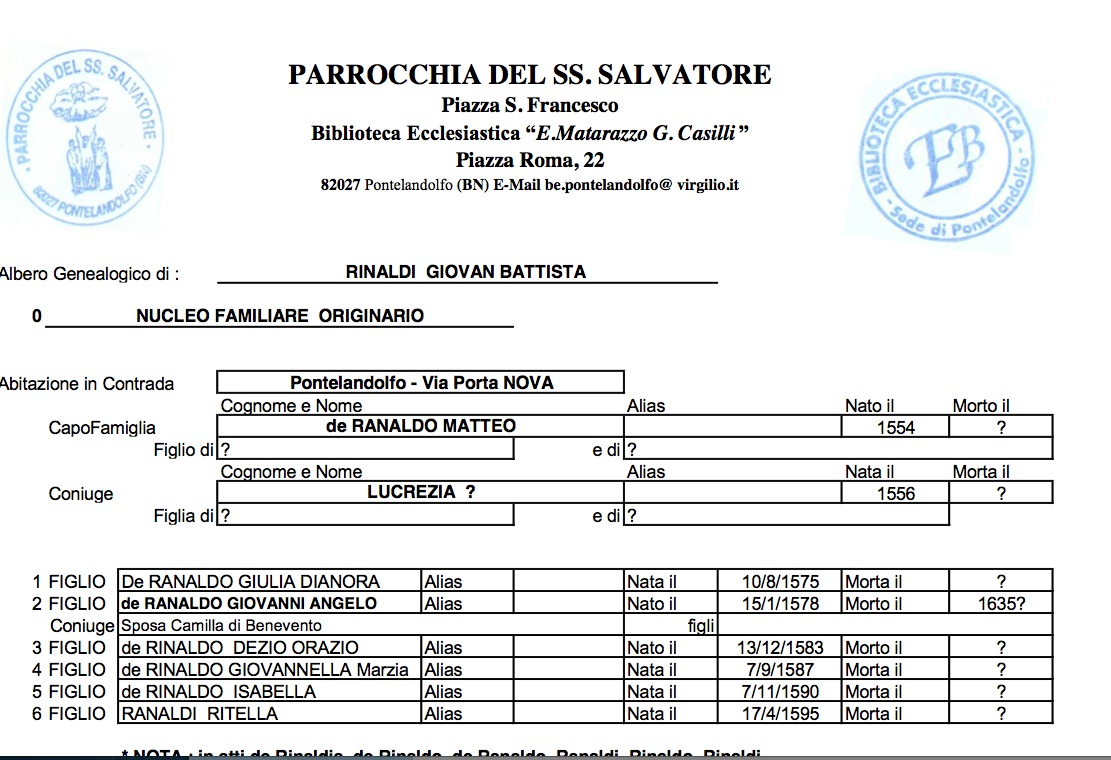
How could it not be satisfactory? It was so much more than satisfactory! Attached were two incredible documents – documents tracing my grandmother’s family back to the 1500’s!
Little boxes of wonder! Pages of them waiting to be entered in my Family Tree software. Anyone want to help?
Immediately I sent PDF’s flying through space to my family. With a little more digging, my newly found ancestors will share incredible stories. But I am getting ahead of myself. Let me start at the beginning –
One beautiful morning Annarita Mancini and I walked up Via Municipo and stopped in front of a small attached stone row house. This part of the Pontelandolfo dates back to the 1600’s. Annarita rang the bell.
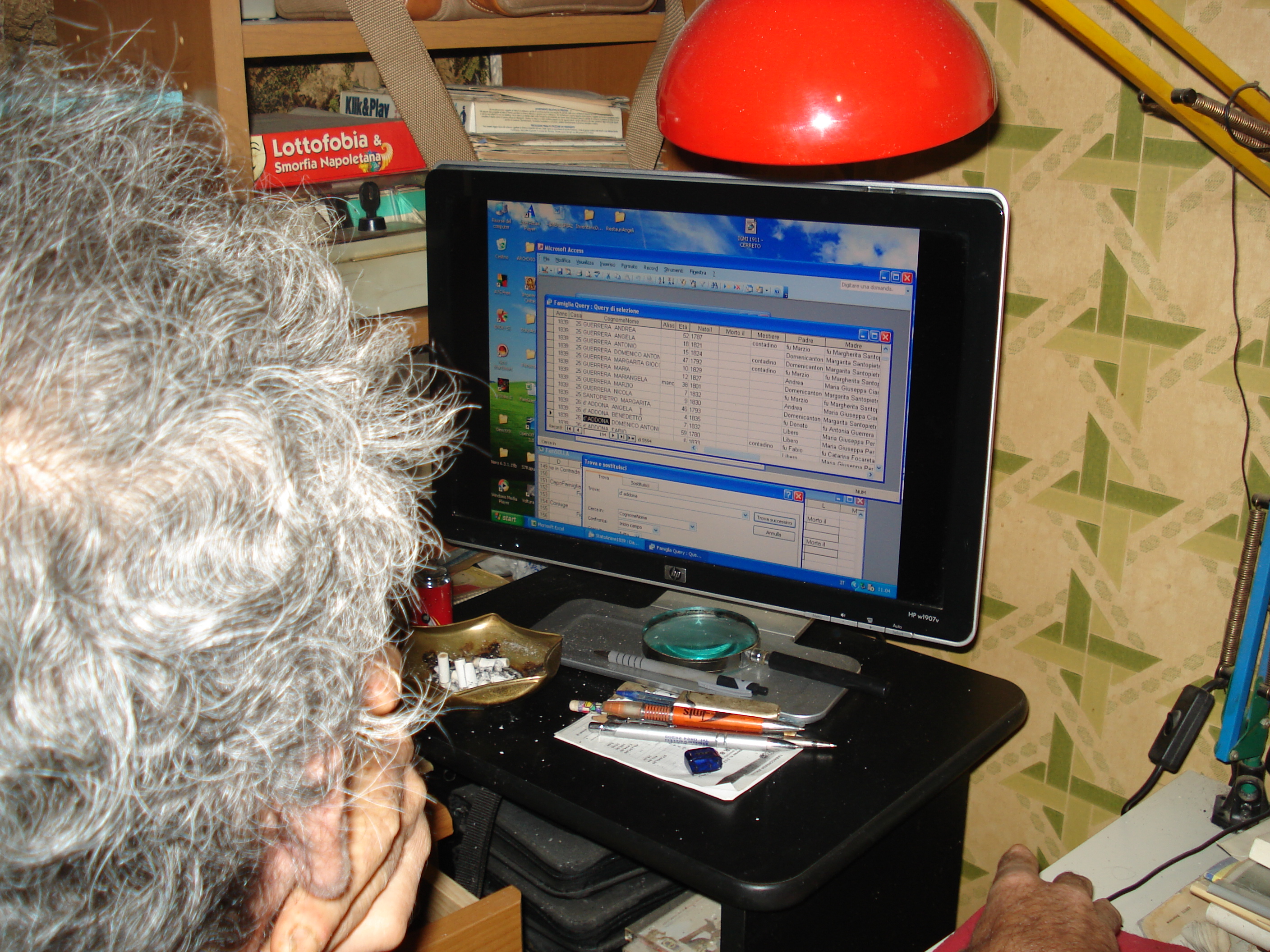
The shutter of the second floor window burst open and our guide into the past thrust out his sleepy head. “Beh?” Oops, were we too early? Annarita explained that we had an appointment to see the church archives. While he was mulling that over, the beaded curtain in front of the door parted and a middle aged woman peeked out. Shouts from above moved her. She ushered us into the front room. More shouts from above and she ushered us up the stairs. Annarita and I looked at each other. Weren’t we supposed to go to the church? Wasn’t he the dude with the archive room key? Why are we going up to – well who knows what? What had my quest for the family’s history gotten us into? That quest had led us to the true keeper of the keys to knowledge – Antimo Albini! After a cursory greeting, Antimo promptly sat down at the computer, lit a cigarette and led me on a four hour journey into my grandmother’s past.
His head of thick grey hair bobbed and weaved as he pulled up database after database. This passionate historian had decided that the history of Pontelandolfo would be lost if someone didn’t do something. He decided to be that someone.
Antimo spent four years of his life meticulously going through all of the church records and putting the information in a Microsoft Access database. This was an incredible undertaking. As he digs into my past, the gleam in his eyes reveals a man filled with passion for both history and the story of Pontelandolfo. He entered data from books going back to 1607 – separate books for each year of the census. There were also combined year range books of births, deaths, and baptisms. That is a heck of a lot of books. Whoops – he had matrimonial books back to 1505! He said, ” as the books disappear, their stories will be gone unless people like us who care about our pasts start passing the stories on.” So get on the stick and start recording your stories!
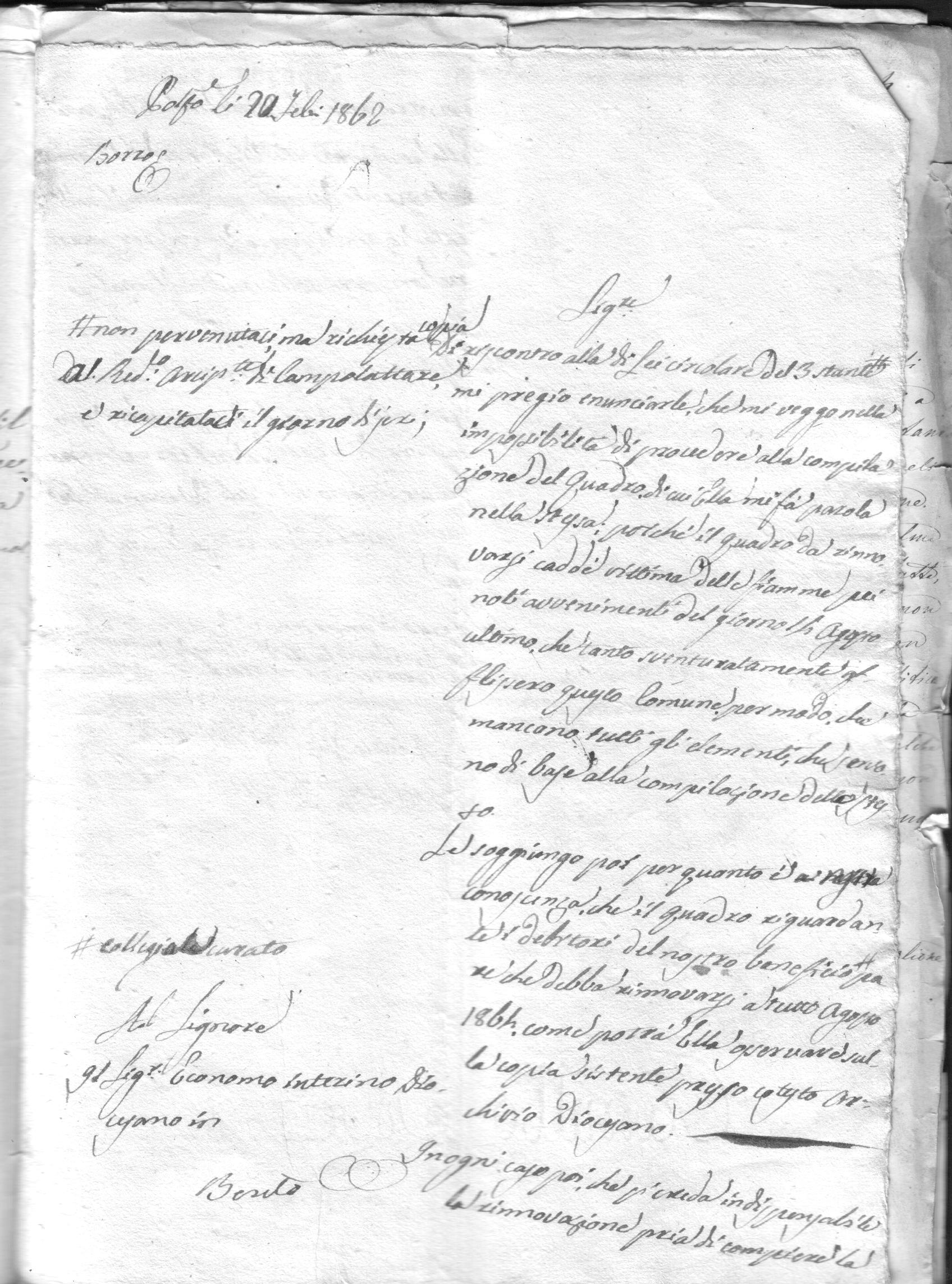
Imagine reading thousands of pages like this one.
As he created the databases he noted the book name, page number and entry number. That way if anyone really wanted to see the fragile old books they could just go to the relevant pages. He also created separate data bases labeled by book. Damn, he is good. The organization will help future historians track data.
We learned that until 1903 the priest of each parish was responsible for doing a census. The census held the tales of the village. The priests would visit each house in the parish – whyam I wondering if they also got donations for the church at the same time – and ask questions. They noted the names and ages of people living in the house, if the house was owned or rented, what kind of jobs folks had, nicknames and what ever else caught their fancy. Those notes are now safely ensconced in Antimo’s database. In 1903 the state took over the job and started to do a census every ten years. These sure has hell don’t include the interesting notes the priests wrote down.
Birth and death registration book from the 1800’s.
Before 1700 there were four parishes serving this mountain town of peasants and landholders – San Felice, San Angelo, San Piedro and San Salvatore. So priests from all of those parishes kept records of births, baptisms, deaths, weddings. These are great old journals with meticulous handwriting on paper so old that it crumbles when touched. We know that because the Comune has it’s own set of unprotected books that are manhandled, falling apart and not digitized! Che fa! Thank God Antimo created a database of the much more complete church records.
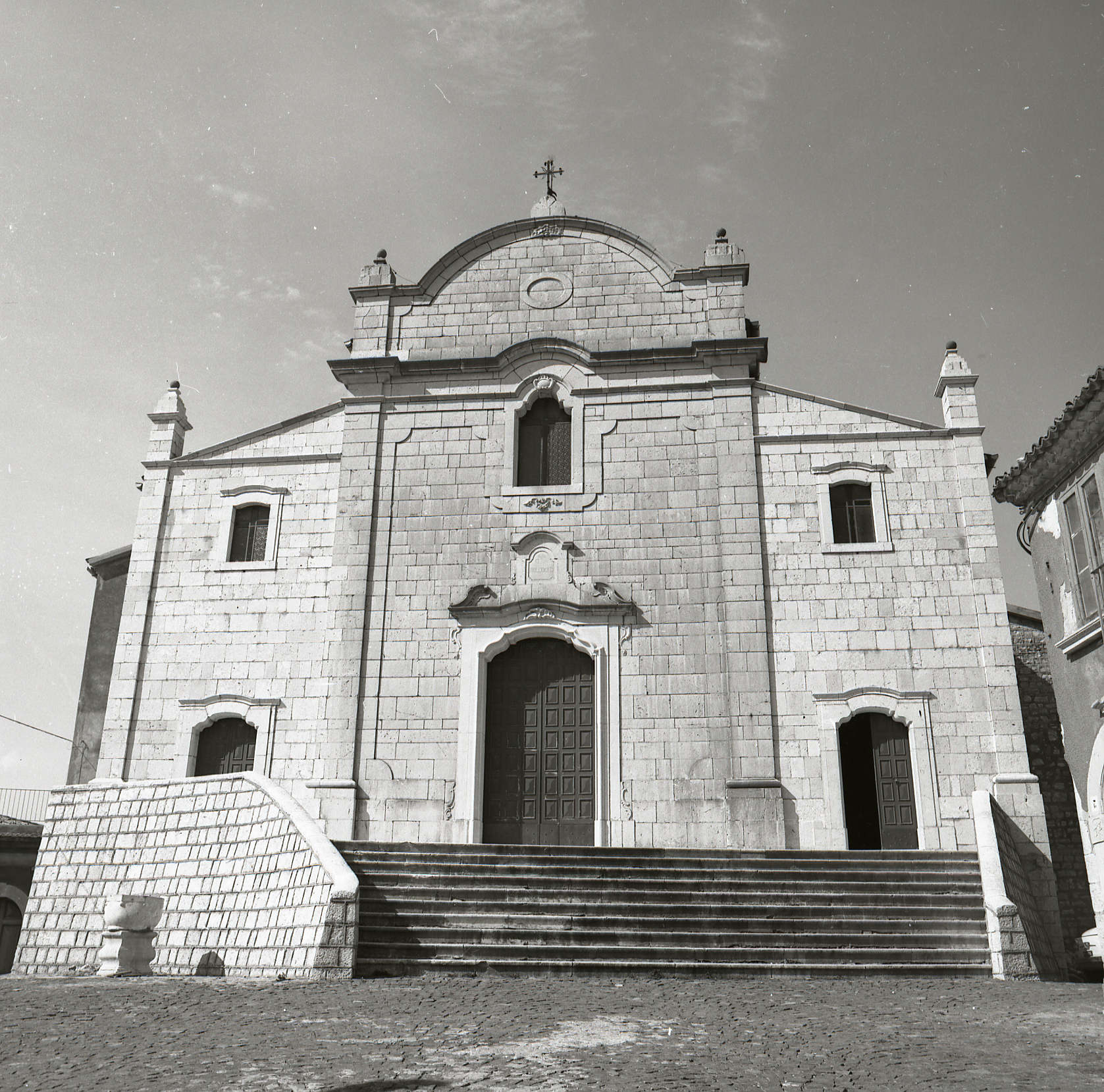
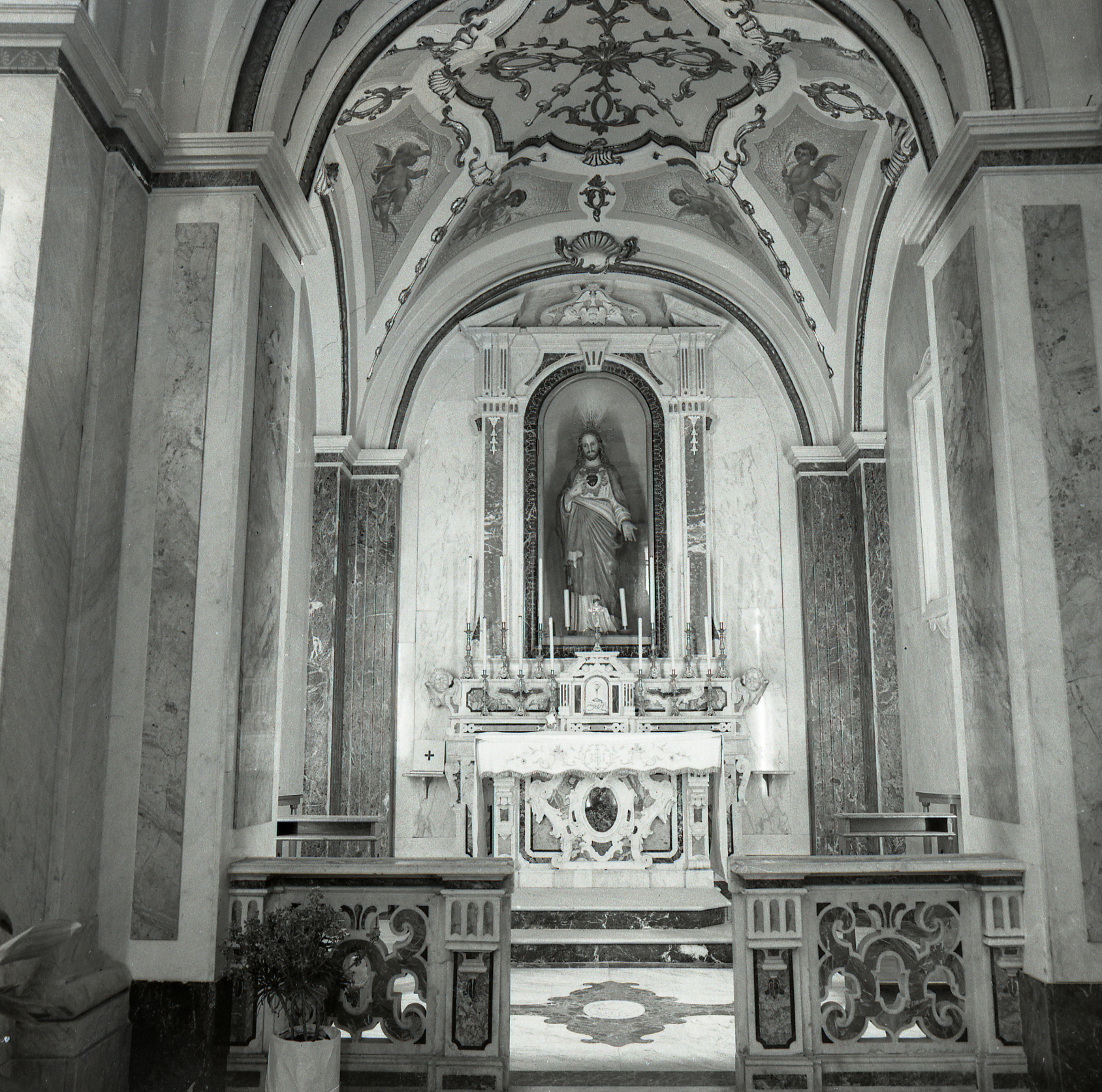
In 1688, there was a huge terremoto – earthquake – after which the parishes were forced to merge. Well. not exactly forced, but San Felice and San Pietro parishes spent a lot of time fighting over who got to be the cemetery. In those days that meant holding the bones of the departed in the catacombs of the church – you know that space just below the seats for the congregation. In the throws of the fight neither church got rebuilt. That narrowed the playing field and in 1700 there was only the mother church of San Salvatore. The church where my grandmother was baptized and twice married. It still stands and we go to mass there often – not because I’m a good catholic but because I can feel her presence there.
San SalvatoreThe art in San Salvador is awesome.These are shots from the 50’s. Later we will have a blog on the parish and you’ll see glorious color.
As I sit in the piazza writing this, my heart fills and tears start to glide down my cheeks. What is that about? How could a middle aged, hard assed woman like me get so sentimental about finding my family? I haven’t a clue but the universe sent me here and as my dad’s first cousin, Giusippina, says often – sangue è sangue – blood is blood and I am the first of the family to return looking for those that stayed.
Finding one’s family is a backwards process. Start with the birth and death certificates of today and work backwards. Since I had already done a lot of research to gather the documents to become an Italian Citizen, I went to see Antimo with the materials he needed to leap even further back in time. (Read the blog about citizenship for more background.) https://midgeguerrera.wordpress.com/2013/06/21/cittadina-italiana-citizenship/)
Antimo started by finding my grandmother’s birth records. We had the day, time and name of her parents, Liberantonio Solla and Maria Antonia Rinaldi. (I am dying to know if we are related to the Rinaldi Olio di Oliva folks.)
Every village in Italy will provide you with your family’s documents. There was a very nominal fee for grandma’s birth certificate.
Then he painstakingly worked backwards, creating a new excel data base for me that included everything he could find. The little details he unearthed painted a picture of the times and the people. nicknames were used everywhere. My great-great grandma Solla had the same name as mia nonna – Maria Rosaria. It was also the same name as her mother. Her birth certificate was noted as Maria Rosaria D’Addona.
Antimo said that baptisms were very close in date to birth records. Many children died soon after birth. Since everyone wanted the babies to go to heaven, people made sure they got those kids to church and baptized immediately. Often if a child died, the same name was given to the next child of the same sex. Boy, does that add another database layer of confusion.
Later we paniced – we couldn’t find my grandma’s grand-mom, Maria Rosaria D’Addona, in any database. Oh where oh where could my grande bisnonna be! We only found the unborn (no birth record) Cesare D”Addona in all the family census databases. Like she fell from the sky. The brilliant Antimo scanned even more documents and realized that Cesare was Maria Rosaria’s nonna’s name. Since there were two Maria Rosarias in the family they decided to call my great great grandma – Cesare. In 1839, Cesare was only 16 years old when she married the widower Felice Solla from Morcone. I am guessing he didn’t have much cash because they moved in with her mother on Via San Felice (now Via Municipo – the same street where Antimo currently lives.) That means I have walked past my great – great grandparents first marital home a million times!
I never would have figured that out. We were blessed to have Antimo, a focused detective, helping us by constantly cross checking information from birth, death, marriage and census records. OK, we found the lineage of my great grandma. Now let’s talk about great grandpop.
My great grandfather was Liberantonio Solla – family tales are full of his musical ability. Zia Caterina also remembered his ability to drink the night away and fall down the mountain on the way home to Via Porta Nuova. On my second visit to Pontelandolfo, we found my great granddad’s house . The rocks of this small medieval stone cottage – now in ruins – held secrets that we will never know. Or will we?
Only a few stone walls are left of the house that my young grandmother, grandfather and aunt and uncles shared with grandma’s parents.
What we didn’t know was that Liberantonio wasn’t called Liberantoino by anyone but his mama. Pitocchio (flea in dialect) was his nickname. As he played the concertina, villagers shouted Pitocchio . I’m not quite sure of the name my bisnonna, Maria Antonia Rinaldi, shouted when he came home dead drunk, having spent all he made singing at the bar.
Oh, I just remembered, great grandma Maria Antonia Rinaldi was born in a rented house. Liberantonio Solla was born on Via San Felice – in the home of his grandma! How the hell did we discover all this in less than ten hours? My great grandfather was a “bracciante” – an ancient term for working the land for someone else and getting a piece of what you grew for yourself – yeah serf. I come from a long line of indentured servants. Weeoo. My great-great uncle Nicola Solla (Liberantonio’s bro) worked for the commune. We discovered that for generations a Nicola Solla worked for the commune. I can’t wait to find out if one works for the town today.
So much to discover. So many stories to hear, feel and relive. So little time to do it all.
Thank you. Thank you. Thank you Antimo Albini for keeping the keys to family history at our fingertips.
Whirling dervishes dance madly in the noon day sun as the wind whips
over the mountains of Campania.
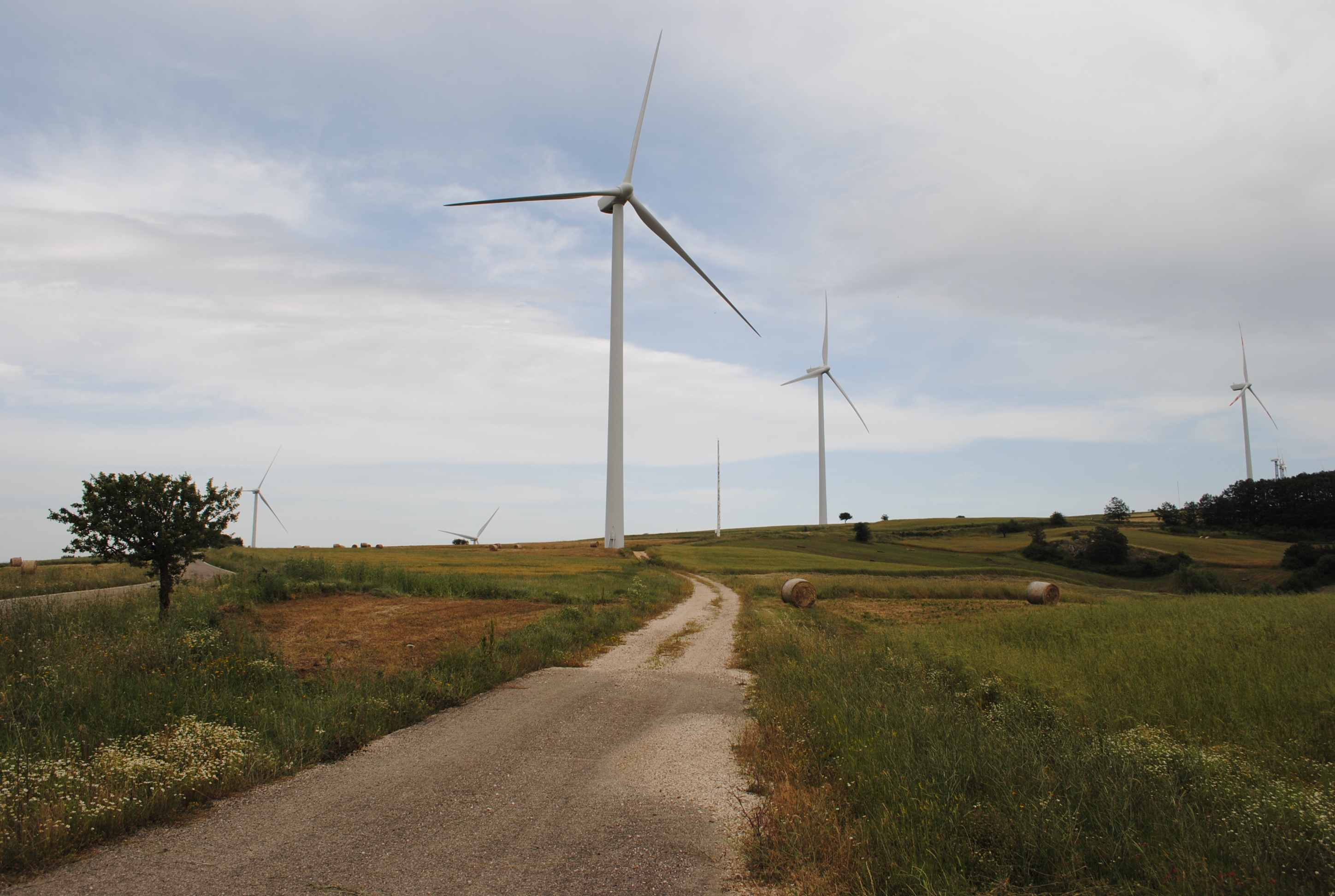
One morning, on our way to the Naples airport , I screeched at Jack to pull over. He raised an eyebrow and kept on driving. Rats, how would I really get a glimpse of the thousands of windmills that peppered the mountain ridge if he didn’t pull over? That was the first time I spied the windmills that are part of the onshore wind farms that earned Italy its 2012 standing as the world’s sixth largest producer of wind power. I have no idea how wind power works but the science guys at http://science.howstuffworks.com/environmental/green-science/wind-power.htm will absolutely explain it all.
Sentries posted on the tops of mountains
Sannino soldiers gaze down on the approaching Romans.
Tall, helmets pointed to the heavens – bodies still against the azure sky.
When I first saw them, I wasn’t thinking – “Gee, how green and save – the – planet this is.” I was thinking, “Hear the sounds of the marching feet as the Roman army emerges over the crest of the hill.” Seriously, from a distance they look like advancing ramrod straight soldiers with pointed hats. Up close they are more like super giant stick figures. Up close? H’mm did she really drive up the mountain to get closer? Yes, by gum we did! Why? Because we could! So why not. OK, if the truth be told, it was a chilly, dreary day and I was going to poke out my eyes with a pen if we didn’t get in the car and do something. Anything – as long as it didn’t cost a bundle of bucks and we didn’t have to change out of comfy clothes. Anything – never give me that option. My brain tumbles and rumbles and soon bizarre suggestions spew forth like Vesuvius. Anything meant – chasing windmills. Jack, knowing divorce was eminent if he didn’t get behind the wheel of the car, started the engine and let me navigate. Navigation was something like – “NO, NO – TURN RIGHT” – when ever I saw the top of a windmill. We were so intent on getting close to the windmills that I didn’t even shriek at the switchbacks along the way. What we didn’t do was record exactly how to get to the ridge. All I remember was from Colle Sannita take SS 212 and make a right on SP 55. I was too entranced to take notes but said into my video at least 10 times – we were on SP55!
http://www.thewindpower.net/zones_en_7_campania.php keeps a database of wind farms and their operators. You tech folks might find this interesting. I don’t know how often they update it. I swear I counted more windmills than are noted. Some may have been the third or fourth phases of a farm and not yet included.
According to http://www.ieawind.org/countries/italy.html, Installation of new wind farms in Italy continued its pace in 2011. Total online grid-connected wind capacity reached 6,878 MW at the end of the year, with an increase of 1,080 MW from 2010. As usual, the largest development took place in the southern regions, particularly in Apulia, Calabria, Campania, Sardinia, and Sicily. In 2011, 590 new wind turbines were deployed in Italy and their average capacity was 1,831 kW. The total number of online wind turbines thus became 5,446, with an overall average capacity of 1,263 kW. All plants are based on land, mostly on hill or mountain sites. The 2011 production from wind farms could provisionally be put at about 10.1 TWh, which would be about 3% of total electricity demand of the Italian system.
Electricity is expensive here so I was hoping the wind farms were producing a lot more than 3%. Well, this data is from 2011 and we know that Italy in 2012 was the 6th largest producer of wind power.
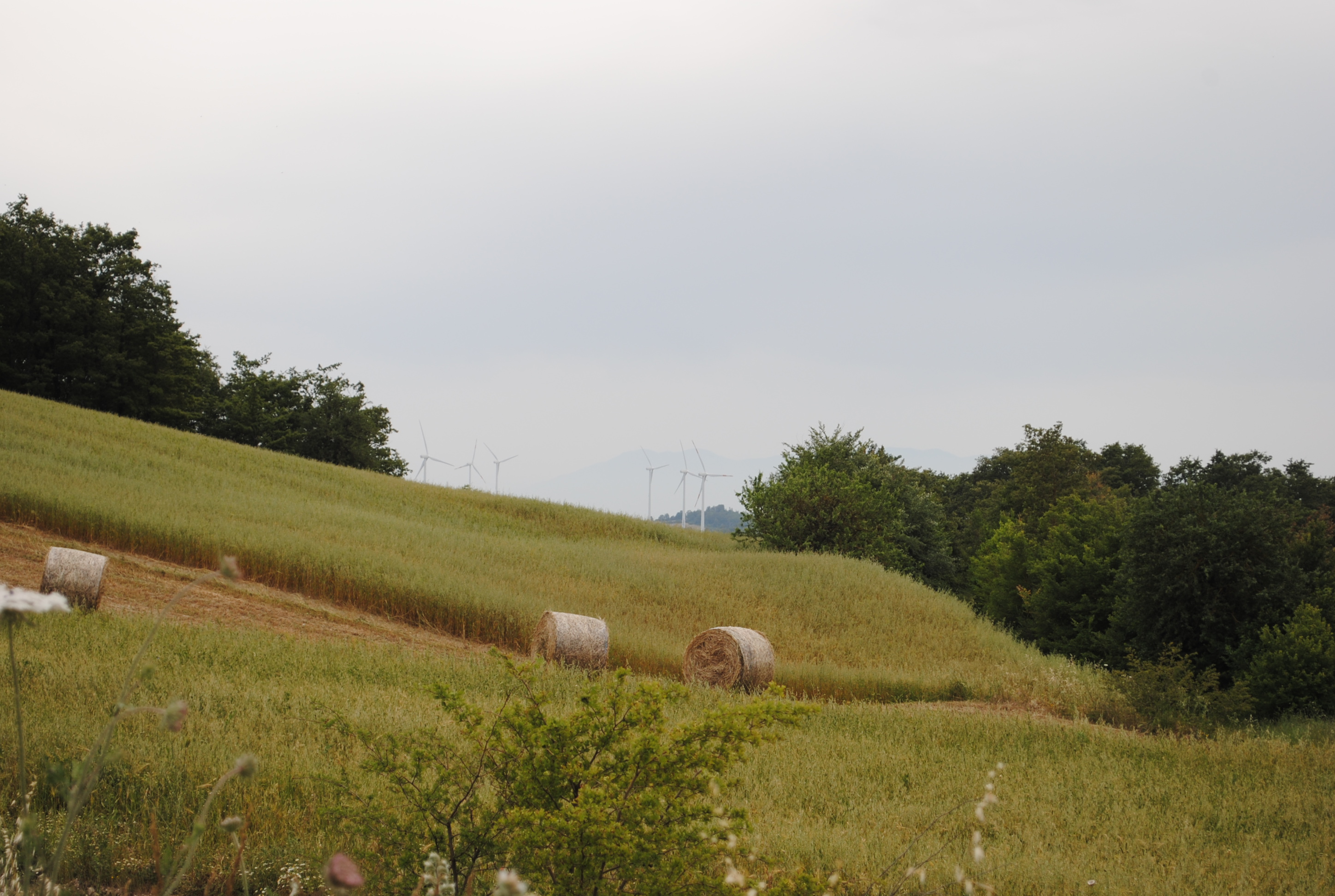
Hay fields surround the windmills.
What is interesting is that the farmers are still working the land around the windmills. As we wended our way around we passed beautiful new combines, tractors and balers . I am guessing that the income from the utility companies helps keep this area green and farmed. Windmills plus farm land sure beats the housing developments plus loss of farm land that are a blight on New Jersey.
Grey day washed away by the buzz of chasing windmills.
I learned something this grey day – chasing windmills is a guaranteed cure for boredom. Listen to the sound of the wind whistling on the ridge!
I know you are staring at me. I’m the new kid. Everyone stares and whispers about the new kid. Even though I am a glorious member of the sixth decade club, whenever I am in a new place with new people I want to scrunch down and get super friendly in the corner behind Mr. Ficus. “But Midge,” pals say. “You will talk to anyone.” Yeah, but first I have to take a deep breath, say, wherever I am God isand allis well, and then give myself an actor’s objective. Damn, getting up the courage to talk takes a lot of stressful work. Work! That always works for me in a strange new situation – work. Around strangers I have to have a job – back to the actors objective – give me the antipasti to pass around and I can chat up a storm.
Lightning bolts of panic zapped around my brain. Strangers in a new town, new country, faced with tons of new people to meet and they speak a different language. How will I meet them? How will I ward off boredom? I need a job!
Before we got to Pontelandolfo, I asked our very own School Board Member (consigliere), Rosella Mancini about volunteering as “madre lingue” in the elementary school.
The bus travels up the mountain collecting kids. Parents PAY if they want the bus to stop.
Starting in “scuola materna” – pre school – English is taught in the public schools. At the lower levels, it is the classroom teachers responsibility. I thought this act of kindness/selfishness would give me something exciting to do and I’d meet a bunch of great kids. They were truly great kids – they stand when ever a teacher enters the room and say Buon Giorno. NO ONE is staring at their phone!
Here’s a quick overview of the educational system – don’t worry I’ll toss in some pictures.
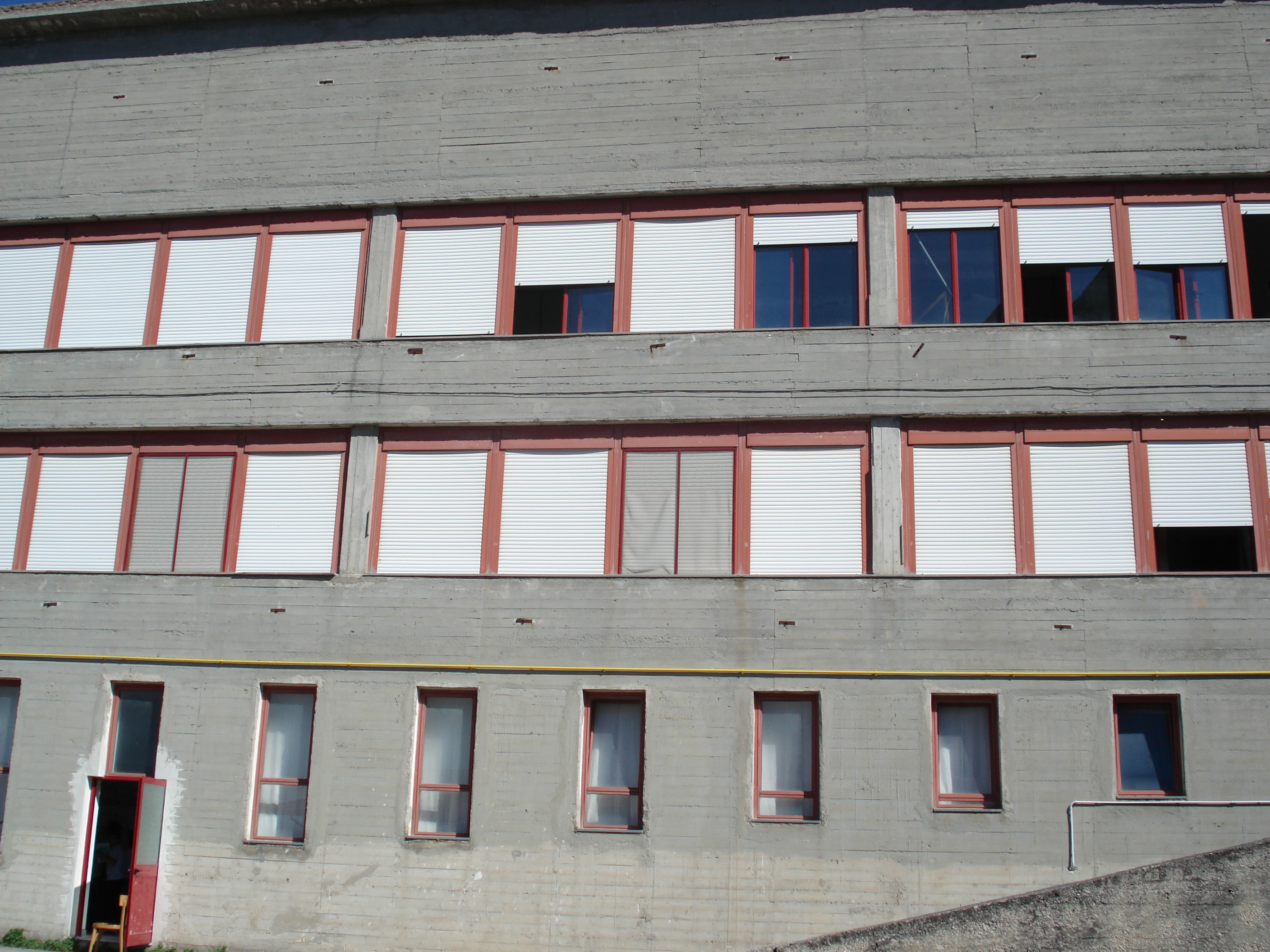
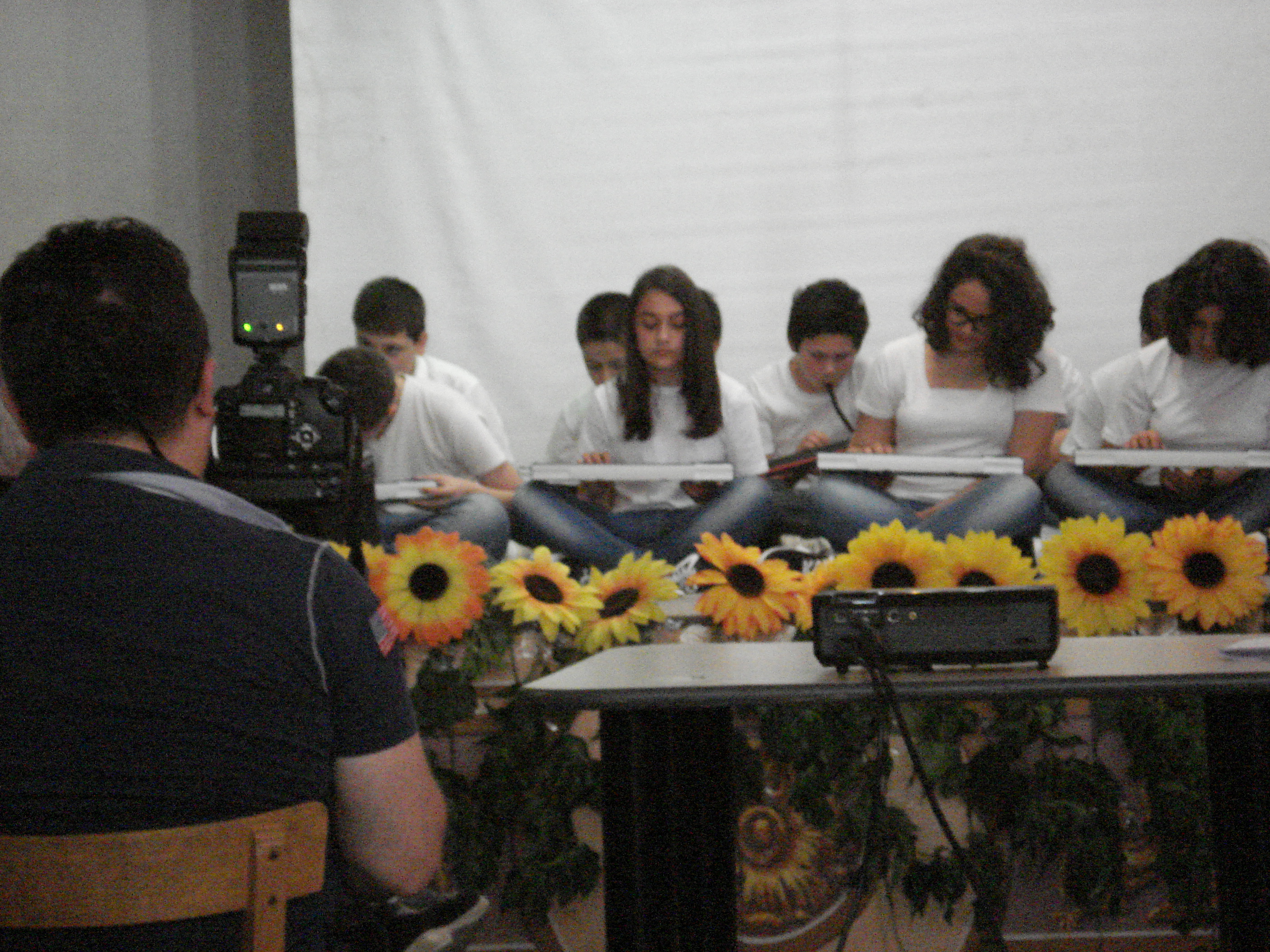
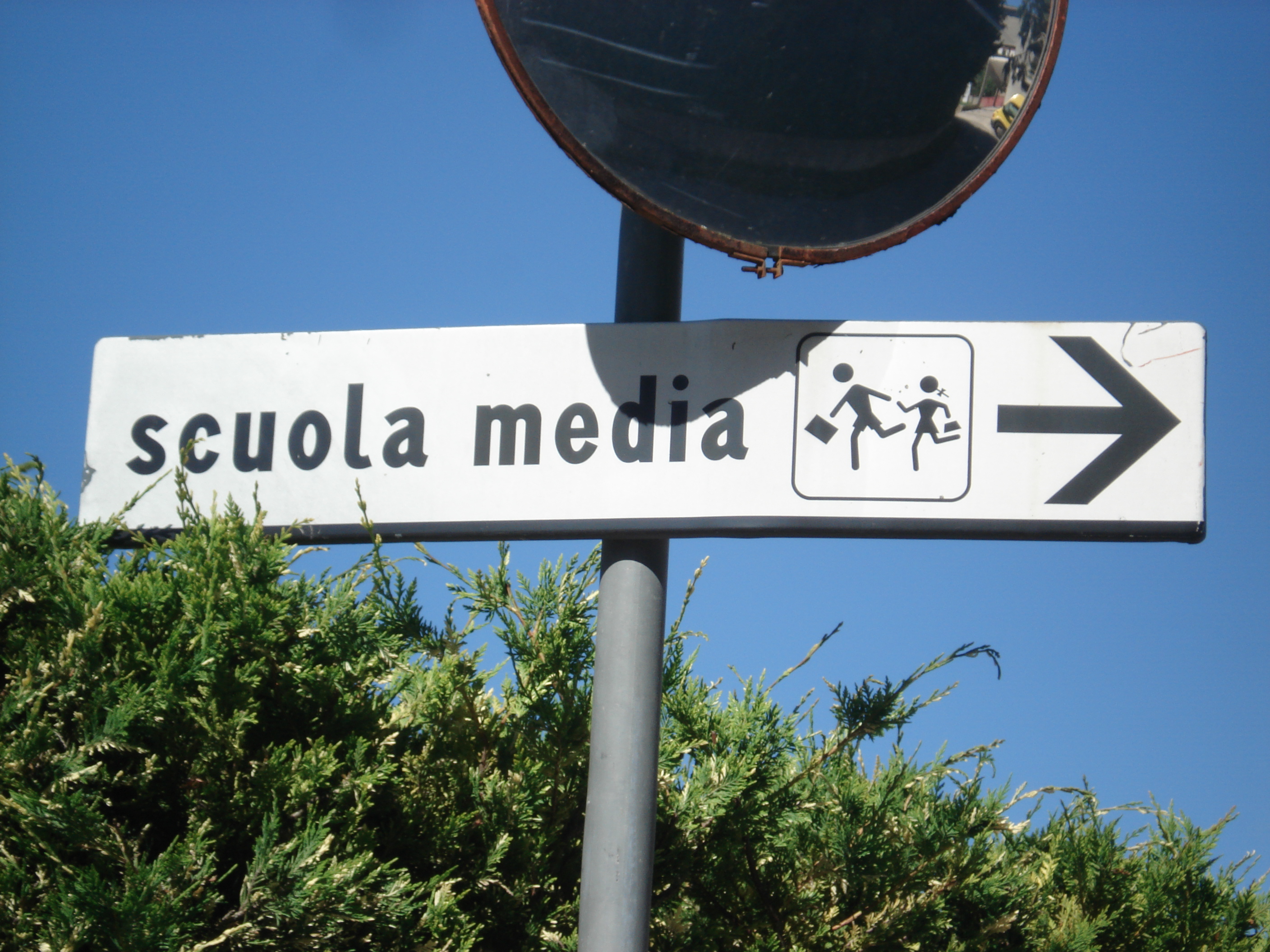
Not the prettiest of buildings. Very 1950’s utilitarian.I wandered and found this on a back alley door. Yes, I reported it.Happier note – they get music and art in every grade. This is a piano keyboard class. Besides English they were studying French too.
All children must stay in school until they are 16 -“Scuola del obligo”. Gossip from the teachers is that school directors don’t accept kids failing. If a teacher fails a child, it is the teacher who is the failure. Whoa – where does that put the responsibility? How many kids just “pass”? I gotta say I taught a good number of college students that graduated from high school and couldn’t write a sentence. Guess some practices are world wide.
TA TA da dum – standardized tests are given by the Italian government during a students third level of la scuola media (students ages 11 to 14). Tests – another global initiative.
The primary school was condemned and now those students have a wing in la scuola media.
Those attending una scuola dell’infanzia/materna, ages 3 to 5, and una scuola primaria/elementare, ages 6-10 get to wear un grembiulino. The smocks are adorable.
Clean, cute and practical. Ours were blue.
The “primaria/elementare” and “media” scuole classes I visited had classes of about 15 students – I am told that is the norm.
i went to the end of year show – music, poetry, history – performed on a very small stage that had incredible art around the proscenium. That great art was covered by pictures the teachers made of fruits and vegetables – REALLY.
NOOOOO! Art Alert! Art Alert!Staples. They used staples.
Not all things are simply fabulous in Italy – the show was to start at 6:30 – it didn’t. Parents started lining up to go in at 6:00. The teachers didn’t open the bloody doors until almost 7:00 and people pushed in to get the limited seats. They need me to produce their end of year shows.
This performance was also the send off for the students going on to una scuola superiore – 5 year high school. These 14 year olds must pick a career so that they can pick what secondary school to go to. Cripes, at 14 I wanted to be something different every day – doctor, lawyer, nun, actor, cabaret star…. (Good link to understand the system – http://www.rome-explorer.com/rome-guide/italian_secondary_school.html)
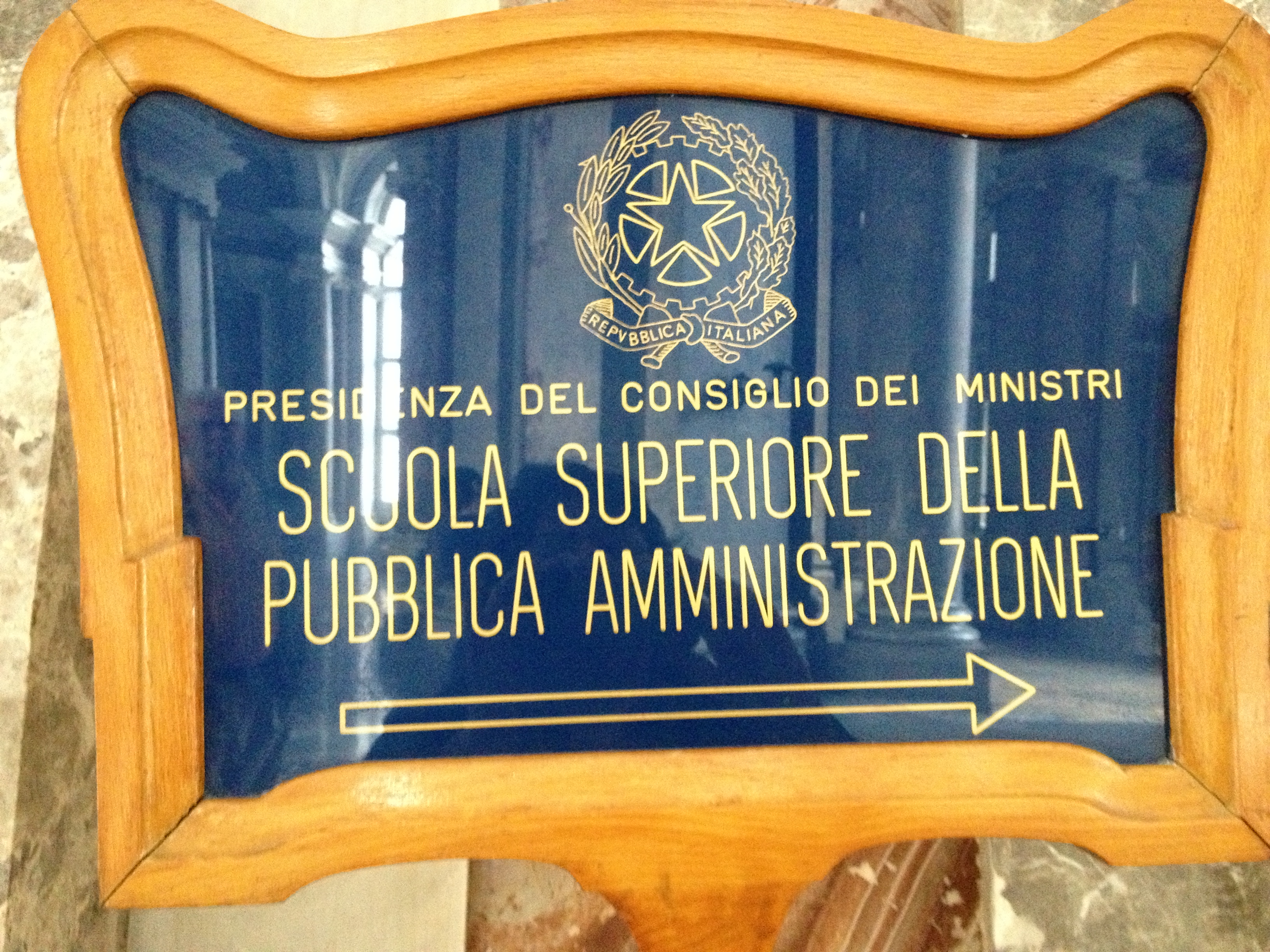
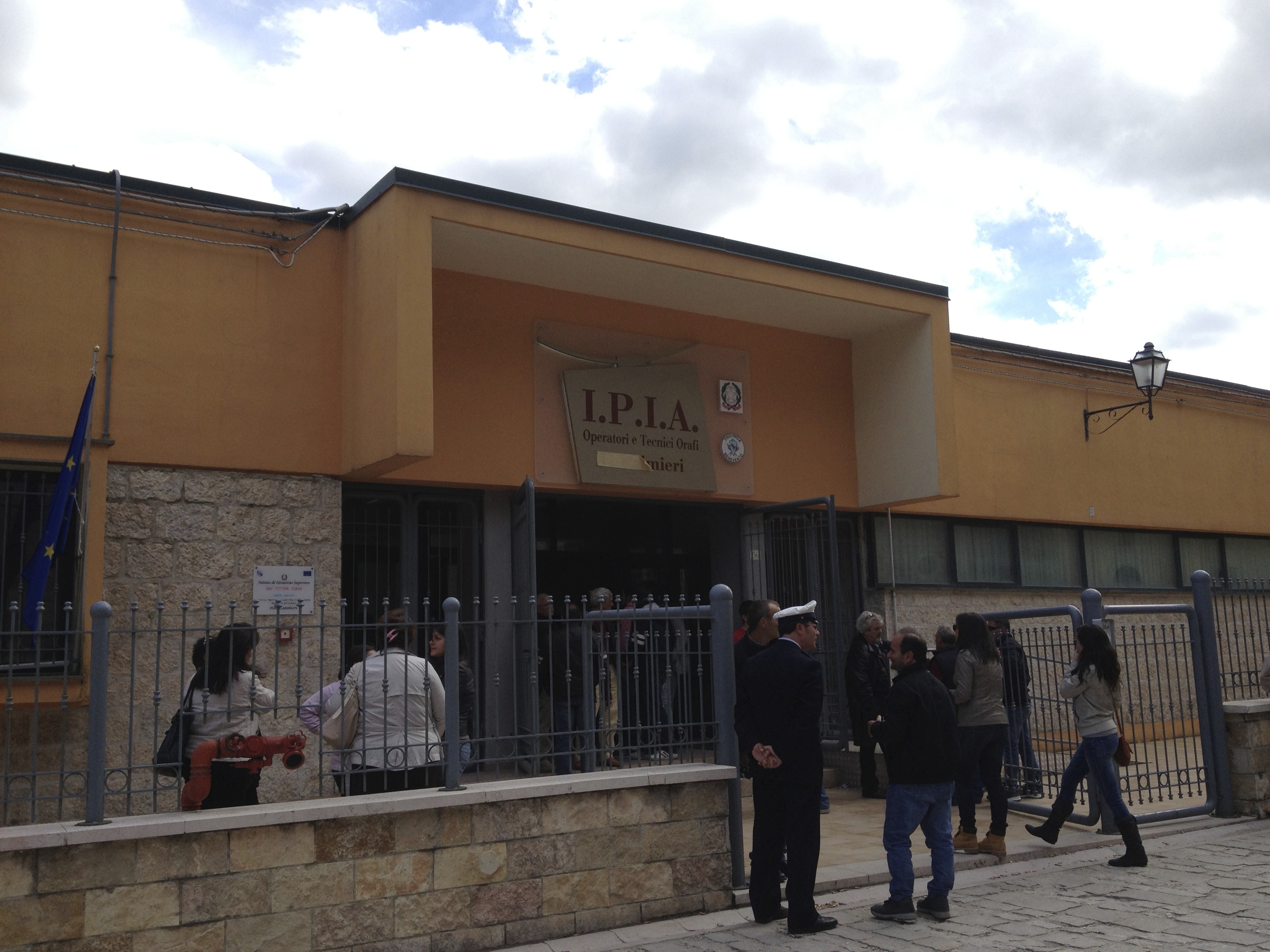
Secondary School for Public Administration! Do we have one of those? I think not.Secondary School located in Pontelandolfo – Art and Design of Gold Jewelry! Sadly, since there is not easy public transportation and enrollment is low the school will be closing.
OK, back to me teaching. To arrange the volunteer commitment, Rossella and I met with the director of the district. I took one look at the head of the schools and could barely remember my memorized bio in Italian. Thank the stars for Rossella who did the commercial for me. My mind went blank. I was stifling huge guffaws – because this woman who deals with tween age boys all day had a blouse on that was cut so low her girls must have been freezing. Geeese Louise – dress for the job.
Worse than not being able to speak was not being able to listen – though Jack says I am a chronic non-listener. I thought she said, “ how do you like Casalduni?” I said something like, yes, I like Casalduni (neighboring village). What she had said was, ” would I mind teaching there too! ” Not being totally fluent got me into tight binds often. Somehow we managed to ignore that request and just focus on the children in my home town.
Day one approached. I had looked through all of English text books for the entire spectrum of grades – from ages 5 – 14. Gulp, they should know more English grammar than I was ever taught. The sweat was dripping off my brow as I created lesson plans for every grade – did I say every grade. Yes, I taught in every single classroom in the co-mingled primary and middle school. A little voice said – “teach what you know.” Kids and creative dramatics are perfect together. Whew, I should have thought of that sooner. Not bragging here – but since the classrooms are very traditionally taught and I ain’t traditional – the kids loved my classes. I started every class with one of the many name games I can pull out of that theatre trunk in my head. Of course to introduce myself, I did something silly and wondered about the gasps on my last name – Guerrera – until I heard all of their last names and heard a bunch of them say – Guerrera. Yikes, more branches on the mulberry tree to explore.
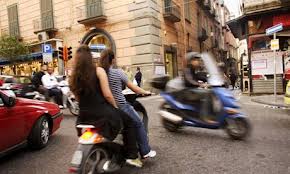
Watch out! Sheeeeeeeet, the motorini is aiming for us. I clutch the armrest. My heart races. Jack scowls and bellows, “stop screeching.”
Photo From Guardian UK
Ahhhhh, thank you for listening. I have discharged my angst. I inhale deeply, and count to ten. H,mmmmmmm. I visualize white light surrounding the car. WATCH OUT!!!!!! I immediately stop all this relaxation, funky granola, bull poop and bellow, “DON’T EVER TAKE A FREAKIN’ CAR INTO THE CENTER OF NAPLES!”
Here’s the story. It was a beautiful day and we thought we could explore Naples. Our fabulous landlord had taken us a few weeks earlier. He drove us directly into the glorious historic center. He was incredibly familiar with the city and assured us the historic center was clean, safe and wonderful. It was! The architecture and history are worth a visit. With Nichola we strolled down to the waterfront, had a caffè in a small bar and people watched.
Post card pretty.
We thought we could do it on our own. (Notice the “we thought”.) We were accompanied by Giusy who attends Università DI Napoli “Federico II”. The plan was to take the train from Benevento. The down side of idyllic, very small village life is that there is really no public transportation. At 7:00 or 7:40 AM students and those lucky enough to have jobs can take the bus to Benevento. At 8:30 AM there is a bus to Campobasso. We didn’t know until a few days later you can take it all the way to Naples but it is a really long – stop everywhere – ride. Where was I? Oh yeah, the plan was to take the train from Benevento. Great plan – 20 minute ride to the station – 30 minutes trying to figure out where to park – and then finding a parking lot only to discover that the prepay machine only took coins! Sounds like New Jersey transit – we’ve got the trains just nowhere to leave your car. Shouting and cursing ensued – that was me. Jack did the scowl sigh thing. Giusy said, “maybe we should just drive.” Well she lives there how bad could it be?
I need to point out that the last time Jack drove to Naples – about 5 years ago – we were going to the Capodimonte Museum and National Galleries and got stuck in a horn blowing, knives flashing, traffic jam at a 1/2 mile wide round-about (circle). We were forced to crawl around the circle for about 45 minutes. We had only gone about half-way around the huge thing when Jack was able to ease off into a wide avenue. In less than one block, the wide two way street had bottlenecked into a goat path. People had double parked or abandoned their cars on both sides of the street. It was an impassable, drivers screaming and horns blaring NIGHTMARE. Jack Mr. Calm in a crisis pulled the car onto the sidewalk and told us to get out. When in Rome or Naples do as …. We abandoned the car, took a cab to the museum and worried abut driving later. So, here we are driving in Naples again. Are we insane? Don’t answer that.
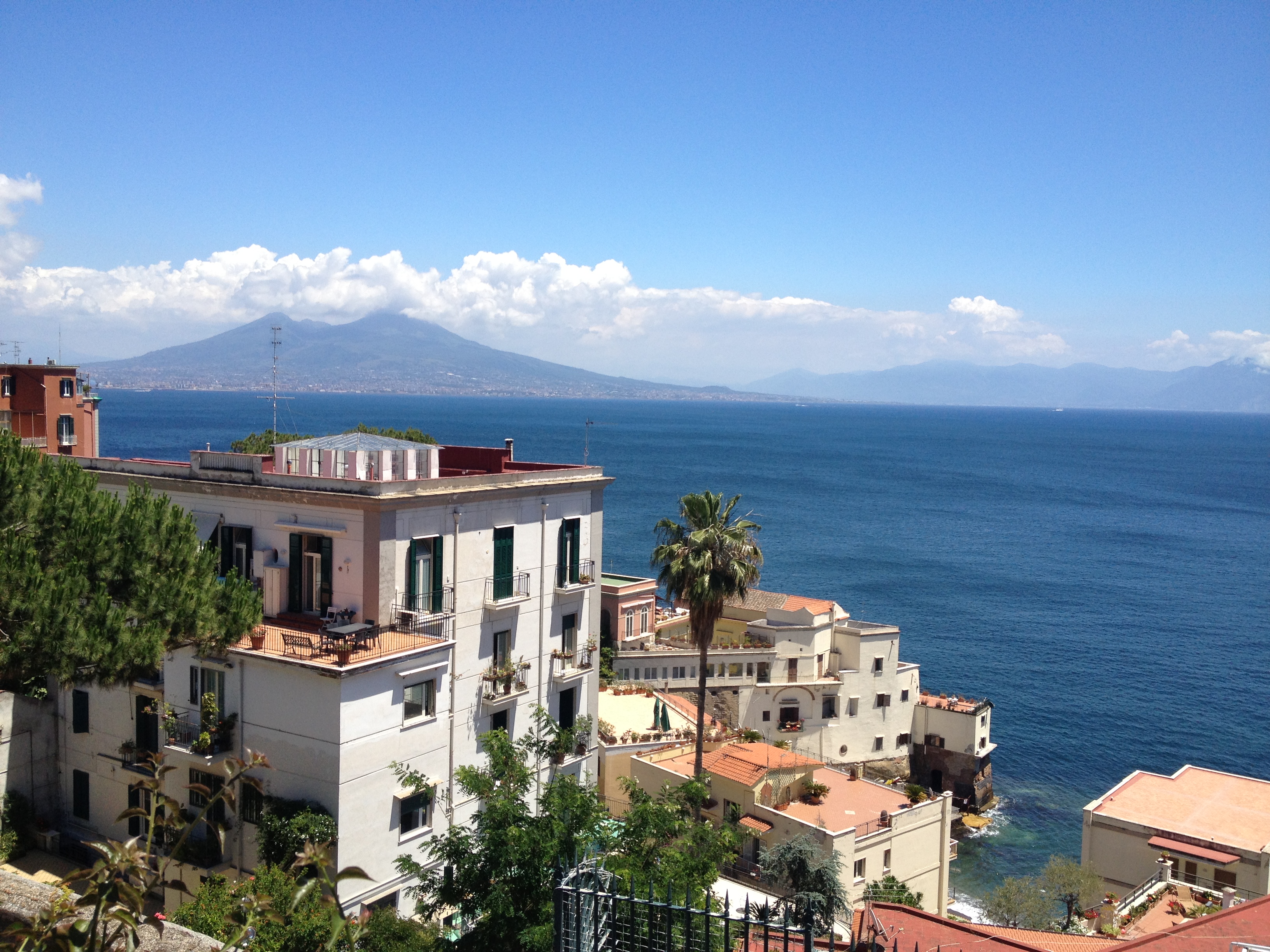
This time we had our handy iPhones and could use the GPS. We knew we wanted to explore a neighborhood and picked the bayside “Posillipo”. Getting in was a dream. We took the autostrada to the city and then followed the water all the way to Posillipo. Parking in a lot was easy – though again you could only use change. Since we figured we only needed three hours to stroll, eat lunch and stare at the sea, we scrounged enough coins. The view from Posillipo is amazing. We all agreed this was the neighborhood to live in.
Blue skies, beautiful buildings – perfect!
Gated private streets led to magnificent houses and apartment buildings. Sigh, anybody want to give me a scant million?
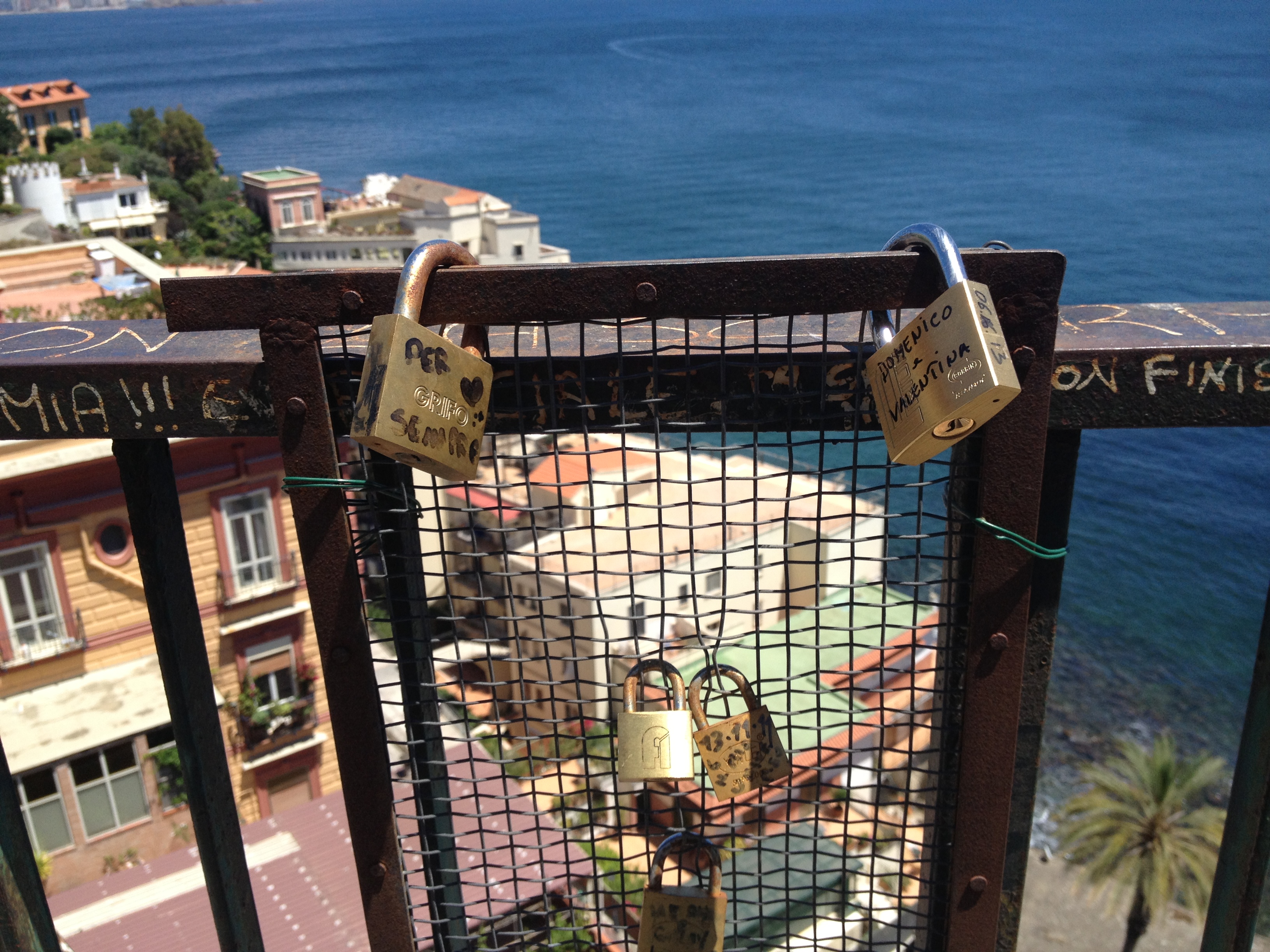
Want to buy me this house in Posillipo?We first saw these “lovers locks” in Paris a few decades ago. Young love….Now this is a roof top terrace!
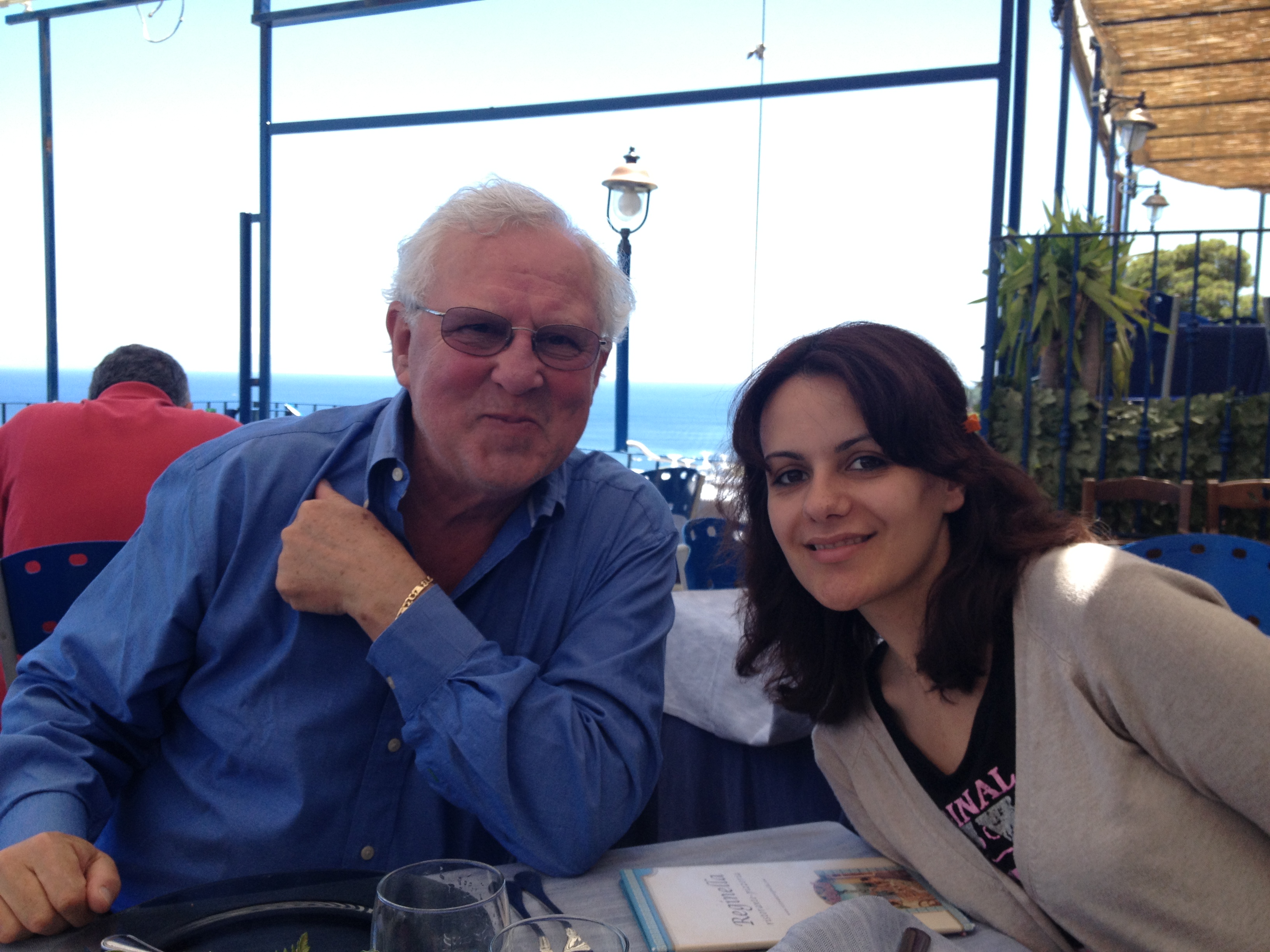
Strolling through the neighborhood we discovered a restaurant with an incredible view. Reginella Restaurant was the type that brochures touting the charms of a seaside community are sure to mention. It was perched on the side of the cliff leading down to the Bay of Naples.
Magical view! Note the very thin wrought iron railings – easy to see the sea.
We sat on a terrace overlooking the sea. Initially, the charming host sat us right next to the railing – ah a glorious view! Giusy and I looked at each other – we were both turning green. All I saw was my life passing before my eyes as I fell off the side of the cliff and lay broken on the rocks below. With chattering teeth we asked for another table.
Ahh – happy new people sitting in our still warm railing side seats.I stopped hyperventilating enough to take a cute photo.
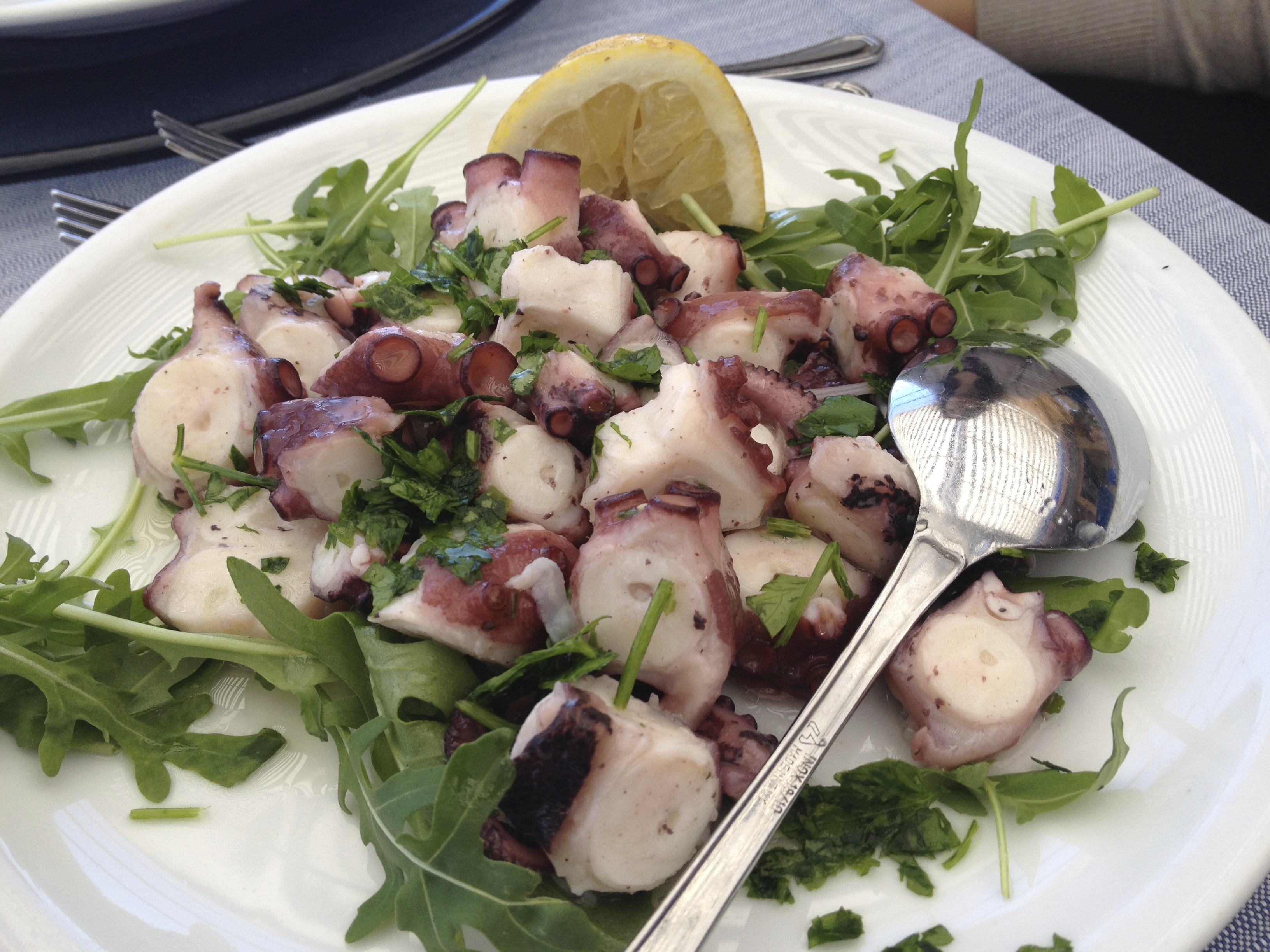
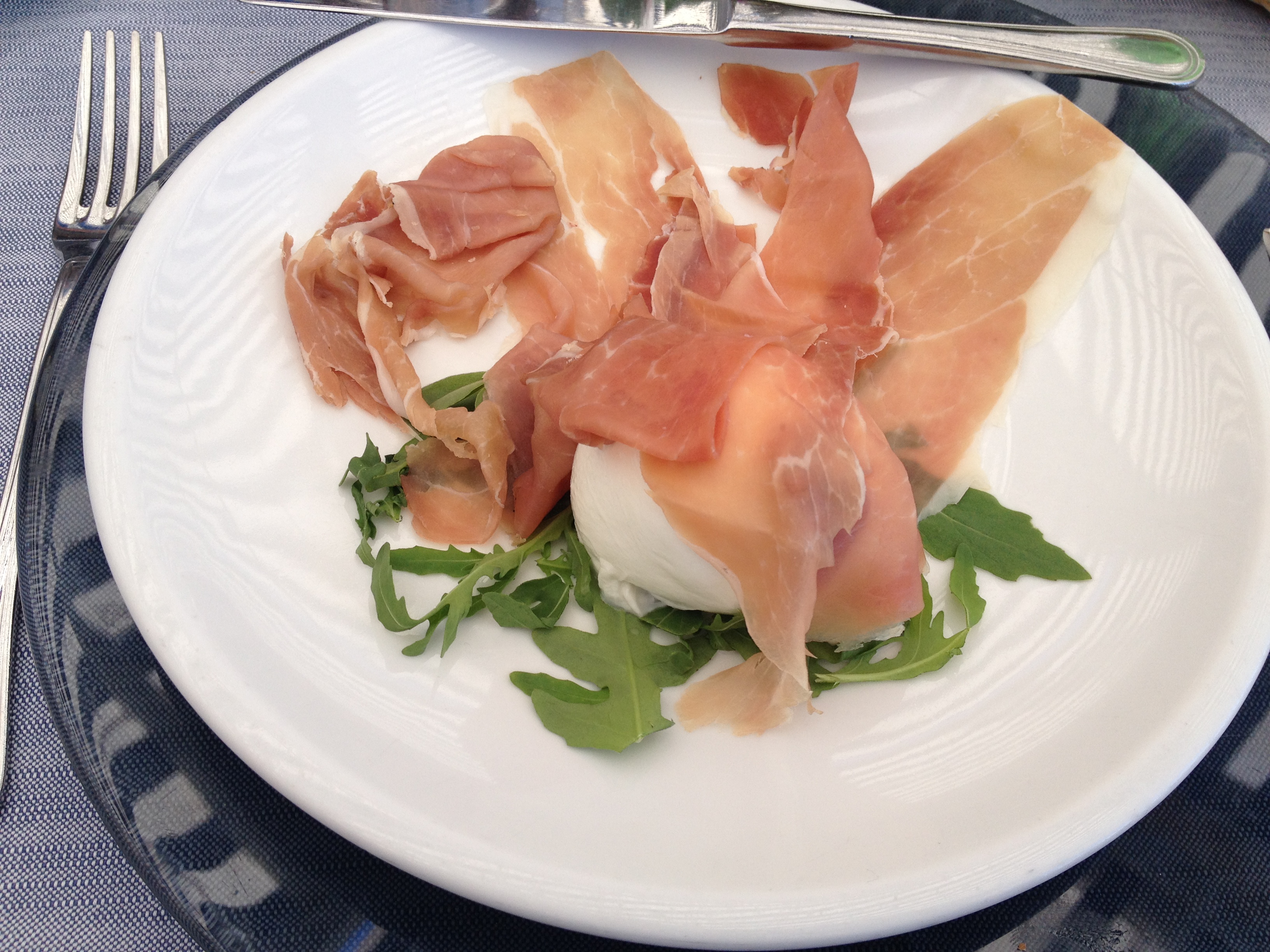
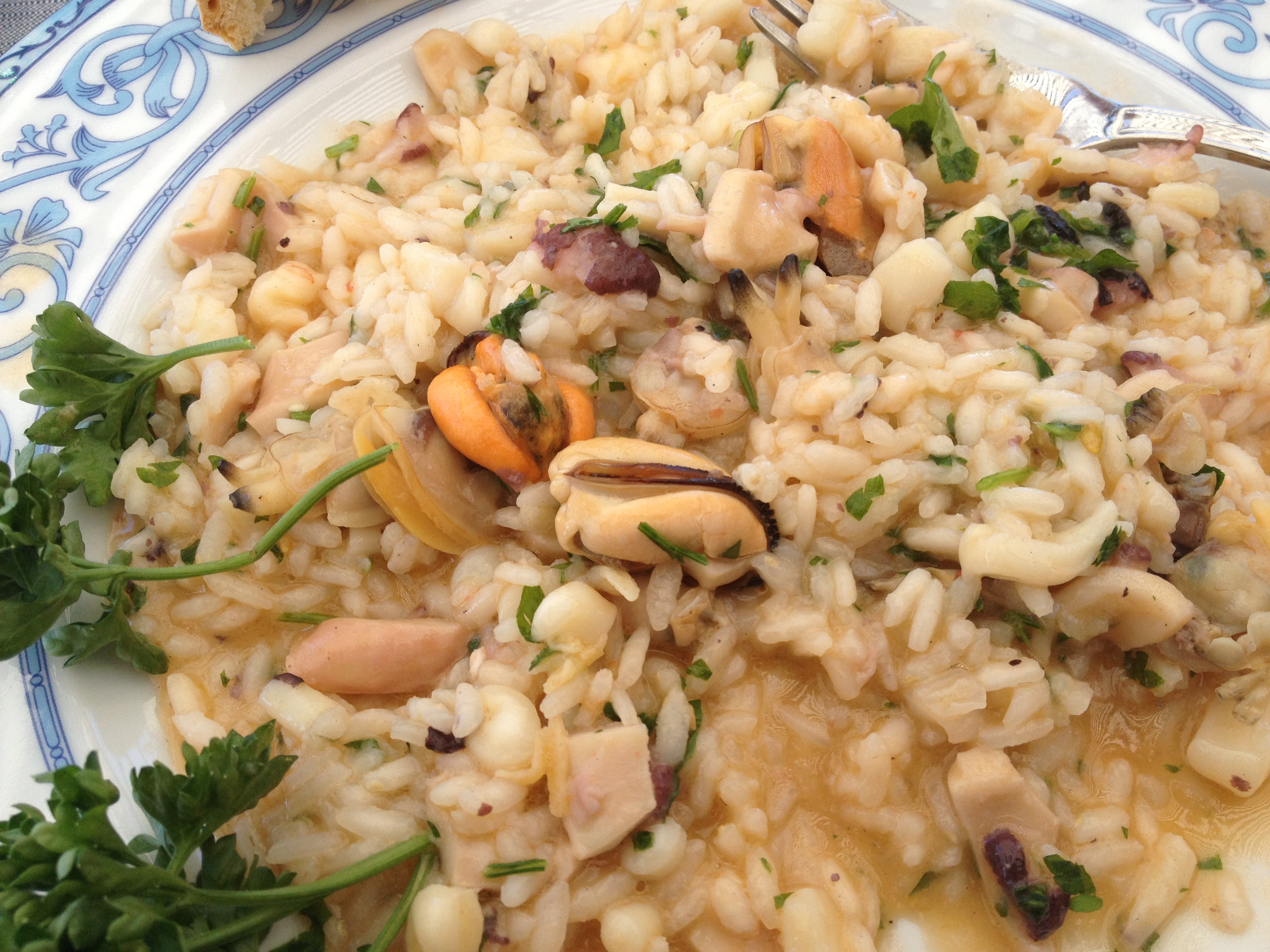
Once we were happily seated a bit further back, we concentrated on the incredible seafood. I’ll let you see the food and judge for your selves. (Pssst – My “risotto alla pescatore” was chock full of clams, mussels, scallops and pieces of calamari.)
Octopus tossed with lemon on a bed of arugula.Need protein? Buffalo mozzarella hidden under prosciutto.I took the mussels and clams out of their shells and then remembered to take a picture. Hey, It smelled like I should dig right in.
Delicious! Seafood by the sea . Those of you waiting for the other DON’T DRIVE shoe to drop. Hang on – here it comes.
After lunch we strolled a bit and took in the sites of the neighborhood. Most shops were closed. Even stores in the cities close for lunch and a break, opening again at about 4:30. Sated from lunch and the fabulous view we decided to head for the historic center and check out where Giusy attended university and lived.
Whaaaaaaa. Whaaaaaa. Nervous breakdown alert. If you do not have a strong stomach for street chaos stop reading.
We set the GPS for the address of the apartment, followed the bay and suddenly were told to turn left into Dante’s third level of HELL. Thousands of Evil Kenivals zoomed in and out of stop and go traffic on motorcycles, motorini and broom sticks. Cars double and tripped parked making streets impassable. The GPS didn’t quite get street closings due to well who knows – it was Tuesday. Where the hell was my Xanax? Clutching the purse on my lap like a life jacket, I tried not to cry out every time a freakin’ car or motorini cut us or or came careening toward us. My nails bit into my palms. Jack squared his waspy jaw and forged ahead. Forging ahead isn’t the right phrase. Begging for life – that’s a good phrase. Or crying for my mother – that’s a good phrase. It is like driving a car in a full washing machine set to the spin cycle. Bump, rrrrrrrrrrrrt, squeak, ugggggggg — HELL.
Giusy reminded us she always took the bus and walked and didn’t really know the direct route to her apartment. Gee, thanks for the relevant information! We saw the sign for a parking lot and whipped the car in. Relief. On foot, we enjoyed exploring the university.
Who could study in this place. I’d be staring at the architecture.
Next, it was on to discover how college kids live. We checked out Giusy’s apartment – palace sized rooms stuffed with kids. Sound familiar? Well, in the U.S. we really don’t usually find apartments with 14 foot ceilings, beautiful ironwork elevators and five bedrooms, two baths for 350 euros per each of the five roommates. Granted, clothes were still tossed around and the furniture was all cast off – but still it felt like a palace.
Time to go – so we trudged to the parking lot – where being 8 minutes late – they charged us for an extra hour. Giusy argued like a trooper and oh yeah – she won! They didn’t charge us. We gritted our teeth for the drive home. I couldn’t watch as Jack tried to squeeze out of the garage to the street. We hadn’t a clue how to get out of town and the GPS in our iPhone was obviously under a lot of stress. We ended up by the docks – well that was fun. Not TOO many cars jockeying for position there. We sat inhaling exhaust for what felt like hours – Jack says it was only 30 minutes. The conversation in the car came to a dead halt. Since I was’t allowed to make caustic comments or scream, it was very quiet. Somehow Jack got us out of the city and on to the highway. We all exhaled and enjoyed the mountains, farms and lush green that is the Italian country side.
Naples is a glorious city. TAKE THE BUS!
PS: Jack says it wasn’t so bad. We got home didn’t we!!!




















 Nonna's Mulberry Tree