Venezia – Searching for Goldoni

Thousands of tales have been told, books written, pictures painted and yet there is always something new to explore in Venezia –  that grand dame of a city. Me?  What did I explore?  Well, I didn’t go to the tourist packed spots like a normal person.  No, with my iPhone in my face I went back and forth across the Rialto Bridge and the same canal about thirty times – searching for Carlo Goldoni.  Not some distant relative – not some gorgeous hunk of Italian charm – but a dead white male playwright.  This Venetian was writing plays in the mid to late 1700s, so I know I couldn’t really find him.  I just wanted to sense him.  Before I talk about the search, let me remind you a little bit about visiting Venice.

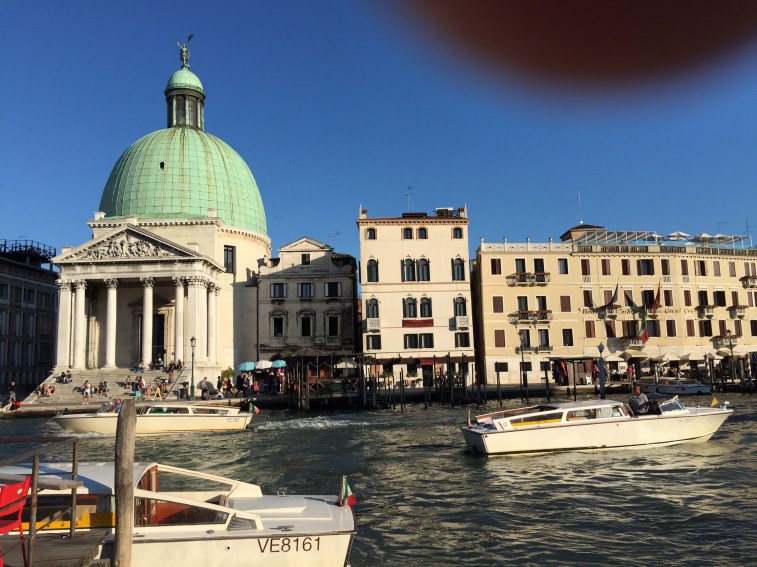
We took the train to the main station, Santa Lucia.  Walking out the front door we were immediately impressed by the great view of the Grand Canal –
IMG_3605
– and then turned into blathering idiots as we watched the swirl of tourists bumping into each other. Our first challenge was figuring out mass transit.  Realizing that since one way tickets on the vaporetti cost €7.50 and we would undoubtably go more than one way a day we bought the €20 a day package for three days.  At the ticket booth, when I asked for a map of the lines I was told I had to buy a map of Venice.  Ten minutes in Venice and we spent €123.  The map by the way is useless. Do not bother buying it.  It is impossible for the eyes of anyone but a 5 year old to read.  We got a better map of the Vaporetti at our hotel. Venezia Transit is the transportation web-site and one can read it in English.

Venice is an expensive trip.  A cappuccino averages €5 – compare that to .90 in Pontelandolfo!

Who cares!  I want to hang out where Carlo hung out.  Of course since he died in 1793 I may not find the same bar he sipped an apertivo in but I can pretend.  Oh, you’re asking – who the hell is Carlo Goldoni?  YOU DON’T KNOW???

Comedia dell’ arte – you have heard of that – Groucho, Chico and Harpo Marx certainly did.  Commedia dell’arte started in Venice sometime in the 1600s. It was a popular form of street theatre – improvised scenarios between stock characters based on universal types of masters, servants and lovers – think cuckold husband, cheating wife etc.  Actors wore masks and performed “Lazzi” – signature gags and stunts.  Slapstick schtick!

Allegedly, regular comedy in Italy was apparently about to “flat line” when  Carlo Goldoni (1707-1793) leaped in with a defibrillator. My man Goldoni laid siege to the conventions of stock characters, improvised performances and the use of masks. Tsk Tsk. This did create a problem early in his career. Masked parts could be played by lousy actors. He had a problem finding actors who could act. At this point in theatre history the Italian playwright had to think more of working with his stable of actors than his public.

This Venetian began his career by writing opera librettos. Gaining in experience and in technical skill, he cautiously attempted to replace the base and (oh my) pornographic Comedia dell’arte with plays of innocent action that told the stories of contemporary events and characters. One hundred and sixty comedies remain – I haven’t read that many.  But I have read a lot – and surprisingly grasped the Italian. Some are written in the Venetian dialect – no way could I read those. He is said to have written as many as sixteen plays in one year.  See why I love him?  He’s an inspiration – I can only write one a year and then I can’t sell the bloody thing. His theatrical invention was remarkably fertile. Imagine – he believed that comedy could be drawn from an understanding of human emotions. He was not only profound, but according to those who knew him – I read all this stuff because except in dreams I never met him but loved the plays – he was charming, witty, true to nature, with buoyant spirits and an inexhaustible humor. Some folks – not just any folks but Voltaire – thought that Goldoni was the Italian Moliere!  He released “Italian theatre from the bondage of the artificial and pantomime performances – Commedia dell Arte – and laid the foundations of the drama as it is understood in our days.  Who doesn’t love him?!  

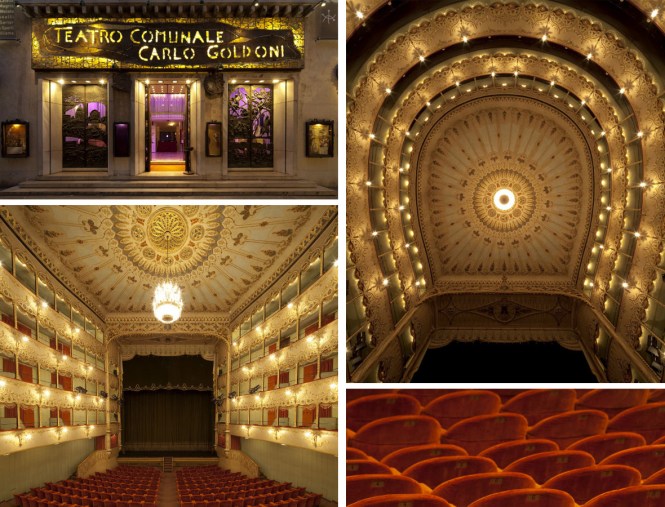
Back to my quest – I got excited by the pictures I found on line.
teatro-goldoni

Il Teatro Goldoni is located in one of the older sections of Venezia.  Not only did the web-site excite me but there were posters around town about a performance of Goldoni’s work!!!!  I wanted tickets!  I wanted to tour the theater!  I love this playwright and have enjoyed reading his work.  I want to walk where he walked!  I put the address in the map app on my phone.  We took the vaporetti to the closest stop.  We walked and walked and asked and asked but couldn’t find it.  We crossed the same canal a pazillion times looking for it. I am quite sure with all that walking that I must have stepped on one cobblestone that Goldoni stepped on.  Not wanting to give up, I went into a small restaurant on a back alley and asked one more time – the waitress said the theater was just around the corner.  We asked her to save us a table out in the alley and we sprinted around the corner – wait – what corner – we tried corner after corner.
IMG_3765

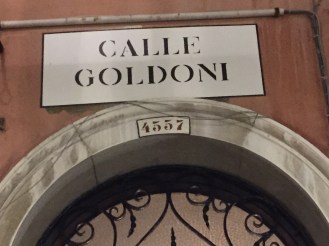
I found this little street -maybe he used to hang out on the corner with his buddies.

IMG_3766

Look – Hotel A La Commedia!  We must be close to becoming one with the spirit of Golden.  BASTA!!! ENOUGH! Downtrodden we just went back and had not only a fabulous meal but lived a Goldoni scene.

An old woman looked down on us from a balcony and began to talk to us.  My Italian can get us food and a hotel but normally isn’t enough to hold a conversation of intricate detail.  Channeling Goldoni, the dialogue poured out of my mouth. The old woman guffawed as I regaled her with the tales of my quest.  She told me I needed to go to his house – Goldoni’s house?  Yes, it is now a museum!

Carlo Godoni’s House Museum, the Casa di Carlo Goldoni, only costs €5 and is located at San Polo 2794, 30125 Venezia. I didn’t find that either …

Ci Vediamo.
Wine Tasting with Giuseppe Izza

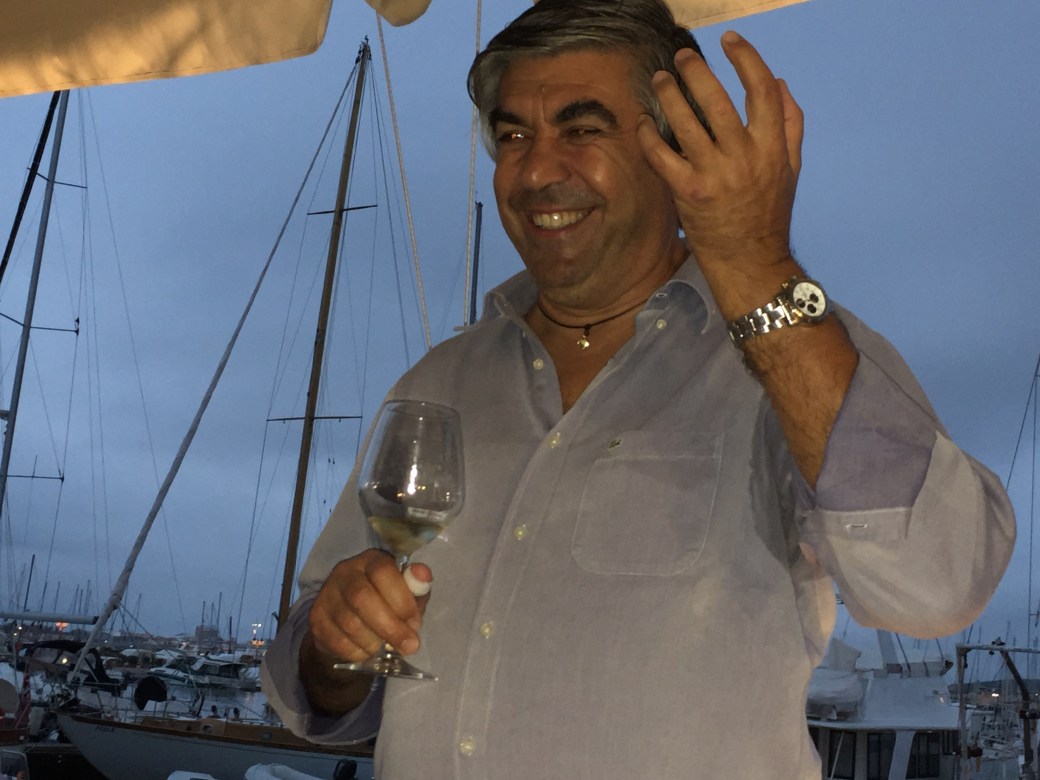
Agronomo – in English it is an agronomist – one who studies agriculture. Dr. Giuseppe Izza has indeed developed a career based on the wonderful edibles that grow in Sardegna.  I met him – not talking about slow food or tasting the fresh vegetables brought to Alghero by local farmers – but DRINKING WINE!  The event was organized by my favorite Italian Language School – Centro Meditteraneo Pintadera.

IMG_4055.jpg

Dr. Izza conducts an incredible workshop on the wines of Sardegna, wine tasting, wine history, wine glasses, what to eat with wine – well just about everything one needs to know to appreciate a good glass of a beverage that starts in the vineyards of Sardegna. Some of those vines have lineages that go back to the Romans in 238 BC.  For example the white Nuragus goes back 3000 years!!!  Other grapes began their journeys a wee bit later and came with the different peoples who controlled Sardegna during its history. For example – the Vermentino – white – from France or the Torbato from Spain.  These grapes have lineages much more noble  than mine.

We were all chomping at the bit to start tasting the wines that Dr. Izza had brought with him.  But NOOOOOOOOO!  First we had to learn how to really taste – not just gulp down that red for a quick thirst quenching buzz.  Babies, he said, have the best sense of taste.  They don’t think about it – now he was not talking about the 3 year old who wouldn’t eat anything green.  His point was that adults are choosy.  Babies eat with their eyes, hands, noses and mouths.  They explore their food – look at it, smell it, taste it.  He encouraged us to – at the first tasting of something – to exam its look, really smell it, then slowly taste it.

IMG_4059.jpg

Look at Jack – he’s all excited.  Dr. Izzo is opening a bottle for us to taste.  What?  We have to wait?  Chill Jack – first one has to pour.  We were told to only fill a wine glass to where the glass starts to get bigger – open wider – that allows the smell to evaporate up.  Hmmm. Next, really visually examine the wine.  What is the color?  If you tilt the glass does that create “unghia” – nails in Italian but we would say legs. What are the color undertones?  Then, rotate the glass and evaluate the fluidity and arches.  We all put our glasses next to our handouts so that we could really see the color – it was hard – some of us were staring at the sunset on the Alghero harbor.

IMG_4060.jpg

We went through the process with a number of both red and white wines.  It was interesting how our individual tastes and experiences created diverse perceptions of each wine.  I might think something had undertones of oak and cherry and Jack would laugh and say – not at all.

Dr. Izza is an enjoyable presenter.  He is a great communicator and had us thinking, laughing and of course drinking. The hours whizzed by and we all left the table with a better understanding of not only the heritage of the local wines but also how we can all be more discernible tasters.  I would recommend any of Dr. Giuseppe Izza’s classes.  You can follow his food adventures on his FaceBook Page or e-mail him at g.izza@tiscali.it.  Find out where he is doing a lecture and go!  The easiest way is to work with him is to join me in Alghero, Sardegna this October on the  Nonna’s Mulberry Tree Trip!

IMG_4049.jpg

Ci Vediamo!

Biennale Arte di Venezia

IMG_3610

On the Vaporetto to the Giardini and the Biennale!

We were excited to attend La Biennale di Venezia.  The 56th International Art Exhibition ran from  May 9th to November 22nd 2015.  Visiting Venice years ago, we had strolled through the Giardini, looked at empty buildings that every two years are filled with art and vowed to return.  Each country that participates in the Biennale has it’s own building to fill or we discovered – to barely fill  – with representative art of their country.  The exhibition takes place not only at the Giardini but also the Arsenale and in various locations across the city of Venice.


Curated by Okwui Enwezor, this year’s event got a scathing review in Art News.  Not to be put off by one person’s point of view and because we never do what we are told, Jack and I booked our train tickets and headed to Venice.

Our Cittidini Anziani – old people – tickets cost of €20 and were good for exploring both artsy sites – Giardini and the Arsenale.  The space is open and easy to navigate.  We strolled from pavilion to pavilion.  It was incredibly interesting to see the stylistic differences between artists and the types of art that were chosen by each country.  It was also interesting to look around and note that probably most of the 501,502 visitors and over 8,000 journalists that the exhibit attracted were our age.

One exhibit that the arts administrator in me found really enlightening was a giant space featuring blow ups of audience surveys from famous museums.  The surveys went back to the 1800s and asked many of the same demographic questions that we ask today.  Current exhibition viewers could sit with an iPad and take the Biennale survey.  As I did that, my answers immediately changed the results by 1 and were projected.  Most of the visitors to the Biennale have an advanced degree!  That bothered me – was it because only people with advanced degrees can afford to go to Venice?  There were young people interspersed among the baby boomers – were they all in graduate programs?  Hmmmm.

Jack and I love to go to museums and galleries.  We appreciate art of all types and eras.  That said – oh you know what is coming – she is going to say something bitchy about someone.  Who picks the American Artist?  I won’t say her name because she might be someone I got drunk with in the 60’s – actually her art reminded me of the crap some of my friends handed in to their art teachers in the 60’s.  The exterior of the American Pavillon could use a touch of paint and maintenance.  We entered through a side door held open by a fire extinguisher – charming.  The darkened interior sported a variety of screens all featuring the same film.  Two young girls dressed like  Isadora Duncan’s Isadorables scampered about, beat on a wooden log with sticks and generally didn’t do anything interesting.  Hung on the walls were props from the films, repeated repeated repeated prints and – oh I really can’t even talk about it.  With all the artists in the United States WHY THIS STUFF?

I did a little research and figured it out!  The artist teaches at the Massachusetts Institute of Technology and guess who curated the American Pavillon?  Good guess – MIT!!!!  They must have a “sacco di soldi” or access to the big list of sponsors that put up the cash for this trash.  Oops – I didn’t mean to make a disparaging comment.

Here’s a short video of just some of the exhibition halls we visited.  We intend to go again.  We had a great time – even if we did snicker at some of the art. Enjoy.

Ci Vediamo!

Cooking in the Kitchens of Pontelandolfo

IMG_1786

Some of the great people who follow my exploits in Pontelandolfo (BN), have asked why they too can’t experience the life in a little Italian village.  Hmmm, I thought, why can’t you!  From Saturday, May 21 to Saturday, May 28, 2016 a very small group – 5-10 people only – will be up to their elbows in Southern Italian home cooking and up to their ears in village life.

For one week, become part of a very small hill top village. No belching tourist buses unloading hordes of people. No souvenir shops filled with stuff made somewhere else. Instead, discover the heart and soul of Southern Italy through its people and food. The Italy that still rests in the afternoon. The Italy that loves to shop directly from the local butchers, pasticceria, fruit and vegetable trucks and the weekly outdoor market.

Hmmm, the scents of fresh vegetables, herbs, meats and grains waft through the kitchen. Pots simmer, pasta boards are out and a wood fire burns in the oven. Welcome to the kitchens of Pontelandolfo. Experience the Southern Italian cooking perfected by the women of the south. Not in a restaurant, not in a cooking school but in the same kitchens these women use to feed their families. Learn the recipes and techniques that have been passed down for generations. Roll up your sleeves, don your apron and get ready to cook.

A local translator will be available for all classes. Or you can practice your Italian – all the cooks and local shop owners only speak Italian.

Included Highlights:

Transportation from the Benevento Train Station to Pontelandolfo

7 nights, single room, with television, refrigerator, morning caffè and coronetto

Welcoming apertivo in a local bar.

Sunday Pranza (Lunch)

5 morning Cooking Classes with local cooks culminating in lunch.

Excursion to the Festa of St. Rita in Casalduni

Open-air market

Excursion to Roman Ruins – Altilia Ruins

Walking Tour of The City of Martyrs – Pontelandolfo 1861

Wine tasting at a local vintner

Meet the local butchers, baker and cheese makers.

Excursion to the museums and shops of Benevento

Translator

Transportation to a different local restaurant each night.

Leave a comment asking for the particulars and I will e-mail you!

Nonna’s Mulberry Tree’s first Italian excursion to Alghero, Sardinia with great Italian classes at Centro Mediterraneo Pintadera was a smashing success.  A second adventure is scheduled for October 2016!  More to follow!


Fittacamere Al Castello

You have heard me go on and on and on about the magical little Italian village that Jack and I live in.  Pontelandolfo is a great example of a Southern Italian mountain town.  H’mm your thinking – will Midge put us all up in her house?  What? Come visit and when you do, you can stay in one of the little hotels and the agriturismo that open their doors to guests.  I must admit, I didn’t realize they existed. Very few local businesses do any public relations or have web-sites.

In August, Pontelandolfo is a magnet attracting back Pontelandolfesse from around the world.  When we first noticed the influx of “tourists” I thought they were all staying with relatives.  Boy, was I wrong.  Over the last few years, I’ve discovered that our little village on the mountain has a number of afittacamere – rooms to let or B&B’s.   I’ve decided to introduce you to places that would be happy to have you.  Now, there is no excuse not to come to Pontelandolfo.   WAIT – that doesn’t mean we don’t like guests.  Well….

I visited Fittacamere Al Castello –  a mini hotel just a short cobblestone walk from Piazza Roma.  It is at the base of the medieval tower that is the icon of the village.  The totally restored building heralds back to the 1800s. The original structure was a granary – place that held grain – and the home of one large family. Over the years it was enlarged and more families shared the space.  Earthquakes wreaked havoc on the building.  The current owners, Donato Addona, and his wife fell in love with the building – sans roof, some walls etc.  He said when they bought it he could see the sky.  It was a total wreck.  They began restoration in 2002 and didn’t put the final touches on the property until 2008.  They did a great job.  You can still see and feel the history of the building. I loved the fact that the owner’s son created a piece of art for every room.

Al Castello

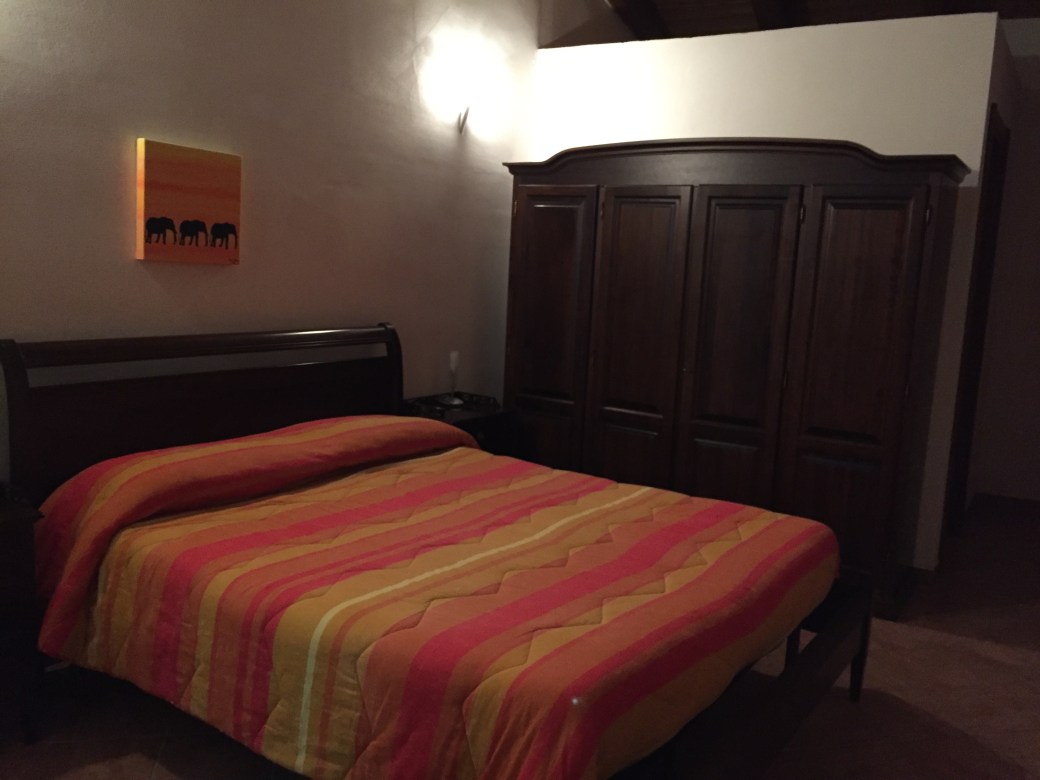
Each room has a fairly large bathroom with a shower, television and small refrigerator.  All I could think about was stocking the fridge with local wine and cheese. Then wandering out to the common area with a good book. Some rooms have incredible views of the valley. There are only about 7 rooms and each one has a different configuration of beds.  A couple have matrimonio – king size beds.  Others have twins or a combination of both.  The “breakfast” room is large, warm and welcoming.  A great place to read a book or write that novel.

The address is Corso Vittorio Emanuele III – oops last year they renamed the road in honor of the Rinaldi Brothers, victims of the 1861 Summer of Terror.  (See Pontelandolfo 1861 story.) The affitacamere is located on Via Fratelli Rinaldi #8.  They don’t have a sign, so you have to know where you are going. Just ask anyone.

To make a reservation or get more information call +39.340.58.24.263 or +39.347.04.36.837.   The owners don’t speak English and or have answering machines. So you can’t leave a message.  Grab one of your Italian speaking buddies to make the call for you or email the owner at Donato.addona59@gmail.com.

Need more photos – hit play!  I’ll be telling you about other places to rest your heads in future posts!  Ci vediamo a Pontelandolfo!

Alghero’s Angelina Demartis

Angelina Demartis è una brava donna anche una insegnante di cucina meravigliosa!  Con lei ho imparato a prepare Malloreddus alla Campidanese, Culurgiones, Cozze Gratinate e Bianchini. Durante questa classe abbiamo parlato solo in italiano!  Gulp….

Angelina Demartis is an incredible cooking teacher. Even though she only spoke Italian and some of the people in our class only spoke English, her non verbal communication skills, animation and love of cooking conveyed the techniques we needed to make some scrumptous Sardegnian fare. 

Whoa, I’m getting ahead of myself. You are wondering where I was when I found her, how I found her and what we made.  Sorry for letting my enthusiasm for her class and the incredible food I tasted in her kitchen get in the way of linear storytelling.

This October a group of thirteen of us headed to the best Italian language school ever – Centro Mediterraneo Pintadera.  As part of our language lessons, we had the opportunity to practice our linguistic gymnastics in the kitchen of Angelina Demartis.  She is a graduate of the Instituto Professionale per Operature Dei Servizi Di Ristorazione – Settore Cucina.  Then went on to university and now by day teaches Italian and History. By night, she cooks and cooks and helps other folks learn to do what she loves to do – cook.

We climbed the three flights of stairs – yes I paused on landings – wondering where we were going, who our teacher would be and what we would be eating.  The what we would be eating was on everyone’s hungry mind.  This gorgeous, smiling bundle of energy and love – Angelina Demartis – opened the door and we at once knew we had entered foodie heaven.  The working space is a large kitchen that leads into a larger room, that leads out to a great roof top patio with a sea view.  Ahhhhh.  After lots of hugging and kissing and putting a glass of sparkling water in each of our hands she began to tell us what we would be making.  Lucky for us, she had prepared handouts in both English and Italian. 

We learned how to make two typical Sardegnian pastas. The first was Culurgiones – it is a filled pasta formed to look like a shaft of wheat.  Of course mine looked like a blob of dough but I kept on trying.  What makes this pasta interesting is that it is made with three types of flour.  Regular farina 00 – flour, semola rimacinata – finally ground semolina, and integral – whole wheat.  The Culurgiones were stuffed with mint, potatoes and two kinds of Sardinian cheeses.  Malloredus alla Campidanese  is a pasta made with semolina flour, saffron and water.  Simple and delisious with a simple tomatoe and sausage sauce. 

Angelina is not only a foodie but an incredible actress – we really didn’t need a translator to understand what she wanted us to do.  Besides the pasta, some of us cleaned mussels, made the stuffing for the mussels and the lucky ones got to make the super sweet and yummy Bianchini – meringues.

Guess what we did after we made all this glorious food?  We sat down, drank wine and had an incredible dinner that included not only what we made but other tasty morsels made by our hostess.  Buon appetito

What you thought I was  going to share the secrets of how to make the pasta and sauce?  Watch the video and you’ll pick up a few tricks.  Better yet, next October join us on our second Nonna’s Mulberry Tree trek to Centro Meditterraneo Pintadera.

Cooking With Angelina Video

Ci vediamo!

Eating My Way Through Alghero

The historic center of Alghero, Sardegna is chock full of eateries serving everything from tourist drek like crepes and waffels to exquisite Sardinian fare.  Guess where we ate?  Yup – if it was Algherese style food – or any Sardegnian traditional yummy – you would find us there.

Jack and I are incredibly fortunate because our pal, Nicola Schroeder – one of the administators of ace language school Centro Mediterraneo Pintadera – has lived in Alghero for over 20 years, knows we are foodies and has never given us a bad recommendation.  Pintadera is not just a school it is a bastian of information on all things tasty in Alghero.

As part of our two week language immersian course, Nicola oranized a welcoming dinner at Tratoria Lo Romani, Via Principe Umberto 29. The menu was a wonderful introduction to artigianal Sardegnian fare.


Owner, Gigi treated us like family. We started with antipasti della casa (selezione dei migliori salumi e formaggio sardi) – think platters of antipasti including melted cheese, fried red peppers, roast pork with carrote e zucchine, sardinian prosciutto two kinds of hard sheep’s milk cheeses, roasted vegetables and cubes of vegetable frittata. We groaned and kept on eating. Next ravioli with cheese, potatoes and mint. Gulp, I asked is there more?  Of course. Mallereddus alla campidanse – Sardegnian mini gnocchi followed.  Carafes of local red and white wine were constatnly filled. Burp. What? Now he is plying us with Sardegnian digestivi – two types of Mirto and limoncino.

To see if if our love for Lo Romani was true love or just starving tastebuds kicking in, we went back on our own. Gigi recomended Granchione with linguine.  Granchione?  Hmm – in my best Italian I said “non capisco”.  Gigi replied – linquine is spaghetti.  How about Granchione – big crab.  Crab is my favorite food in the world and the thought of big crab had me salivating.


This dish was so perfectly prepared that I danced out the door and have told everyone I’ve bumped into to head over to Trattoria Lo Romani at Via Príncipe Umberto, 29. Yup, true love!

Nicola also recommended La Botteghina. You will notice that I have absolutely no photos of either of the two dinners we ate there. Why? Because it was all so incredible that we ate every bite before Jack looked at me and said “hey, you didn’t take any pictures.”

On our first visit I had absolutely the best piece of beef I have ever had in Italy. I’m not kidding. No one ever seemed to understand rare. This was a perfectly cooked fillet drizzled with red wine sauce. Jack had a tuna carpaccio that kept him up all night. Not because he was sick, but because he kept thinking about it. Our dinners that first night were so good that we went back with a large group. What a pleasant surprise! The restaurant has a rooftop terrace. Of course with my shaky knees that was a bit precarious but after we got up up up there the view was great and the sampling of sea foods we had was even greater. La Botteghina is also on Via Principe Umberto,63. (Labotteghina.biz)

Oops, it is 4 o’clock here in Alghero. You know what that means! It is cocktail hour! I better write about my third favorite restaurant and head on over to the bar for an apertivo.

One morning in Italian class my nose started twitching. The incredible smell of garlic being tossed in olive oil was wafting up from the restaurant below through the open windows of Pintadera. Who could think about Italian grammar. All I could think about for the next two hours was ho fame!!

Our Italian classes get out at 1 PM. Jack and I raced down the steps and slid in an outdoor booth at Al Refettorio.  The restaurant is located on Vicolo Adami,47. I had an insalatina di polpi – octopus – that was so fresh I thought I was swimming with it. Next I had a creamy baccala montecato. I had discovered this awesome dish on Murano and eat it whenever I see it. Jack loves tuna and had both carpaccio di tonno and grilled tuna. He raved about both.

What?  You think all we do is go out to eat?  Nah. We love our Italian classes and don’t cut them for a nosh. Besides if we didn’t go to class I couldn’t ask Nicola for restaurant recommendations.

Ci vediamo !

Murano – The Venetian’s Venice


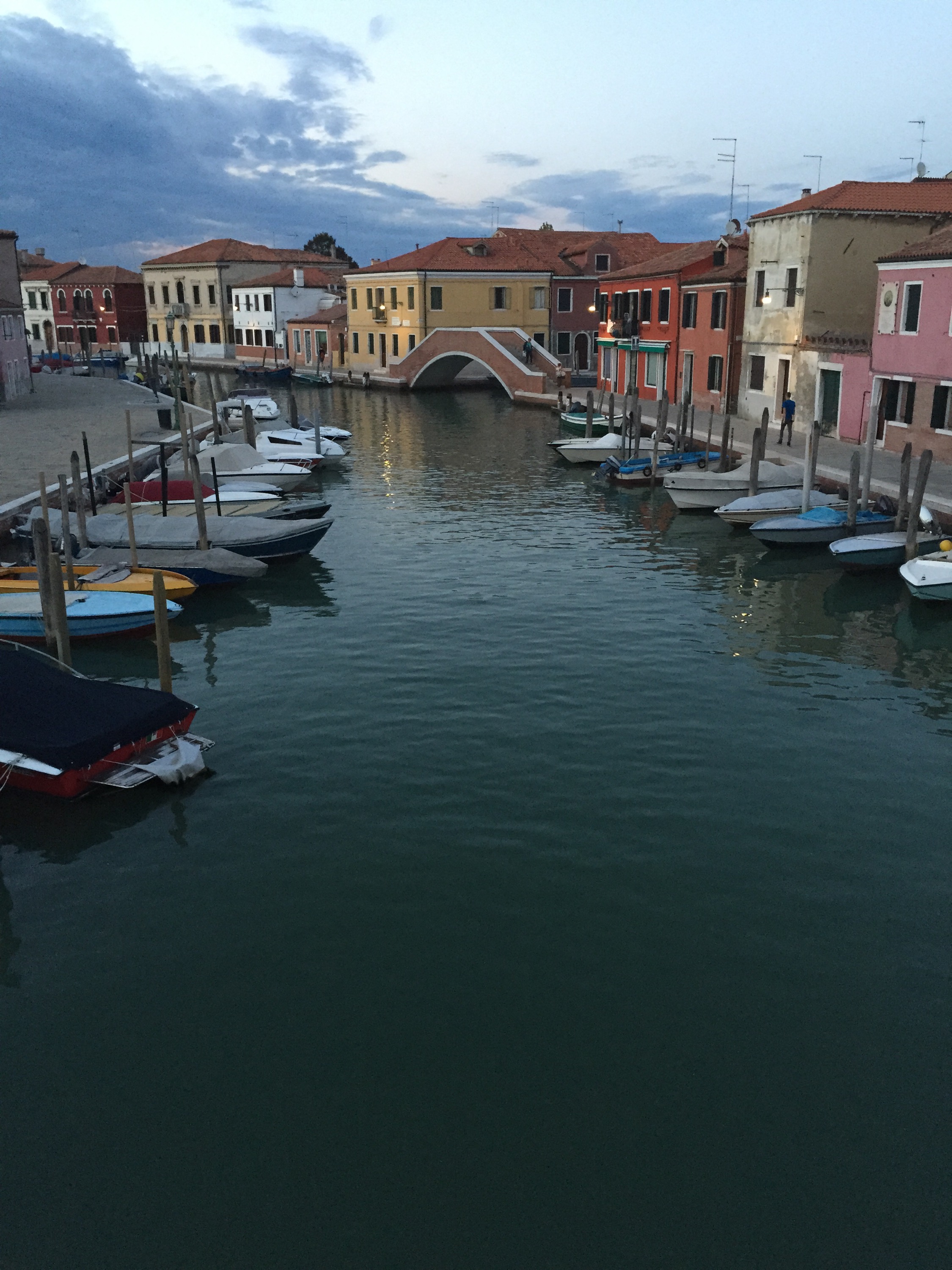
Beautiful isn’t it. This isn’t a picture postcard enticing you to visit Venice. I shot this picture at 8:00 PM on a Tuesday night in Murano. What is missing from this tranquil setting? A gaggle of tourists racing off cruise ships or stepping on each other’s sneaker shod toes to get a better selfie in front of this or that.  That is what the historic center of Venice is like today. Why deal with that when you can enjoy the Venetian life style right here in Murano.

When I say Murano, I bet you say “Glass”.  Yup this is the island in the lagoon that is famous for the production of incredible glass products and the preponderance of faux Murano glass made in Chinese factories.  How do I know?  We stayed on the island for a week, chatted with folks and visited different shops.  Some shops even posted giant signs saying “Buy Murano Not Chinese.”  We did buy but from folks that were actually working on products that we could see.  Museo Del Vetro is a wonderful way to fully understand the glass business and see beautiful glass work.  For cittadini anziani (over 65)the fee was only €7.50

The vaporetti crammed with tourists that dash from glass shop to glass shop roll in about 10:00 AM and the last shopping bag laden person seems to have disappeared by 5:00 PM.  Those of you who read me know I have the patience of a gnat when it comes to tourists – loud pushy tourists.  So how did I survive even six hours of a place chocked full of crazed glass shoppers?  We stayed off the main canals and hung out where the real people lived.  That is the beauty of Murano – once you move inland away from the major canals it is pretty tranquil all of the time.

Our hotel, Hotel Conterie, was on the quiet Calle Conterie, 21.  We walked through a piazza to get there and saw children playing and people sitting on benches taking the sun.  The hotel was clean, our room was a fair size and the staff was helpful. My knees had a hard time with the two and half flights of steps to our room.  There is a hotel tax in Venice – for two people for 3 nights it was €22.90. The breakfast room used a SAECO  self service machine.  You know “push a button” to get the style of coffee of your choice.  My morning cappuccino was a major disappointment. The steamed milk was obviously steamed chemicals.   That said, I still liked the hotel. It was only a five minute walk, sans suitcase, to the vaporetti station. The boat buses run all night.  From Murano it is easy to get around to the other islands.  Venice Water Buses

In the piazza, I chatted with a local woman who said they loved living on Murano and working on the main island.  It was a safe place to raise children and tranquil.  She also pointed out a local bar/restaurant on the same sun filled piazza we walked through.

Murano Restaurant

We wouldn’t have know that “Ai Bisatei” existed and were happy she let us know that the fare was local.  We ate lunch there one day and paid about 50% less than the other restaurants charged near the main tourist driven canals. The lima beans with saor were wonderful.  We found this yummy sweet, sour and salty condiment in lots of fare – it is simply onions that seem to have been sitting in vinegar.  Of course we had to have the sweet wine with the requisite S shaped cookie.  A grown up dunker.  Hmmm.

Until we made local pals, it was a bit tricky to find restaurants that were open after the last tourist hopped on the vaporetto.  We did find three restaurants that were open in the evening.  The rest appeared to only open for lunch – high tourist time.  That was a bit disturbing.  Considering how small the island is and how most folks eat cena – the light evening meal – at home, it does make sense.   Osteria al Duomo Pizzeria, Fondamenta Maschiop 20-21 (Osteria al Duomo) sat just across a bridge from Il Duomo and did a brisk nighttime pizza business.  It was the first place I ate the traditional bacala mantecato – my new favorite lush and creamy way to have bacala.  The price point was great too.  We averaged €40 a night for dinner and wine. It was only a short walk from the hotel, we liked the food and the local people, so we ate there three times.  We became instant regulars.

Can we talk about bars?  In Piazza Roma – Pontelandolfo – tables and chairs in front of every bar announce that this is the place to grab a coffee, wine, nosh and chat with pals.  One morning, not wanting the crappy hotel cappuccino we went searching for a bar and a brioche.  We walked and walked until 10:00 not seeing one chair in front of one building welcoming us.  At ten, the tourist spots on Canal Grande di Murano and Canale San Donato starting putting out their  chairs.  I went into one small bar, ordered due cappuccini and asked where the early morning bars were.  Turned out that one opened at 7:00, one at 8:00 and this guy at 10:00. Unless you lived there you would never know it.  We did find a bar, in a kiosk, near where the boats laden with fruit, mail, and other boxes came into the canal.  It was a “stand and go” type of place.  They had a sign “no picnics here.”  Then it hit me – doink.  If there were tables and chairs outside tourists, not locals, would plop and probably not go in the one man operations to buy anything.  It was great to get a real cappuccino – cost €3.50 – €2.60 more than we pay at home in Pontelandolfo.  Now we also knew where the local spots were – sans outdoor seating.

Of course, I had to buy some glass trinkets and Jack and I decided to look inland for a local “hot shop”.  Andrea Giubelli makes beautiful necklaces – yes I bought one – and other small items. Here is his website – Andrea Giubelli.  His studio – I watched him work – is Calle Luna 12.  

Murano Impressions – just a few quick brush strokes before the video

Clear skies and quiet nights.  Laughter floating out of shuttered windows as families gathered.

Yesterday’s garbage neatly tied and hung on hooks high out side doors.  Men  dragging carts collecting trash and smiling.  Where do they take the garbage?  Barges with dumpsters collect from the carts and head off.  Where do they take the garbage?

Men and boys, fishing poles pointed to the heavens, legs dangling off piers staring at the sea.

Women dragging shopping bags on wheels from marchelleria, to fruitivendolo to the supermarket COOP.

Barge toting fruit and vegetables, barge toting building supplies, barge toting UPS boxes, barge toting cases of water, barge toting frozen Bindi desserts, barge toting everything COOP needs on its shelves, barge toting a crane, barge toting a cement mixer,  barges — the necessities and amenities of life dependent on barges.

Check out my video –

Ci Vediamo!