Take a moment and imagine small town America before ugly strip malls and giant box stores polluted the landscape. See happy healthy people greeting their neighbors as they walk to those wonderful, small family owned shops.
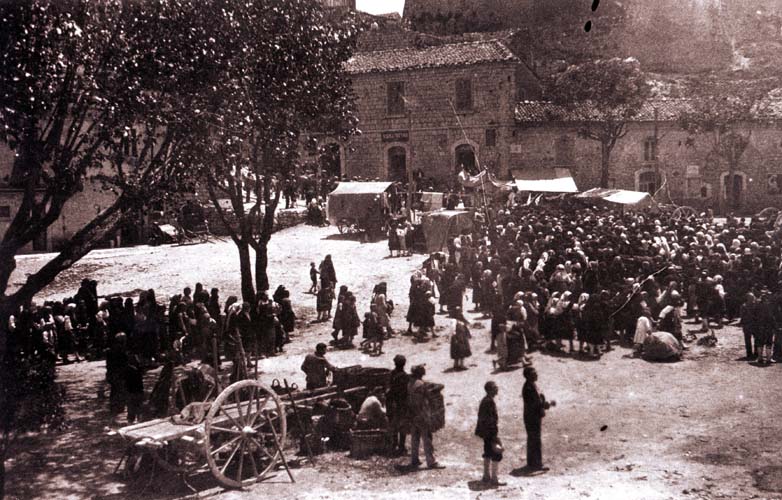
Turn of the 20th century shopping in Pontelandolfo!
Clutching your mom’s hand you visit the butcher, who knows your name and gives you a big smile. You mom says she wants to have a pork roast for dinner – the butcher asks for how many people? “Just six” she says. The big walk-in fridge is opened and you see giant hanging slabs of meat – half a cow, a whole pig – is that goat?
Meat hooks at a butcher. (Photo credit: Wikipedia)
He pulls down the pig carcass and brings it to the giant wooden shopping block. Like a sculptor wielding sharpened knives and a dancer moving to the crack of the cleaver, the butcher magically creates the perfect pork roast just for you. Wrapped in white butcher paper and tied with twine, the gift of good eating is ready to carry home. Hmmmm – no porcine growth hormones, no chemical enhancements just farm grown – the way nature intended it – meat.
Growing up in Flagtown, NJ – when the area was still rural/agrarian – I actually played in fields that held cows, pigs, chickens, goats, sheep and lots of piles of @#$%. My grandmother taught us how to butcher and clean poultry and game. Our little village even had a butcher shop. Aniello De Scala moved from Brooklyn to Flagtown long before I was born to open a small shop and get away from the Brooklyn mob (so his daughter told me). When I was a kid Aniello’s son George was the butcher. (One of the De Scala butcher blocks is currently feeling lonely in my garage.) Then the developments started eating up the farm land and “progress” brought us supermarkets. Small stores faded away…..
Living in Pontelandolfo is a return to a kinder and gentler way of living and eating. We are in carnivore heaven in Pontelandolfo – there are not one, not two but three butcher shops in our little village – great food means a lot to Pontelandolfesi. The shop I visited the most was Marcelleria, Cinque M.A.M. S.R.L., located at Via Falcone E Borsellino. (I have no clue what the initials mean – they’re all on the sign.) My cousin Carmella explained that this shop was a cooperative for the local farmers – a big plus for me.
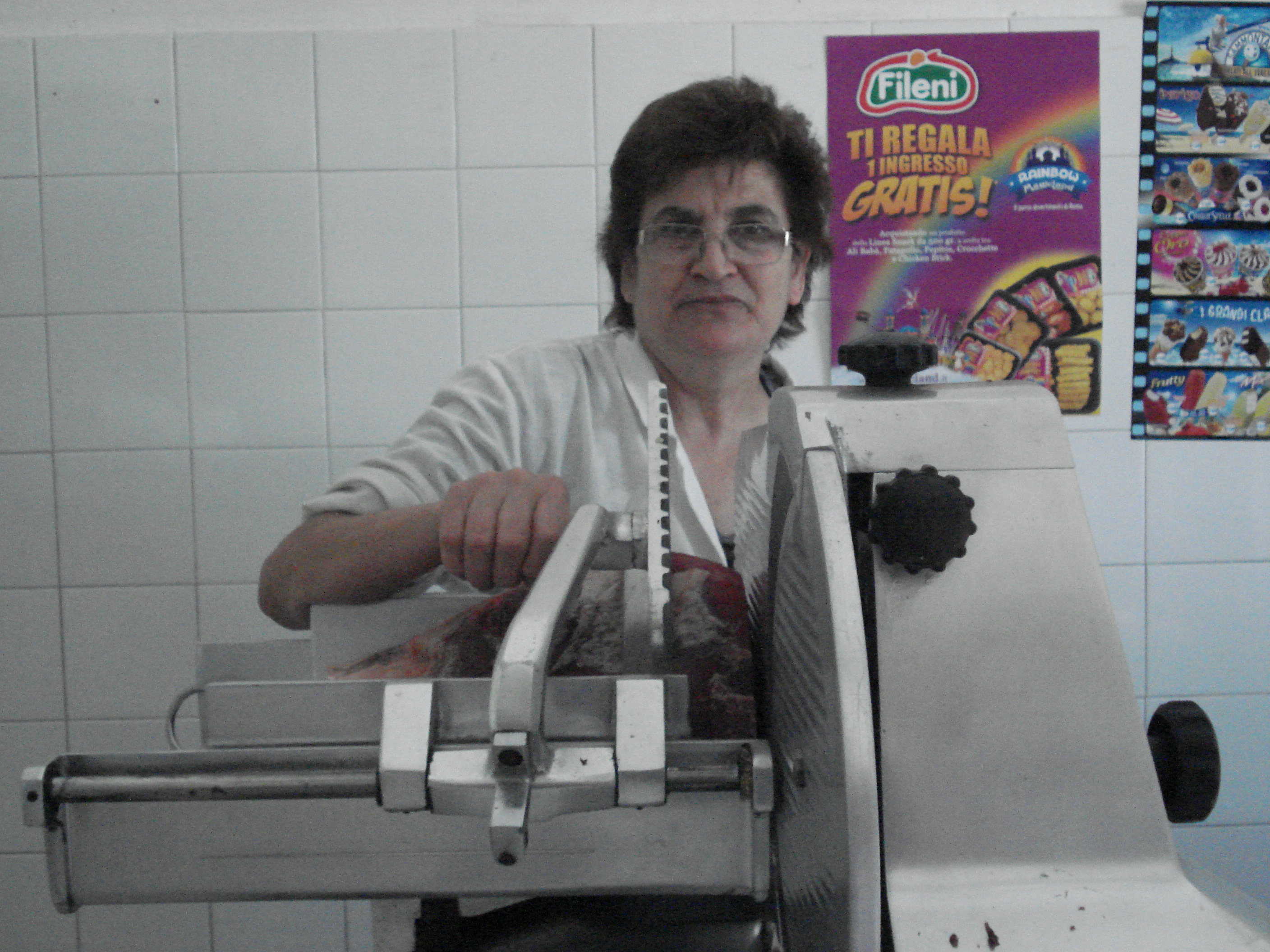
Santina Guerrera, ace butcher and charming woman.
Santina Guerrera (h’mm is she related to me?) would greet me every time I went into her Macelleria with a big smile and once with a great question – “Hai intenzione di parlare un buon italiano oggi o cattivo italiano?” (Are you going to speak good Italian today or bad Italian?) I paused, shrugged my shoulders, smiled and repied “Sempre cattivo!” (Always bad.) Clean up your minds – this wasn’t about talking dirty but speaking Italian properly – something I still haven’t mastered. Santina would smile as I fuddled through my orders. The first time I wanted chicken for my extended family of eleven, I learned what an Italian meat portion was. I originally asked for 7 chicken breasts and four full thigh/legs. Santina looked at me and asked “how many are you cooking for?” When I said eleven she cut the order in half and got the cleaver out to separate thighs from legs and cut each breast in half. I thought, this won’t feed eleven. In the USA everybody gets 1/2 pound each! She was right, my Italian cousins eat small healthy portions.
Santina prepares beef and pork for grinding.
One day, I decided to make an “American” meal for my extended family. Meatloaf, mashed potatoes, and some green thing or another. I told Santina what I wanted to make – un grande polpettone – and couldn’t understand why she took huge hunks of meat out of the walk in fridge. Midge, you silly girl, she is going to grind it fresh!
She tossed a hunk of beef and a hunk of pork in the giant grinder and out came ground integrated meat. I started to drool on the counter. Of course everything I bought was beautifully wrapped up for me.
The other butcher I visited was Macelleria Perugini Franco on Via Falcone Borsellino, 4. Franco made incredible sausage. At first I had to figure out what days he was grinding meat and adding his magical spices – because until I got the schedule down there wouldn’t be any left! He made the sausage fresh. I just found an old receipt and it only cost me € 3,87 (about $5 for 4 servings of freshly made exceptional sausage.)
No matter where we are in the world, I try never to buy supermarket meat – schifoso – wrapped in plastic, pumped full of chemicals, grown in small crowded cages – gag me – chicken and beef that – well I better stop so I don’t ruin your appetite. When Jack and I are in Flagtown we buy most of our meat directly from local farmers – Farview Farm (http://www.farviewfarm.com) in Readington and Lima Farms (http://limafamilyfarms.com) in Hillsborough.
Carnivores of the world unite behind your local butcher and family farm! We are blessed to have ours in both of our home towns.
Time to tell Zia Caterina’ s tale of Eleanor and Franklin Delano Roosevelt –
It’s presidential!
Franklin D. Roosevelt and Eleanor Roosevelt in Warm Springs, Georgia – NARA – 195635 (Photo credit: Wikipedia)
This is the tale of my dad’s older sister, Caterina Guerrera’s, journey on the rocky road to the American dream. You may remember my Aunt Cat from the earlier blog about my family’s Ellis Island experience – https://nonnasmulberrytree.com/2013/09/18/nonna-comes-to-america/.
Two-year old Caterina Guerrera was racing over the hills of Pontelandolfo talking as fast as the village’s babbling brooks. Then the world stopped. This peasant child was stricken with polio. Her mother put hot stones on her limbs, massaged and massaged. One of the reasons the family came to America was that my nonna, Maria Rosaria Solla, was afraid that Caterina would end up in an institution for the insane and deformed. Caterina was smart and fought hard and seven years later was able to board the ship in Naples for America.
Charcoal Drawing done in Italy. Maria Rosaria Solla, Savatore, Caterina, Francesco and Nicola Guerrera
When nine-year old Caterina entered her first American school she discovered just how quick a learner she was. In those days immigrant kids didn’t have the benefit of bi-lingual education or ESL – it was total immersion. On the happy little girl’s first day of school the teacher said something – Caterina looked at her and smiled – the other kids put their heads on their desks. Suddenly the teacher’s yard stick whacked Caterina on the back of the head. Aunt Cat figured out immediately what the English phrase “put your head down” meant.
Polio left her with a short right leg, “baby sized” arm and marked limp. Because of her jaunty walk – step and drag the dead leg, kids would call her 1 and 2 and. She swore to me it didn’t phase her – that they were just teasing. Bottom line, she remembered and replayed the story tape for me.
At that point in time, folks who were disabled were often hidden away. Well no one was hiding Caterina Guererra – “Guerrera” does mean female warrior. She was a fighter, often protecting herself and her younger brother, Salvatore, by tossing rocks squarely at all taunters. Eventually, the family moved to a small farm in the Flagtown, section of Hillsborough Township, New Jersey. A number of other Italian families had settled in Flagtown – this was the depression and members of this tight knit community helped each other.
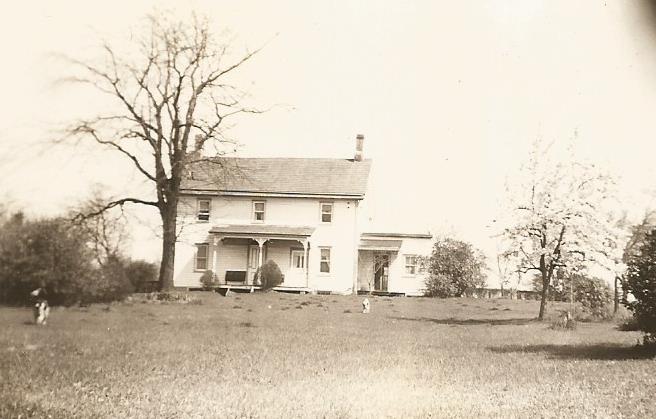
Fifteen acres for nonna to farm with Catherine’s help.Grandma and Aunt Cat tend the garden to feed us all.
She graduated from Somerville High School in June of 1933 and then attended Drake College (business course – 6 months). Catherine wasn’t going to let anyone hold her back. After attending secretarial school and pounding the pavements looking for work, the only job she could get was in a sewing factory in Bound Brook – cleaning. With her shriveled right arm that hung like a dead branch and a right leg that didn’t work at all, she picked up dropped pieces of cloth so the ladies sewing wouldn’t have to take the time to bend down. Catherine took the train every day, angry that her active brain was mildewing in a sweatshop. There had to be something better – mannaggiathis was America!
The President during this period of American history was, Franklin D. Roosevelt, also a victim of polio – something he hid well. Roosevelt overcame his affliction and Catherine felt she would too. He had helped all kinds of folks during the great depression. Including her brother, Salvatore, who traveled across America improving our park lands with the the other poor young men of the Civilian Conservation Corp. The CCC was just one of the programs that were instituted under the “New Deal” moniker. The Works Progress Administration was one of my favorite programs. Jobless Americans built buildings, bridges, schools. More importantly artists, writers, musicians and theatre professionals were included in the WPA. WPA art can still be seen in public spaces around the country.
CCC Camp in Hackettstown, NJ 1935 – Uncle Sal is 6th from the left – front row!
“It is only in recent years that we have come to realize the true significance of the problem of our crippled children. There are so many more of them than we had any idea of. In many sections there are thousands who are not only receiving no help but whose very existence has been unknown to the doctors and health services.” Radio Address on President Franklin D. Roosevelt’s First Birthday Ball for Crippled Children January 30, 1934
Aunt Cat saw that Roosevelt also was instrumental in raising funds for polio treatment and creating the innovative use of hydrotherapy with polio patients in Warm Springs, Georgia. This plucky young lady sat down and penned a letter to the Roosevelts.
This is how my Aunt Cat told the story to me:
I wrote to Eleanor Roosevelt. My friend Libby (Elizabeth Quick) thought I was pazzo – why would the president’s wife listen to a “guinea” from Flagtown, NJ? My father and Mr. De Angelis started the Democratic Club here. All the Dutch farmers were Republican. I wrote 20 different letters and finally got it right. I sent it.
One day – I was giving Mary the horse some hay – and then a big black car pulled in the yard and sent the chickens running. This woman got out of the car and showed me some papers. She came from the state and she said that she was going to take me to see a doctor who could maybe help me walk better. My father was working and my mother was at Mrs. Gallo’s – Julie’s mother – I told my brother, Tony, to tell mama I was going to see a doctor and I got in the car. If someone could help me walk without dragging my leg like a mail sack than I was going. What I didn’t know was that the doctor was in Newark – in those days you only had Route 28 and it took 2 hours to get to Newark. She took me to Beth Israel Hospital – Dr. Henry H. Kessler himself saw me and asked me if I was strong. He said it would take 8 surgeries but he could make me walk better and my bad arm wouldn’t just hang like a dead branch. He laughed when I told him that I milked the goats and cows, plowed the field following Mary the horse and dragged my leg the ½ mile to the train stop to go work in the sewing factory – strong – I was strong. I was old enough to sign the papers and the next thing I knew I was in a huge room lined with beds – in those days you slept in a bed in a ward with 40 other beds. I wasn’t even afraid. Dr. Kessler had this way about him – he cared – like the Roosevelt’s. Dr. Kessler fixed my arm first. I had 9 surgeries. After the first surgery, Dr. Kessler asked the nurse why no one ever came to visit me. Even then he knew that you had to treat the whole person – not just be an orthopedic mechanic. He asked me if I had any family. I told him my family lived in Flagtown – which to him was like living in Appalachia. I had left with the social worker and never went home. I thought she told my mother.
Dr. Kessler asked me if I wanted to use the telephone and call them. You didn’t have a phone in the depression unless you were rich. So I wrote them a letter and told them where I was – the boys could read in English – as soon as they got the letter they came. Mama was furious that I would not let them take me home – but after all the surgery and I could walk she stopped being angry.
I have never voted for a Republican.They still are for the rich – look at Bush and the oil people. Bush wouldn’t send someone to help a girl with polio unless he could get something. What did Mr. Roosevelt get? A thank you letter from me, a girl whose father laid railroad ties and whose mother kept us eating by her garden and animals.
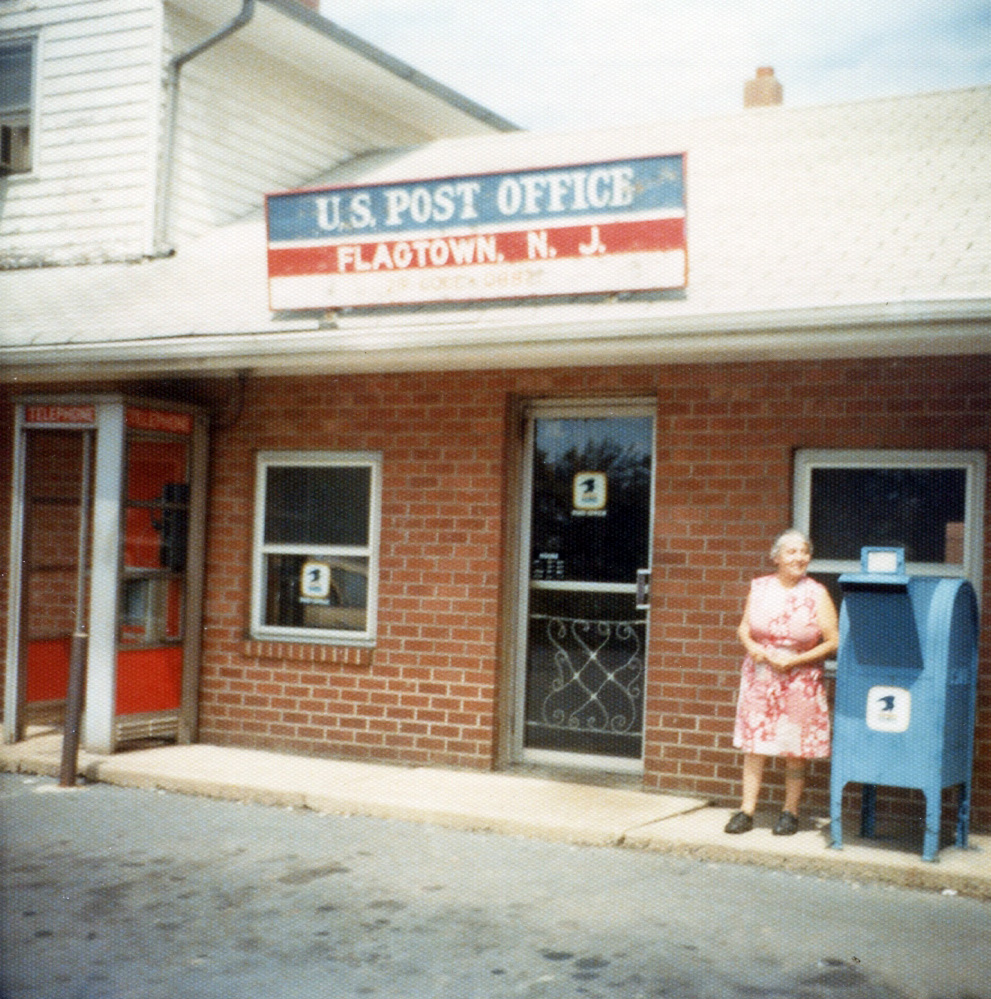
She was soon – well not that soon – I mean nine surgeries is a big deal – back in the fields, passing her driving test on the first try – her macho brothers couldn’t do that – and looking for work. Then a miracle happened – the federal government decided that a post office was to be set up in Flagtown. Whoever ran it wouldn’t get a salary but a commission on what postage was sold. (Damn, an entrepreneurial helping hand at no cost to the government – who’d have thought!) The whoever – thanks again to the helpful Roosevlet hand – was Catherine (AKA Caterina) Guerrera. At first she didn’t want to do it – a commission – who wants to work on commission. Her dad, Francesco convinced her to take the new position. In Italy it was an honor to be the postmaster.
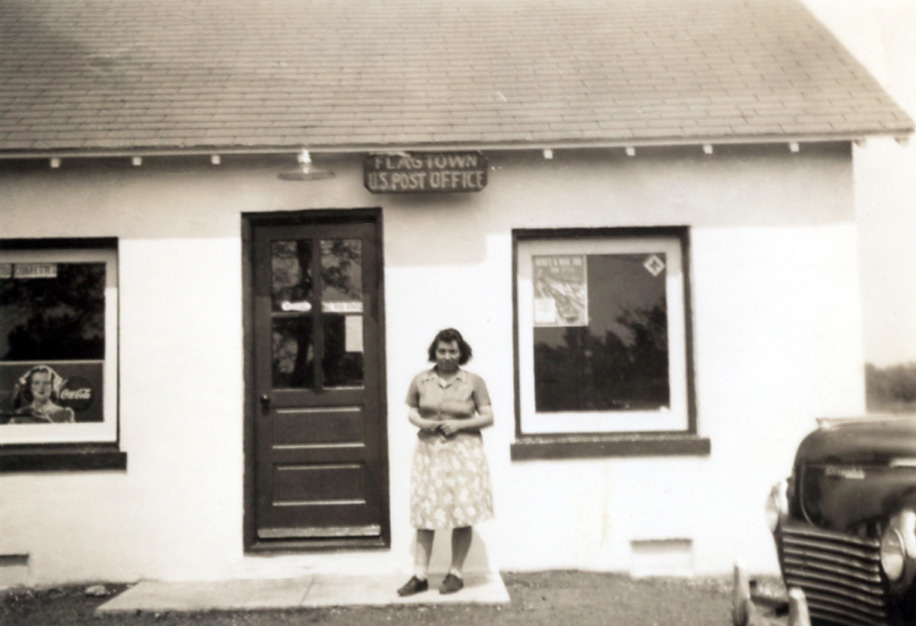
On March 26, 1943, Frank C. Walker Postmaster General of the United States of America appointed Catherine Guerrera Postmaster at Flagtown in the County of Somerset, State of New Jersey. Originally she worked out of a shack near the rail road tracks. Then her entrepreneurial brain started twirling. Due to her personality, more people were buying stamps and the little postal stop was growing. Why not own the building? She got a parcel of ground from her dad and with her brothers help built a post office that she rented to the government. To this day my cousins rent the newer version to the postal service.
She also ran a small lending library and smaller general store out of the space.
She then marketed the hell out of that little rural post office and by the time she retired in 1980 – at a vital aged 69 – had built it up to a first-class post-office. (This designation is no longer used by the postal service.) The building also grew. From that one room rural oasis to a solid facility with an accompanying luncheonette and two apartments. She had a vision and watched it grow. Cha- ching!
From one room to many! That is my Aunt Cat.
Every story has a moment of sadness. Catherine Guerrera had been Post Master for forty years and hated that forced retirement. In 1984 – four years after retiring – the dreaded polio returned – post polio syndrome. I blamed the forced retirement – she was no longer lifting and chucking huge mail bags, standing and sorting mail, bending to talk to children. This time she had the resources to get the best of care at NYU’s Institute of Rehab Medicine under the guidance of Dr. Kristjan Ragnarsson. It took a while, but after a good number of months in New York learning how to deal with a wheel chair, take in the sights of the city from a little bit lower perspective and outfitted for new braces she was back to her “give ’em hell” self.
This great American Dream story demonstrates to all those non-believers – that a little bit of government assistance can jump start a life. And – for those of you who are died in the wool conservatives – her estate taxes more than paid off Uncle Sam for all his – I mean Roosevelt’s – help.
My fabulous Aunt Cat taught me that hard work, hope and being a Democrat was the American thing to do.
Yesterday, I posted an article about our experiences in Pontelandolfo buying medicines. It makes me want to scream at our legislators for allowing big pharma to decide how much to rape and pillage for profits. Thinking that maybe I was simply a wacko with a pharma conspiracy theory, I was soooo vindicated to read today’s New York Times. Since I don’t want you to think I’m a wacko, I had to post this story from the New York Times.
Here are some excerpts from the article:
With its high prescription prices, the United States spends far more per capita on medicines than other developed countries. Drugs account for 10 percent of the country’s $2.7 trillion annual health bill, even though the average American takes fewer prescription medicines than people in France or Canada, said Gerard Anderson, who studies medical pricing at the Bloomberg School of Public Health at Johns Hopkins University.
=======
Thanks in part to the $250 million last year spent on lobbying for pharmaceutical and health products — more than even the defense industry — the government allows such practices. (pay generic drug makers to stall release and don’t make things over the counter because folks won’t pay more than $20 OTC.) Lawmakers in Washington have forbidden Medicare, the largest government purchaser of health care, to negotiate drug prices. Unlike its counterparts in other countries, the United States Patient-Centered Outcomes Research Institute, which evaluates treatments for coverage by federal programs, is not allowed to consider cost comparisons or cost-effectiveness in its recommendations. And importation of prescription medicines from abroad is illegal, even personal purchases from mail-order pharmacies.
“Our regulatory and approval system seems constructed to achieve high-priced outcomes,” said Dr. Peter Bach, the director of the Center for Health Policy and Outcomes at Memorial Sloan-Kettering Cancer Center. “We don’t give any reason for drug makers to charge less.”
And taxpayers and patients bear the consequences.
=======
In all other developed countries, governments similarly use a variety of tools to make sure that drug manufacturers sell their products at affordable prices. In Germany, regulators set drug wholesale and retail prices. Across Europe, national health authorities refuse to pay more than their neighbors for any drug. In Japan, the price of a drug must go down every two years.
Drug prices in the United States are instead set in hundreds of negotiations by hospitals, insurers and pharmacies with drug manufacturers, with deals often brokered by powerful middlemen called group purchasing organizations and pharmacy benefit managers, who leverage their huge size to demand discounts. The process can get nasty; if mediators offer too little for a given product, manufacturers may decide not to produce it or permanently drop out of the market, reducing competition.
=====
Welcome to the USA – home to the big pharma lobby. Read the article – it is part of a series on the cost of medicines in the USA.
Whoa – all I can think about are drugs! With the air waves bombarded with the shut down of the American Government and all that debate over the Affordable Health Care Act – who wouldn’t think of drugs. Medicine to keep us healthy. Medicine to keep us sane. Time to look into the meds that keep us sane and send some to the USA Congress. It makes me crazy to think that a country still exists where some retired folks stop taking medicine when they find they are in the Medicare Part D donut hole of higher profit for big pharma. I am hoping that the Affordable Care Act – if allowed to live on and grow – addresses that too. OK, enough politics – let’s get down to what it is like for an expat to go to the pharmacy here in Pontelandolfo.
There is only one pharmacy in our village – the sign says Farmacia. It is not Waldgreens or CVS or any big box monolith run by employees who will never remember your name. It is simply La Farmacia – a family owned and operated small space on the Piazza Roma. No, they do not sell soda, bread, flip flops, books or toys – there is however a condom dispenser on the nearby exterior wall. How clever – condoms in a machine available 24/7 right out there in public!
Before we leave for extended Italian stays we always try to stockpile medicines for my husband. I’m lucky – I just take a blood pressure med and I made sure to get a thousand samples. Jack takes a suitcase full of heart, cholesterol and who knows what else stuff. What I do know is that when Jack’s Medicare Part D falls into the donut hole of death for the poor, his monthly tab for meds can be $2,000. Damn, my first car cost less than that. Rats, Jack just edited this and said I am lying about the $2,000. Ptblahhhh ( that is me sticking my tongue out at him.) I got the breakdown for what Jack’s co-pays were before we left for Italy in April – $1718.49. So I exaggerated a little but hey – some people don’t have $1718.49 – and that is still more than my first car.
Jack knew, before we hit the Italian hills, we couldn’t afford to buy multi-month’s worth of pills in the USA . So, we spoke to Michelle and Michael our fabulous local – non corporate – pharmacists at Raritan Apothecary. They said – buy them in Italy – they will be a hell of a lot cheaper.
Blatant Plug – Buy Local
Raritan Apothecary
25 West Somerset Street Raritan, NJ 08869
I will admit, my drama queen worry mamma surfaced. What if we couldn’t get Jack all the stuff he needed? Would I have to send him home? Get in touch with my wild women roots and make drugs from monkwart? The first time Jack ran out of a medicine, I brought the empty bottle to la farmacia and introduced myself to the Perone family team of Nicola and Tina, the father/daughter pharmacists who keep Pontelandolfo on a healthy path. (Yes, I did remember the Italian courtesy of saying Buon Giorno as soon as I entered the store.)
Tina Perone – who always said “Ciao Midge”. That doesn’t happen at CVS.
Dott. Tina Perone recognized me as Carmella’s cousin – the American who dances two nights a week with her mother. Small villages create the art and activity they need. Carmella had organized a bi-weekly line dancing excersize and get together gab fest at the indoor bocce courts. I love to dance, need excersize and wanted to meet the village women. It was a win – win – win since it gave Tina and I an immediate connection.
Even without that connection, Jack and I would have been treated like people not numbers. Dott. Nicola Perone took the empty bottle and then proceeded to research for an incredibly long time the formula and ingredients. When he had the Italian perfect match he provided Jack with his meds. We do not have health insurance for Italy. We are not part of the Italian health care system. We paid full retail. Full retail that was freakin’ less than Jack’s bloody co-pay in the USA! How the hell can that be?
Over the course of months we visited the pharmacy often. Jack’s meds were always researched and supplied. The one thing that cost more in Italy was Advil – ibuprofen – one euro a pill! Of course they only sell 400 mg of Ibuprofen – not our 200 mg bottles. Jack needs to pack his Costco Ibuprofen or start using the Italian Spedifen! Interesting that vitamins weren’t pushed – apparently most people only take those vitamins that docs prescribe – like vitamin D. That made me pause and think about how much I spend a month on supplements.
Poor Jack, he loves to walk in the noon day sun up and down the hills. Too bad the soft corn between his toes hurt like a son of a bitch. We went into the pharmacy to get the name of a podiatrist and the first thing Dott. Nicola said was take off your shoe. Jack took off his shoe and Dott. Nicola looked at the giant thing between his toes. Damn, I wouldn’t even do that and I love the guy. He gave Jack some rubber things to put between his toes and some gunk to put on the ugly thing. Did you catch that, the pharmacist got on his knees and checked out my husband’s toes. You don’t see that at Walmart.
Dott. Nicola Perone – our fabulous pharmacist!
I am uncomfortable sharing the meds my husband takes so I will only give you one example of price point differentials. Before we left for Italy Jack got Nexium 40mg – 90 pills – for a $311.95 co-pay or $3.47 co-pay per pill. In Italy for the generic exomeprazolo it cost .73 per pill retail – not co-pay. I just checked on line and the exomeprazolo 40 mg for 90 days co-pay at CVS on line comes to .55 per pill. Retail is less than or a wee bit more than the USA co-pay. Huh?!!! What?!!!!
Interested in learning more about Italian pharmacies and brushing up on your Italian –
Le farmacie sono luoghi organizzati dallo stato ma operati da professionisti medici che vendono medicinali solitamente dietro ricetta medica. Con l’istituzione delle parafarmacie è possibile acquistare medicinali equivalenti senza ricetta medica.
Pharmacies are places organized by the state but operated by medical professionals who sell medicines usually with a prescription. With the establishment of drugstores you can buy generic medicines without prescription. Are big box drugstores coming to Italy? I hope not. We did see pharmacy concessions with a separate check out in big grocery stores – kind of a grocery/Walmart store set up.
Just like I won’t shop in a Walmart in the USA and we only get medicine at a local pharmacy – Raritan Apothecary. When in Italy, I’ll stick with going to see Dott. Nicola and Dott. Tina in our little La Farmacia on the Piazza. La Farmacia where every “Buon Giorno” is greeted with a smile and you are served by people you can trust.
Full Disclosure: I HATE THAT WE ARE BEHOLDEN TO COMCAST CABLE TO PROVIDE INTERNET SERVICE IN FLAGTOWN, NJ. Verizon never wired our street for FIOS – that makes Comcast/Xfinity the only show in town. What happened to choice? Oh yeah, we don’t have it.
Before we left for Italy I called Comcast to downgrade our account – we had the famous triple play package. Our monthly bill was close to $200. Since we wouldn’t be watching TV or using the phone I wanted to downgrade to simply internet. Easy. NOT.
Why is it that in this day of technology a kid at a computer can send a drone to pin point a target thousands of miles away, yet you still have to repeat all of your contact information a minimum of three times when you call the cable company?
Robot:
Please say or type into your keypad your cable account number or telephone number.
Me:
CCXXXXXXX – I had put on my good speech voice and said it slowly.
Robot:
Please say or type into your keypad your cable account number or telephone number.
Me: (Using the non-pretentious voice)
CCXXXXXXX
Robot:
Please say or type into your keypad your cable account number or telephone number.
Me: (With my hand over the phone.)
BITE ME!
I type the number into my keypad.
Robot:
Please say your address
Me:
Can’t you see that from my account number?
Robot:
Can’t you see is an unknown address. Please say your address.
I slowly said the my address.
Robot:
Please say the last four digits of your social security number.
Me:
Uugggggxx*&^%!
I carefully say the last four digits of my social security number and think I should play the number in the next big lottery.
Robot:
Please wait while we connect you to the next available operator
Operator:
Hello this is wp0e85rbv (name impossible to understand) may I have your Comcast account number or phone number please?
Me:
Excuse Me?!
Finally, I make her understand that I do not want to talk to anyone about another type of plan or upgrading my service or adding the ESPN package. All I want is internet – I can’t get it from anyone else. Just internet now costs us $52.48 that equals 38.81€. Remember that number!
After rehashing Comcast for you, I took some deep cleansing breaths and am now able to talk serenely about our Internet connectivity in Pontelandolfo.
We didn’t know how to begin. My family members use wireless USB devices. Jack and I thought that we needed something more permanent with unlimited access. The wonderful Annarita Mancini and I went on a search for alternative services. Annarita discovered LCR System and Emilio (the contact for Pontelandolflo.) She did the calling for me and asked all the right questions. Putting her hand over her phone she asked, “Is 25€ a month too much? I think it is too much – it is usually less but you are only here for 3 months and he doesn’t want to do it for 3 months.”
Do I think it is too much? That is 13.81€ less than I pay Comcast normally. Yes, yes, have them come, I shouted. (I don’t know what their normal rate is but I think it is 20€ per month.)
The system is incredibly brilliant. They have a WiFi tower somewhere in Pontelandolfo and installed an antennae on top of our house. The antennae was hard wired into a router that they placed in a room on the second floor. That means – without cable or FIos – you can have internet access even on the top of a mountain! They charged me 75€ for the installation. Comcast also charges for set-up and activation. I haven’t been able to do a price comparison. Some smart folks will note that we needed to amortize the fee over three months which shot our charges up. We are going back for 6 months in May and I am hoping the antennae is still on the roof.
Speed was fast. We never had a problem! Jack seamlessly uploaded library books to his iPad.
I could upload and download video and pix easily. We also used it for our Magic Jack phone and iPhones.
In our thick stone wall house it worked best on the second floor and the dining room/living room which was directly below the router. It also worked outside on both our upper terrace and patio.
IT COST LESS AND WORKED ALL THE TIME! I swear when all the kids are home from school the Comcast internet is a traffic jam of bits and bity bits.
Yes, you can leave home, move to Italy and still be wired!
Mia nonna coraggiosa e zii. One woman alone with three kids in steerage.
Before we can talk about my nonna’s trip to America, I thought we’d take a peak at where she came from. There isn’t much left of il casolare in pietra – the stone cottage my nonna, Mariarosaria Solla left behind. I was going to say hut – stone hut – but it was a tad bigger than that. Imagine a stone one-car garage built when all cars where VW Beetles. When Rosaria (I never heard the Maria part of her name) left for America, she had been living in a one-room house of stone that dated back to the Middle Ages. Obviously, houses constructed of huge rocks were built to last. This one did until an earthquake took out most of the town.
Following sprightly nonagenarian Filamena as she scampered over rocks, past thistles and up the hill, my stomach gave a twitter. It might have been because I haven’t been able to scamper like a goat since I was ten and here was Filamena sporting the traditional kerchief, dark stockings, long dress and nun’s shoes laughing as she guided us to my nonna’s house. Or it could have been because with every step I took I felt more and more rooted in this community.
We found the house at the top of a hill in the section of Pontelandolfo called Brecciale. From the remains of the cottage, one can see the village center, tower and church steeple. The view is spectacular! The thought of walking down the hill through the valley and up the hill to the central piazza carrying goods to barter or sell brought tears to my muscles. It was my nonna’s parent’s home – Liberantonio Solla and Mariantonia Rinaldi. Story has it that my bisnonno, Liberantonio, was a musician! The vein of artists in my family obviously can be traced back to our beginnings. Accepting wages of wine, Liberantonio would play his concertina in the piazza. He’d make it down hill number one, across the small valley and be crawling by the time he was mid-way up hill number two. That’s when my bisnonno would bellow for bisnonna, Mariantonia, to drag him up the hill home. She’d ignore him. Good for her. I come from great stock!
Nonna did what the children of every other poor family did than and still do today, lived with her parents. As I explore the village that sprouted my family and meet cousins I didn’t know I had, I’m meeting families that still have two or three generations living under one roof.
Up a piece from nonna’s house was a patch of rock that the local farmers used to grind wheat. The marks from a heavy stone wheel are permanently imbedded in the rock. An oxen or mule was harnessed to a contraption that smacked on the grain. You can also still see the circular track of decades of animals walking round and round and round and round.
Living on the top of a hill, means to fetch water from the river or the nearest fountain Nonna Rosaria walked down steep paths. Easy for Jack and Jill to go down the hill – but with buckets full – it is up hill to home. Even though life was tough, nonna and her children loved living there. I understand now why my nonna’s farmhouse and land in New Jersey looked the way it did. She and my nonno, Francisco Guerrera, tried to remake their little piece of New Jersey into a little piece of Pontelandolfo.
Take a peek at the video of her house today – Nonna’s House
To find out more about my grandmother’s trek across the ocean to America, we took my Zia Caterina to see Ellis Island. She had made that journey with her mother and two brothers. When we walked into the great hall of the immigrant’s reception center her face turned grim and she started shaking. Like a soldier suffering Post Traumatic Stress Syndrome, residual fear racked her body. It was the same fear she felt when the line watchers at Ellis Island ripped her away from her mother and put her in quarantine. We passed a door and she shouted, “that’s the room – the room they put the sick ones in.” “They left us there and no one could speak our kind of Italian and tell me anything.” “I was scared but looked them in the eye and said sto bene – I’m well.”
Caterina’s Story:
When I was two in Italy I got polio – they didn’t know what to do then – not many got polio. My mother, put hot rags on me and massaged and massaged my leg and arm. She said I just cried all the time. I walked when I was 9 months old – I talked at 12 months. Then at 2, it was over. The priest wanted to send me away – he said cripples couldn’t stay. My mother wouldn’t let them take me. She kept rubbing my legs and rubbing my arms. She never wanted to come to America. My father came first and worked in the Patterson silk mills. Mamma was afraid that if we stayed in Pontelandolfo they would take me and put me away with the crazy people. The priest kept coming to look at me – he’d shake his head. When papa saved enough to rent a place to for us to live in, he sent for us. The Pontelandolfesi women told my mother to only pack her nicest clothes for America – in America everyone was rich. What nice clothes? They were contadini – kind of like sharecroppers. (Serfs – I told you I come from good stock.)
Mamma was a fool and listened. She left her good wool skirt, heavy wool shirt and shawls. Beh, those stupid women kept saying only peasants dressed in those. I think the other women wanted her warm clothes. On the ship it was so cold mamma couldn’t stop shaking. She didn’t have anything heavy to wear.
She promptly made a warm cape in NJ!
Mamma was shivering and had a fever. She just stayed in the bed – we were all way down in the bottom of the ship – hundreds of us. My brother Nick, Sal and me – mamma was so sick – we were kids. We didn’t know what to do. They didn’t give us good food only bread. We had a piece of cheese in our bag. An old man felt sorry for mamma and took care of her. He got coats from the other men and piled them on her. Somehow she lived.
When we got to Ellis Island because I had polio mamma was scared that they wouldn’t let me in America. She made me stand between her and Nick in the long line – close so you couldn’t see my little arm and shriveled leg. Men in white coats walked up and down the line and looked at us – even made some people open their mouths. A man stopped and took me. I could hear my mother screaming. They took me away to quarantine and she didn’t understand what was going on. None of us did. They kept me at Ellis Island for a couple of weeks. She and papa came every day to ask for me. They told her nothing. Finally they let me out – I thought I would never get out. My mother cried that day until there were no more tears inside her.
My nonna, Mariarosaria Solla, overcame her fear and was the rock that my family was built on. She learned English immediately – I was never spoken to in Italian by anyone – we were Americans. Also, I was born just as WWII was ending and even though young men like my dad served in the military – Italians had been persecuted in America – many put in interment camps and others sent back.
This woman of the country was now living in an industrialized part of New Jersey. The long shifts that my grandfather worked at the silk mills meant that she had to learn to be self-sufficient in a new place. Eventually, my grandfather and Great-uncle John bought a farm together in Neshanic, New Jersey. Later nonno and nonna bought their own fifteen acres in Flagtown – where I was raised with the sheep, chickens and goats. Nonna was an incredible farmer – my family continued to be subsistence farmers – just like they had been in Italy. Nonna and Zia Caterina could grow just about anything. Those skills came from Pontelandolfo. Yes, nonna did snap a chicken’s neck so we could have a roast and butchered goats, sheep etc. I only learned how to kill and clean fowl – not sure if I could even do a rabbit. But hey, life brings new adventures for all of us. I just hope that I have inherited a piece of her courage for my journey.
15 acres to farm – and just like what I see today in Pontelandolfo – the women are in the fields. Nonno worked for the railroad.
It was 10:00 PM and we had just finished dinner at Landulphi, a great space that resonates with its medieval heritage. Outside Piazza Roma was a buzz of activity. Picnic tables were crammed in front of Bar Elimar. A lit bandstand filled one section of the sidewalk. Tots in strollers, pre-school hellions chasing each other throughout the crowds, moms, grandmas, twenty and thirty-somethings and tweens edge closer to the action.
Crowds creep in closer to hear not Rock ‘n Roll but rocking traditional music.
Tonight, that action was a sweet group of young performers – I’m guessing music conservatory instead of university students – wailing out traditional Italian music on the accordion, all sorts of percussive instruments and electric guitars.
Curtesy Sud Terranea
There is a college age dancer – barefoot on the cobblestones – dancing her heart out in the style of my ancestors. Twirling, toes pointed and then flexed as she stamps, kicks and brings us back to a time in this village – even before the unification of Italy. The sounds of Sud Terranea – “music popolare mediterranea” – brought young people to their feet dancing not the bop of hip hop but the traditional footwork of their great grandparents. ( http://sudterranea.jimdo.com/)
Curtesy Sud Terranea
Boy was I happy I had on a white shawl. It gave me something to hold up as I too did my whirling dervish routine. Weeee – I almost but not quite worked off the calories I gobbled down at Landulphi.
It was interesting that this bit of performance art popped out of nowhere on this particular day. Earlier – on a Skype call with my friend George Hansel about producing his new cabaret act, Burly Man Sings Girly Songs: My Life as a Show Tune Queen and Sexual Outlaw, (yes that was a plug) George raised a devastating question.
George has the greatest laugh in the world. See his show and laugh with him.
Could I really live in a small village with no easy access to the cultural richness of New York and Philadelphia? Hey, I bellowed back, I grew up in Flagtown, NJ – a small village with easy access to culture and an uncle who worked for the then New York Mirror and got free tix to stuff. Ask me how often we actually got to go????
George also, reminded me that I have the attention span of a gnat and boredom can easily weasel its evil sighs into my soul. I explained that during my last bout of boredom I realized that if I was bored it was my fault. All it took was a walk down to the village with my laptop in tow to chase the boredom away. Just sitting at a bar (cafe) surrounded by village life and listening, watching and being perpetually surprised at the instant art that pops up can get my creative juices flowing and the deeps sighs disappearing.
Living in New Jersey with easy access to my state’s professional theaters and being able to zip into both nearby cities, is indeed terrific. But how often do we really do it? Finances come into play. Tickets are expensive, add travel, or driving costs and suddenly an opportunity to experience art is fiscally out of the question. Here in Pontelandolfo, the fiscal crisis has folks pinching euros. Yet, art is accessible to them. They often create it themselves.
Site specific theatre produced by the town’s twenty-somethings took place in a variety of outdoor locations. The audience moved from scene to scene.
Sponsored by bars, community groups and Pontelandolphesi living in the USA and Canada, there seems to be music, dance, theatre and visual art happening weekly. Look for upcoming blogs on many of those events including a two part blog on Associazione Culturale Ri Ualanegli – our dance company – and the week long national folk dance festival.
Folkloric dance companies from throughout Italy performed in the Piazza nightly for almost a week. Here they are on the church steps after mass.
A quick peek at http://www.eptbenevento.it/archivio_eventi_mostre_benevento.html – the EPT Benevento (ente provinciale per il turismo) events website – lets me know that other villages in the province also are bringing in art. Campania, the region we are in, even has an “art card” – http://www.campaniartecard.it/ – reduced rate admissions and listings.
A short drive over the mountain takes us to Cerreto Sannita where di antica tradizione ceramica lives on. Artisans freely open their studios to folks like me to watch and learn the process – note FREELY.
We boldly knocked on a studio door and the artisan, Pietro, welcomed us into his space.Pietro is proud of the ceramic history of Cerreto Sannita. After touring his studio he literally opened the doors to the closed ceramics museum and shared that with us too.
San Lupo – just a scant 10 minutes over curvey mountain roads – sponsors a annual classical music festival.
Music fills the hill top streets.
How much are the tickets? Nada!, Niente!, Bupkus!
Damn, we missed the theater festival in Amorosi – a 20 minute or so trek down the mountain. They do charge for tickets and bring in professional companies from as far away as the USA. (http://www.amotefestival.it/) Next year we absolutely will get tix to something and report back.
The bottom line is that art and culture is just a matter of everyday life in Italy – even in the smallest villages. There is public art everywhere – our village has three large installations. Of course, the remnants of Ancient Rome are everywhere too.
Band stand is getting set up. I wonder what will be happening.
Revisit some of my earlier stories – Circo acquatico, San Antonio Festival, Calcio – stuff just happens here and I don’t have to pay the tunnel tolls, gauging parking fees and high ticket prices to drink in all this culture! Like my New Jersey ArtPride pals say – Be a Culture Vulture – I am and I am loving every second.
So, dear George, I think I can really live in a small village with no easy access to the cultural richness of the tri-state area. Of course, we do have to figure out a way to get your one man cabaret act across the pond.
Before I ventured into Alimentari De Angelis, our local salumeria for the first time alone, I stood outside and took a breath. My heart was pounding. Would I remember all the Italian I needed to buy mortadella or prosciutto or – well anything? Etto? Cento grammi – was that close to 1/4 pound? Theatre training kicks in – I review my lines – visualize my actions – think about what I was doing before I went through the door and said, “Vorrei un etto di – – Un etto of what – eeeeeeech -here is where I point at the case and resist saying “that salami looking stuff”. I know these words. I eat these words – wait – I didn’t say that right.
Now you are thinking – it is just a store in a small Italian village – stop with the dramatics. You’re right. But in this village everyone knows everyone else. I can’t embarrass generations of Guerreras and Sollas. I notice the woman on the bench near the store staring at me. I go in. The small shop – about 8X10 – was crammed full of just about anything you needed to create a quick scrumptious meal. Packets of pasta, a few round loaves of bread, rice, canned good, juice, paper plates, – you get the picture.
The three people in front of the meat counter turned as I pushed aside the beaded curtain, entered and said “boun giorno.” (Everyone says boun giorno every time they enter a shop – most times the folks in the shop echo an answer.) While I was waiting for my turn, the other customers and I stood close together in the jammed packed shop. This was a good thing. I could see and hear how they interacted with the shop’s owner, Pierina De Angelis. After all, we were all here for what was found in the refrigerator case – mortadella, prosciutto, salami di Milano, salami di Napoli …..
Soon it was my turn – I noticed a price list taped to the refrigerated display case and had memorized it. How could everything be un euro or un euro e 20 centesimi per un etto? Cheap great meats – how did I know the cold cuts were great? My cousin and world’s greatest cook, Carmela Mancini, shopped here.
The friendly Pierina De Angelis and her husband Antonio Santo Pietro. (My nonna’s first husband was a Santo Pietro – wonder if we are kind of related?)
“Vorrei un etto di mortadella, per favore.” The blonde Pierina standing by the old fashioned counter smiled and asked me where I was from – in Italian of course. Damn, was my italian so bad that she pegged me right away as an outsider? That happens to me a lot. I told her I was from New Jersey and before I knew it we were having a simple conversation and she discovered where I was from, who I was related to and how long I was staying! She made me feel comfortable and not embarrassed by my accent. I wanted to be her friend for life! OK, now it is time to order – guess what – I forgot the entire product list that I had memorized. Ugggg. We started with the mortadella.
If you haven’t had great mortadella – but only the crap we get in the USA super markets – you haven’t tasted the cold cut that makes you keep coming back and buying more! As a matter of fact, even though my cholesterol rises when ever I think of mortadella, I bought the yummy meats about every other day.
Mortadella – so very very very good.
Starting in about 1899 Americans were calling anything made of pork parts and stuffed in a casing bologne/baloney. Maybe manufacturers thought they could trick folks with limited taste buds into buying the stuff thinking it was like Mortadella – a famous culinary tradition of Bologna, Italy.
Mortadella di Bologna starts with finely ground pork, usually the lesser cuts of meat that are not used for other types of sausage. In fact Mortadella is a testament to the resourcefulness of the Italian pig farmers as nothing edible on the pig is wasted. This ground meat is mixed with a high quality fat (usually from the throat) and a blend of salt, white pepper, peppercorns, coriander, anise, pieces of pistachio and wine. The mixture is then stuffed into a beef or pork casing depending upon the size of the sausage and cooked according to weight. After cooking mortadella is left to cool in order to stabilize the sausage and give it firmness.
It must be cocktail hour somewhere! I wrapped mortadella around grissini added olives and Campari soda. Now that is art.
After the first week of repeated stops at her shop, Pierina could almost guess my order. Un etto di mortadella for me and due cento grammi di salami for Jack. Jack experimented with the various types of salami and couldn’t decide which he liked best. Bottom line? It was all wonderful.
No it is NOT Boars Head. This one – whose name I have of course forgotten – was spicy.
Alimentari De Angelis has been in Pierina De Angelis’ family for generations. She and her husband Antonio Santo Pietro have run it for a long time. I was saddened to hear that they will be closing the shop this fall. They are moving on toward retirement. Boy, do I hope that someone as nice and who sells productsjust as good steps in to fill the gastronomic void.