Do You Hear A Bell?

Che sarà sarà – Rant #1

Emergency Preparedness? “Bo?”


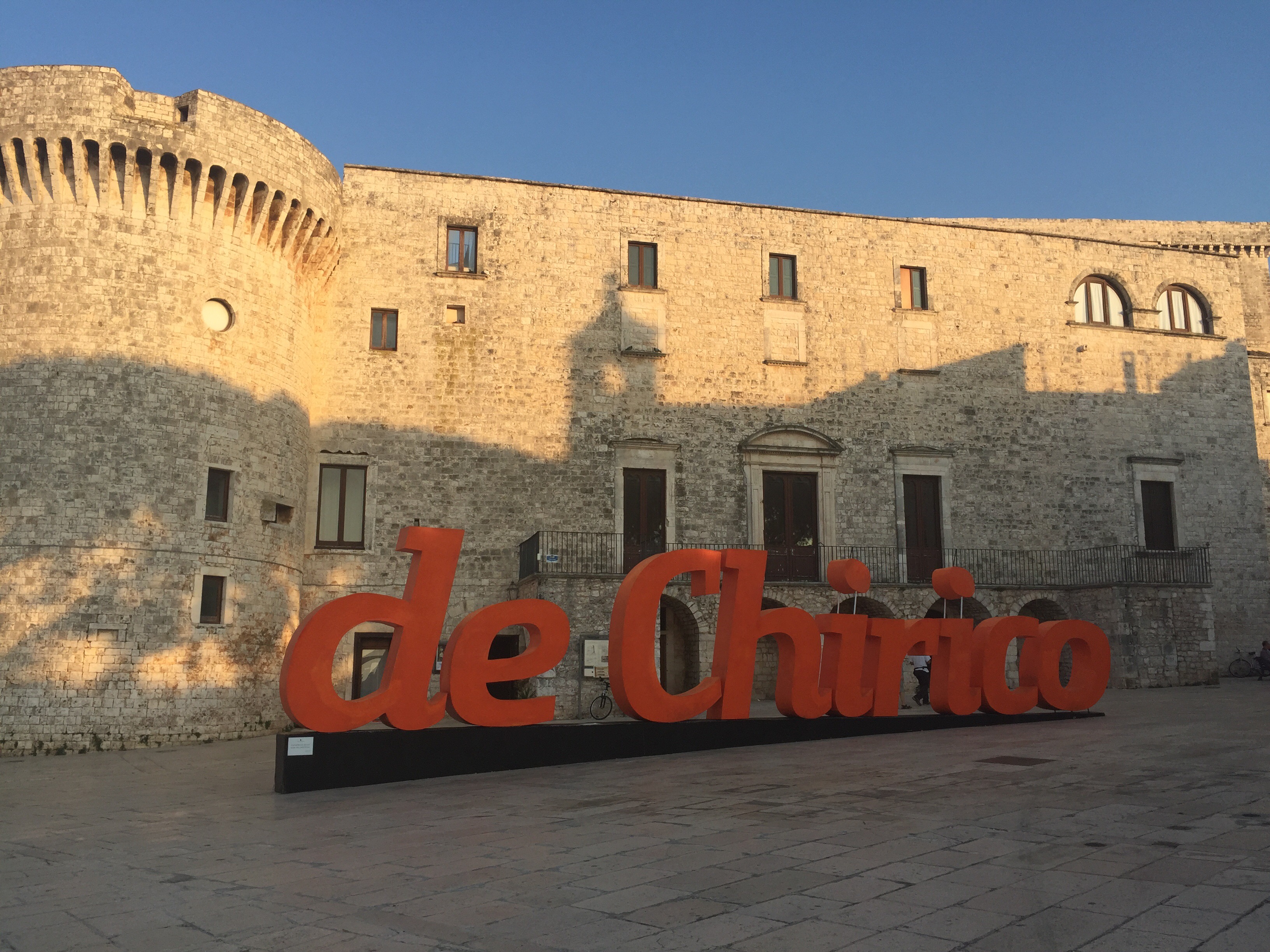
My hip isn’t always a happy hip. After a day of sightseeing in Bari, my hip was hurting. Our Pugliese pals, Salvatore and Rosanna, wanted us to see an art exhibit in the village of Conversano’s medieval castle. The artist – Giorgio de Chirico – is famous for “pittura metefisica”.  Think Picasso. Suddenly, we found ourselves living in a metaphysical nightmare. 

Salvatore entered the ancient stone structure, climbed the rock steps to the top and discovered the elevator for folks with disabilities. Actually, it looks more like a floating floor than an elevator. He bravely stood on the sheet of metal and rode it down to pick me up. Bump, click, groan and emergency bells started to bellow.  Frankly, we heard bells and didn’t have a clue what they meant. We were in the courtyard waiting for Salvatore.  Apparently, no one who worked at the castle knew what they meant either.  No one came running. After about 15 minutes we all walked to the elevator and light bulbs started flashing in our brains!!  Salvatore!! 

When the platform got to the ground floor the door wouldn’t open.  I would have been screaming my bloody head off. Salvatore calmly rang the bell. When we got there, he chatted with us through the locked door. 

Let him out!!!

After what seemed like ions of bells ringing, The security guard arrived opened the closet housing  the motor, reset it and nothing happened. He moved to the locked door, bent over and opened-a cleverly disguised by a lump of black rubber – keyhole. “We need the key.” What key? The key that in a nanosecond would open the door. Other castle staff members appeared and didn’t have a clue what to do. The sweet young thing hired for the exhibition leaned over the top of the floating platform and told Salvatore not to worry. 

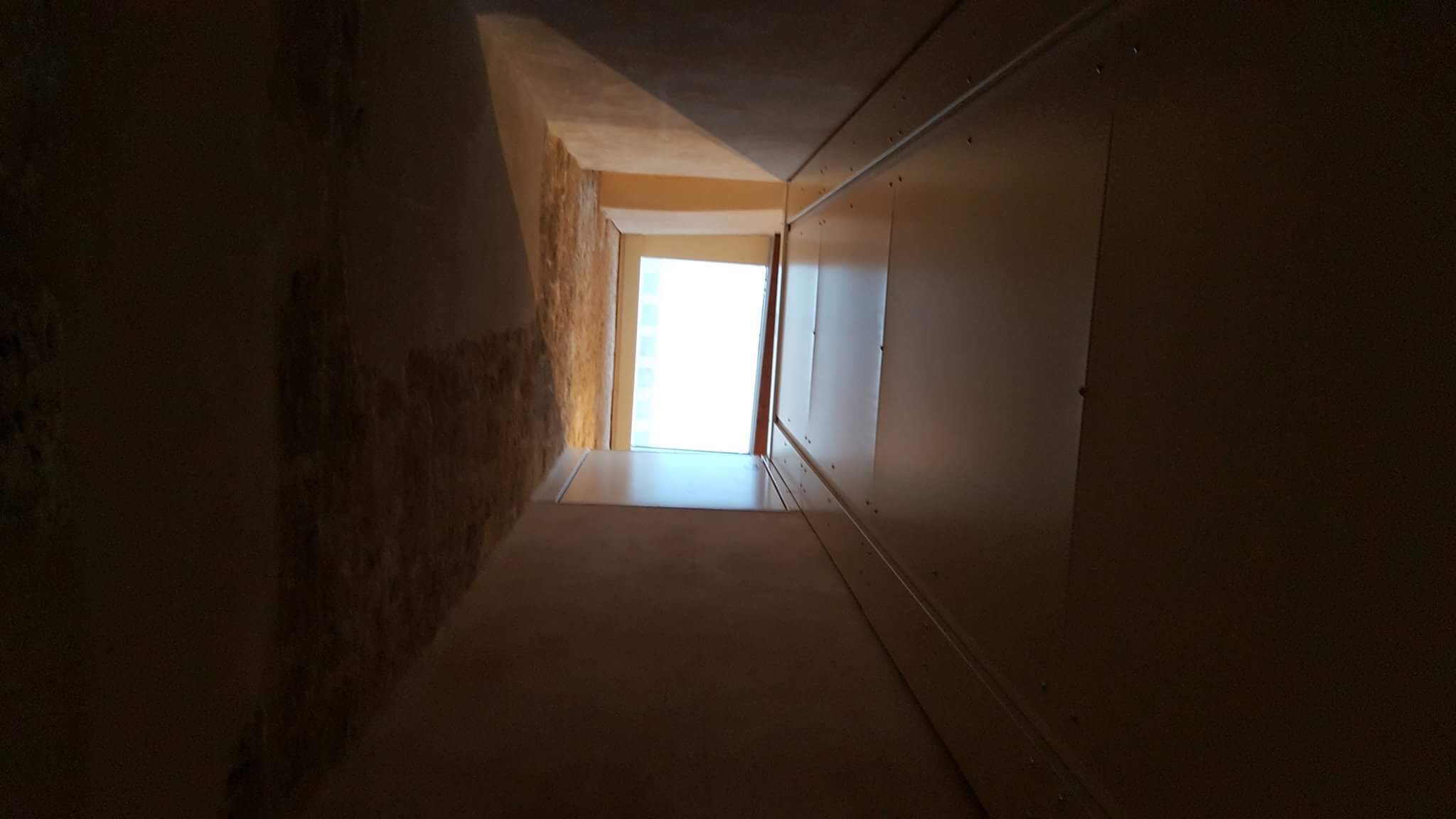
Salvatore’s view for over one hour.

We were told that help may be coming from the nearby city of Monopoli. Che sarà sarà may make for a nice song but the laid back attitude doesn’t resonate with me. As a matter of fact it sucks. Why hasn’t the management of the public space trained people for this type of incident. Why didn’t they have a copy of the magic key?Is this another example of bureaucracy gone insane – is there a regionally annoited key keeper? What if a pregnant woman was trapped inside with her water breaking all over the vertical tomb?  What if I was inside screaming every curse word I knew in multiple languages and kicking the shit out of the walls?
More folks kept coming and looking. Nothing was happening.  Until, after one very long hour the Man got here from Monopoli. Two seconds and one tiny key later, Salvatore is released. 

Quest’è Italia. Che sarà, sarà…

Beware Duty Taxes

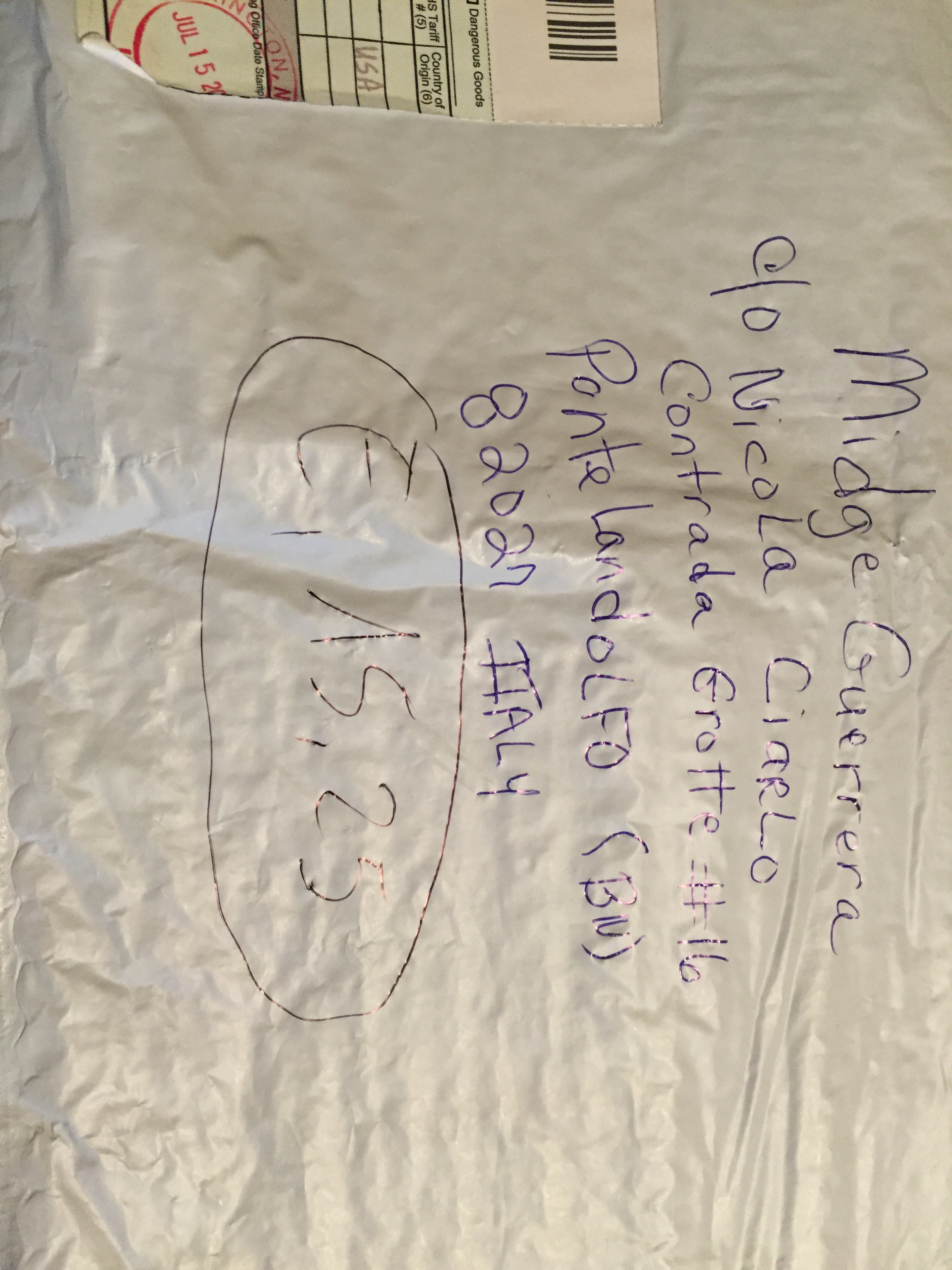
A few weeks ago I recieved a lovely gift from a New Jersey pal.  It was an envelope with six artfully designed dish towels.  Scrawled across the envelope was €15.29.  Since I wasn’t home when the envelope came, the postman couldn’t collect the duty.  Actually, until my pal Nicola explained what the scrawl was I didn’t realize I owed the post office anything or that the number scratched was a tax. Yup, on an envelope with contents valued at $50 it was simply scrawled €15.29. The recipient would know through osmosis that it was a tax.  Note, I said the amount was scrawled across the envelope.  There was not an official stamp, not a receipt, not – well not a thing to indicate why I had to pay someone anything. 


A few weeks went by and I didn’t go to the post office.  I never got a formal notice of owing the duty tax.  I kind of just forgot about it.  Guess who didn’t forget about it?  Il postino, the postman.  Finally, one day I was home when he came. What I didn’t know was that when he got back to the post office from his route he had to pay the €15.29 in duty.  He delivered the envelope and he was responsible.  

Errrrrggggg, I felt like a real creep for not following up and paying.  When I paid him and asked if there was a receipt of any kind from the customs people he looked at me like I was crazy.

Welcome to Italia.  

Ci vediamo

Donation Avenues and Earthquake Thoughts 

Donation Avenues –

No time today for courtesy. I’m going right to the “ask” – reach into your wallet and give what your heart tells you is right, in what ever method you choose to help the victims of the Central Italy, August 24th earthquake that destroyed complete villages, killed 290 people and left thousands living in tent communities.

1. This Sunday, September 3rd, entrance fees from public museums across Italy will be dedicated to rebuilding the earthquake stricken zone.  This is incredibly fitting since many churches and irreplaceable medieval buildings were decimated by the 6.2 magnitude earthquake.

2. Elizabeth Minchilli shared this information on her blog Elizabeth Mincilli in Rome:

Many have asked me on social media how they can help. For now the best way to help from afar is to donate to the Italian Red Cross.

The Croce Rossa Italiana has set up a special account.
The IBAN number is:

IT40F0623003204000030631681

BIC/SWIFT CRPPIT2P086

Beneficiary: Associazione italiana della Croce Rossa

In the description write: Terremoto Centro Italia

You can also make a donation to the Croce Rosso with your credit card or paypal by going to their website.

3. The National Italian American Foundation and their partners in the Italo-Americano community have set up another fundraising vehicle.  You can donate and research them by clicking here.

4. Do your own research to unearth other methods of giving.  Give.  Then share those avenues with us.

THANK YOU!!!!

Earthquake Thoughts –

At about 3:30 AM last Wednesday, an earthquake devastated towns in Lazio, Umbria and Marche.  Now, 290 people are dead. One moment before they were sleeping and a second later they were dead.  After the earthquake, just like after 9/11 – when the twin towers fell – many people used the internet to reach out to their loved ones.  Not feeling a rumble or hearing a sound during the night, I didn’t understand why Thursday morning I had close to 100 FaceBook messages, texts or e-mails.  That is how I learned about the tragedy, from all of you in a different time zones who reached into my heart asking if Jack and I were OK.  I promptly turned on the television and followed the horror.  I cried.  I cried for the terror those people in the earthquake zone were going through and I cried because so many people cared enough about us to reach out.  The similarity to my experience during 9/11 resonated within my soul.  Different tragedy.  Different country.  Same internet connection.

Life is short. Live it without regrets.

Ci vediamo.

Paris in the Thirties – Guardia Sanframondi

Before the dinosaurs roamed the earth, I visited Montmartre, the old artist’s quarter of Paris. Noooo, the artists weren’t old the quarter was old. During the 2016 Vinalia in Guardia Sanframondi I felt like I was walking back in time. The purpose of the Vinalia Festa  is to reinforce the town’s position as a center for fabulous wines. What it also did was help me understand why American writers and artists were buying homes in the funky centro storico.  Clare Galloway, may have been the first artist pioneer.  She bought a house in 2011 for €10,000 and working alone transformed it into “Arthouse,” a B&B and artist studio.  Clare, has been an avid supporter of the arts in this hilltop village.


Borgo Artisti was the best part of Vinalia.  In the medieval quarter we found pop-up gallery after gallery of local art.  Every vacant street level space was professionally lit and showcased  individual pieces or groupings of art.


Jack and my pal the poet, Maria Williams, venture down the steps to Clare’s Studio.

During our walk we met some of the WOMEN who are homesteading in Guardia.  What really resonated with me, was that they are doing this alone.   We met a playwright, massage therapist/ alternative practitioner, artist and —well just a table full of really interesting international women who were looking for a different lifestyle.  AND  a  place to do their art that cost less than it would in the USA and offered the beauty of this Italian hill town.

The sexy sounds of  a French chanteuse  was broadcast through the air. Cobblestone streets, free flowing wine and art. Lots of art. Paris. No – Italy!!  Southern Italy the Sannio hills.

That said, it is 1/2 an hour from Ponelandolfo and really, if you want to live in a beautiful village with wonderful people, consider my hometown.  The hook?   Why me. of course!

Ci Vediamo!

Arts Live in Pontelandolfo!

IMG_5072

Streets are being swept, sets are being built, venders are already setting up their stalls.  The jewelry stores in town have stocked Pontelandolfo-esq memorabilia and the back rooms of bars are filled with cases and cases.  As the energy of the arts infuses us all with good cheer, the whole town feels more alive. It is the arts that make this an incredible week for me.

13775758_1221245064566567_1060994111522203998_n

Kicking off the week is a production of  Dramma Sacro Di Santo Giocondina.  This community production, spearheaded by the multi talented Gabriele Palladino, will be live streamed!  The Pontelandolfo News has a great story – it is in Italian but even I can read it – and a link the live stream.  The play is only on for two nights – tickets are a scant €2 each.  I was impressed with the abilities of the local actors.  Their commitment and pride is contagious.  The saga of Santo Giocondino is performed every four years.  Now that I have seen the process, I can understand why!  This group has been working for over eight months. Yes, in the hills of Southern Italy – THEATRE LIVES!

DSC_0135

Comicron Film Festival is something that I am absolutely looking forward to. This year it is on August 4th and 5th. Initiated by the famous Italian Film/Theatre Director and Producer, Ugo Gregoretti, the festival is dedicated exclusively to comedy shorts. They are in all languages and range from the intellectual to the broad strokes of Commedia dell’ Arte.  My only hope this year is that the audience here learns to be quiet and watch the films – last year I found out more than I wanted to know about a middle aged woman’s love life.  Audience courtesy please.  Jack says he won’t sit with me if I keep turning around  ssssssssssshhhing.

Gregoretti spent his childhood summers in Pontelandolfo and wants to put an arts based spotlight on the village.  According to Gregoretti – (from the Comicron Website.)

“Io sono un crociato della comicità e quindi vorrei svolgere la mia crociata qui a Pontelandolfo facendo di questo paese la Gerusalemme del cortometraggio comico.” Tra le nuove idee e le diverse iniziative culturali programmate, è stato costituito il Centro Studi dedicato all’opera dell’autore romano Ugo Gregoretti, che raccoglierà e valorizzerà il suo immenso archivio, conservato presso l’ottocentesco palazzo Rinaldi, che si compone di scritti inediti del regista, lettere di esimie personalità (da Rossellini a Rodari, passando per Napolitano e Guttuso), articoli e manifesti, libri e riviste, premi e riconoscimenti. Si tratta di una grande raccolta, che ripercorre, attraverso la figura del grande Maestro, la storia del Novecento italiano. Una raccolta che Gregoretti ha donato al Comune di Pontelandolfo. Il progetto prevede anche la creazione della prima Accademia Nazionale d’Arte Comica e sarà, altresì, realizzato un progetto di più ampio respiro teso a rendere Pontelandolfo la “Capitale della risata”. Il “Centro Studi Ugo Gregoretti” è aperto a studiosi e appassionati che vogliono esplorare e indagare l’opera gregorettiana.

“I am a crusader for comedy and  I would like to end my crusade here in Pontelandolfo making this town the Jerusalem of the comic short film.” Among the new ideas and different cultural activities planned, the Ugo Gregoretti Center has been created.  It is dedicated to the work of Ugo Gregoretti and will contain such things as the unpublished writings of the director, correspondence from esteemed personalities(from Rossellini to Rodari,  Napolitano and Guttuso), articles and posters, books and magazines, prizes and awards. This collection traces the professional life of the great master and the history of the 20th Century Italian films. Gregoretti donated the collection to the City of Pontelandolfo. It is housed in the recently restored Rinaldi Palace.  The project also includes the creation of the first National Academy of Comic Art and aims to make Pontelandolfo the “capital of laughter”. The “Ugo Gregoretti Studies Center” is open to scholars and enthusiasts who want to explore and investigate the work gregorettiana.

Pro Loco of Pontelandolfo, the local authority coordinates the annual Festa.  I couldn’t find a web-site, but their Facebook page is full of information.  The other events of the week include on August 3’rd traditional music and dance of Southern Italy and on August 7’th Francesco De Gregori in Concert. The mysogynistic Miss Mondo is an event I will happily miss. The host is – well  – a creep.

We will have a houseful of guests next week.  Two from Holland and one from Massachusetts.  Why are the visiting my home town?  Not to see Midge and Jack but to enjoy the rich culture that can be found in Southern Italy.  The FESTA is just another reason to visit Pontelandolfo.

Ci Vediamo!

More Zucchini Recipes.


The zucchine elf - Zia Vittoria!
The zucchine elf – Zia Vittoria!

Everyday it seems there is a mysterious bag, basket or pile of zucchini by my door.  These things must multiply like rabbits.  Last year, it seemed like I was chomping down on zucchini blossoms daily.  Bundles of fully formed zucchini didn’t appear because we were all too busy frying up the flowers – remember this post:  Fried Squash Blossoms     Don’t forget – all recipes are posted in the recipe section.  Look above the Tower Picture to find the tabs.

Giambotta

I thought I knew how to make giambotta!  Take whatever summer vegetables were starting to turn ugly in the fridge, slice them, dice them and sauté them with ground meat, dump in a couple of cans of diced tomatoes, add a pinch of salt and a few basil leaves.  Easy peasy.  Since everyone in New Jersey grew zucchini, the first giambotta I ever ate featured zucchini, more zucchini and nothing but zucchini.

EEEEEEE. Midgeee, questo non e ciambotta.  I got my hand slapped by Santina the butcher when I ordered carne macinato – ground meat – and she asked what I was making.  I got my head smacked by every other elder who I asked about giambotta.  But, I swear my mother or grandmother or someone always added ground meat.

Simply put, giambotta is a beautiful blend of fresh – not almost rotting in the fridge – vegetables.  Zucchini, green beans and eggplant are pleantiful now.  Carrots spill over in the market with fresh white onions and tomatoes.  I add tomatoes but my cousin and ace cook Carmella Fusco didn’t and her giambotta was magic.

The trick I have learned here in Pontelandolfo about cooking some vegetables is to not add any liquid.  The vegetables have all the liquid you need.  Put a nice thick layer of extra virgin olive oil in the bottom of a pan and add the vegetables in order of how long they take to cook. I always start with the onions, then toss in carrot slices, then add the beans, zucchini and eggplant.  Rats, Jack hates eggplant – he puts it in the ‘tofu category’.  Don’t tell him that the perfectly formed cubes are eggplant.  I toss in so little salt that it doesn’t count and add a handful of crushed fennel seeds.  Note:  No added liquid like that can of  squashed tomatoes that I used to use.  The vegetables do have enough liquid to create their own sauce.  Also, I’m the only one that seems to add carrots to the mix. Yummy.

I can not tell too many lies – I often still add ground meat to the onions and when it is brown add the vegetables.  I also often dice up fresh tomatoes and toss them in too.

Carmella’s Spaghetti with Zucchini and Zucchini Flowers

When cousin Carmella sends me a “WhatsApp” text that says –Venite a pranza oggi?   I always quickly respond with a SI!  Carmella is a world class cook and lunch at her house might be the simplest of ingredients but they are always tossed together delectably.  Check out Carmella’s cooking on her Facebook Page A Pranza dalla Nonna.

Today we had another variation on the zucchini theme, Spaghetti with Zucchini and Zucchini Flowers.  Fresh, local ingredients easily tossed together and delicious.  Zucchini flowers, zucchini, garlic, extra virgin olive oil, salt, hot pepper, spaghetti and pecorino cheese round out the list of ingredients. (You lucky New Jerseyans who belong to a CSA like Hillsborough’s fabulous Martenette Farms have access to lots of zucchini and zucchini flowers this time of year.)

As I was slowing chewing my spaghetti, I asked Carmella her secret.  Simplicity is the secret.  She cut the flowers into little pieces.  They added great orange color to the pasta.  A few cloves of garlic were chopped and after cutting a zucchini in quarters it was thinly sliced.  She put a walloping helping of olive oil in the pan – it thickly covered the pan – and added the garlic.  She let that sizzle for a second and then added the zucchini and flowers.  Next came a tazzino – espresso cup of water – or two fingers in a Nutella glass – and salt.  The veggies cook until the water has evaporated and then they sauté for a couple of minutes more.

At this point the salted spaghetti water should also be on the stove.  Cook the spaghetti as you normally would.   When the pasta is done, drain it and add it directly to the pot that has the oil and sautéed zucchini.  Carmella said, saltare in patella.  Toss it and let it cook a wee pit in the pan.  At this point she also added a hint of hot pepper and freshly grated pecorino cheese.

That was our primo piatto!  Zucchini heaven!

(Carmella is one of the cooks who opens her home for the Cooking in the Kitchens of Pontelandolfo program.  Interested? Message me.)

Ci vediamo

Midge


Festa Della Trebbiatura 2016

This past Sunday, I had a perfect day.  Jack and I went to an event that I not only loved – but drew me back to my childhood.  Growing up in Somerset County, New Jersey when it was still pretty rural agrarian, I experienced lots of farm life.  4-H introduced me to kids who grew or raised just about anything America ate.  Sunday, I thought of my childhood, how much growing up in a farming community shaped me and the work my grandmother did on her subsistence farm.  Festa Della Trebbiatura in the Contrada Montagna in Morcone harkened back to farm days of old and celebrated the contadini – farmers – of the Matese Mountains.  The type of people my ancestors were.

Did I mention mountains?  Those of you that know me, know I clutch the death grip in our Fiat whenever the wicked Jack drives like an Italian around the S curves sans safety rails on mountain roads.  This trip around those curves was worth it.  The views were incredible.

I need to take a moment to praise my Jack a wee bit.  From the town center of Morcone – which is literally clinging to a mountain – we made a left at the Auto School and drove up.  We didn’t know which way to go when the road split.  We opted for the one that looked steeper on the left.  It was really su, su, up, up.  Shit, I screamed as Jack hit the breaks.  The cobblestone street narrow to begin with had cars parked on both sides and didn’t go anywhere.  Jack backed our large car down the hill and didn’t take the mirror off one single parked car. Hugs to him.

Back to the Festa.  We found out about it from Antonella Lombardi, owner of Bar Mix Fantasy, and a member of the Lombardi family that produced the event.  Thank you Antonella for making sure that I knew about what turned out to be a wonderful day.  When we got to the farm and I saw the rows of seats under the trees and the Priest ready to start mass, I smiled and sat down.  Hearing this great speaker do the mass surrounded by mountains, fields of grain, a clear blue sky and floating cotton clouds started the day beautifully.  After mass children went for “hay” rides on the farm wagon festooned with shafts of wheat.  We walked through the exhibition set up by the Museo del Contadino and I kept pointing at stuff that had been in my grandfather’s barn.  Since we sold the family property and all the relics two years ago, it got a little painful to see  the artifacts.

During the day, people could wander through the World Wildlife Federation Preserve in the mountain, watch demonstrations and eat country fare. One of the featured foods was pecora interrata.  Interrata means underground.  Of course that is what I had!  In the evening there was music and dancing.  Since the zanzare, mosquitoes, and I have a love/hate relationship, they love to eat me and I hate them.  We left before it got dark.

The word trebbiatura  means threshing the grain.  There were glorious fields of wheat in this part of the mountain.  We were celebrating the harvest and the people that make sure we have bread and pasta on the table – the farmers.  The first threshing methods involved beating grain by hand with a flail, or trampling it by animal hooves.  The demonstrations included women doing this.  Women were doing lots of the heavy work – this is still not unusual in our little village of subsistence farms.  What was even more fun to watch was the early threshing machine!

(Uggggg – Jack just told me I have a typo in a caption in the video.  Sorry.)

Ci vediamo!

Midge

Genealogy Hints – Naturalization of your Ancestors

richedit2Our resident genealogist, the charming and smart Rich Venezia of Rich Roots Genealogyhas returned with more helpful hints on discovering our individual stories.  Many of you of Italian descent, have e-mailed me about obtaining Italian Citizenship.  Rich is the expert .  Here he talks about the first and most important step – naturalization of your ancestors.

Dear Readers of Nonna’s Mulberry Tree,

This month, we’ll be tackling a question I am asked all the time: How do I know if I qualify for dual citizenship?

While there are lots of rules and regulations – it is the Italian government, after all! The most important question you have to answer is the naturalization question.  Just when did your ancestor become an American Citizen?  If your Italian ascendant (say, your grandfather), naturalized prior to the birth of their child/your American-born ascendant (say, your father) – well, then the Italian bloodline was not passed through, and you’d be ineligible. However, if the Italian ascendant never naturalized, or naturalized after the birth of your American-born ascendant – well, we may be in business!

What?  You don’t get it?  Simple – we’ll use Midge as an example.  Her Grandfather, Francisco Guerrera became a naturalized American Citizen after Midge’s dad, Giovanni Francisco Guerrera, was born.  Even though her dad never understood that he was an Italian citizen until Midge started researching – he was!  The Italians don’t care where you are born if at the time of your birth your parents – or parent  – is an Italian citizen, then you are too!!!  Midge’s story.

So, the first step to citizenship – start looking into your parent’s or grandparent’s (great grandparent’s, etc.) naturalization. Here are some places you can survey –

The best place to start is by searching census records. These are accessible in various places online – notably Ancestry.com (check if your library has a subscription). Censuses starting in 1900 have a citizenship status column, and censuses until 1940 are available. (1950 becomes available in 2023.) If your grandfather immigrated in 1913, you should be able to find him on the 1920 census. Usually, one of four things are listed in the citizenship column:

NA = Naturalized

PA = First papers submitted (usually, a declaration of intent [to become a citizen])

AL = Alien (i.e., unnaturalized)

NR or blank = No record; it’s possible immigrant provided the info or know

Biagio Camperlino - 1920 census - Ancestry.com

Thanks to Ancestry.com – we see the PA and AL on the right.

So – if you find Grandpa in 1920, and he is listed as AL, and then you find him again in 1930, and he listed as NA – you can surmise that he probably became a citizen between 1920 and 1930. (Now – let’s just hope your father was born in 1919!)

The thing about censuses is that they can be very inaccurate, so it is unwise to take this information as completely factual without corroborating with further research. I have seen people go from being listed as “NA” in one census to “AL” in the next census, or people list “PA” for 30 years running! Do use the censuses as a guide, but just a guide! You’ll want to corroborate your information, especially for something as important and complex as obtaining dual citizenship.

World War I draft registration - FamilySearch

World War I Draft Registration from FamilySearch noted he was an alien.

If your male Italian ancestor was here in 1917 and/or 1918, and was “of fighting age” – that is, born between about 1873 and 1900, he should be included in the World War I draft registration card database. Note that all eligible men had to register – these cards don’t just exist for men who served in WWI. These registration cards can be found on websites like Ancestry.com or Fold3, as well as for free on FamilySearch. Most of these cards have a question relating to citizenship status – whether the registrant is a natural-born citizen, a naturalized citizen, an alien, or having declared intention. If your ancestor’s citizenship status matches that on the 1920 census (remember there were 2 or 3 years in between), you are one step closer to the truth.

Now that you have a timeframe in which your ancestor may have naturalized, what do you do next? The age-old answer: It depends. Naturalization records are held at different repositories, and each state and county may hold their records at different places. In New Jersey, most county clerks hold the naturalization records for their county (for instance, Middlesex County and Hudson County records can be found in those counties.). By calling the Office of the County Clerk, you can determine if they hold these records. However, in Monmouth County, for instance, their records are held at their County Archives – which has a searchable database online!  It is worth the phone call to see if you can do the research from the comforts of home!

Michelle Tucker Chubenko of Jersey Roots Genealogy is a colleague and friend of mine. She wrote a blog post that might be helpful on finding records in the NJ district courts.

In Pennsylvania, records are *generally* held at the Prothonotary’s Office, but this differs from county to county.

This is Midge, I had never in my life heard the word “prothonotary.”  What the hell is that?  According to the source for all – Wikipedia: The word prothonotary is recorded in English since 1447, as “principal clerk of a court,” from L.L. prothonotarius (c. 400), from Greek protonotarios “first scribe.”  Who knew?!  

If you are having trouble finding the records, keep in mind that some state archives, local or regional libraries, or genealogical societies may also hold these naturalization records. The New Jersey State Archives, for instance, holds a vast collection of naturalization records – for some counties, into the 1940s and 1950s! (Union or Sussex County ancestors, anyone?)

Another complication is that the naturalization laws changed in 1906 – and a lot of Local Courts lost their ability to naturalize citizens.  Now the search gets a little sticky!  Just what court naturalized our ancestor??

If a US District Court existed in the city or county where your ancestor lived, it’s extremely likely they would have naturalized through this court. In Allegheny County, Pennsylvania, for instance, after 1906, all naturalizations occurred in the US District Court of Western Pennsylvania in Pittsburgh. In New York City, many immigrants would have been naturalized at the US District Court of New York (Southern District) if they were Manhattanites or from the Bronx. Queens, Kings, and Staten Island residents likely naturalized through the US District Court of New York (Eastern District). In New Jersey, there were District Courts in Newark, Camden, and Trenton. The records of the US District Courts are generally held by their regional branch of the National Archives (NARA) – NY and NJ at NARA New York, Pittsburgh and Philadelphia at NARA Philadelphia, Ohio at NARA Chicago, etc.

Citizenship Frank

My nonno was naturalized in a Local Court.

The good news is that a lot of these records can be searched online (at least up to the 1930s or 1940s). Italian Genealogical Group has indexed the records of the NJ and NY District Courts. The Pennsylvania District Courts’ records are on Ancestry.com up till 1930. FamilySearch also has a large amount of naturalization records available online for free – both District Court and Local Court records. You can also order a search with NARA for a nominal fee – National Archives.

If you have lots of time to wait and not a lot of time to do the research – this may be the option for you. It requires a little less detective work but a long waiting period .  Just pay the fee and order an index search from US Citizenship & Immigration Services (USCIS). They hold all naturalization records from 1906 onward. A search can be ordered here: US Citizenship and Immigration Services. The current waiting period to receive the results of the index search is anywhere from 6-8 months.  That doesn’t seem so bad.  However, then factor in another 6-8 months to receive the record if one has been found using the index search. I generally find it a little easier to verify naturalization by other means. However, you should be able to use the results of the index search to determine your eligibility. A date of naturalization is usually listed on the index search, so you can determine whether this was before or after the birth of your American-born ancestor.

A USCIS index search would also come in handy if you believe your ancestor never naturalized. There will likely be an AR-2 (alien registration form) for them if they were alive in 1940. (Midge here -Why is it that alien makes me think of ET Phone Home?)  Even if the USCIS search is negative – no naturalization for grandpa – you may subsequently request a letter certifying the non-existence of a naturalization.  If this were the case for your ancestor, the Italian Consulate would require such a letter for your dual citizenship appointment.

The bottom line is – no matter how you find your ancestor’s naturalization record, the date that they were granted citizenship to America is key. It must be after the date of their child, your American-born ascendant. The concept of dual citizenship jure sanguinis, through bloodline, only works if the bloodline is unbroken – and until 1992, Italian nationals could hold only one citizenship.

In boca al lupo. May your search be swift and uncomplicated, and may you be eligible for a beautiful red passport!

Rich Venezia is a professional genealogist based in Pittsburgh, PA. He specializes in Italian, Irish, and immigrant ancestry, and NJ/NYC and Pittsburgh-area research. He also assists clients with dual citizenship applications. He has worked on two genealogy TV shows (including PBS’ “Genealogy Roadshow”) and is available for client research and speaking engagements.  His website can be found at richroots.net and he can be reached at rich@richroots.net. He adores Midge and her blog, and is so thrilled to be visiting with her regularly. A presto!