14 Agosto 1861 – August 14, 1861

14 Agosto 1861. August 14, 1861. Books have been written, art has been created, songs have been song, blogs developed, plays have been performed, movies have been made, Pontelandolfo remembers, but have lessons been learned?

Genocide is hard to forget or forgive and yet genocide continues all over the world. OK, I am not a historian and I am calling the 1861 rape, pillage, burning and shooting of the people and places in Pontelandolfo genocide. Genocide done by the Italian army. An army that was told to annihilate everyone in the village. Italians killing Italians. Wow, in today’s world that sounds familiar.

A little back story – thanks to Pontelandolfo News – Renato Rinaldi and San Felese Society of New Jersey for a history lesson. This is all about money, power and who should be in charge. The unification of Italy and booting of the Bourbon Dynasty didn’t make everyone happy.

On August 13, 1861 General Cialdini commander of the Piedmont forces in southern Italy was getting reports from throughout southern Italy, especially in the rural southern countryside, about folks rebelling against the new regime. 

 He was outraged to hear that about 45 Piedmont soldiers had been killed by some rebels between Pontelandolfo and Casaldini in the province of Benevento. General Cialdini – think central casting super evil dude – loved punishing pro-Bourbonist southern Italians. Actually, bang, bang, he adored having his minions kill any pro-Bourbonist. 

 Why were Southern Italians so pissed off? With a new king, new government and pocket lining politicos, life changed dramatically. Decisions that seemed anti-south were imposed by Piedmont controlled local politicians as well as by central northern “national” politicians in Turin.

General Cialdini orders his field general in Campania, General De Sonnaz, to get rid of those blasted rebels and townspeople who had had the audacity to call for a Bourbon return. De Sonnaz passed the job on to Colonel Pier Eleonoro Negri.

Loving revenge, Italian Colonel Negri directed his men to launch an attack.  As Pontelandolfese calmly slept, an indignant, Colonel Negri ordered that his soldiers destroy the community.  Leave no stone left standing, he cried. (This command will forever seem extreme.) Entering Pontelandolfo in the middle of the night, Negri easily attacked.  Within moments, the countryside was in turmoil. 

Executions Under the Tilia Tree:
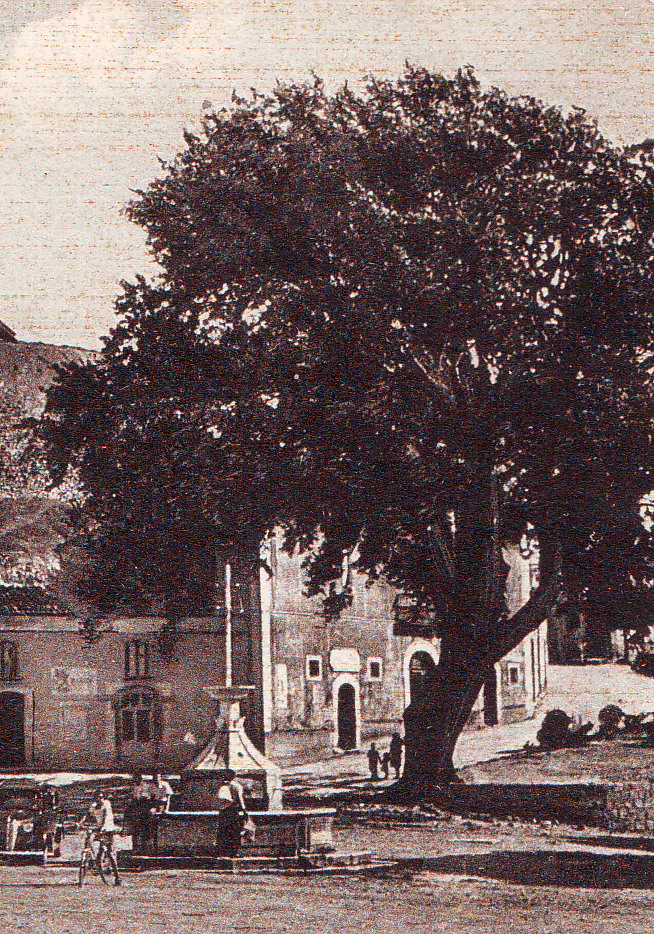
Italian soldiers crept into Pontelandolfo in the middle of the night.  Everyone was asleep.  Within minutes soldiers started pounding on doors, the church bells started to ring, guns were fired, boots pounded on the cobblestones.  Sleeping families woke up.  Holding their drowsy babies, parents wondered what was going on.
Racing to windows, balconies and doors, the Pontelandolfese were shocked to see soldiers running through their streets. The Italian Army had arrived, and everyone had a right to be afraid. The soldiers, kicked in doors, leaped up stairs, raced into homes killing men, women and children. They stole things and did things I don’t want to think about.  Flames soared into the night sky, and the village burned. The people that tried to fight back were dragged under the Tilia Tree in Piazza Roma and shot. Bang, bang!
Renato Rinaldi is the publisher of the Pontelandolfo News. He was a professor, as well as, a former Officer of the Navy.  Rinaldi is a passionate researcher of local history and has provided an in-depth look at the Pontelandolfo massacre of August 14, 1861.  As an author, he keeps the history of Pontelandolfo before us. We thank him for that.  We also thank him for his assistance with bringing Pontelandolfo to the world at large. He was instrumental in creating a village walking tour of the massacre of 1861. (I’m not sure if that is a real tourism draw but it is great for our school kids to learn our history. ) He had written stories to go with each stop on that tour and asked me to translate them into English. A few years ago, I did just that and printed a little pamphlet. Here is one of the graphic tales –

CONCETTA BIONDI

The story of Concetta Biondi has come to represent the disdain the mercenaries in the Italian army had for all that was good and pure. Women were treated like chattel and passed from man to man. Children were tossed aside like garbage. Husbands and fathers were held by laughing plunderers and forced to watch the mayhem.

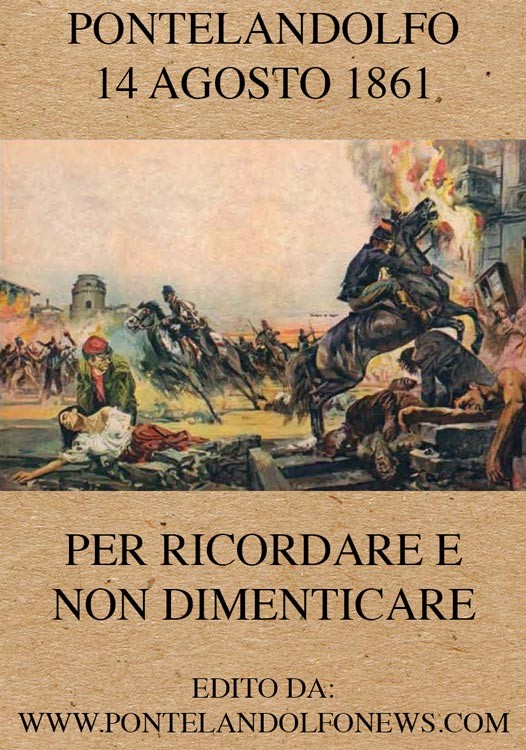
As the marauders plundered the city, young Concetta Biondi, fearing the inhuman assailants, hid behind some barrels of wine in her family’s basement. When the young maiden was discovered by the mercenaries she fainted. Like cats with a mouse they toyed with her. Her father, Nicolas Biondi, charged down the steps to save her. He was quickly tied to a chair and forced to watch the debauchery. Finally, with a murderous hand, soldier killed this delicate flower and tossed her aside. Wine poured out of the barrels mingling with Concetta’s blood.

Tonight, we will be going to see the latest play about the massacre. It is written by our pal Michele Albini. As long as the story gets told, perhaps the lessons will be learned.

Ci vediamo prossima volta.

Midge

Award Winning
Cooking in the Kitchens of Pontelandolfo

Is now organizing for 2025!
Lively Learning is also exploring artist, writer and musician retreats.
Contact me for more information. info@nonnasmulberrytree.com
Concetta Biondi

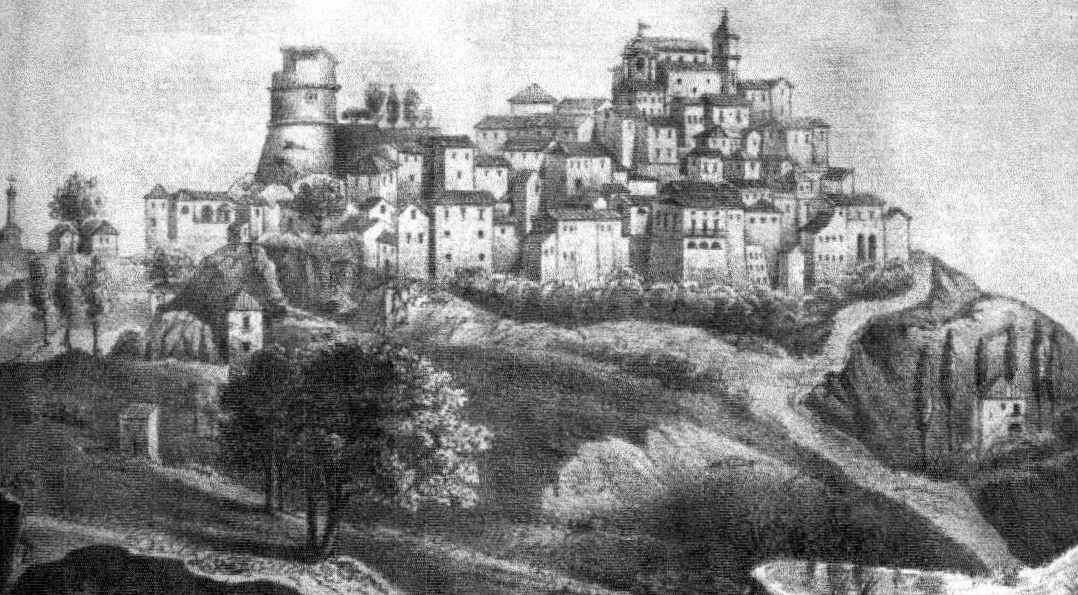
Ponte Old

On August 13, 1861, Pontelandolfo, home to 18 year old Concetta Biondi, was a quiet little mountain village.  Contadini were farming the land, children were seeking shady places to play and women were doing the million chores that women did daily.  Concetta may have been doing laundry in the common fountain trough.

THIS IS AN ARTIST’S RENDERING OF WHAT HAPPENED THE NEXT DAY!  

pontelandolfo-1861_ricordare-per-non-dimenticare-526x750

Concetta Biondi was collateral damage in a battle – massacre – during the unification of Italy.  “Collateral damage,” that sounds so much better than raped and … I’m getting ahead of myself. Pontelandolfo is famous, along with neighboring Casalduni, for being destroyed by the Italian army.

In 1861, some partisans captured and killed a small number of Italian soldiers in nearby Casalduni. Seeking revenge, Italian Colonel Pier Eleonoro Negri directed his men to launch an attack.  “Leave no stone left standing,” he cried.  (Cfr. Nicolina Vallillo: L’incendio di Pontelandolfo in Rivista storica del Sannio. 1919.)

Entering Pontelandolfo smack in the middle of the night, Negri’s oafs butchered and burned the village . Oops, husband Jack just read over my shoulder and said, “oafs is not fair.  They were soldiers obeying orders.”

Ok, OK, I’ll fix it.  Soldiers obeying orders butchered and burned the village. Within moments, the countryside was in turmoil. Families leaped out of bed to the ringing of the church bells, rapid discharge of rifles and the crunch of boots pounding on the cobblestones. Clutching their drowsy children, adults wondered what the hell was going on. Racing to windows, balconies and doors, the Pontelandolfese were shocked to see soldiers running through their streets. The Italian Army had arrived and they didn’t look like happy campers.

The soldiers, kicked in doors, leaped up stairs, raced into homes killing men, women and children. Those that tried to fight back were dragged under the tilia tree in Piazza Roma and shot. Flames soared as the village burned.   I’m guessing my ancestors were lucky to live in an outlying Contrada or I wouldn’t be here.

“The conduct was horrible and immoral.  The looting and arson is infamous.” (Historian G.De Sivo, The Story of the Two Sicilies, Vol.II).

Concetta Biondi’s story has come to represent the disdain the mercenaries and the Italian army had for women.  Hmm, hot night, testosterone high men, sleeping women dragged out of bed wearing who knows what…  The bastards, as history has told us happened countless times, passed the women around like bowls of candy waiting to be munched.  Children were tossed aside like garbage and trampled.  In the name of Italy, dads and husbands were held by the barbarians and forced to watch the madness.

As the marauders plundered the city, Concetta Biondi, hid in her basement behind some barrels of wine . When she was discovered by the mercenaries, she fainted. I can imagine them tossing her around like a sack of potatoes, copping feels and stripping her.  Her father, Nicholas Biondi charged down the steps to save her. Tied to a chair, he was forced to witness the depravity.  When they were sated, the pigs killed Concetta and tossed her aside.  Wine poured out of the tapped barrels mingling with Concetta’s blood. Nicholas Biondi was executed by a firing squad.

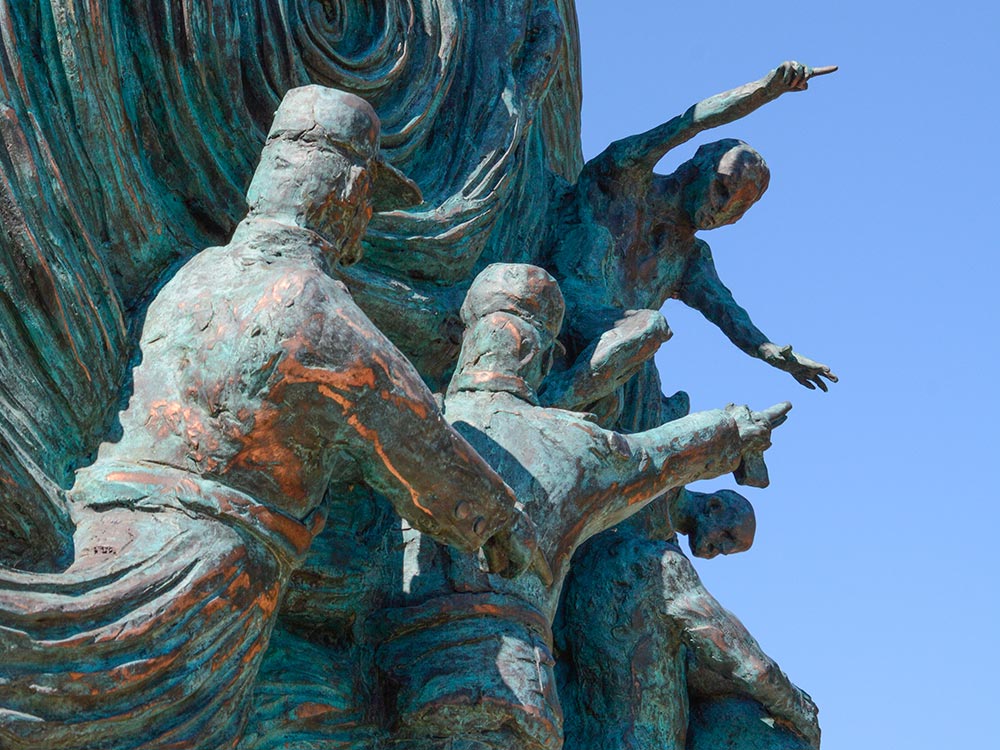
StatueThis giant sculpture near Piazza Roma reminds us never to forget 14 Agosto 1861.  We even have a walking trail for tourists who want to learn more about the atrocities and walk where the dead walked.  Gruesome, but interesting. Lots of books have been written about the incident, including a graphic novel!  IMG_0004
Professor Renato Rinaldi of the Pontelandolfo News is one of our resident experts. He has documented much of what happened.

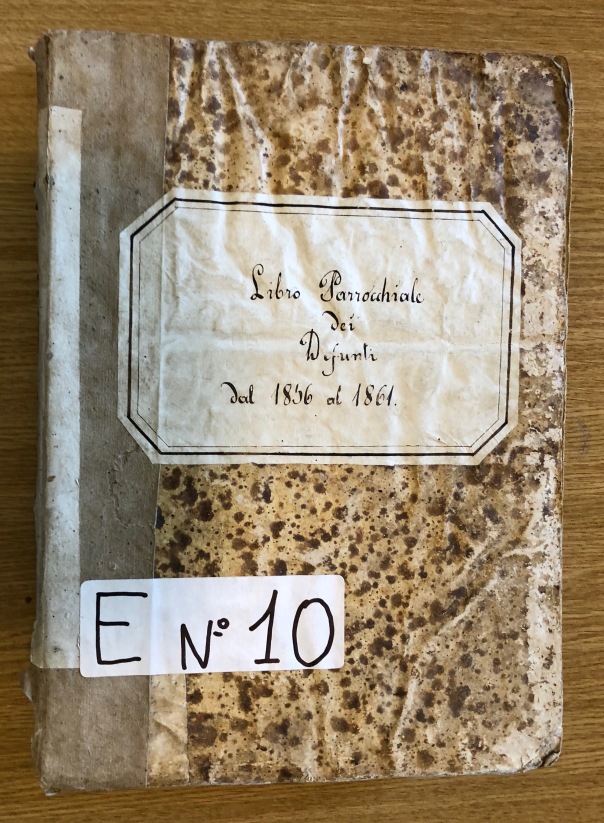
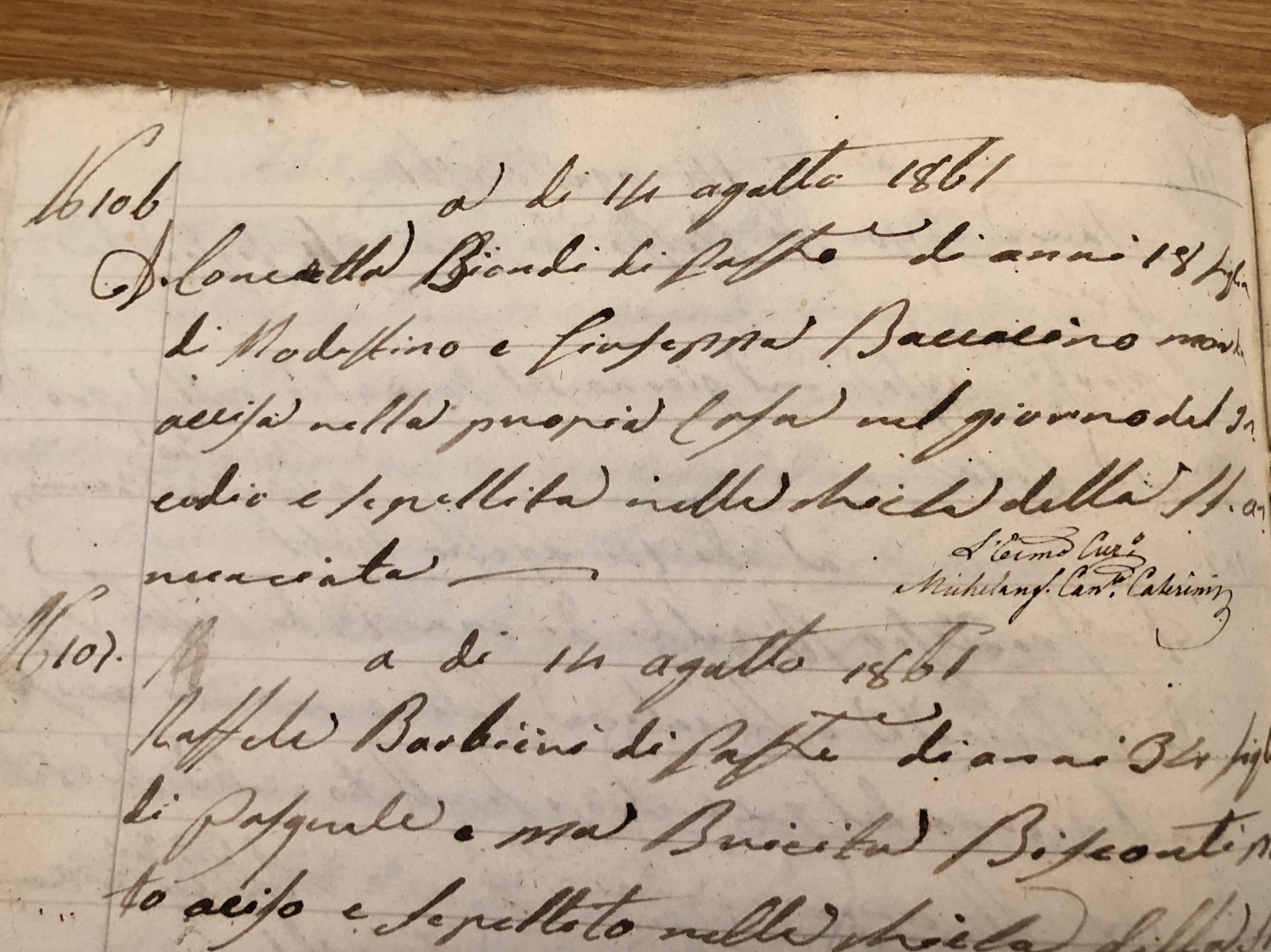
Can we get back to Concetta Biondi please?  Certainly.  Saturday, for the first time I realized she was an actual human being.  Not just a fable representing war crimes.  But a real young woman who hadn’t done a thing to deserve dying like she did.  Il Club del Libro di Pontelandolfo hosted Italian genealogist Domenico Carriero for the day.  Many of us tagged along.  We went to the parish archives and watched as Domenico started researching Concetta Biondi.  The books – held in a area that is anything but climate controlled – though it was hot and a window was open – go back to the 1600s!  Our guide to the archive was Antimo Albini. ( This is the link to a story about him researching my family.). When this book was opened –

IMG_1265.jpg

I began to feel the spirit of Concetta Biondi.  Her existence was noted in the parish records.  She once had walked the same cobblestone streets that I have explored.  She might have known my great grandfather or great grandmother.  Seeing the registry brought tears to my eyes and frankly, created an “ah ha” moment.

IMG_1262.jpg

As mankind continues allowing violence to occur in villages around the globe, I’m glad Concetta Biondi reminded me that atrocities leveled in the name of nationalism are often heinous deeds perpetrated on innocents.

Ci Vediamo.

___________________________________________________________________________

 Announcing the 2019 Session

May 18 – 25, 2019

Cooking in the Kitchens of Pontelandolfo

img_0039

Complementi Pontelandolfo 1861!

Ponte Old

 Sono orgolioso di “Pontelandolfo 1861”!  Bravo!

(I am proud of “Pontelandolfo 1861”! )

I know that is not an attention grabbing first line but, damn, I am so proud of the my little Italian home town’s latest initiative.

With funding  – finanziamente -from the Unione EuropeaFondo europeo agricolo per lo sviluppo rurale: l’Europe investe nelle zone rurali (European Union – investment program for rural areas), Italian Ministero Delle Politiche Agricole Alementari E Forestali (Italy’s Department of Agriculture, Food and Forests) , and the Regione Campania Assessorato Agricoltura (Region’s Department of Agriculture)  – Pontelandolfo is undergoing a renaissance.

Renato Rinaldi of the Pontelandolfo News (Pontelandolfonews.com) made sure I got an invitation to the August 26th –

Presentazione progetto “1861 i luoghi dell’eccidio”

Alla manifestazione di presentazione del progetto “1861 i luoghi dell’eccidio”, progetto integrato per la realizzazione di un itinerario storico-turistico alla scoperta della città martire di Pontelandolfo.  (A presentation of the “1861 places of the massacre”,an integrated project designed to attract historical tourism to the martyred city of Pontelandolfo.)

Renato Rinaldi, who has written a complete history of the period, gave an overview of the history.  He has a great voice and engaging presentation.  After the presentation I asked if he had been an actor.

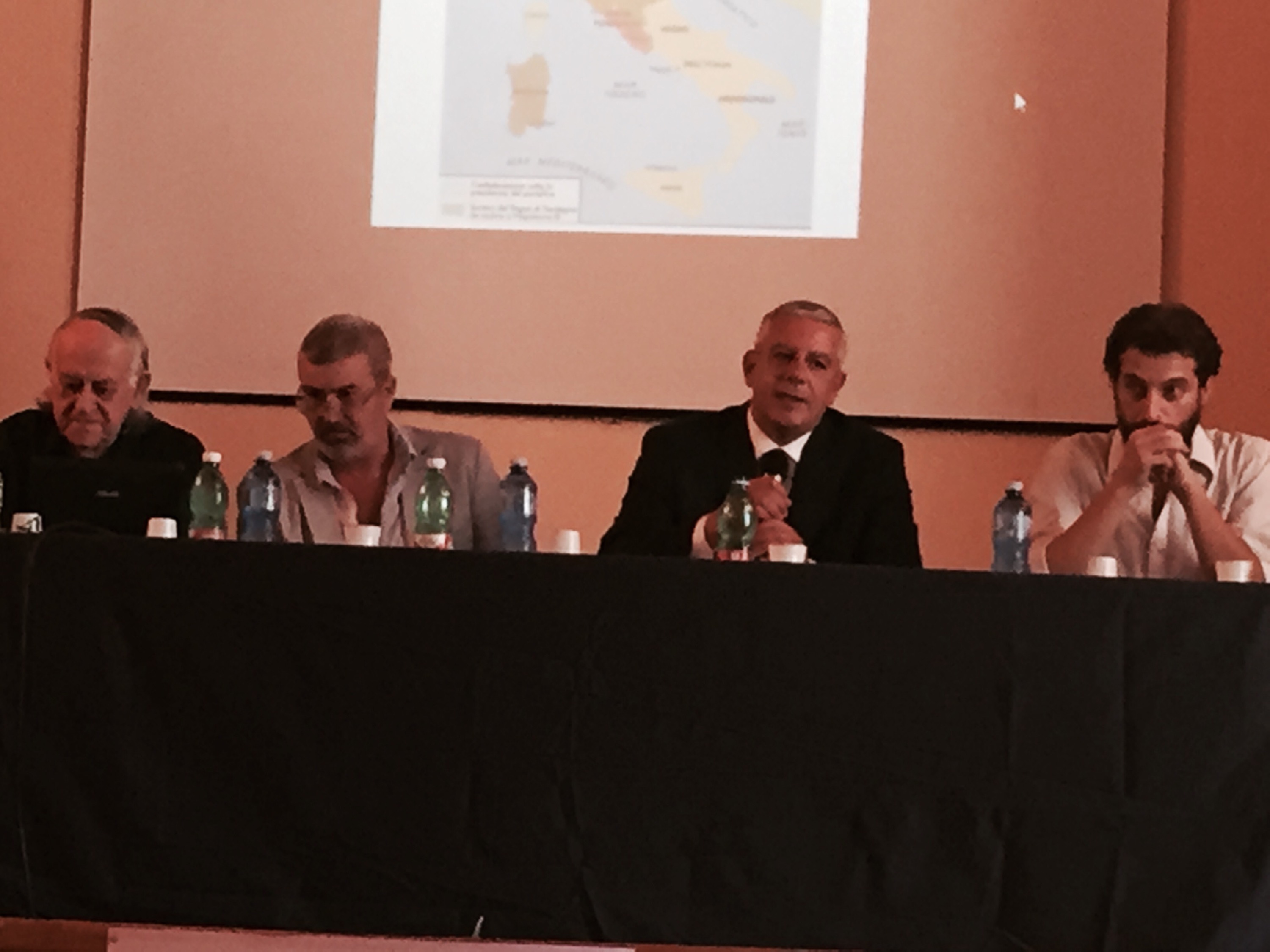
Prof. Renato Rinaldi, Gabriele Palladino, Sindaco Dott. Gianfranco Rinaldi,  l’artista Riccardo Fortuna

This presentation gave the community an overview of the project that will hopefully give a financial boost to Pontelandolfo.  With funding from all levels of government the historic center of the town is undergoing a much needed facelift. Buildings that have crumbled over the last 1,000 years are being restored, a charming park with a great view was just finished and the town council is committed to bringing tourists back – or perhaps here for the first time.

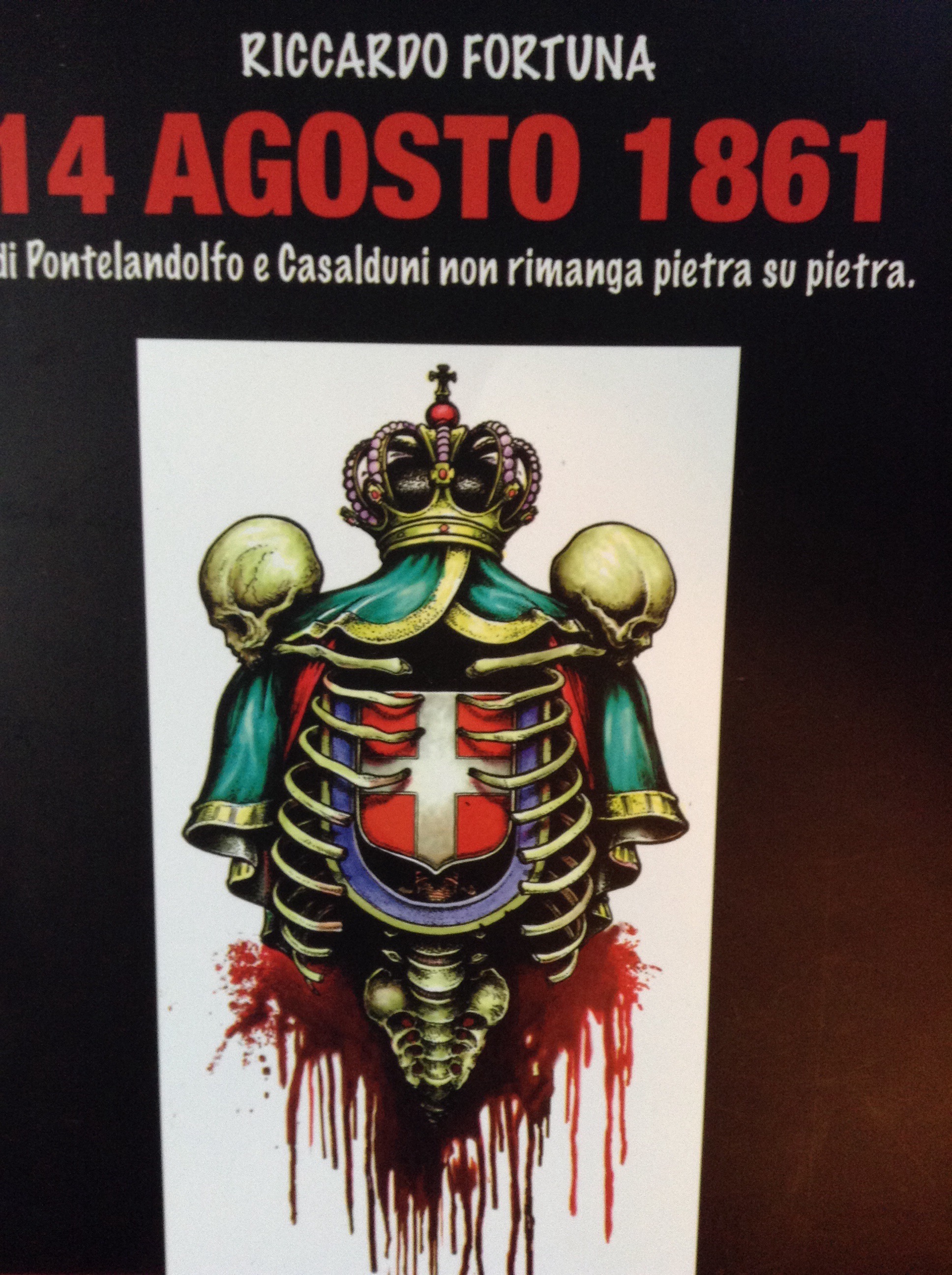
I know, I know this sounds like the dream and plan of every small Italian town – here is why I am SO PROUD.  Pontelandolfo came up with a very specific and chilling historic hook.  On the 14th of August 1861 the town was destroyed – burned to a crisp.  After being forced from their homes, men, women and children were butchered.  Is that date percolating in your brain?  This was during the not so peaceful march to unify Italy – risorgimento.  What – women and children were murdered?  Yup!  Rebels from San Lupo – folks who were content with their Burbone King –   had hidden in Pontelandolfo and popped out to kill a couple of Garibaldi’s soldiers. General Cialdini was in charge with getting Southern Italy to toe the unification line.  He wasn’t pleased with loosing a few men and sent 500 soldiers to Pontelandolfo and Casalduni with the order not to let a rock remain.  Hey – we are talking farmers here – no hidden weapons of mass destruction.  It was one terrifying and troubling night.  The story plays well – believe me – the underdog – rebels for a just cause etc.  It is quite the hook!  Books have been written about it – the most recent a Fumetto sull’eccidio di Pontelandolfo e Casalduni – graphic novel with great art by Riccardo Fortuna. Riccardofortuna.it. In 2011, the President of Italy actually apologized for the massacre.

Statue

Realizzato dallo scultore Mario Ferrante

Wonderful sculpture representing the horror by Mario Ferrante.

Check out this incredible website – the google offer to translate pops up – Pontelandolfo1861.  I hope they continue to grow this site and add more information for tourists – in a variety of languages.

During the presentation we heard from il sindaco Gianfranco Rinaldi – the mayor.   He announced that this was a two pronged program.  First the centro storico would be rehabbed, the website completed and signage describing the medieval history of the town and the night of terror would be placed around the town.  They also printed two pamphlets to describe the towns  history.  They are slick and I hope they will let me help create a set in English.  The art work on the large signs is wonderful and I am sure the Italian descriptions are perfect.  The English translations need some revision.

 Signs at worksites are popping up all over. Thanks EU!

The second phase is to attract tourists to come.  I am not sure how they plan to do that but hope they include an italo-americano in the strategy session.

SO PROUD!!!