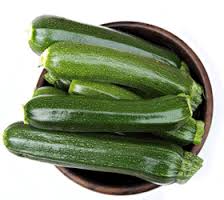
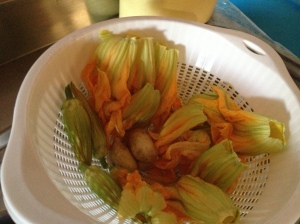
Everyday it seems there is a mysterious bag, basket or pile of zucchini by my door. These things must multiply like rabbits. Last year, it seemed like I was chomping down on zucchini blossoms daily. Bundles of fully formed zucchini didn’t appear because we were all to busy frying up the flowers – remember this post: Fried Squash Blossoms
This year, I didn’t get invited to imbibe as much in my favorite fried flower. Now I know why. People let the blossoms grow into long green meaty vegetables. But what is a woman to do with them? I can’t say no thank you – half the time I don’t know where they come from and the other half – well it would just be rude. I remember making tons of zucchini bread in Flagtown but we’re in Italy – so it is time to start finding out what the elders do.
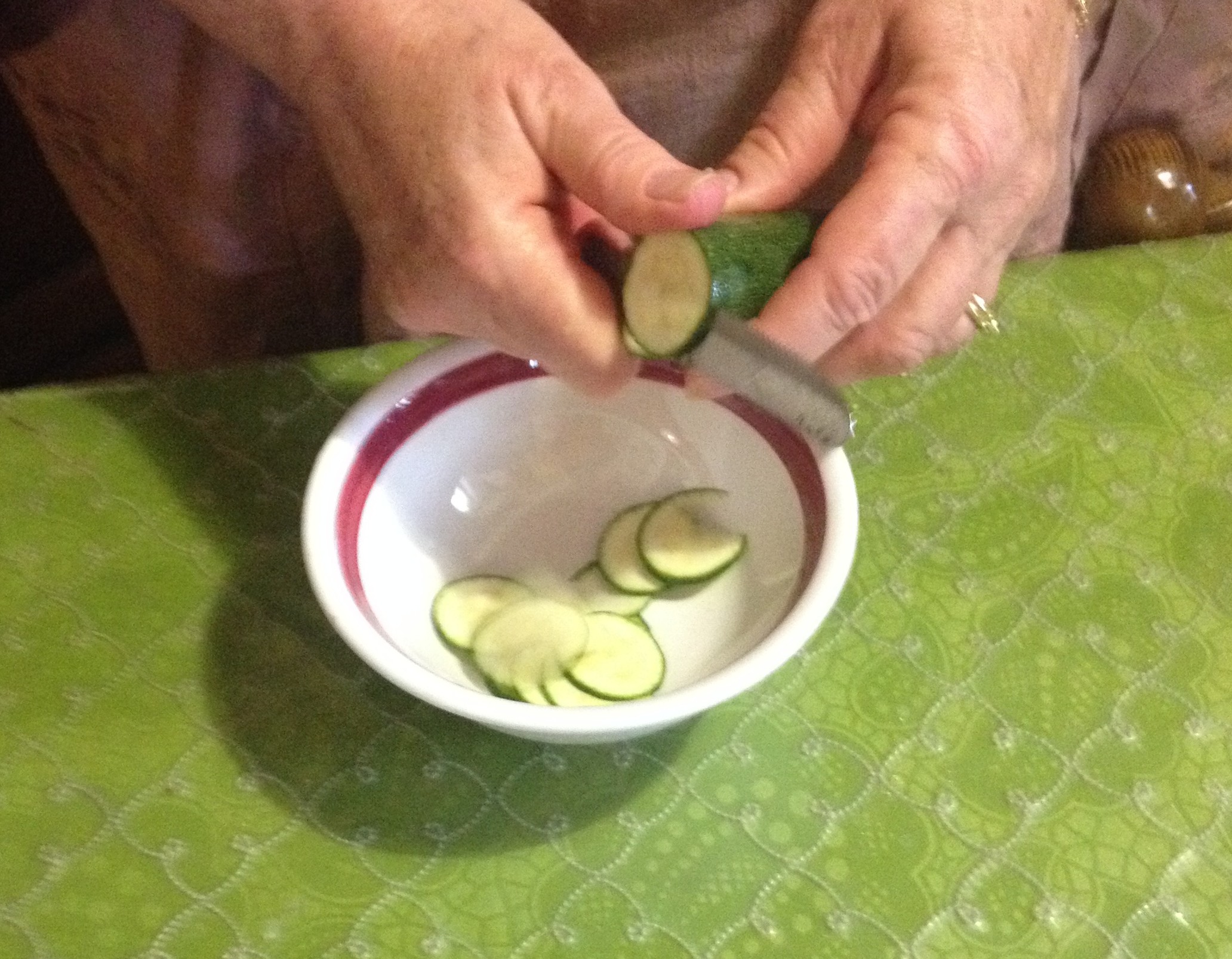
Zia Paulina taught me how do make a simple zucchini topping for pasta. Actually, she tortured me with a little knife by insisting that I cut paper thin zucchini slices without using a cutting board, mandoline slicer or food processor. None of my slices were thin enough – come carta – like paper! When I finally got the thinness just right she was pleased. Then I watched her dump some olive oil in a frying pan, sauté the zucchini slices and toss them with pasta and a healthy dose of parmigiana. Prima piatta was finished.
I decided to see if anyone else tossed zucchini with pasta – a quick web search found lots of recipes. Being an independent type, I ignored all the advice and just followed my instinct – the pinch of this, a handful and there you go style of cooking. The first step was to create the paper thin slices that really worked in Zia Paulina’s dish.
Note – I slice towards my thumb! How dumb but it works.
My smart ass husband watched me get closer and closer to lopping off a finger and he decided to show me how to get those paper thin slices. First he took out the potato peeler and peeled the skin off one cucumber. Then he cut it in half and started making short thin slices with the peeler.
Master chef makes quick work of the zucchini – but where is the cute green? Oh, next to the cutting board.
Jack’s system would absolutely work. But I wanted the zucchini – which I know had absolutely no yucky chemical crap on them – to have that cute green trim. White zucchini against white pasta couldn’t look very appealing. So I finished up the rest using the potato peeler on unpeeled zucchini.
Cripes, they didn’t teach me this in 4-H. What a cool use of a peeler.
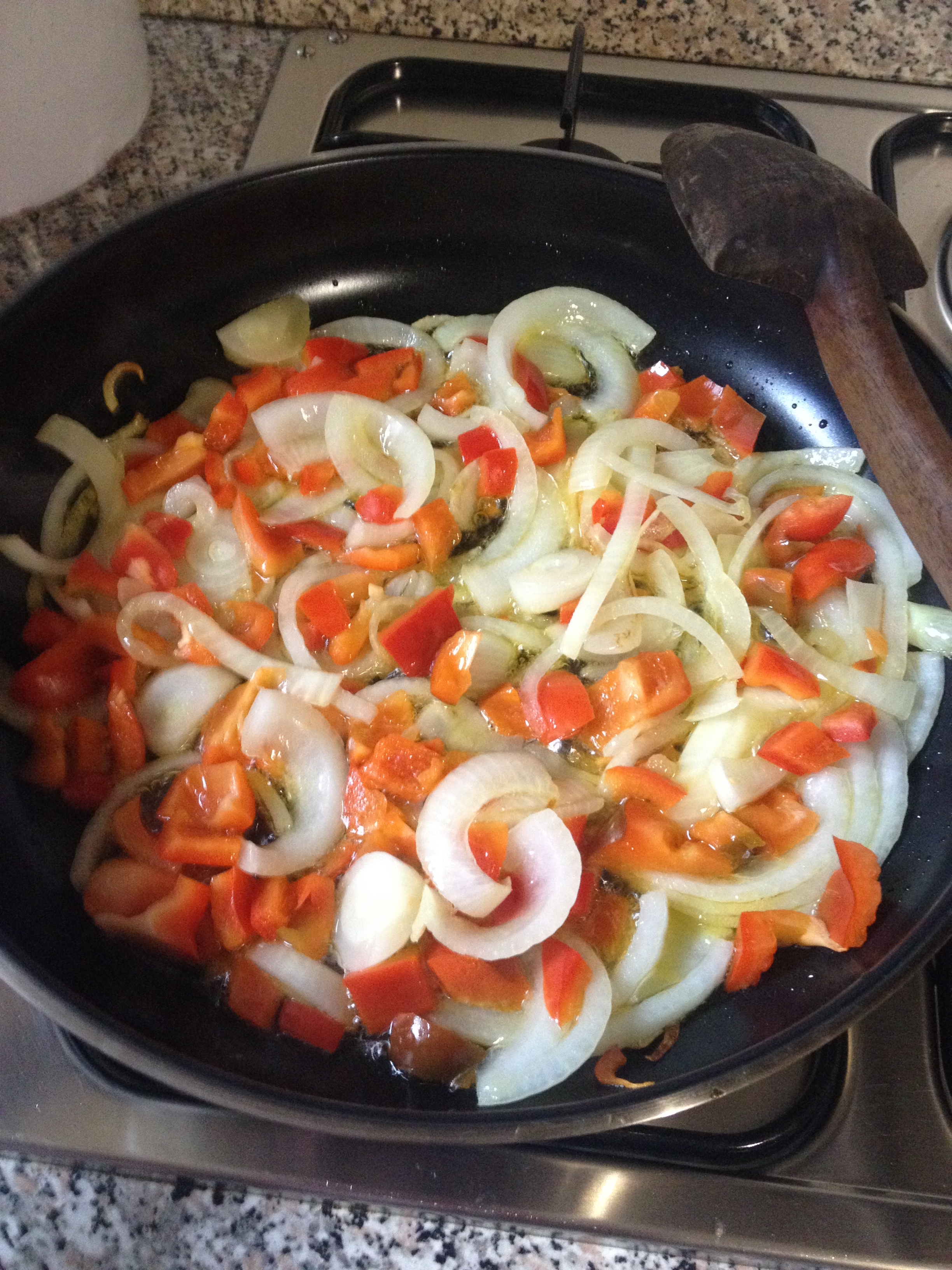
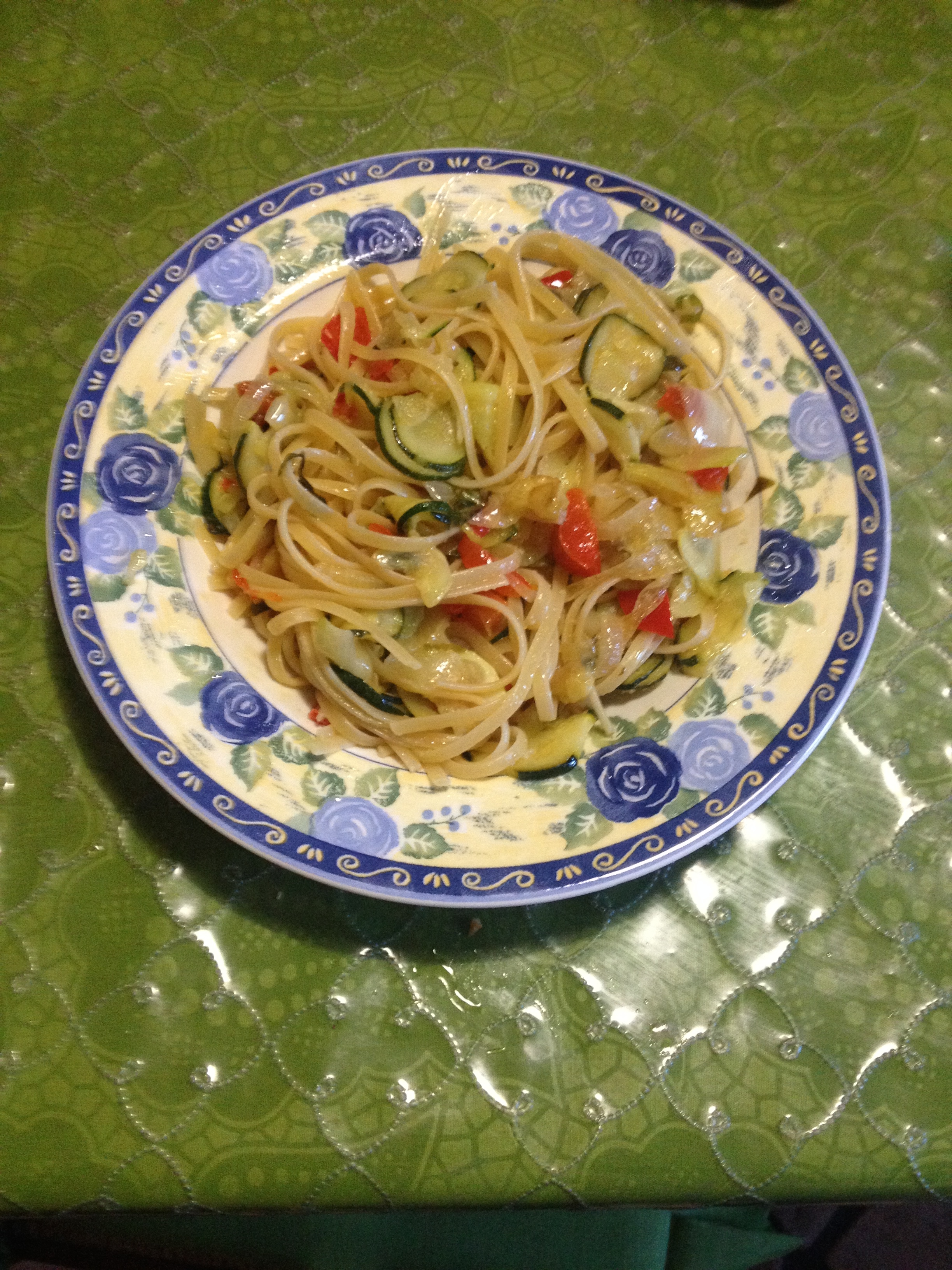
The actual cooking of the dish was much simpler. I sliced up some onions and a red pepper. Why the red pepper? Because I had it and I liked the color – back to white pasta and white onions and white zucchini – you get the idea. The olive oil that we have here is literally from the trees in our yard and pressed locally. It is heaven on the tongue all by itself. It really helps to use good olive oil for dishes like these. While the water for the pasta was getting up to boil, I quickly sautéed the onions and peppers.
What a beautiful red color! They do not sell green bell peppers here – because red means ripe!
Salt, pepper, a touch of garlic powder – I noticed that none of my Italian relatives cook with onions and garlic in the same dish. Loving garlic anyway I can get it, I tossed in the garlic powder. When I added the zucchini, I happened to look out the window at the basil growing madly and thought – why not. The basil added at the end gave the dish more color and a little zing. Here is the final product – I added grated cheese to the dishes before I tossed them. Buon appetito!
Pontelandolfo’s major festa is TOMORROW! The Festa di San Donato is the cornerstone of our little town’s tourism drive. July 31 is the kick off and we will all be exhausted when the festa is over on August 7th. The finale is a concert with a headliner act and fireworks. The week long event has historically brought tourists and an infusion of cash into the town. I’m told that years past, buses of American tourists searching for their roots would roll in. The oldest church would be open – not with vendors but with artisans and purveyors of local wines and food products. This year, no one that I’ve asked as been able to tell me if that is happening. I’ve only been in the ancient church once, many years ago and would love to see the inside again.
This is a religious festival but I can’t find a thing on any poster or web-site about when there is a mass or the procession. As a matter of fact, the town web-site doesn’t even list the churches. How could that be?
I’m thinking that as much as I love this town, it is hard to attract tourists looking to “see something” – you know to check it off their list. Like the millions do that race through the museums in Florence and take a selfie with David. Due to lack of funds – everyone blames “i crisi” – the small local museum is closed. The library is closed. And listen to this travesty – years ago, one mayor sold the commune’s one major historic attraction – La Torre – for hardly any money to some out of towner. Now that is closed to tourists and it’s secret garden – well no one knows because you can’t get to it – but I’m betting weeds. The tower is the iconic image of the town. Good old Prince Landolfi probably lived there. Now, no one sees it. Uggg
Our famous tower – a vacation home for some out of towner who is never here. Want to see if we can buy it?
This year, it looks like the town is prettying itself up for the week. I noticed men chopping down the weeds along the side of roads, the cement ditches are being cleaned.
Thank you to all who are working so hard!
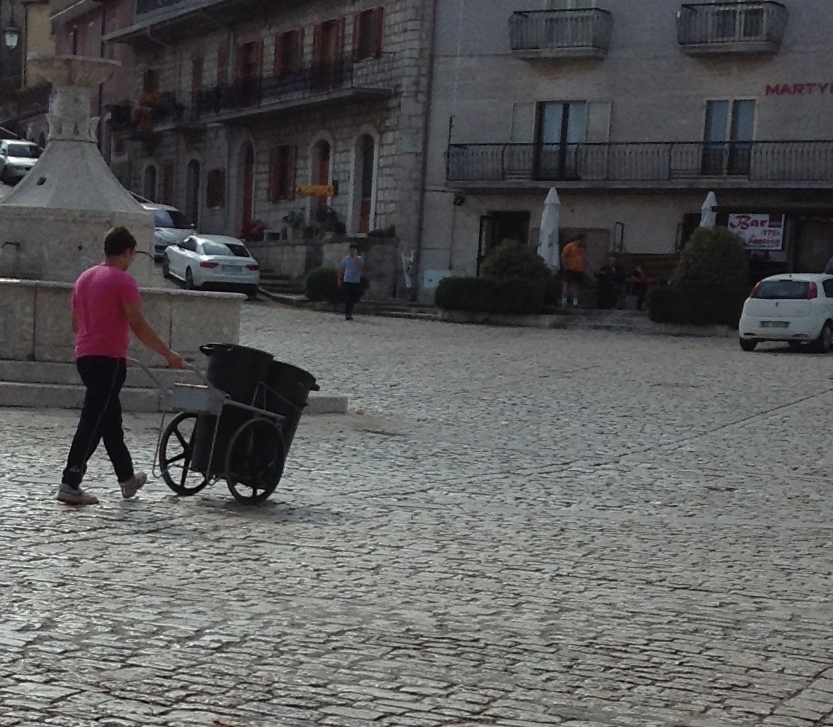
Normally every morning men clean the streets and the piazzas but this week I sensed a new bounce in their steps.
Every cobblestone is solid thanks to this man. No tripping in our town!
There was a crew in front of Bar Mix Fantasy sculpting shrubs. I noticed new plants set up around the out door tables at Nonsolo Pizza. The portable tables and chairs are stacked by all the bars. The sun is shining and all hope it will shine from July 31 through August 7.
Tomorrow, happy revelers will be sitting at tables!
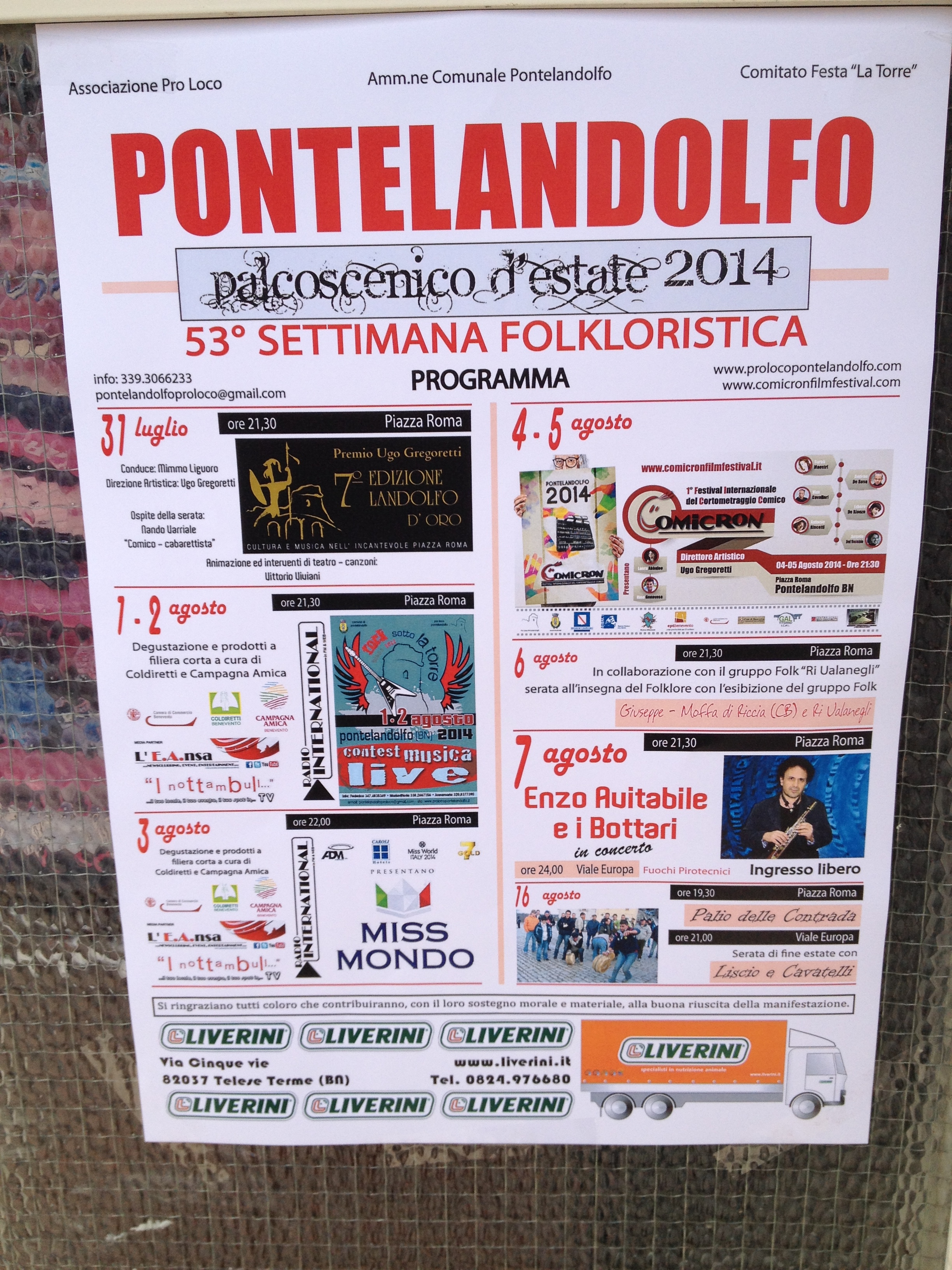
The other night we drove to Circello – a village about 30 minutes away and saw posters for the headlining acts plastered on walls. Every night of the celebration of San Donato there is something. (Could any of you good Catholics out there tell me what he is the special saint for? I spent an hour searching and couldn’t find anything related to this part of the world. One of the elders said that he was instrumental in stopping the plague here but that is all I got.) Here is this year’s line up. Tourists are already trickling in. Yesterday, I was standing at a bar having a caffè when a woman speaking the ancient dialect of the village – the first clue that it is an out of towner who had elders from here – picked up a candy and asked me if it had sugar. She couldn’t read the Italian. I asked her in English if she was American. She said, oh you don’t speak Italian. I responded in Italian that one candy didn’t have sugar and could I read the other. Are you proud of me? She and her husband were from Buenos Aires, Argentina. A good number of Pontelandolfesi immigrated to Argentina.
Today is Wednesday – market day – and I noticed a good number of folks I hadn’t seen before. One visitor, who was driving and staring at the vendors ran smack into a parked truck. Ooops! I’m told that many people come during festa time to visit their relatives. Not a bad idea! I tried to convince mine to come but didn’t have any takers.
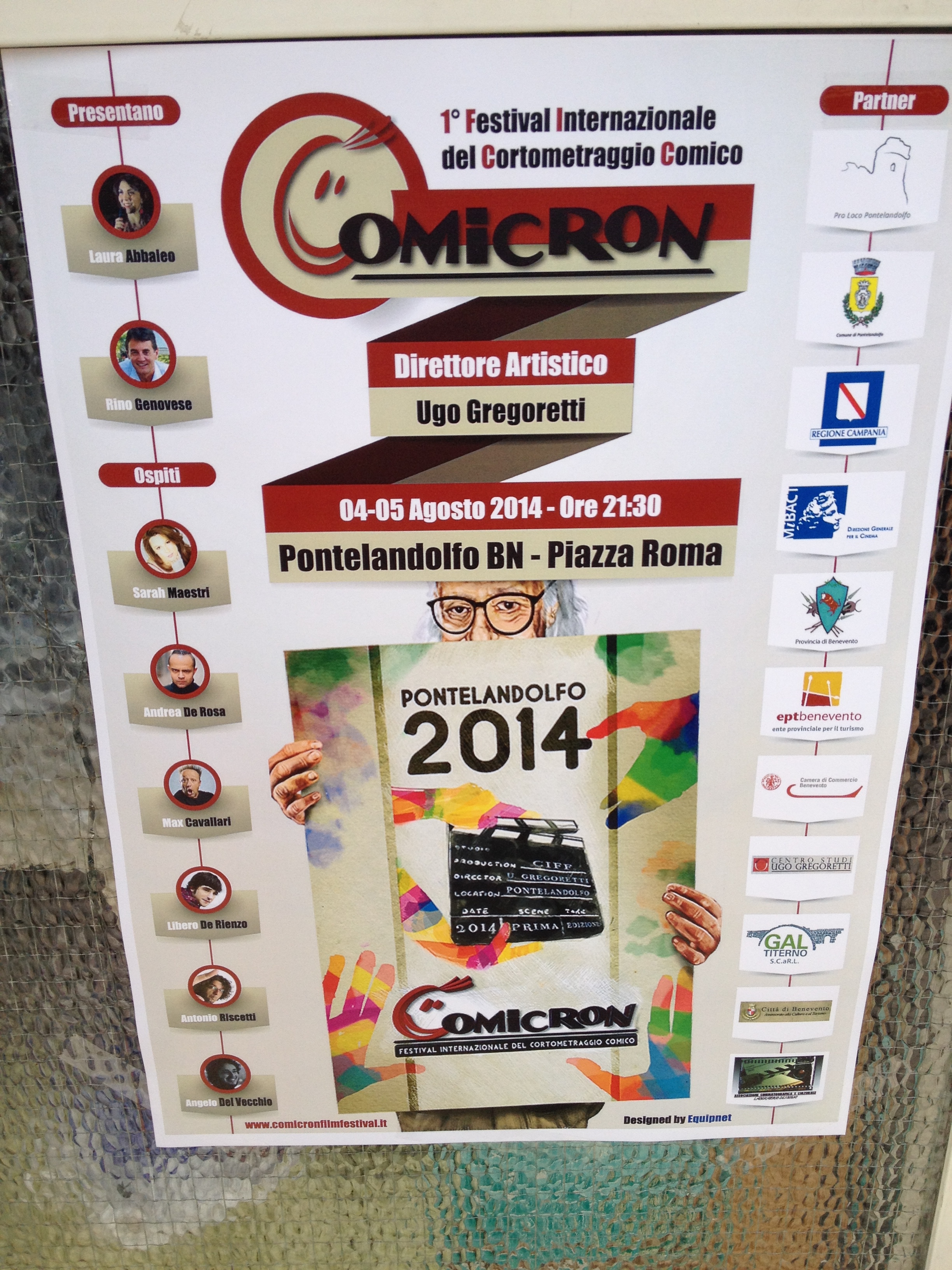
With help from the producers and production companies that are providing the shows, Pontelandolfo is really trying to promote the events. Last Monday, July 28th, as part of the television program “UNOMATTINA Summer” on Raiuno the hosts interviewed the artistic director of the Award program “Hugh Gregory – Landulf d’Oro” (scheduled for July 31) and “Comicron”, the first international festival of short comedic films scheduled on August 4 and 5. That my friends, brings this year’s festa national attention. I’m hoping tons of people come and all of the businesses make a little extra money.
In this time of economic struggling, I kept asking folks who the hell was paying for all this. Everyone said, we are! I didn’t quite get it until two business owners explained it to me. A committee went door to door asking every citizen for a donation. Hey, as I used to tell my Arts Management students, it doesn’t hurt to ask. Folks are so proud of the festa that the majority gave what they could and were rewarded with a flier that listed the events. To be a sponsor and hang a banner cost about €200 per business. In other years, I’m told, it cost €500. Bottom line, everyone contributed to the best of their ability.
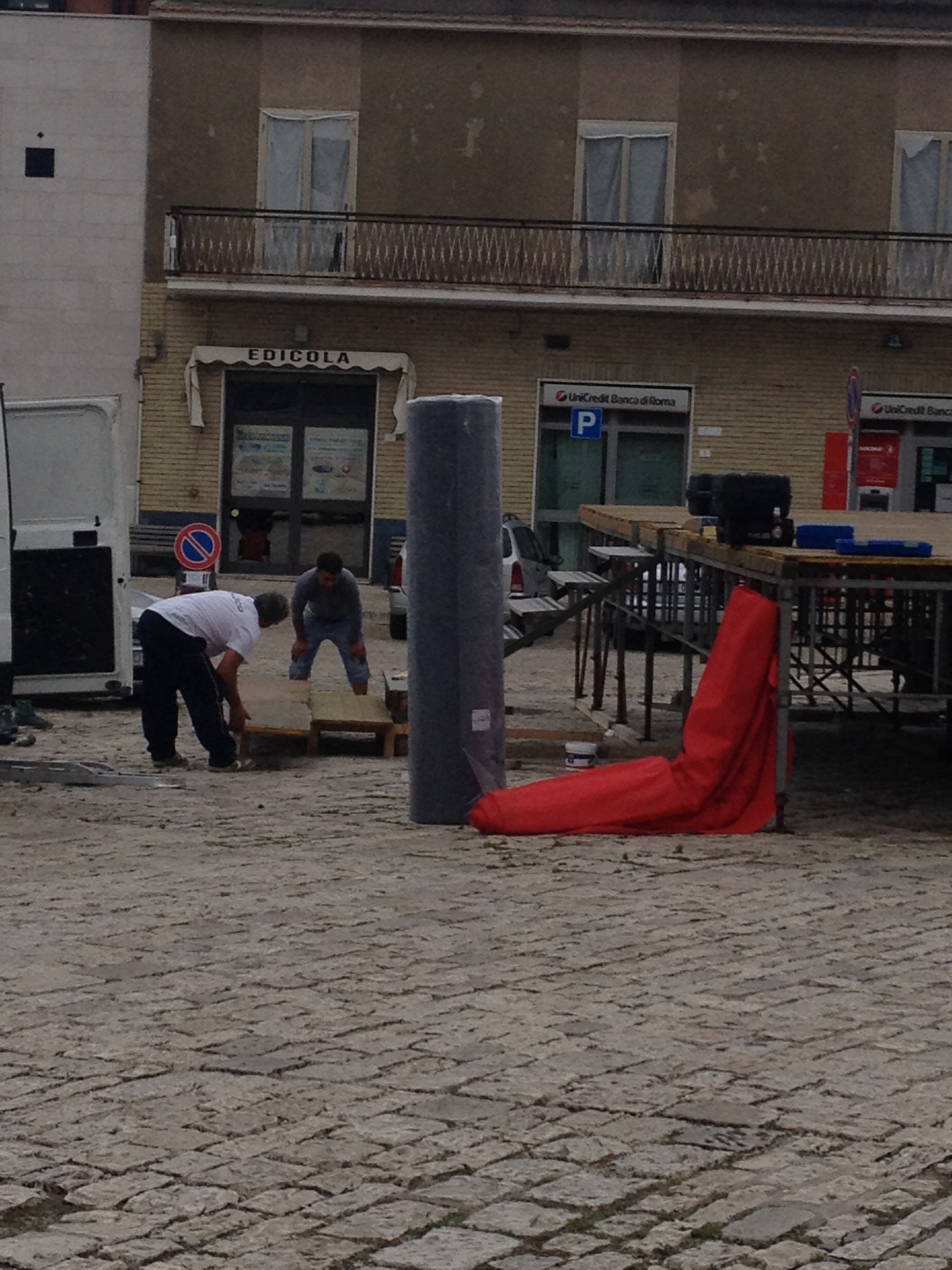
Putting the finishing touches on the huge stage.
I’m excited to see and hear everything that will be going on. Of course nothing starts before 9:30 PM so a nap is important. Keep your eyes peeled because everyday, unless the late night partying is just too much for me, I’ll write a post about the event of the day. Please, please send me energy so I can send you stories!
If you can’t make it to Pontelandolfo, but can get to Connecticut, why not check out the next best thing San Donato Festival in the USA – Waterbury Connecticut http://www.ponteclub.com/festa-di-san-donato-2013/
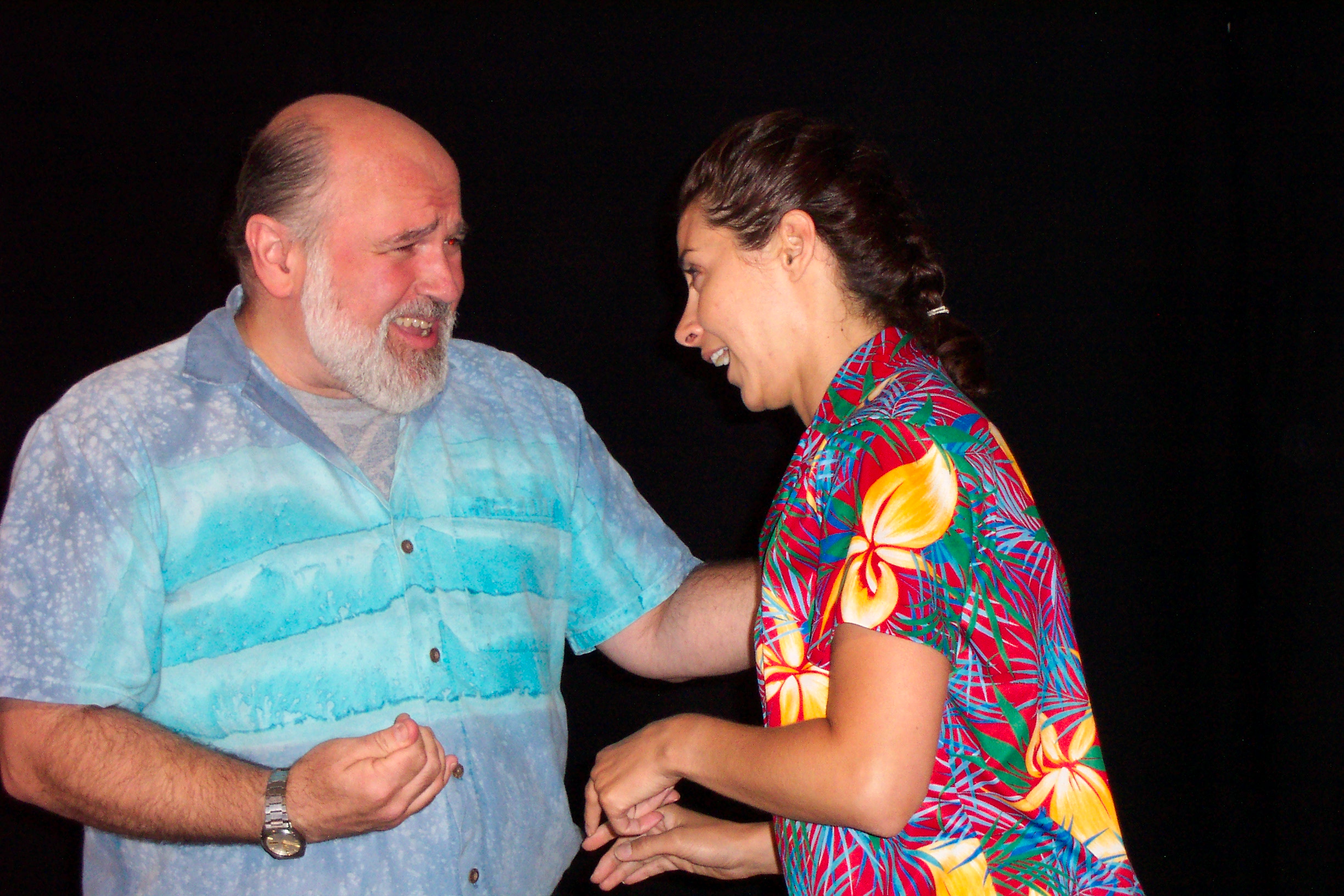
George Hansel & Tracey Paleo in NY Production of my play “Annarita.”
My friend George Hansel is the second of my Asbury Park pals to become an Ex-Pat. Maybe it was all that sea air that got us to looking beyond the Atlantic Ocean. George married EB, the Dutch love of his life, and moved to the Netherlands. His journey is full of love and the quirks of being the new boy in a very old city. I follow his blog and when I read this story – a history of one of EB’s elders – I felt I had to share it. We all have someone in our lives who has helped shape us into who we are today. Willy is one of the folks who has had an impact on EB. Read George’s blog about Willy. While your at it, why not look at some of his earlier posts and subscribe. Yeah, you got that right, for years George and I have had a mutual admiration society. He took dramatic chances by producing some of my plays and asking me to direct for his company. It was a joy to see him act in my play Annarita. I love George and know that if you read his work you will too. http://blogdenhaag.wordpress.com/2014/07/22/sunday-at-the-beach-with-willy-sunday-20-july-2014/#comment-41
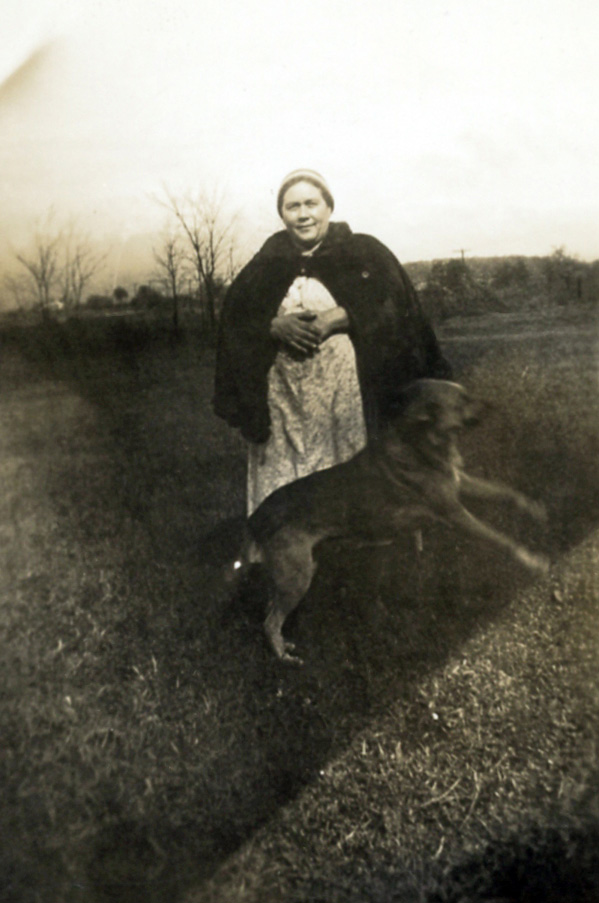
My woo woo pals will not even blink when I say that at 7:00 AM the other morning I bumped onto my grandma. She died when I was 16 but I remember her vividly – it was her.
Wearing the same kind of caftan I had on when I first saw Ruth St Denis, whoops that’s the mom of modern dance and she has nothing to do with this story. It’s just the magic of the caftan. So wearing this old tied died caftan, I was walking in The field across the street from my house carrying a plate of apricot peels. As I started to toss the peels into the field – there she was. Smiling because I hadn’t been lazy and walked way out onto the field just like she taught me.
Whew, where did that memory come from – why was she here now? When I was a wee thing we had pasta at grandmas house every Sunday. After the locusts in my family had managed to eat everything but the mopeen – dish rag we all used to wipe our saucy fingers on – it was often my job to take the pile of bones and other table scraps out to the field. The instruction was walk far and toss. Sometimes a lazy kid would just dump the plate at the edge of the lawn. ( Jack screams at me now because I’ve turned into a lazy kid and dump on our Flagtown lawn line.)
This was a no no and would draw rats close to the house. We didn’t have a fancy compost pile or Eco box. We had the field. Foxes loved the bones and they were soon gone. The egg shells and the veggie scraps were great for revitalizing the earth. Now 60 years later, here I am in the place where my nonna learned that doing a field dump wasn’t a trailer trash thing. It was simply keeping the cycle of growth happening.
That morning I was doing something I know she had done. The field was a recently shorn hayfield. The feral cats and foxes still eat any meat stuff and the rest just rots back into the soil. Maybe next year this field would be a potato patch – enriched by or simple veggie scraps.
What struck me was how the simple action of tossing apricots peels brought my nonna back to me. She was there making sure I walked out far enough and did the job right. This had a colossal impact on me. After a year long painful inner dialogue about selling our house in NJ, it was this moment in a field that nonna made me realize that I could. The farmhouse was my grandma’s and is the place where I feel the presence of my elders everyday. Nonna let me know that wherever I am they are and all is OK.
Jack and I rented an apartment for a week in a cute seaside town. The Adriatic Sea is just over the mountain from Pontelandolfo. It took us an hour and a half to get to San Salvo. That’s a hop, skip and a jump to a fabulous beach resort. Having lived in Asbury Park and Jack’s growing up in Sea Girt, we are pretty familiar with life at the beach. Well, life at the beach here is a wee bit different than a visit to the Jersey shore. First of all, I wasn’t the pack mule carrying an umbrella, chair, cooler, towel, hat, book, water bottle etc. I was a lady of leisure with my own little spot on the water line.
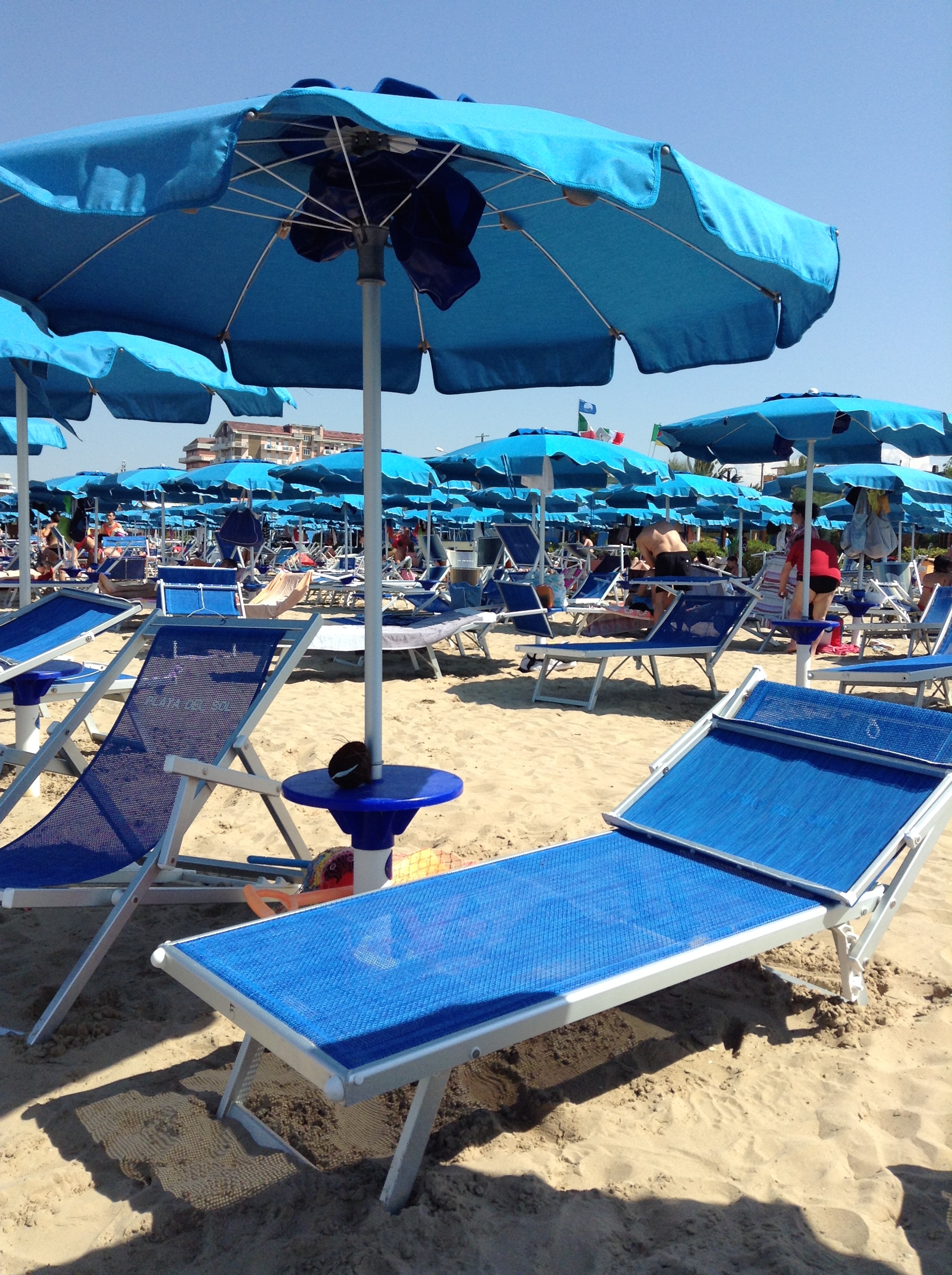
When we first got to San Salvo I scoped out the beaches across from the apartment. One of the things I love about Italy is the beach system. There are totally free beaches that are well maintained or you can rent a fully furnished spot on the beach. I was determined to get the best deal on renting il posto for a week. This would include 2 lettini (lounge chairs) separated by a little round table with the requisite umbrella. Since it was June and not yet high season I was looking for a sconto. The seasonal price for a week averages €100. For €70 we rented a prime spot in the first row of set-ups with the sea lolling in front of us. Ahhhhhh. No schlepping chairs to the beach – just a bag with our iPads, sunscreen and towels. This beach, as they all did, had a bar. Who could ask for more!
Lounge chairs, a table and an umbrella opened by the friendly beach boy.
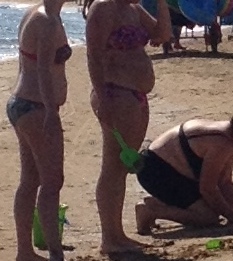
While I was lying about reading novels and staring, what struck me smack in the face was how secure the Italian women were and insecure I was. There I was hiding in a beach coverup, hat, towel and just about anything that would disguise my 65 year old pudgy body. There is something about self esteem and bathing costumes. Italian women exude an incredible self confidence and sexuality. That was made even more apparent to me in San Salvo. Scantily clad women of all and I mean all body sizes and types were strolling along the water line. Teeny tiny bikinis were the fashion of the day on everyone – but me. There was no hint of I hate my fat ass and am hiding it under this diaphanous skirt.
These women were laughing, charming, sexy and confident! I hid.
Bare topped little girls, hair streaming as they ran and played, were not embarrassed by their bodies. Even the chubby ones frolicked like nymphs. I’m not saying that I had a lousy childhood. I’m saying models of security begat secure children. Here, that really hit home. Growing up I was used to covering up – hide those imperfections – from Clearasil for zits to bows in my hair to draw attention from my too skinny little girl face (yeah, hard to believe that now.) Thank God I came of age in the 60s and started to uncover but still felt I was too fat, too skinny, too not right. I sat on my lettino staring at the Adriatic Sea thinking about all of this self esteem stuff. Feeling pretty and good about themselves seems to be part of the Italian female DNA or is it cultural? Yikes, I’ve got the DNA it must be cultural!
OK, your bored with this topic.
The Condominium – We were on the top floor.
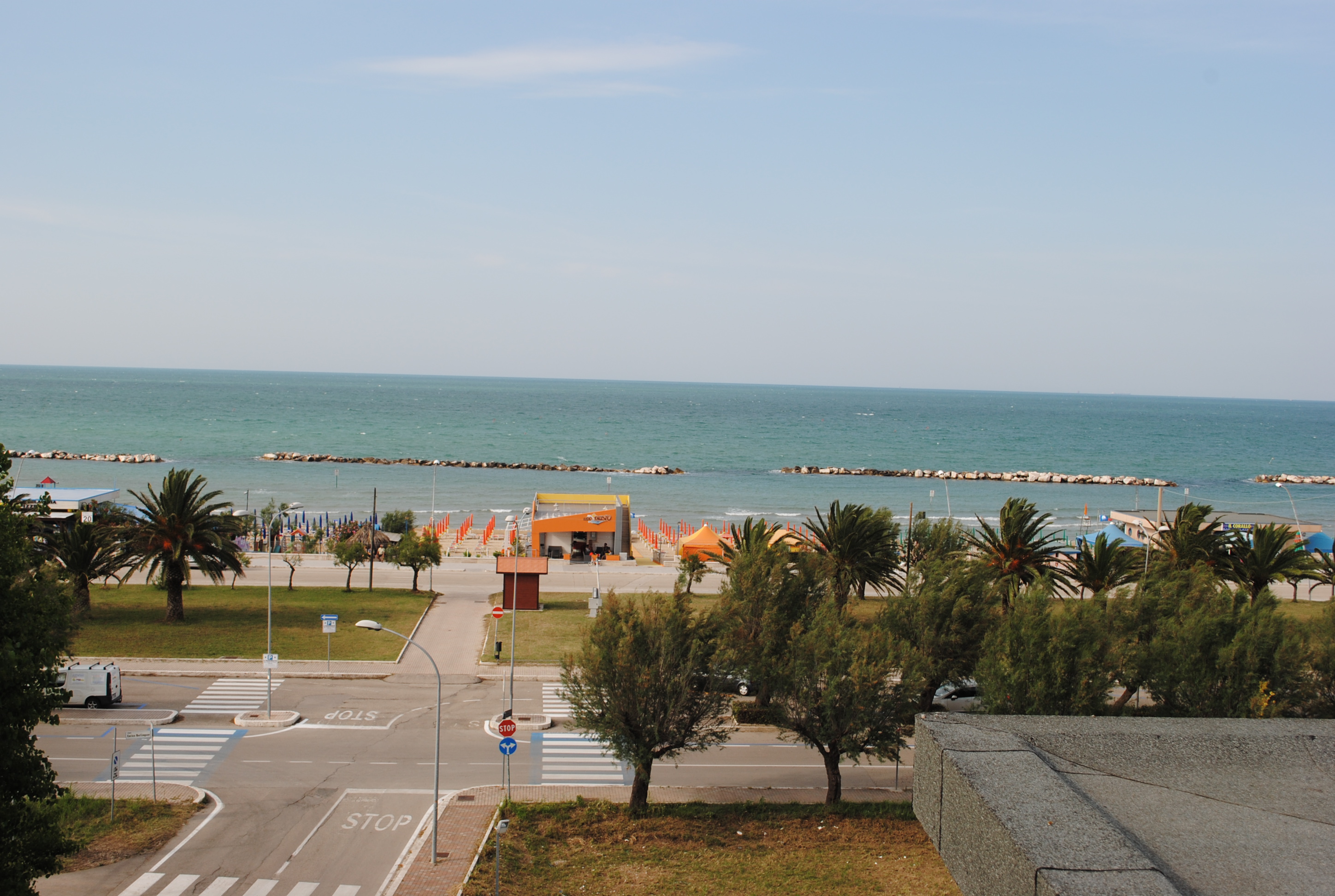
Back to San Salvo. We rented a 2 bedroom apartment with an ocean view – if I stood on my tip toes I could see out the windows. It only cost us off season €250 for one week. It was on the 4th floor of a building that needs its condo owners to take a little better care of the exterior. The elevator only went to the 3rd floor which was perfect – I considered the steps my daily stair master workout. The apartment was small but clean and the owner was charming. I’d rent it again. Actually, I’d rent his second apartment on the same floor – it has a giant terrace facing the sea. The best part was that we were a scant 2 unencumbered blocks to the sea. Here is the link to one of the apartment listings: http://www.mediavacationrentals.com/campomarino-vacation-rentals/0006966000/84945.
View from our Kitchen window. Our blue beach is on the left.
The Adriatic is incredibly calm. It is easy to see why families come here. I could walk out for at least as long as a football field and still only have water up to my waist – at high tide.
Jetties defined the beach bathing area. It was June so the beach was not crowded during the week.
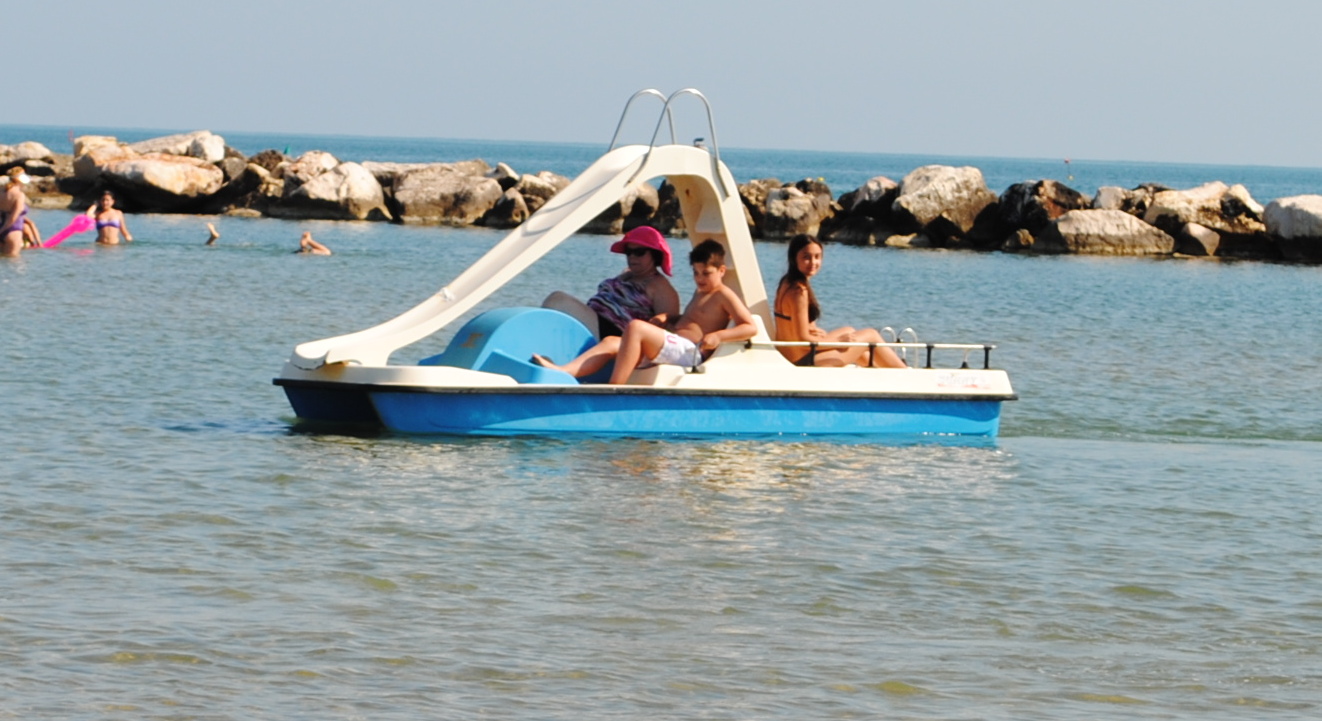
The best part of the week was when Rosella Mancini, Pasquale Iacovella and my favorite Pontelandolfo kids – Alessio, Gabrielle and Annalaura – came to visit. I rented a paddle boat with a slide and got a great butt workout pedaling around for a hour while the kids slid into the water.
That’s me hiding from the sun in the pink hat.The sliding board was a great idea.
The market comes to San Salvo on Sundays – even before church there were folks shopping. They line up the market trucks along the pedestrian beach walkway. I bet there were 100 stands selling everything from artisanal cheeses, breads, preserves to electrical supplies. The clothing stalls were more high end than the trucks that come to Pontelandolfo. We all ate lunch at one of the pork stands – yummy roast pork on crunchy hard rolls. I would take a ride back on a Sunday just to go to the market.
The vendors went on for blocks along the walkway.This vendor was snoozing. Guess business was slow.Great colors everywhere.
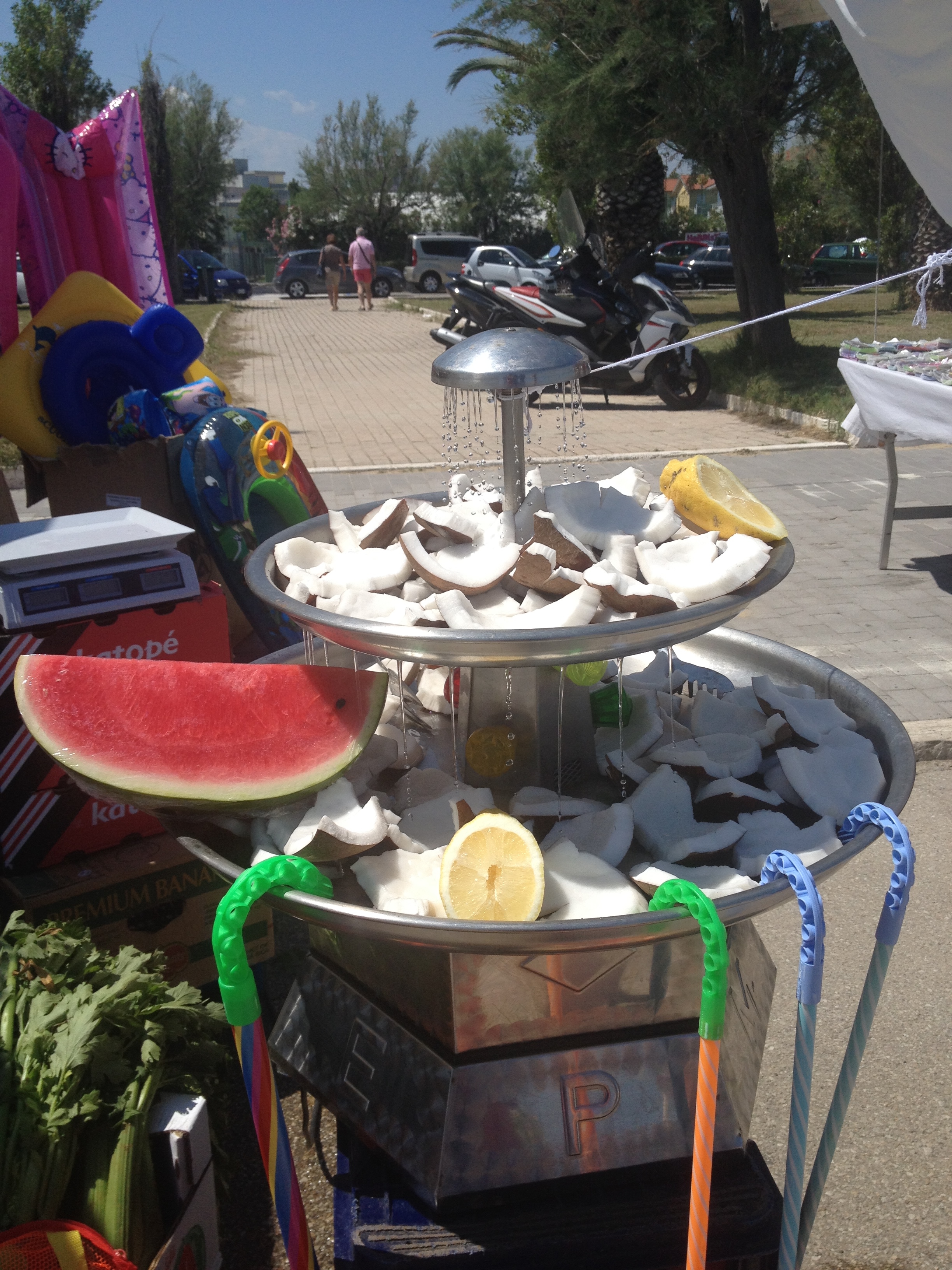
Does coconut grow in Italy?
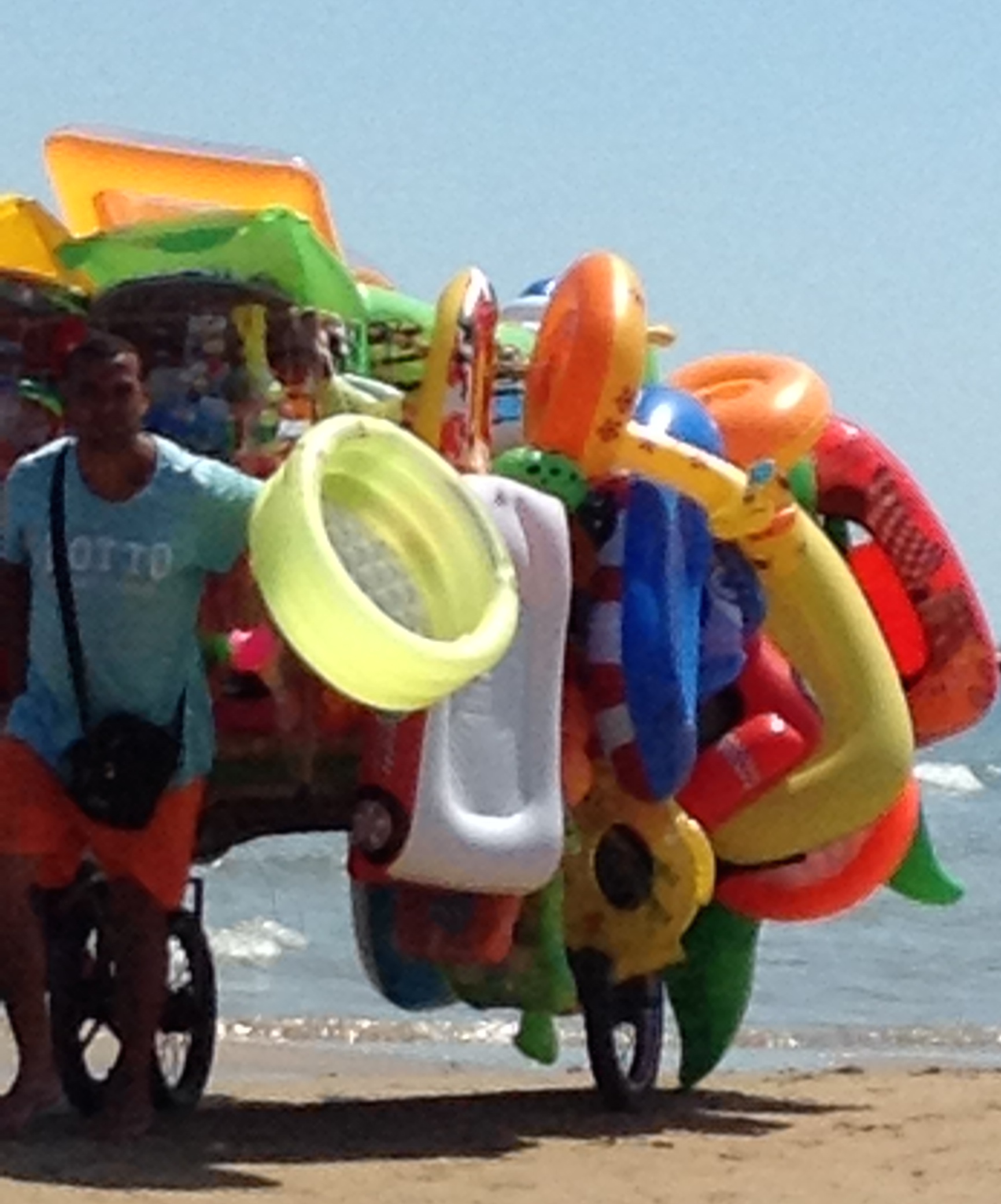
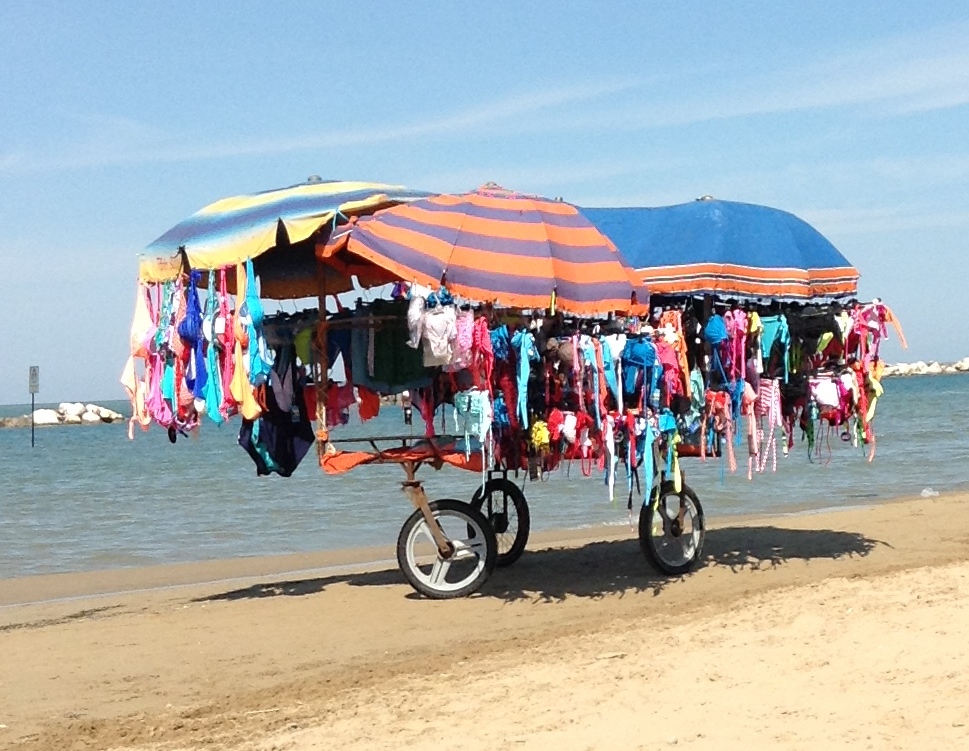
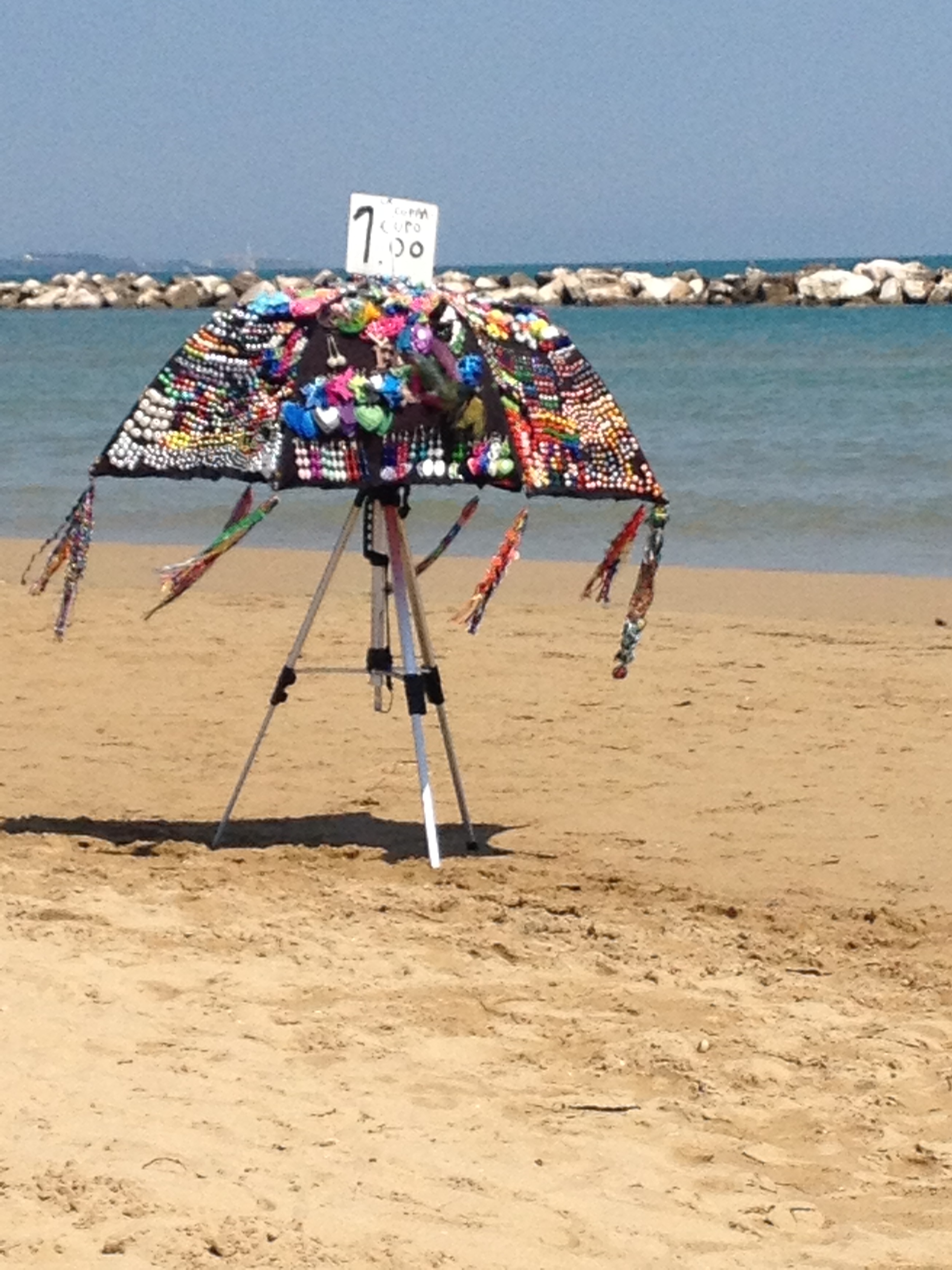
For those of us who were just too lazy to get off our lounge chairs and walk to the market – the market came to us. Every day vendors of all types strolled the beach. Looking for gold – well maybe it was gold – here comes the guy with the velvet cases. Want your hair braided? How about a henna faux tattoo? Coconut milk to slurp – here comes the rolling cart. Need beach toys – no worry – just raise your arm and the vendor delivers. Rats – you spilled goop on your bikini – for €10 you can get a new one. I loved the action between the vendors and the beach goers and I perfected my ,”no, grazie.”
Wait – I need that wading pool.Color, fashion and a cheap price – who could ask for more!?
What a clever way to display jewelry and walk on a sunny beach.
Moms and grandmoms were buying colorful scarves – not for themselves but for the boys in the family. The pirate look was DE RIGUEUR for all young men – really young. Have you ever tried to get a boy to keep a sun hat on? I haven’t but I’ve seen moms prodding, threatening etc. The pirate look was everywhere and no one’s little head got burnt.
Ahoy matey!
We found a super restaurant, Porto Turistico La Marinelle Osteria del Mare, next to the yacht marina. We quickly became regulars – by that I mean we ate there every other day! We would sit outside, look at the water and order fish. Of course, we were usually there before anyone else and the family was just setting up. 8:00 PM is a bit too early for Italians to venture out for cena. The family didn’t make too much fun of us and were charming to the American who was butchering the pronunciation of the fish. Fresh food, all prepared in house and a nice family staff.
San Salvo is just down the road from Termoli a really interesting beach city with a terrific downtown. Lots of bars, shops and historic sights to peruse. We visited on a day Italy was playing in the Calcio World Cup – every bar but the one I picked was jam packed with folks dressed in their best “go Italy” costumes cheering on their favorite team. We went to the only bar that didn’t have a TV set up – “go aperitif”. Not only did we get the requisite Compari soda for me and white wine for il mio marito but it came with an adorable plates of little snacks. We sat, listened to the sea, munched and watched the world go by. Ahhhh.
Toss the SPF 50 in a bag and visit San Salvo – you’ll be glad you did.
I had been coughing for three days – you know that deep you can’t sleep barely move kind of coughing. The ever wonderful Carmela Fusco insisted I visit the doctor. Last Wednesday morning she pushed me up the stairs to the doctor’s office. After the visit and a trip to the farmacia to pick up antibiotics etc, we sat down at Bar Mix Fantasy for a cappuccino and a cornetto – I needed food in my stomach in order to take the pill. I looked like hell, red nose, dirty hair, don’t touch me I’ll kill you look on my haggard face. OK, you got the back story?
As I sat staring, my head so congested I can barely hear, breaking through the clogged head barrier comes “Sei tu Midge?.” I glance over my right shoulder to spy a tall distinguished gentleman looking down at me. “Si” I reply, “Sono Midge.” Carmella smiled at him and said “Ciao Renato”, so I knew we were OK.
Prof. Renato Rinaldi had wanted to meet me and recognized me sitting there – I’m not sure how – and introduced himself to me. “Buon Giorno,” I say – delighted to meet the esteemed gentleman but also embarrassed at how I looked and felt. You see, I had contacted him a while back to let him know about this blog. http://www.nonnasmulberrytree.com and wanted to meet him. Prof. Rinaldi is the creator and editor of Pontelandolfo’s local on-line news magazine – Pontelandolfo News. He is a Pontelandolfo activist and advocate. Check out his web-site at http://www.pontelandolfonews.com/
I often read the Pontelandolfo News to find out what is going on locally – from politics to real estate. It contains link to news articles on other sites, info on local businesses, reports on government and well, lots of material on Pontelandolfo.
After chatting for a while, Prof. Rinaldi made me an offer I couldn’t refuse, he said that I had his permission to use content from his website for this blog! Grazie mille! I will absolutely take him up on his generous offer. But more than that, he said he had a gift for me and popped back to his car to get this –
By Prof Renato Rinaldi
I was incredibly flattered and touched to receive this huge book. It represents years of research and editing. As the editor, Prof. Rinaldi has created the ultimate compilation of documents that recount the heinous burning and mass murder of Pontelandolfesi on August 14, 1861. Last year the young theater folks of Pontelandolfo staged a venue specific theater piece and frankly, that was the first time I truly understood the story of Il Brigante.
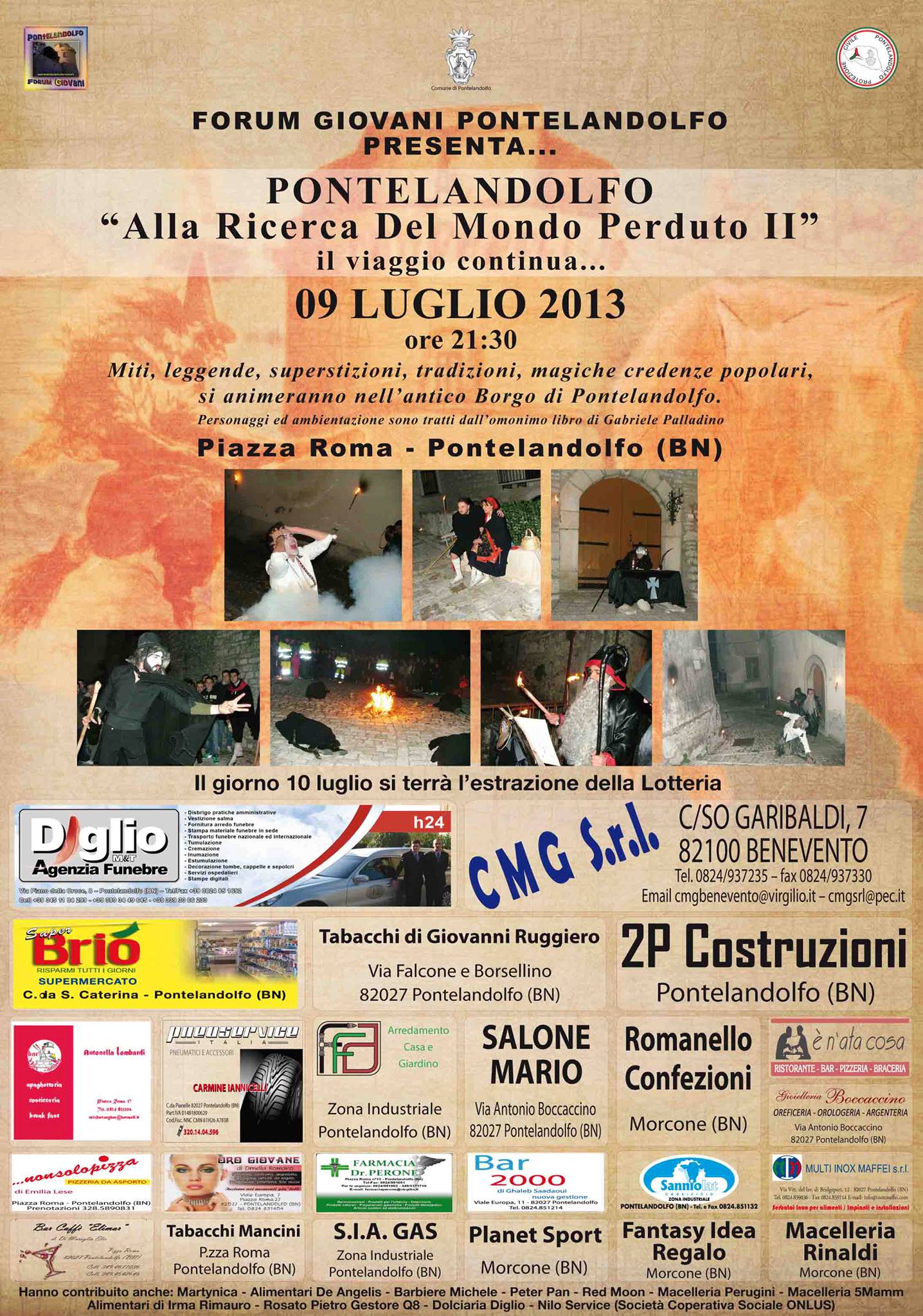
Poster from last year’s show. The work included more than just the massacre story.
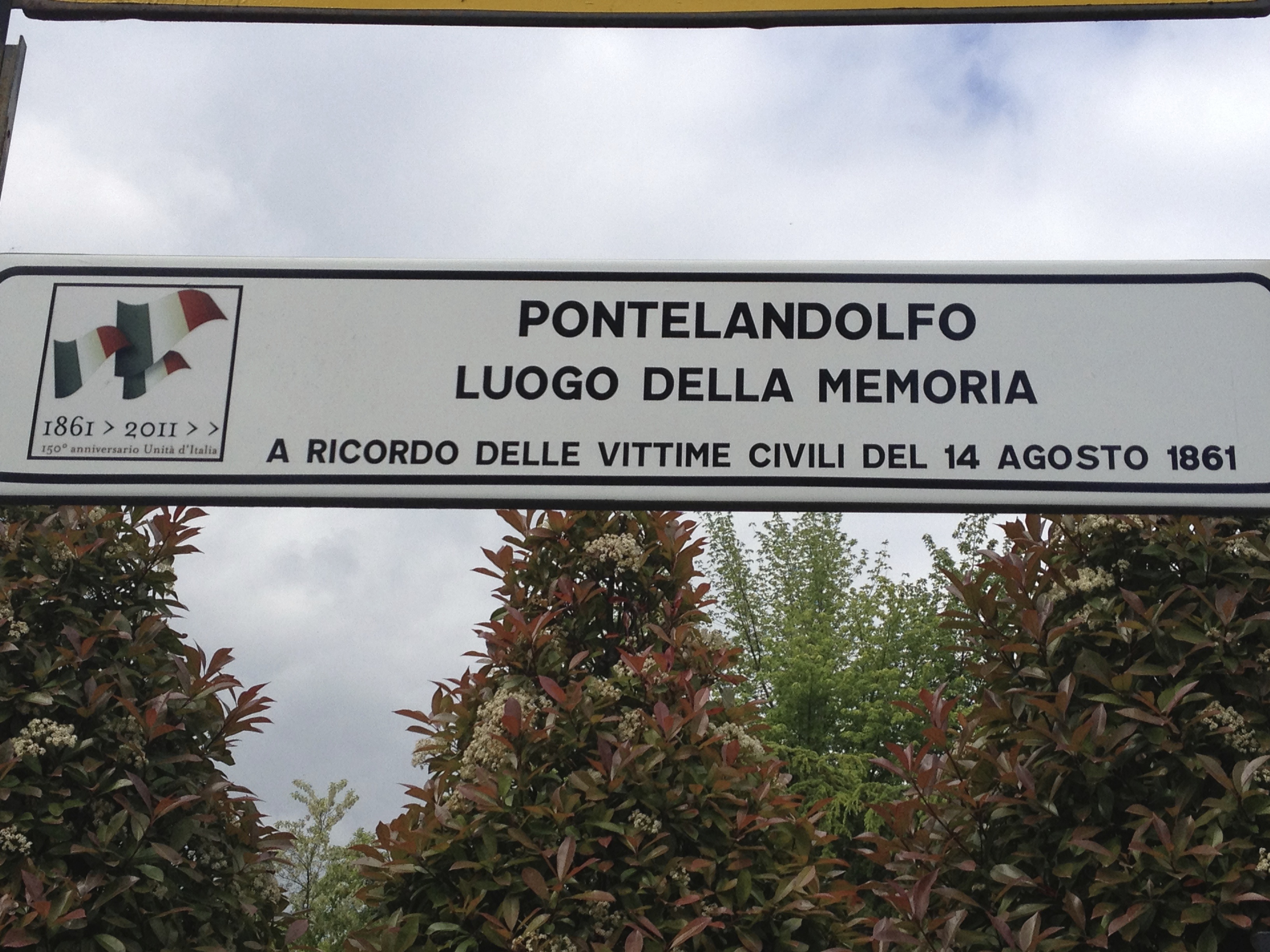
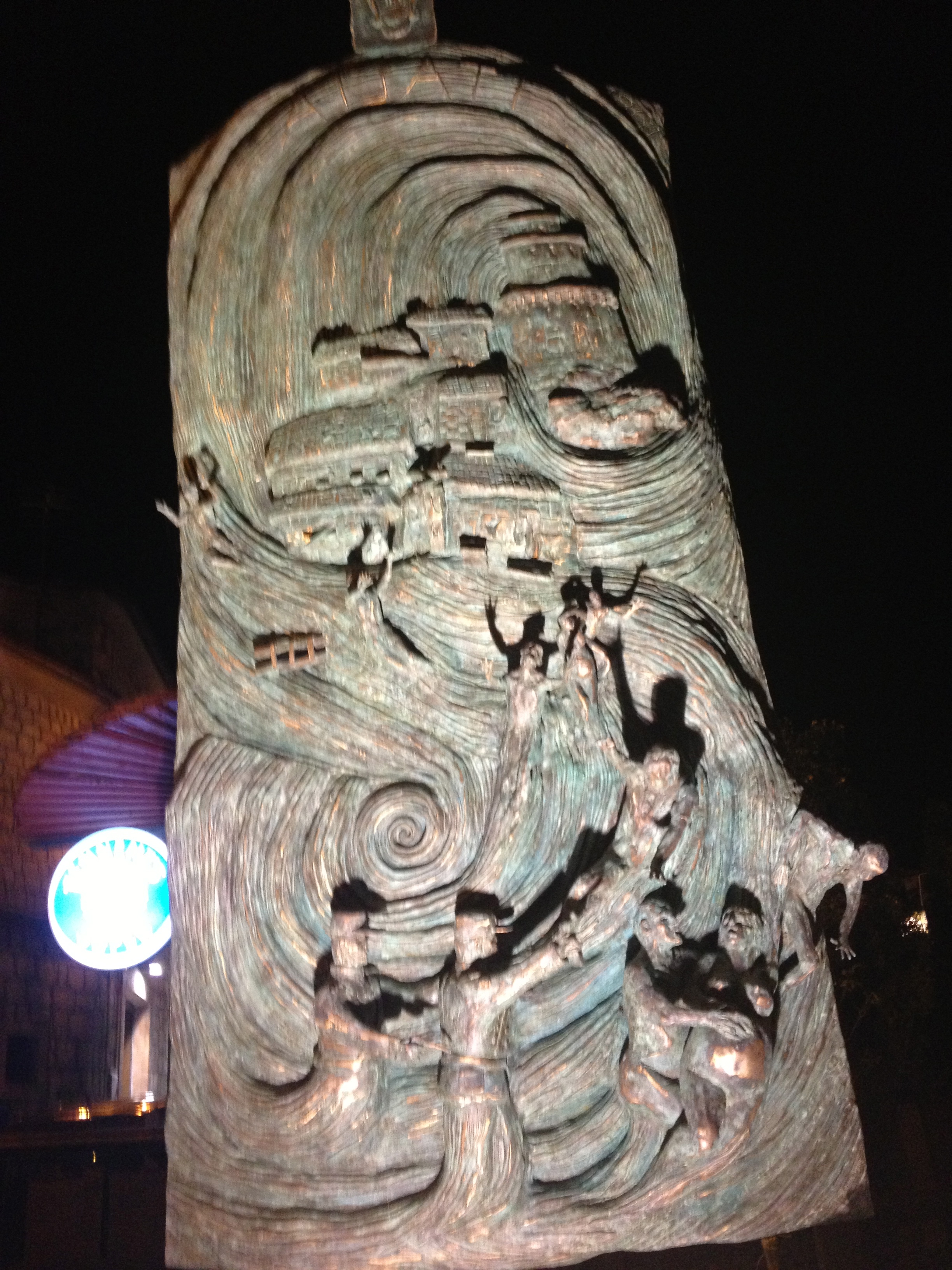
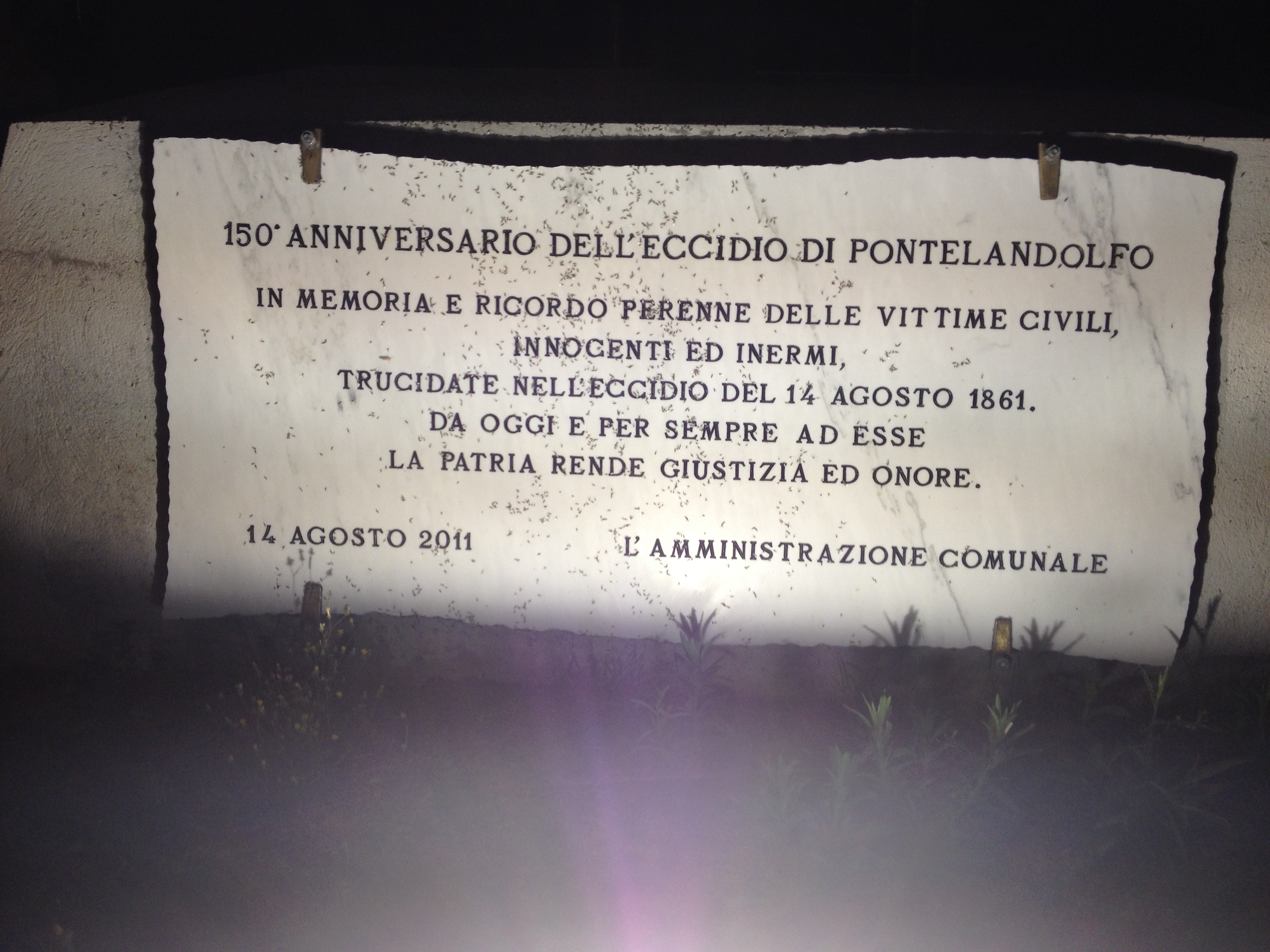
Not all parts of Italy welcomed the idea of “risorgimento” – unification as one country. Frankly, the south wasn’t all that interested and it was only the heavy handed military actions that induced their cooperation. One such incident occurred on August 14, 1861. Pontelandolfo and the neighboring Casalduni were attacked – some bad folks had killed a few members of the army and the army took its revenge. The citizens of Casalduni had a little warning and fled. The attack on Pontelandolfo occurred in the dead of night. Gun bursts and fires waking up the town. It is said that about 3,000 men, women and children were mutilated, raped and murdered. The entire town was burned to the ground. We will do a full story on this when I’ve had a chance to read Rinaldi’s thorough collection of essays and historic documents.
Prof. Rinaldi was sharing his insight into this history with me, but I was having a difficult time understanding. My head still spinning with the bronchitis. He gave me his card and offered to meet with me again. He also said he would share some historic photos with me. I can’t wait to sit down with him.
Prof. Rinaldi took my miserable morning and turned it into a wonderful Pontelandolfo experience. I thank him for that and his generosity.
When my nonna told stories about life in Pontelandolfo she often mentioned the fountains. There is a massive one in the main piazza but there are others scattered among the hills. Some of these fountains date back to Roman times. These fountains were a hub for gossip, doing laundry, getting a quick drink on a hot day and gathering water to drink, cook with and wash in. For generations, mountain spring water has run through ancient pipes and spurted out into jugs that were carried home.
The fountains still exist – but there is a new kid in town! This year when we drove into the center of Pontelandolfo we noticed this big stainless steel box – Acquaself – and a bunch of people hanging around with plastic bottles. Holy smokes – they are getting water! It costs only €.05 a liter for spring water – sparkling or plain. Oh no, I thought, yet another rural ritual blown out of the water.
Years ago, Jack joined Mario Mancini and went up into the mountains to one of five or six ancient fountains. Mario, a foodie and mountain gatherer, knew where to take his bottles to get the best tasting water. They drove miles away from the village center and what did they find – other men filing bottles. Jack was flabbergasted when one of the men turned to him and said in English – where are you from – “New Jersey” – “Me too – Livingston”! That is the magic that happens around the fountain.
The Pontelandolfo main fountain has been a meeting place, photo op and life blood of the community. In the summer kids fill water balloons from the constantly flowing spring water. When that happens I run in the other direction – cross fire can be pretty wet. Can Acauself – a stainless steel box – really replace all that? Interesting question. I’ve gone for our water – I mean .05 for a litter of sparkling water – and chatted with folks who were filling their bottles. Maybe the conversation will continue at the box but I can’t see anyone doing their laundry. The talented Annalaura Iacovella will explain how Acquaself works – so those of you who speak Italian can test your skills – those of you who don’t can read the titles. Happy mineral water to you.
A few nights ago the family phone tree clicked into high gear. We got a call telling us there would be a evening of theater at this incredible winery – Terra di Briganti in near by Casalduni. How could we not go. We love theater and we love all of the organic wines that we have tasted from Terra di Briganti. To get a feel for the space check out their website – http://www.terradibriganti.it/
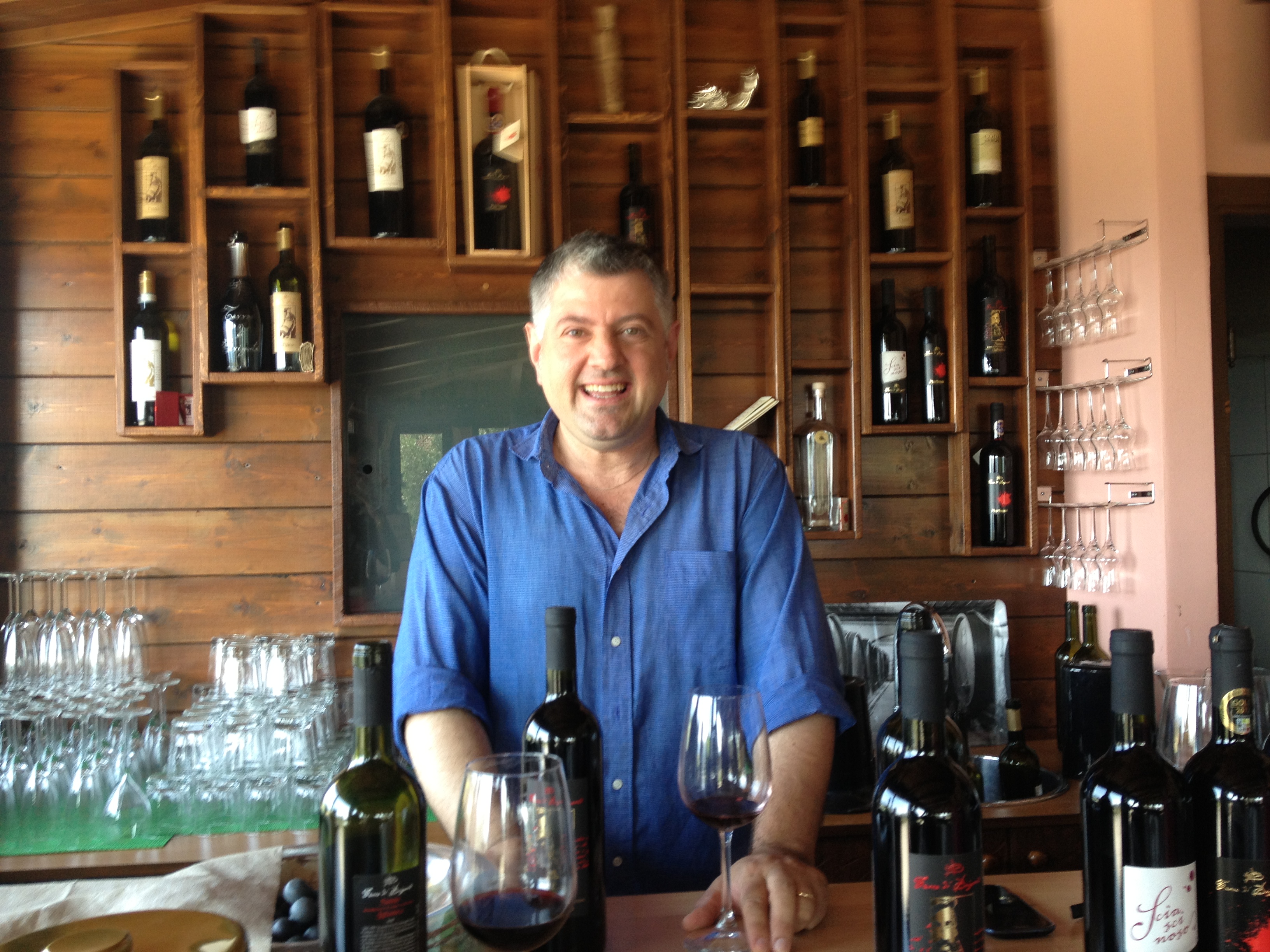
Tony De Cicco is passionate about eating and drinking local!
Terra di Briganti
Società Agricola s.a.s.
Contrada Tacceto. 6 Casalduni (BN)
We met the vinyard’s owner, Tony De Cicco, last year and were blown away by his passion for the land, the heritage of the area and sharing the pure goodness that grows in Casalduni. Terra di Briganti deserves its own blog post, but I will save that for another day and talk about theatre as a marketing tool.
Chairs were set up on a hill above the rows and rows of grape vines and thousands of olive trees. It was a beautiful night and the audience was packed with folks of all ages. I’m always amazed at how little tykes are brought to dinner, events, festas – everything that an adult would do in the evening the kids do. Baby sitters need not apply – kids are introduced to all manners of culture at a young age.
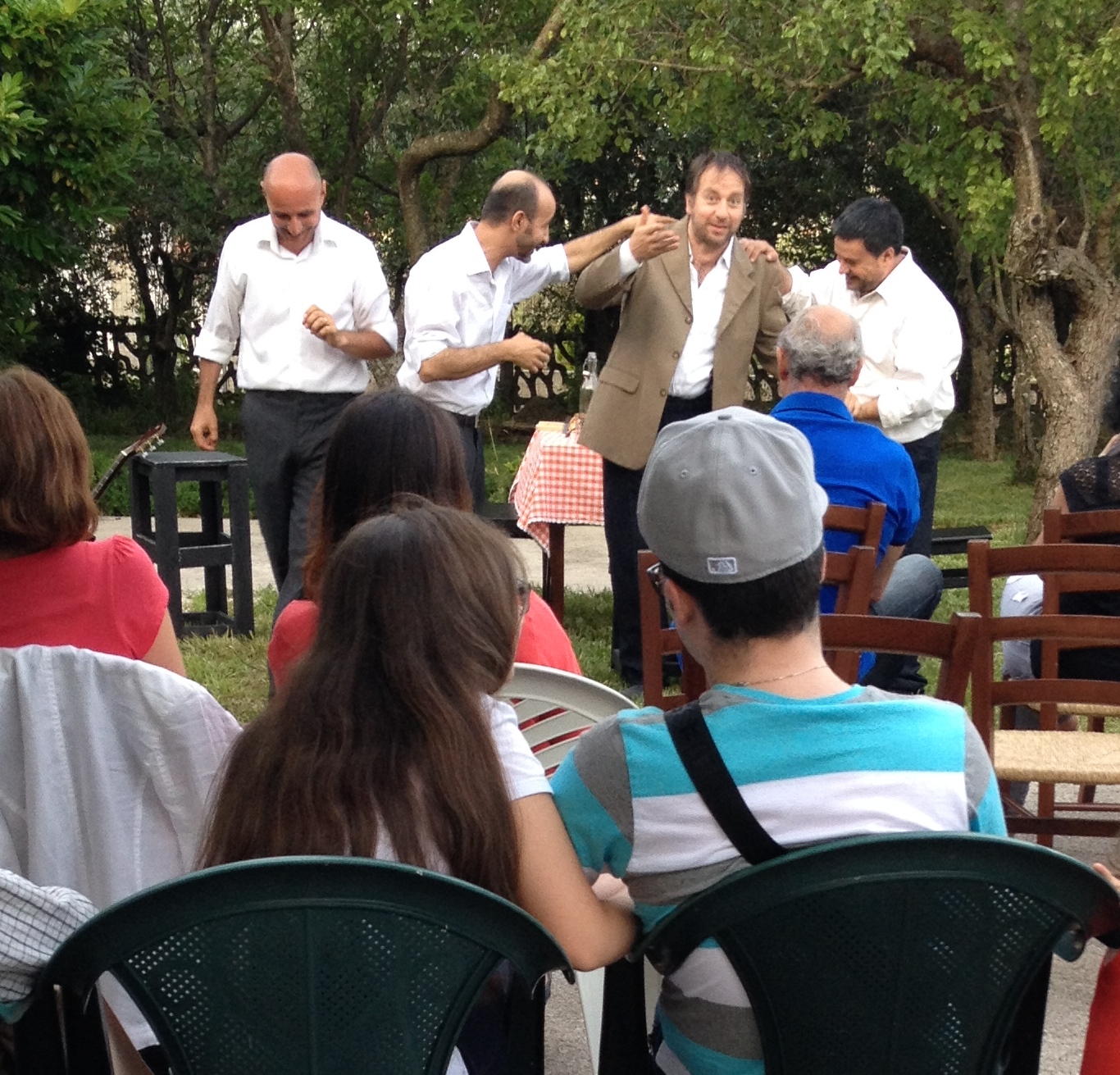
The moment the four actors entered they captured and kept everyone’s attention. What really was amazing for me was that I actually understood them! The “spettacolo” was in Italian and the local dialect but the actors articulation was so incredible that I was able to not only capture the essence of the work but understood the dialogue! It truly was said “trippingly on the tongue.”
But what was the play about – you ask. Olive oil! Who knew that you could work an entire piece about the beauty, taste and uses of olive oil! I’m wondering if the local agriculture and tourism council underwrote a piece of the program. The play could absolutely be used to help sell local artiginal oils. It opened with a wee bit of the history of olive oil and moved into a tasting – one actor in a jacket being the “tastee”. A personal aside – how come I feel like I know the actor in the jacket? Anybody else recognize him or did I just bump into one night in a Manhattan bar? I never got his name.
Who is the guy in the Jacket? Is that my former student Jonathan in the cap? Was I just lonely for people I knew?
Through comedy and music the company stressed that local oils taste best because they are made with the olives of one area. We learned that many oils that are marked “Made in Italy” are simply pressed here and shipped to places like the USA. The olives used are a big mystery and could come from Spain, Greece, Turkey….. You want oil that is grown and pressed in Italy. That means – when you can go to the source – buy your oil or order directly from the source. If you can’t buy from a vendor you trust.
We were all howling at the varied uses of olive oil. It only take three (3) drops in blessed water to cure the mal’ochio – evil eye.
The local strega will cure you of anything.
Other uses of the precious oil? H’mm any of these guys could have given me the massage they were lampooning. Open that stuck lock – olive oil. Fix the crud in your hair – olive oil. The music really opened up my heart and hunger to pane con olio d’olive. The singer lovingly – I mean I was wanting some loving – sang a ballad to olive oil on bread. Be still my heart.
This actor was able to make bread sexy.
Foodies and non-foodies were all laughing, engaged and engrossed in the variety of ways to eat bread and olive oil – my favorite was with tomatoes. Again – how could four actors and a playwright turn olive oil into both an educational and entertaining evening?! I want to meet the playwright!
The talented quartet was from Solot Compagnia Stabile di Benevento. It is a theater school and agency. I wonder if these men are also on the faculty. it would be great for the students if they were.
As we left the playing area to have some wine we passed Tony’s display of products. Terra di Briganti has expanded their offerings to include their own olive oil – but you guessed that right? We can’t wait to try some. We left happy and with 6 bottles of Tony’s fabulous sulfite free organic Falanghina. If you are ever in the area or want to buy his products wholesale just visit his web-site.