Arts Live in Pontelandolfo!

IMG_5072

Streets are being swept, sets are being built, venders are already setting up their stalls.  The jewelry stores in town have stocked Pontelandolfo-esq memorabilia and the back rooms of bars are filled with cases and cases.  As the energy of the arts infuses us all with good cheer, the whole town feels more alive. It is the arts that make this an incredible week for me.

13775758_1221245064566567_1060994111522203998_n

Kicking off the week is a production of  Dramma Sacro Di Santo Giocondina.  This community production, spearheaded by the multi talented Gabriele Palladino, will be live streamed!  The Pontelandolfo News has a great story – it is in Italian but even I can read it – and a link the live stream.  The play is only on for two nights – tickets are a scant €2 each.  I was impressed with the abilities of the local actors.  Their commitment and pride is contagious.  The saga of Santo Giocondino is performed every four years.  Now that I have seen the process, I can understand why!  This group has been working for over eight months. Yes, in the hills of Southern Italy – THEATRE LIVES!

DSC_0135

Comicron Film Festival is something that I am absolutely looking forward to. This year it is on August 4th and 5th. Initiated by the famous Italian Film/Theatre Director and Producer, Ugo Gregoretti, the festival is dedicated exclusively to comedy shorts. They are in all languages and range from the intellectual to the broad strokes of Commedia dell’ Arte.  My only hope this year is that the audience here learns to be quiet and watch the films – last year I found out more than I wanted to know about a middle aged woman’s love life.  Audience courtesy please.  Jack says he won’t sit with me if I keep turning around  ssssssssssshhhing.

Gregoretti spent his childhood summers in Pontelandolfo and wants to put an arts based spotlight on the village.  According to Gregoretti – (from the Comicron Website.)

“Io sono un crociato della comicità e quindi vorrei svolgere la mia crociata qui a Pontelandolfo facendo di questo paese la Gerusalemme del cortometraggio comico.” Tra le nuove idee e le diverse iniziative culturali programmate, è stato costituito il Centro Studi dedicato all’opera dell’autore romano Ugo Gregoretti, che raccoglierà e valorizzerà il suo immenso archivio, conservato presso l’ottocentesco palazzo Rinaldi, che si compone di scritti inediti del regista, lettere di esimie personalità (da Rossellini a Rodari, passando per Napolitano e Guttuso), articoli e manifesti, libri e riviste, premi e riconoscimenti. Si tratta di una grande raccolta, che ripercorre, attraverso la figura del grande Maestro, la storia del Novecento italiano. Una raccolta che Gregoretti ha donato al Comune di Pontelandolfo. Il progetto prevede anche la creazione della prima Accademia Nazionale d’Arte Comica e sarà, altresì, realizzato un progetto di più ampio respiro teso a rendere Pontelandolfo la “Capitale della risata”. Il “Centro Studi Ugo Gregoretti” è aperto a studiosi e appassionati che vogliono esplorare e indagare l’opera gregorettiana.

“I am a crusader for comedy and  I would like to end my crusade here in Pontelandolfo making this town the Jerusalem of the comic short film.” Among the new ideas and different cultural activities planned, the Ugo Gregoretti Center has been created.  It is dedicated to the work of Ugo Gregoretti and will contain such things as the unpublished writings of the director, correspondence from esteemed personalities(from Rossellini to Rodari,  Napolitano and Guttuso), articles and posters, books and magazines, prizes and awards. This collection traces the professional life of the great master and the history of the 20th Century Italian films. Gregoretti donated the collection to the City of Pontelandolfo. It is housed in the recently restored Rinaldi Palace.  The project also includes the creation of the first National Academy of Comic Art and aims to make Pontelandolfo the “capital of laughter”. The “Ugo Gregoretti Studies Center” is open to scholars and enthusiasts who want to explore and investigate the work gregorettiana.

Pro Loco of Pontelandolfo, the local authority coordinates the annual Festa.  I couldn’t find a web-site, but their Facebook page is full of information.  The other events of the week include on August 3’rd traditional music and dance of Southern Italy and on August 7’th Francesco De Gregori in Concert. The mysogynistic Miss Mondo is an event I will happily miss. The host is – well  – a creep.

We will have a houseful of guests next week.  Two from Holland and one from Massachusetts.  Why are the visiting my home town?  Not to see Midge and Jack but to enjoy the rich culture that can be found in Southern Italy.  The FESTA is just another reason to visit Pontelandolfo.

Ci Vediamo!

More Zucchini Recipes.


The zucchine elf - Zia Vittoria!
The zucchine elf – Zia Vittoria!

Everyday it seems there is a mysterious bag, basket or pile of zucchini by my door.  These things must multiply like rabbits.  Last year, it seemed like I was chomping down on zucchini blossoms daily.  Bundles of fully formed zucchini didn’t appear because we were all too busy frying up the flowers – remember this post:  Fried Squash Blossoms     Don’t forget – all recipes are posted in the recipe section.  Look above the Tower Picture to find the tabs.

Giambotta

I thought I knew how to make giambotta!  Take whatever summer vegetables were starting to turn ugly in the fridge, slice them, dice them and sauté them with ground meat, dump in a couple of cans of diced tomatoes, add a pinch of salt and a few basil leaves.  Easy peasy.  Since everyone in New Jersey grew zucchini, the first giambotta I ever ate featured zucchini, more zucchini and nothing but zucchini.

EEEEEEE. Midgeee, questo non e ciambotta.  I got my hand slapped by Santina the butcher when I ordered carne macinato – ground meat – and she asked what I was making.  I got my head smacked by every other elder who I asked about giambotta.  But, I swear my mother or grandmother or someone always added ground meat.

Simply put, giambotta is a beautiful blend of fresh – not almost rotting in the fridge – vegetables.  Zucchini, green beans and eggplant are pleantiful now.  Carrots spill over in the market with fresh white onions and tomatoes.  I add tomatoes but my cousin and ace cook Carmella Fusco didn’t and her giambotta was magic.

The trick I have learned here in Pontelandolfo about cooking some vegetables is to not add any liquid.  The vegetables have all the liquid you need.  Put a nice thick layer of extra virgin olive oil in the bottom of a pan and add the vegetables in order of how long they take to cook. I always start with the onions, then toss in carrot slices, then add the beans, zucchini and eggplant.  Rats, Jack hates eggplant – he puts it in the ‘tofu category’.  Don’t tell him that the perfectly formed cubes are eggplant.  I toss in so little salt that it doesn’t count and add a handful of crushed fennel seeds.  Note:  No added liquid like that can of  squashed tomatoes that I used to use.  The vegetables do have enough liquid to create their own sauce.  Also, I’m the only one that seems to add carrots to the mix. Yummy.

I can not tell too many lies – I often still add ground meat to the onions and when it is brown add the vegetables.  I also often dice up fresh tomatoes and toss them in too.

Carmella’s Spaghetti with Zucchini and Zucchini Flowers

When cousin Carmella sends me a “WhatsApp” text that says –Venite a pranza oggi?   I always quickly respond with a SI!  Carmella is a world class cook and lunch at her house might be the simplest of ingredients but they are always tossed together delectably.  Check out Carmella’s cooking on her Facebook Page A Pranza dalla Nonna.

Today we had another variation on the zucchini theme, Spaghetti with Zucchini and Zucchini Flowers.  Fresh, local ingredients easily tossed together and delicious.  Zucchini flowers, zucchini, garlic, extra virgin olive oil, salt, hot pepper, spaghetti and pecorino cheese round out the list of ingredients. (You lucky New Jerseyans who belong to a CSA like Hillsborough’s fabulous Martenette Farms have access to lots of zucchini and zucchini flowers this time of year.)

As I was slowing chewing my spaghetti, I asked Carmella her secret.  Simplicity is the secret.  She cut the flowers into little pieces.  They added great orange color to the pasta.  A few cloves of garlic were chopped and after cutting a zucchini in quarters it was thinly sliced.  She put a walloping helping of olive oil in the pan – it thickly covered the pan – and added the garlic.  She let that sizzle for a second and then added the zucchini and flowers.  Next came a tazzino – espresso cup of water – or two fingers in a Nutella glass – and salt.  The veggies cook until the water has evaporated and then they sauté for a couple of minutes more.

At this point the salted spaghetti water should also be on the stove.  Cook the spaghetti as you normally would.   When the pasta is done, drain it and add it directly to the pot that has the oil and sautéed zucchini.  Carmella said, saltare in patella.  Toss it and let it cook a wee pit in the pan.  At this point she also added a hint of hot pepper and freshly grated pecorino cheese.

That was our primo piatto!  Zucchini heaven!

(Carmella is one of the cooks who opens her home for the Cooking in the Kitchens of Pontelandolfo program.  Interested? Message me.)

Ci vediamo

Midge


Festa Della Trebbiatura 2016

This past Sunday, I had a perfect day.  Jack and I went to an event that I not only loved – but drew me back to my childhood.  Growing up in Somerset County, New Jersey when it was still pretty rural agrarian, I experienced lots of farm life.  4-H introduced me to kids who grew or raised just about anything America ate.  Sunday, I thought of my childhood, how much growing up in a farming community shaped me and the work my grandmother did on her subsistence farm.  Festa Della Trebbiatura in the Contrada Montagna in Morcone harkened back to farm days of old and celebrated the contadini – farmers – of the Matese Mountains.  The type of people my ancestors were.

Did I mention mountains?  Those of you that know me, know I clutch the death grip in our Fiat whenever the wicked Jack drives like an Italian around the S curves sans safety rails on mountain roads.  This trip around those curves was worth it.  The views were incredible.

I need to take a moment to praise my Jack a wee bit.  From the town center of Morcone – which is literally clinging to a mountain – we made a left at the Auto School and drove up.  We didn’t know which way to go when the road split.  We opted for the one that looked steeper on the left.  It was really su, su, up, up.  Shit, I screamed as Jack hit the breaks.  The cobblestone street narrow to begin with had cars parked on both sides and didn’t go anywhere.  Jack backed our large car down the hill and didn’t take the mirror off one single parked car. Hugs to him.

Back to the Festa.  We found out about it from Antonella Lombardi, owner of Bar Mix Fantasy, and a member of the Lombardi family that produced the event.  Thank you Antonella for making sure that I knew about what turned out to be a wonderful day.  When we got to the farm and I saw the rows of seats under the trees and the Priest ready to start mass, I smiled and sat down.  Hearing this great speaker do the mass surrounded by mountains, fields of grain, a clear blue sky and floating cotton clouds started the day beautifully.  After mass children went for “hay” rides on the farm wagon festooned with shafts of wheat.  We walked through the exhibition set up by the Museo del Contadino and I kept pointing at stuff that had been in my grandfather’s barn.  Since we sold the family property and all the relics two years ago, it got a little painful to see  the artifacts.

During the day, people could wander through the World Wildlife Federation Preserve in the mountain, watch demonstrations and eat country fare. One of the featured foods was pecora interrata.  Interrata means underground.  Of course that is what I had!  In the evening there was music and dancing.  Since the zanzare, mosquitoes, and I have a love/hate relationship, they love to eat me and I hate them.  We left before it got dark.

The word trebbiatura  means threshing the grain.  There were glorious fields of wheat in this part of the mountain.  We were celebrating the harvest and the people that make sure we have bread and pasta on the table – the farmers.  The first threshing methods involved beating grain by hand with a flail, or trampling it by animal hooves.  The demonstrations included women doing this.  Women were doing lots of the heavy work – this is still not unusual in our little village of subsistence farms.  What was even more fun to watch was the early threshing machine!

(Uggggg – Jack just told me I have a typo in a caption in the video.  Sorry.)

Ci vediamo!

Midge

Genealogy Hints – Naturalization of your Ancestors

richedit2Our resident genealogist, the charming and smart Rich Venezia of Rich Roots Genealogyhas returned with more helpful hints on discovering our individual stories.  Many of you of Italian descent, have e-mailed me about obtaining Italian Citizenship.  Rich is the expert .  Here he talks about the first and most important step – naturalization of your ancestors.

Dear Readers of Nonna’s Mulberry Tree,

This month, we’ll be tackling a question I am asked all the time: How do I know if I qualify for dual citizenship?

While there are lots of rules and regulations – it is the Italian government, after all! The most important question you have to answer is the naturalization question.  Just when did your ancestor become an American Citizen?  If your Italian ascendant (say, your grandfather), naturalized prior to the birth of their child/your American-born ascendant (say, your father) – well, then the Italian bloodline was not passed through, and you’d be ineligible. However, if the Italian ascendant never naturalized, or naturalized after the birth of your American-born ascendant – well, we may be in business!

What?  You don’t get it?  Simple – we’ll use Midge as an example.  Her Grandfather, Francisco Guerrera became a naturalized American Citizen after Midge’s dad, Giovanni Francisco Guerrera, was born.  Even though her dad never understood that he was an Italian citizen until Midge started researching – he was!  The Italians don’t care where you are born if at the time of your birth your parents – or parent  – is an Italian citizen, then you are too!!!  Midge’s story.

So, the first step to citizenship – start looking into your parent’s or grandparent’s (great grandparent’s, etc.) naturalization. Here are some places you can survey –

The best place to start is by searching census records. These are accessible in various places online – notably Ancestry.com (check if your library has a subscription). Censuses starting in 1900 have a citizenship status column, and censuses until 1940 are available. (1950 becomes available in 2023.) If your grandfather immigrated in 1913, you should be able to find him on the 1920 census. Usually, one of four things are listed in the citizenship column:

NA = Naturalized

PA = First papers submitted (usually, a declaration of intent [to become a citizen])

AL = Alien (i.e., unnaturalized)

NR or blank = No record; it’s possible immigrant provided the info or know

Biagio Camperlino - 1920 census - Ancestry.com

Thanks to Ancestry.com – we see the PA and AL on the right.

So – if you find Grandpa in 1920, and he is listed as AL, and then you find him again in 1930, and he listed as NA – you can surmise that he probably became a citizen between 1920 and 1930. (Now – let’s just hope your father was born in 1919!)

The thing about censuses is that they can be very inaccurate, so it is unwise to take this information as completely factual without corroborating with further research. I have seen people go from being listed as “NA” in one census to “AL” in the next census, or people list “PA” for 30 years running! Do use the censuses as a guide, but just a guide! You’ll want to corroborate your information, especially for something as important and complex as obtaining dual citizenship.

World War I draft registration - FamilySearch

World War I Draft Registration from FamilySearch noted he was an alien.

If your male Italian ancestor was here in 1917 and/or 1918, and was “of fighting age” – that is, born between about 1873 and 1900, he should be included in the World War I draft registration card database. Note that all eligible men had to register – these cards don’t just exist for men who served in WWI. These registration cards can be found on websites like Ancestry.com or Fold3, as well as for free on FamilySearch. Most of these cards have a question relating to citizenship status – whether the registrant is a natural-born citizen, a naturalized citizen, an alien, or having declared intention. If your ancestor’s citizenship status matches that on the 1920 census (remember there were 2 or 3 years in between), you are one step closer to the truth.

Now that you have a timeframe in which your ancestor may have naturalized, what do you do next? The age-old answer: It depends. Naturalization records are held at different repositories, and each state and county may hold their records at different places. In New Jersey, most county clerks hold the naturalization records for their county (for instance, Middlesex County and Hudson County records can be found in those counties.). By calling the Office of the County Clerk, you can determine if they hold these records. However, in Monmouth County, for instance, their records are held at their County Archives – which has a searchable database online!  It is worth the phone call to see if you can do the research from the comforts of home!

Michelle Tucker Chubenko of Jersey Roots Genealogy is a colleague and friend of mine. She wrote a blog post that might be helpful on finding records in the NJ district courts.

In Pennsylvania, records are *generally* held at the Prothonotary’s Office, but this differs from county to county.

This is Midge, I had never in my life heard the word “prothonotary.”  What the hell is that?  According to the source for all – Wikipedia: The word prothonotary is recorded in English since 1447, as “principal clerk of a court,” from L.L. prothonotarius (c. 400), from Greek protonotarios “first scribe.”  Who knew?!  

If you are having trouble finding the records, keep in mind that some state archives, local or regional libraries, or genealogical societies may also hold these naturalization records. The New Jersey State Archives, for instance, holds a vast collection of naturalization records – for some counties, into the 1940s and 1950s! (Union or Sussex County ancestors, anyone?)

Another complication is that the naturalization laws changed in 1906 – and a lot of Local Courts lost their ability to naturalize citizens.  Now the search gets a little sticky!  Just what court naturalized our ancestor??

If a US District Court existed in the city or county where your ancestor lived, it’s extremely likely they would have naturalized through this court. In Allegheny County, Pennsylvania, for instance, after 1906, all naturalizations occurred in the US District Court of Western Pennsylvania in Pittsburgh. In New York City, many immigrants would have been naturalized at the US District Court of New York (Southern District) if they were Manhattanites or from the Bronx. Queens, Kings, and Staten Island residents likely naturalized through the US District Court of New York (Eastern District). In New Jersey, there were District Courts in Newark, Camden, and Trenton. The records of the US District Courts are generally held by their regional branch of the National Archives (NARA) – NY and NJ at NARA New York, Pittsburgh and Philadelphia at NARA Philadelphia, Ohio at NARA Chicago, etc.

Citizenship Frank

My nonno was naturalized in a Local Court.

The good news is that a lot of these records can be searched online (at least up to the 1930s or 1940s). Italian Genealogical Group has indexed the records of the NJ and NY District Courts. The Pennsylvania District Courts’ records are on Ancestry.com up till 1930. FamilySearch also has a large amount of naturalization records available online for free – both District Court and Local Court records. You can also order a search with NARA for a nominal fee – National Archives.

If you have lots of time to wait and not a lot of time to do the research – this may be the option for you. It requires a little less detective work but a long waiting period .  Just pay the fee and order an index search from US Citizenship & Immigration Services (USCIS). They hold all naturalization records from 1906 onward. A search can be ordered here: US Citizenship and Immigration Services. The current waiting period to receive the results of the index search is anywhere from 6-8 months.  That doesn’t seem so bad.  However, then factor in another 6-8 months to receive the record if one has been found using the index search. I generally find it a little easier to verify naturalization by other means. However, you should be able to use the results of the index search to determine your eligibility. A date of naturalization is usually listed on the index search, so you can determine whether this was before or after the birth of your American-born ancestor.

A USCIS index search would also come in handy if you believe your ancestor never naturalized. There will likely be an AR-2 (alien registration form) for them if they were alive in 1940. (Midge here -Why is it that alien makes me think of ET Phone Home?)  Even if the USCIS search is negative – no naturalization for grandpa – you may subsequently request a letter certifying the non-existence of a naturalization.  If this were the case for your ancestor, the Italian Consulate would require such a letter for your dual citizenship appointment.

The bottom line is – no matter how you find your ancestor’s naturalization record, the date that they were granted citizenship to America is key. It must be after the date of their child, your American-born ascendant. The concept of dual citizenship jure sanguinis, through bloodline, only works if the bloodline is unbroken – and until 1992, Italian nationals could hold only one citizenship.

In boca al lupo. May your search be swift and uncomplicated, and may you be eligible for a beautiful red passport!

Rich Venezia is a professional genealogist based in Pittsburgh, PA. He specializes in Italian, Irish, and immigrant ancestry, and NJ/NYC and Pittsburgh-area research. He also assists clients with dual citizenship applications. He has worked on two genealogy TV shows (including PBS’ “Genealogy Roadshow”) and is available for client research and speaking engagements.  His website can be found at richroots.net and he can be reached at rich@richroots.net. He adores Midge and her blog, and is so thrilled to be visiting with her regularly. A presto!

Grazie a Tutte Le Zie

Midgeeee,  Midgeee, Zia Vittorias voice echoed up the stairs to my second floor office. I raced to the top of the stairs and yelled, “Sono a secondo piano.”  I kept running and found her in my kitchen fiercely holding a mop handle raised in the air. The stick she was going to use to scare off the crooks who were in my house. I started to cry. My Aunt Catherine’s thinly little face puckered in her fierce warrior woman look flashed before me. She too, at eighty something came racing to protect me. How do you thank women like this?  You channel their strength and let it seep into your being. Strength you can use to protect the youngest in your clan. 

Oops, sorry, I bet  you want to know what the hell happened. Homes in our little village have been broken into. I blame jobless kids with nothing to do but spy on people , learn schedules and pop in when no one is home. Last summer it was wretched to hear that one house even got broken into – well the door was open – while the folks were upstairs.  Today, we parked the car on the side of the house in the shade. Jack drifted off somewhere outside and I went upstairs to my office. My clunky feet make a lot of noise going up the stairs. Zia Vittoria heard my noises but didn’t see our car. First she went outside and yelled for Jack. No answer. Nicola wasn’t home to fight off the bad people so she took her mop and came into our side of the duplex to investigate. Our front door was unlocked. There was no car. Jack did not respond. She made enough noises for an army of Italian nonne and kept calling for me. That is when I entered the scene. Her mission – scare off the crooks!! God bless her moxie. 

The day after my mother’s funeral her long time creepy boyfriend- the evil, obnoxious, heinous Doug-  went to XXXXXX’s Auction, got a truck and was preparing to empty my mothers house. (Fearing litigation, Jack made me take the name of the local company out.) I was the executor for the estate and hadn’t even gone to probate with my moms will or inventoried her assets. He had really jumped  the greedy blood sucking gun.  I had spent the night next door to my mom’s house at Aunt Catherine’s.  Being back on the family compound just felt right.  I was outside hanging clothes on the line when I noticed a large white panel truck – the auction house truck.  Without thinking I bellowed at Aunt Cat and raced up the path through the field.  The house was locked – the smarmy creep may have been inside.  I banged and bellowed.  Then I called XXXXXX’s Auction and explained that any items brought to the auction were stolen from my mom’s estate and I intended to press charges.  While the owner was sputtering I hear the buzz of my Aunt Cat’s electric scooter jostling up the path. With her bastione held high in her good arm and her phone clutched in her bad hand steering the scooter she was determined to protect me, the memory of my mother and help me fend off any bad guys.  I hung up on XXXXX and raced to hug her.  Then we both went back down the path cursing evil men in general and Ugly Dougly in particular.   

In both cases, not for one moment, did the elders in my life consider themselves. With the inner strength of women the world over and Italian women in particular, they felt action had to be taken and they were prepared to take it.  A lesson we all could learn from.

Ci Vediamo.

Cooking in the Kitchens of Pontelandolfo II

Saturday, September 3 to Saturday, September 10, 2016

Join us for the Second Session of Cooking in the Kitchens of Pontelandolfo

The May 2016 cooking classes were a smash hit.  The Pontelandolfo women who lovingly opened their homes to American women this spring want to do it again!  They hope women from all over the world will come to love their little village.  Don’t think about it – just come and live the life of a Southern Italian.

The May video says it all better than I can –

Included Highlights:

  • Transportation from the Benevento Train Station to Pontelandolfo
  • 7 nights, single room, with television, refrigerator, morning caffè and coronetto. Five rooms in this cute B&B have private baths.  A two room suite share a bath.  Il Castello
  • Welcoming apertivo and snacks in a local bar. All the cooks will be there!
  • Sunday Pranza (lunch)
  • 5 Cooking Classes with local cooks culminating in eating with the families. Each pranza is complete with first and second courses, local wine, dessert, after dinner drink, coffee and conversation!
  • English Speaking Translator for all classes and events.  Translators in other languages can be made available for a group of 5 or more.
  • Wine and artesian food tasting at a local vintner
  • Pontelandolfo Day – open air market, tasting of locally produced products and other activities.
  • Excursion to Altilia Roman Ruins   http://www.sepino-altilia.it/
  • Walking Tour of Historical Pontelandolfo – http://www.pontelandolfo1861.it/
  • Excursion to the museums and shops of Benevento
  • Transportation to a different local restaurant each night.
  • Apron
  • Written recipes in English. (If a group is not English speaking other translations can be arranged.)

This culinary adventure is limited to 10 people.  We have a 5-person minimum.

This adventure wouldn’t happen without the commitment and support of Pontelandolfo Città Martire Associazione Culturale and il Sindaco Gianfranco Rinaldi.

Air Emirates has had some terrific sales from JFK – New York to Milan!  We booked last year two seats for $900 – $450 a piece!  Keep an eye on their sales.

Air Meridiana flies from JFK directly to Naples!  It is relatively inexpensive.

Contact me via the comments section for particulars and with any questions, thoughts or just to say hi.

Ci Vediamo!

The Floating Piers – Lago D’Iseo

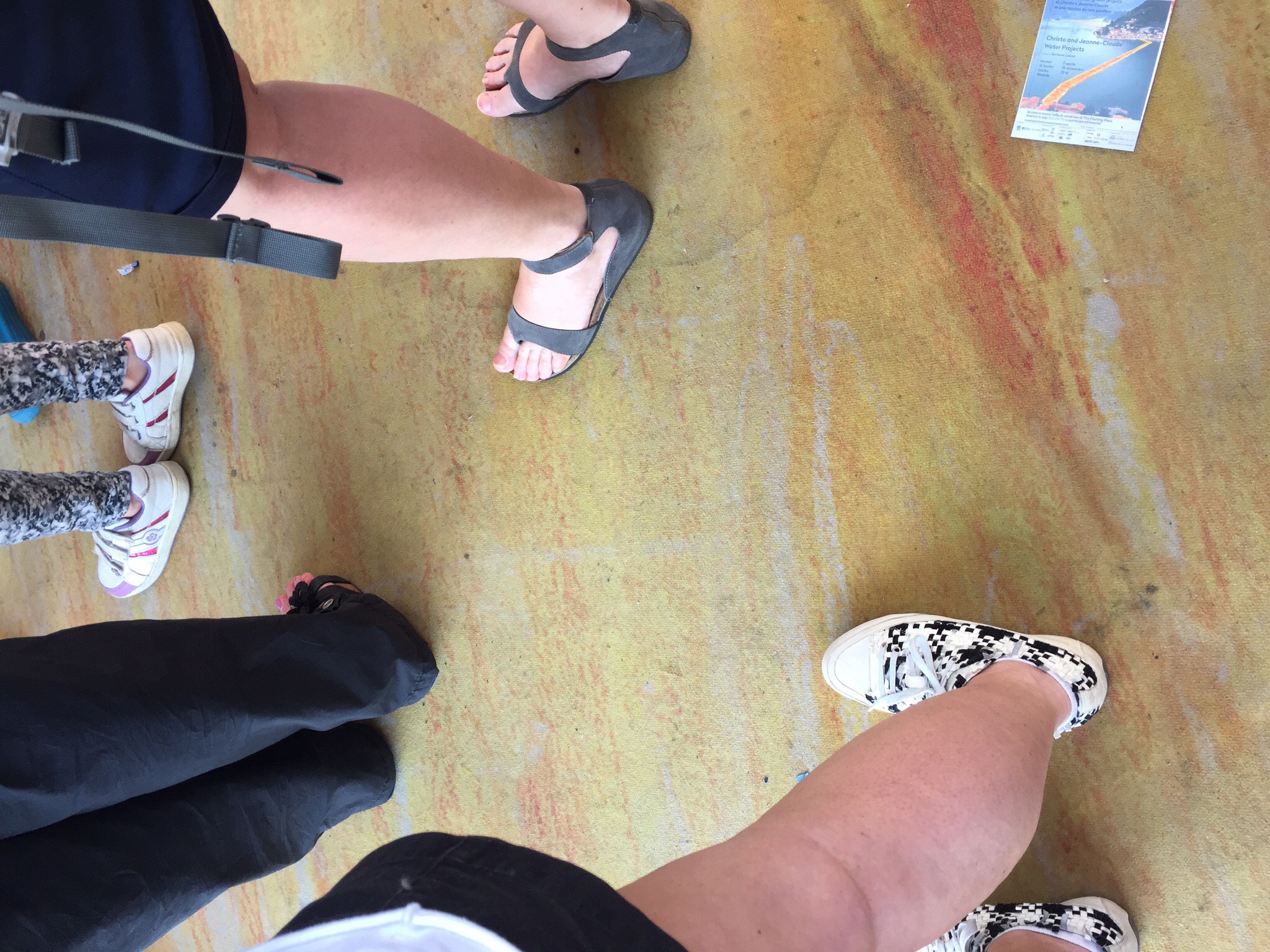
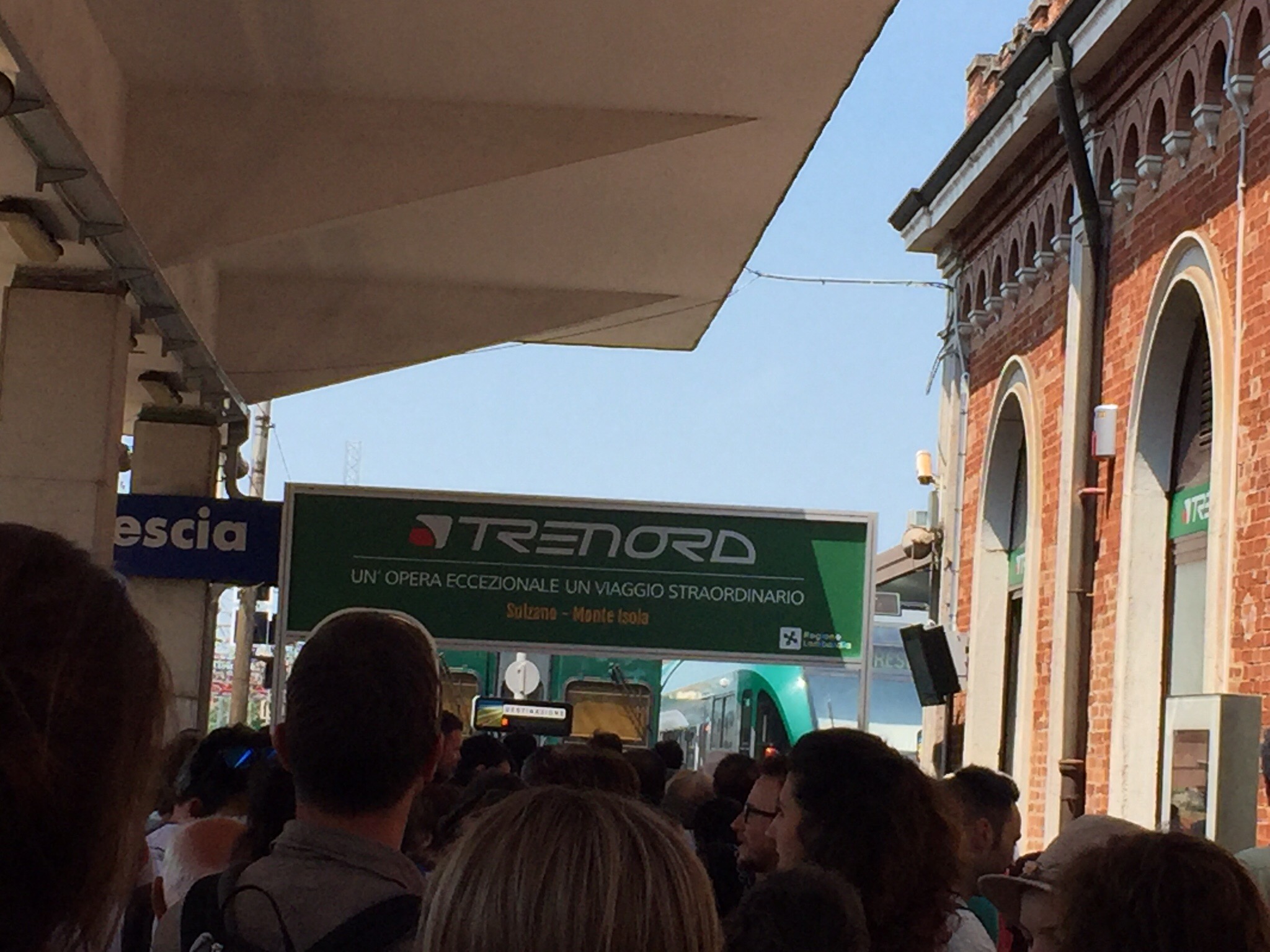
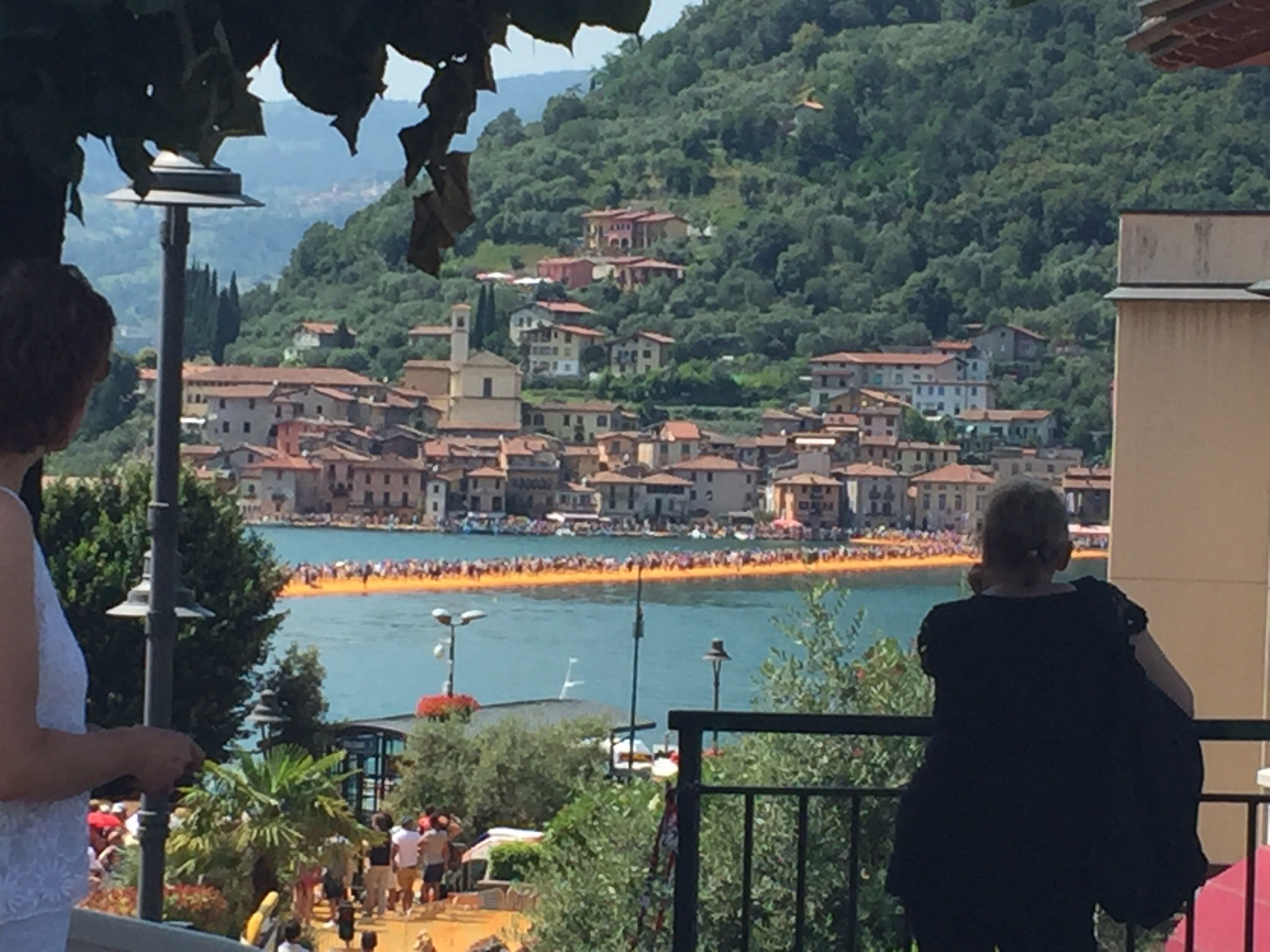
We first saw an installation by Christo and Jeanne-Claude in New York City’s Central Park.  Walking through the orange gates floating from the sky was mesmerizing.  Being a part of the art was an inspiring experience.  When we discovered that the latest Christo installation was going to be in Italy we promptly made arrangements to wend our way there.  We drove to Milano and stayed at our Milanese home away from home Hotel Il Girasole.  Wednesday morning we took the metropolitana to Milano Centrale and hopped a train to Brescia.  Disembarking we noticed signs, like the yellow brick road of Oz, leading us towards our goal.  Following the Floating Pier signs we found ourselves on a rather long line of jovial people standing on a yellowish carpet.  


Oz!  The excitement was building.  People were chatting and swapping tales of their journeys to the piers.  We met an Australian couple that told us they were staying in Brescia and had tried to get to the Floating Piers that morning.  So many people had come that they cancelled all the outgoing trains to Salzano – the starting point of the pier.  It was 11:00 ish and they were trying again.   Shit, I remembered Woodstock.  A group of pals and I bought tickets for the final day of the concert to end all concerts.  We were so excited.  We were so screwed.  They closed all the roads before the end of day one.  No one else would be allowed in.  Shit, this would be another Woodstock.  “Don’t think like that,” my optimistic spouse whispered.  How did he know what I was thinking.  OH, I told the story to the folks in the line!  EEGGGG.


We all waited for about an hour and then boarded an extremely modern air conditioned train for the half hour ride to Iseo!  It felt like a bar crawl bus. Everyone was in high spirits!  Hmmm.  The train isn’t moving???  Maybe  a half hour later the train started moving.  We had seats and the conversations flowed. Oh, it is a local with stops at every station between Brescia and Iseo. 45 minutes later we got there.   In Iseo we boarded and sat on the train in the station.  Perhaps 45 minutes later they told us to change to yet another train. People  raced pushing and shoving onto the second train. This was a very crowded, standing room only train to Sulzano.   Yeah!  This will be the train to our art experience.   We waited.  It started up!  The art party disembarked from the train and was herded onto the magical yellowish carpet.  We are one with the art!  Then the slow forced march began.  The cue to reach the beginning of the pier took almost an hour – but we were still on yellowish carpet.  I could smell the water.  Oz was close.  


Look, I screamed at Jack as we slowly walked down the hill – I can see the lake.  I can see the pier!  TAKE a picture!  Ouch, a backpack smacked into my side and another hit my stomach as those odious people who insist on taking their life long possessions on a day trip also tried to squeeze a picture through the crowd.  


 Slowly we advanced on the lake.  A radio squeaked at a guard point – yes there were guards along the way.  The piers are over crowded.  Stop the Crowd. We stopped.  Jack and I were at the very front of a line that wended its way all the way back up the hill to the train station.  I thanked the guard.  She looked at me like I was crazy.  Why? she asked.  Because you are standing out here in 100 degree weather keeping us safe.  She yelled over to the other guard – This is the first time in two weeks that someone thanked me!  Some one finally realizes what we do!  Of course I do, I’ve organized huge events and I’ve got to say that they tried here but didn’t anticipate the number of people who would come to a little out of the way island that is accessed via limited public transportation.  This isn’t New York City.


IT was fun learning about the project from our friendly guard. After waiting for about 45 minutes, we were allowed to follow the yellowish road down to the water.  All thousands of us.  You could actually feel the ebb and flow of the water beneath your feet. The mountains surrounding the lake were –  ouch another fucking back pack smacked me as some cretin turned to look at the view.   No stopping, we are reminded by the crowds behind us surging forward.  The forced march continued across the water. Jack tells me I am too critical and must be more open to the experience.  I am open – opened to a concept that from the helicopter tours in the sky it was breathtaking.  From a boat, we discovered later, it was incredible.   Walking on it surrounded by others walking was simply boring.  To become part of the art, I needed a minute to stop, stand and stare.  I wanted to twirl and prance on the water.  Take out my notebook and write a sonnet.  I wanted to live the art.  A forced march across the lake – well it brought to mind things that were not so pleasant.  When we reached Monte Isola, the little island upon which the yellowish road continues to the next Floating Pier, it was so crowded that there was no way to even grab a bottle of water or a snack.  Every little bar was packed.  The roads were packed.  Someday, we will come back to this lovely little island.  It must be scrumptious in March. – devoid of tourists.  We saw a sign for a ferry back to Sulzano and had a pleasant ride over the lake, past the piers.  They looked fabulous from the water.  I’m so glad we got to see them.

Ci Vediamo!

Can’t Argue With Logic

Jack and I will soon be back in our mountain home engaged in interesting, albeit, frustrating dialogue about all things Italian.  I wanted to title this “You Can’t Argue With Jack,” but that might have sounded smarmy. Get my implication???

Nonna Garden

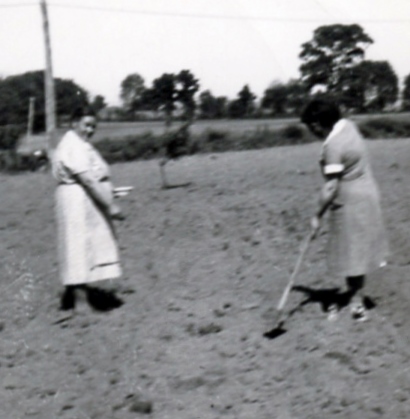
A little back story – My grandmother and Aunt Cat were the queen and princess of subsistence farmers.  They used the skills they brought with them from Pontelandolfo and our small Flagtown, NJ farm was chock full of good eating.  No one used pesticides – who could afford them and if they killed bugs they would probably kill you.  Fertilizer? Mary the horse gave you that.  No disgusting crap was sprayed on the lawns to kill the dandelions.  We learned to pick the young dandelions and thank mother nature for the free salad. They were not evil weeds. Today, my nonna would think people spending money to make their lawns fake green and without weeds – free salad – pazzo.  My families connection to the earth is a part of me.  No I’m not a funky granola aging hippie but I am a “if it ain’t natural I won’t eat it” fanatic.

One day while driving to Milano I saw something that made me think of my grandmother. Along the autostrada in the region of Emiglia Romagna  there were acres and acres of herbs growing and drying. It was quite beautiful until I remembered that people ingested them.  Poured the herbs into their stew.  Mixed the herbs with hot water and drank them.  Eucccch!! Acres of herbs and other crops get a 24 hour dosing of global warming causing carbon monoxide emissions. Double euuccccchhh!

I tell Jack how disgusting that is and mention I need to really read where dried spices and herbal teas come from. If they are made in Emilia Romagna, I will refuse to buy them. Why, he said, they’re fine.

Determined to let him know that the spices were not “fine,” I googled the effect of carbon monoxide on plants and found lots of great stuff written by super smart folks – here is one study from the National Institute of Health

Carbon monoxide (CO), a by-product released during the degradation of heme by heme oxygenases (HOS EC 1.14.99.3) in animals, plays a major role as neurotransmitter, regulator of sinusoidal tone, inhibitor of platelet aggregation and suppressor of acute hypertensive response, and most of above effects are similar to or mediated by nitric oxide (NO), another signal molecule in both the animal and plant kingdoms. Previous result demonstrated that NO could act as a promoter of plant cell elongation, acting similarly to IAA, inducing morphogenetic responses leading to expansion in plant tissues. Recent observations revealed that CO is an inducer of cell expansion in wheat root segments, acting similarly to IAA and NO. Evidence also indicated that IAA could result in either the potent induction of HO-1 transcript or endogenous CO releasing in wheat root segments. Additionally, our results suggested that above CO signaling might be related to NO/cGMP, Ca2+ and even ROS-dependent pathways. In this addendum, combined with other previous results, we further proposed a possible hypothesis for CO signaling role in regulation of plant root development induced by auxin.

What the @#%#?  Who writes this stuff and since it was from a USA government website, who was supposed to read it?  Not me – since I haven’t a clue what any of the above means.  Coming back into the room and the discussion, I remind Jack that Zia Vittoria would not let me pick the wild fennel along the sides of he roads – because of the cars. My grandmother wouldn’t let us pick wild asparagus or strawberries close to the road either. Those farmers and inherently natural foodies knew the yuck from passing cars was poison. POISON!!!!  Who wants to eat food covered in exhaust stuff.

Jack shook his head and reminded me, those are the same women who said you can’t go outside – even in the summer- with wet hair.

Errrrrrrrgggggg.  I have nothing left to say.

See logic wins!