Alanna’s Amalfi Roots

Alanna Jamieson stayed with Jack and I for a week or so.  Her journey toward new beginnings for herself had her thinking about her heritage.  Being a heritage junkie, I was delighted to help out and we enlisted Jack as our noble driver during the worst time of the year to drive the Amalfi coast.  We headed from the hills of Pontelandolfo to the the Commune of Amalfi Coastiera. If you didn’t read this – READ IT NOW! Amalfi Coast – Road of HELL!

Here is Alanna’s story:

Searching for Cavaliere

By Alanna Jamieson

I am very close to both sides of my family. However, for me, that family had extended only to my cousins, aunts, uncles, and grandparents who all live in the U.S., within New Jersey and Connecticut. I had always proudly identified my heritage as “100% American”, involving a diverse mix of U.K., French, German, Slovakian, and Italian nationalities. On my mother’s side, I am the third generation born in the U.S., and on dad’s side, I am in fact eligible for the Daughters of the (American) Revolution historical society.

The past four months of my life have involved several major transitions, which have found me cutting ties, widening my eyes, and (as cliché as it may sound) exploring Europe with only a carry-on suitcase and a 24-hour plan at any given time. When Midge and Jack invited me to visit them in Pontelandolfo, the decision was a no-brainer. I immediately jumped at the opportunity to spend some time in a beautiful, small Italian town with warm people and wonderful food. I also knew that Midge had spent years and countless hours researching her Italian family’s history, learning their language, and absorbing their culture. Sure enough, when I arrived in Italy, Midge enthusiastically offered to help me see what roots of my own Italian ancestors we could uncover, in nearby Amalfi.

This foreword is what led us to that winding road on the Amalfi Coast – some call it terrifying, some call it exciting, and excited is exactly how I felt! When we arrived in Amalfi, we easily found the Municipio (town hall), and inside we were greeted by a cheerful and bright-eyed woman named Angela Petrillo.
IMG_3415

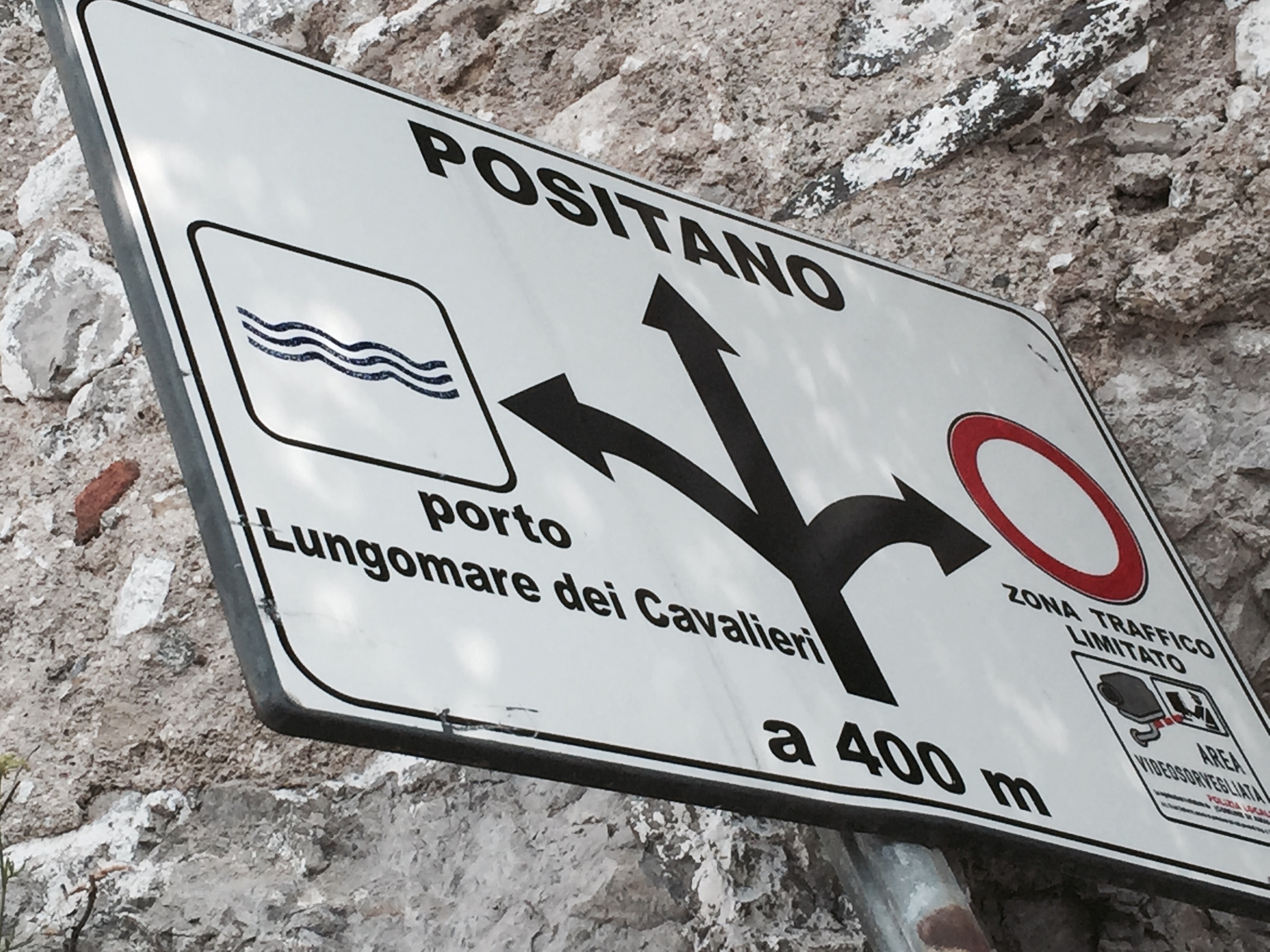
Cavalieri Found on a Road Sign

We stated our purpose: I was interested in learning more about my Italian family, the Cavalieres. Upon hearing this, Angela smiled; Cavaliere is evidently a very common name in Amalfi, so our task would be to determine which Cavalieres in the Municipio records were my direct relatives. Luckily for me, my Cavaliere grandparents from Connecticut had created a detailed family tree and had even visited the Amalfi Municipio themselves.

After Angela and Midge exchanged a few more words in Italian, I nervously presented Angela with my family tree information, not sure what to expect and feeling grateful that Midge was there to translate and guide me. Angela expertly scanned the details and then whisked away out of the room to retrieve the records we sought. As we waited for her to return, I also felt relieved that Midge had taught me the proper way to say ‘Cavaliere’. My family pronounces it ‘caah-vuh-leer’, whereas in Amalfi it would be pronounced ‘caah-vuh-lee-air-ayy’ (spoken quickly). I might not speak Italian, but at least I could say my own family’s name as it would have been pronounced before its anglification adjustment on Ellis Island!
IMG_3422

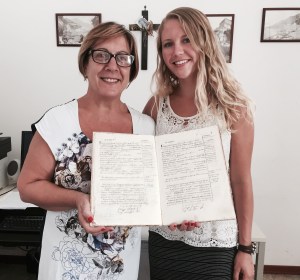
Angela Petrillo and Alanna Peered Through Ancient Records

A minute later Angela reappeared with several old records books that dated back to the early 1800s. As she flipped through the book, I noted how yellowed the pages were and how frayed the edges had become, and I realized where I was standing, in both time and place. My family members had stood in this very building, holding these same books, listening to the waves wash against the sand on the beach outside the window. Like me, these people had hopes and dreams and joys and sorrows. They had cherished their past and looked forward to new opportunities, just as I am doing now in my own life. As these thoughts swirled in my mind, Angela stopped turning the book’s pages and pointed to a point halfway down it, showing us the name “Francisco Cavaliere”, my great-grandfather. The record showed the full details of his birth. At the bottom of the page were signatures of names we didn’t recognize. Angela explained that this was because Francisco’s father couldn’t write, not even to sign his own name on his son’s birth record.


We spent the next 20 minutes looking through the records, uncovering additional names, dates, and details. One member of my family, we discovered, was a midwife. Many of them were farm laborers who worked on others’ properties in exchange for perhaps currency, housing, or goods. The whole process was fascinating, sometimes even more so when we hit a dead end with a particular individual; for example, we discovered that Francisco’s mother was not born in Amalfi. Angela told us that her maiden name suggested that she hailed from one of two neighboring towns, so we would have to visit those villages in order to continue researching her history.

As the conversation with Angela drew to a close, we thanked her profusely for her time, and I looked once more at Francisco’s birth record. Thirteen years after that document was signed, in 1911,”Frank” (as he came to be called) would travel to America with his family. As I realized this, I felt a sense of comfort and encouragement. If the Cavalieres and many others were brave enough to face 3,000 miles of ocean and a strange new country where they didn’t know the language, surely I can face the unknowns that lay before me.

As we left the Municipio to start our journey home, I looked up at the Amalfi cliffs that meet the Mediterranean Sea. Today, the hillside is filled with homes, and the coastal road was packed with vendors, cars and tourists. As I stood there, it was easy to imagine the view 100 years prior, with 75% of the clutter gone, as it looked when my farmer ancestors lived there. They had adapted to the terrain, and then to a new life in America. With a vow to myself to keep their sense of perseverance and adventure close at heart, we started the long drive home, tired but happy.

Thank you Alanna Jamieson for sharing your search.
Genealogy Hint 1 – Start with your Family!

Dear Readers,

richedit2I’ve got GREAT news!  Genealogist Rich Venezia has volunteered to share his knowledge with us.  OK that is a lie, I asked him.  There is now a tab at the top of the blog that says “Genealogy”.  If you open that tab – in the future – any information we get from Rich will be posted there.  There will be easy links to articles.

Midge

Genealogy Hint 1 by Rich Venezia

Buon giorno a tutti!  I couldn’t say no to Midge (how could I?) and am happy to share my passion for genealogy with all of you. Here is the first installment of Researching with Rich.

My first, and arguably most important, research tip – whether you are a novice or experienced researcher – is to interview your family members! Whip out your steno pad! Does anyone even use those anymore? Grab your tape recorder (or your phone), and get cracking! It’s really best to start with your older relatives – they’ll have one or two or three generations more knowledge than others. Moreover, you never know how much longer 95-year-old Aunt Tillie will be around. If you haven’t already gathered DNA from your relatives, when you interview them is a great time to start! But that’s another blog post entirely…

A number of key reasons to interview your elderly relatives –

  • Their stories, memories, and knowledge perish with them, unless they have taken the time to write or record them, or they have been written or recorded by someone else. Here’s looking at you, dear genealogist.
  • They may have personally known some of the people who you are researching or need to research. Now, you can have a first-hand account of your great-great-grandfather, who up till this point, only existed for you in census records and a few old photos. Nothing beats that.
  • Even if their information is wrong, it’s often half-true. My great-grandmother always said she was from Naples. Was she from Naples? No – but she was from a village less than an hour outside of Naples. No, of course it wasn’t in the province of Napoli… you can’t win ‘em all! At least this gives you a place to start.
We still have the original!
  • They may know who is the keeper of the stuff or they may be so themselves. The old photos, passports, identity documents, and certificates of naturalization – these all-important documents were likely passed down to one child or another. Perhaps your relative can help you pin down who has the documents you want. Borrow it and scan it so you can digitize your history for the rest of your family. And remember to return the items that you borrow!
  • Elders may be able to tell you tales that hadn’t previously been told to younger generations… Just the other day, I told a story about my great-great-grandmother’s arrival in the US to my father. It was told to me by my great-grand-aunt (who turned 100 this week!) and he had never heard it before. Apparently great-great-grandmother was pregnant with my great-grand-aunt (another one), and faced some issues when entering because of this… she threatened to throw herself in the river if they deported her. Needless to say, she stayed out of the water!

Professional Hint – don’t forget to bring the sfogliatelle or pizzelles.

The following tale is the reason I implore you to ask where the old documents may be hidden or stored away. My parents and I were cleaning out the garage last summer, and Dad pulls out a box and tells me he’d been meaning to give it to me. Inside was my great-grandfather and great-grandmother’s original certificates of naturalization (1923 and 1944), original certificate of marriage (1919), my great-grandmother’s Italian certificate of birth (obtained in 1966), and information on my great-grandfather’s burial (1940). I’d been the de facto family historian for eleven years at this point – and a professional genealogist for a year. I knew all this information already – but it would have been helpful to have it handed to me years ago! The documents would have saved me a lot of time. In Dad’s defense, I never asked – so I never received. Ask where the stuff is – and you may well be rewarded.

And while you’re bugging them about the memorabilia – and especially if they get cranky since you’ve already asked 5 times – tell them why you want the stuff and the subjects of said stuff. Everyone in the family will benefit from your research!

Great Grandma G

Inquire about their recollections of specific ancestors. Bring out an old photo you found and ask if they remember that person, or show them an obituary or a document that may trigger some memories. Organize your questions – this is an interview but it should be fun! And a tip – you can use the same set of questions for different relatives… but make sure to keep who’s who straight! Some folks videotape the interviews – this is also a terrific way to share the stories.

Some examples of questions you may wish to ask your relatives (or a few to start with):

  • Where are your grandparents buried?
  • Did your Grandma and Grandpa ever say where they were born?
  • Do you have a little book with everyone’s birthday and anniversary?
  • Do you remember what your Grandpa and Grandma were like?
  • What church/synagogue did you go to as a child?
  • What was the special dish your family cooked for holidays?
  • At whose house did your family celebrate big events? Who was there?
  • Am I your favorite niece/nephew? – JUST KIDDING!

Family history is all about that – family. You never know what will turn up – and that’s part of the beauty of it.

Rich Venezia is a professional genealogist based in Pittsburgh, PA. He specializes in Italian, Irish, and immigrant ancestry, and NJ/NYC and Pittsburgh-area research. He has worked on two genealogy TV shows (including PBS’ “Genealogy Roadshow”) and is available for client research and speaking engagements. His website can be found at richroots.net and he can be reached at richvenezia@gmail.com. He adores Midge and her blog, and is so thrilled to be dropping in. A presto!

From Bridgeport, Connecticut back to Castelfranco in Miscano

 A few weeks ago, I got a call from Nicola – one of the directors of Centro Mediterraneo Pintadera that world class language school in Alghero, Sardinia – she asked if she could give my phone number to a current student at the school.  He too was searching for his family and they were from a village not far from me.  Of course I said yes! I love the community of people who are as passionate as I am about finding their heritage. Kevin Monks and I played phone tags for a day and finally connected.  We met for coffee in Benevento and swapped family stories.  Kevin now lives in Cremorne, Tasmania – Australia!  Talk about a long trek to find your roots.
This is Kevin’s Story:
image3
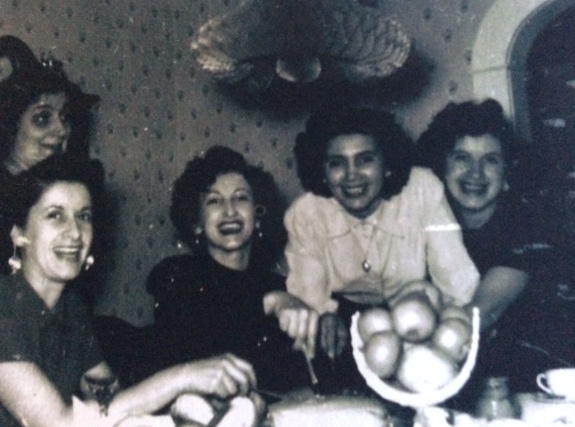
Italian Mom and aunts in Connecticut (early 1950s)
My name is Kevin, son of an English father and US born Italian mother. My childhood memories of my Italy-born grandfather are as snapshots….just a few really, oh and one scent.
Walking up a dark hallway toward the kitchen light in Bridgeport, Connecticut. I must have escaped my bed to visit the happy sounds coming from the kitchen where adults were talking and laughing late into the night. “Pops” Gabriele stood with a smile on his face as the little boy entered into the light.
The scent that I remember is my grandfather’s pasta e fagoli soup wafting through the house. I’ve identified that precise scent only 1-2 times, both time  while visiting Italy.
image1
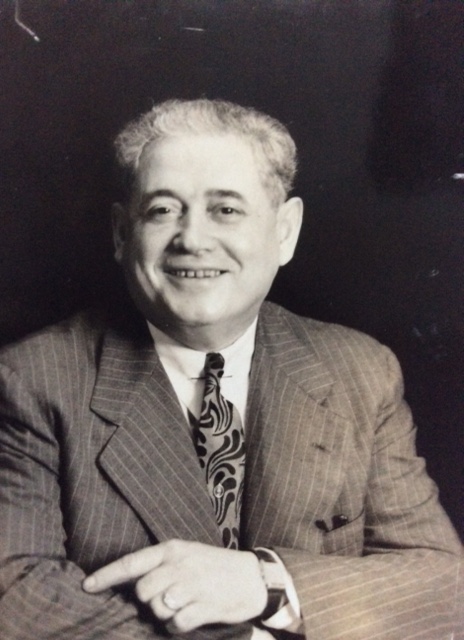
Antonio Tito Gabriele (nonno)
My mother didn’t really tell us much about Pops Gabriel (dropped the ‘e’ after immigrated to US). All she said was that he immigrated to US. (Ellis Island, then Bridgeport) when he was nine years old. His US Italian wife (Mary Ann Vertucci) died when my mother was 16 years old. Pops was born in a town called Castelfranco but she didn’t know where it was and never looked into it.
Both of my parents are gone now, but I wanted to look deeper into those few facts left to me. Starting at the usual places,/ I discovered my Nonno’s fathers name (bis nonno) and my great-great grandfathers name ( bis bis nonno). Along with the names came the point of origin – Castelfranco in Miscano.
I wanted to go see this place. Why did they leave? Adventure, poverty, famine, war? Who were they…what did they do? Well, I booked the tickets and set out from Tasmania to visit this place.
Setting out from Benevento, Campania I boarded the only once-a-day 12 seat autobus to go to my destination. The route left the flat rural farmland and snaked upwards through hilltop villages and finally stopped in the little town of Castelfranco in Miscano.
Midge had given me the best places to look, who to enquire of…so I set out for the Municipio…not a long walk (100m….double that and I would be out of town). It was an old style building with a serious looking clerk who looked at me as if I’d beamed down. “Sono Australiano…Italiano nonno”. She had that look of “great, another balmy touristico seeking truth and identity”. Well, another clerk helped with my very limited Italiano and calmly took action when the elder clerk’s expression became dark and aggravated. All good…I thanked them for a photocopy of the records they found. Bis bis nonno was a shepherd….and bis nonno was a labourer, one of seven brothers.  They gave me their email address to formally request an in-depth search. I don’t know where they were going to look…maybe out the back door and raid the church records.
image2
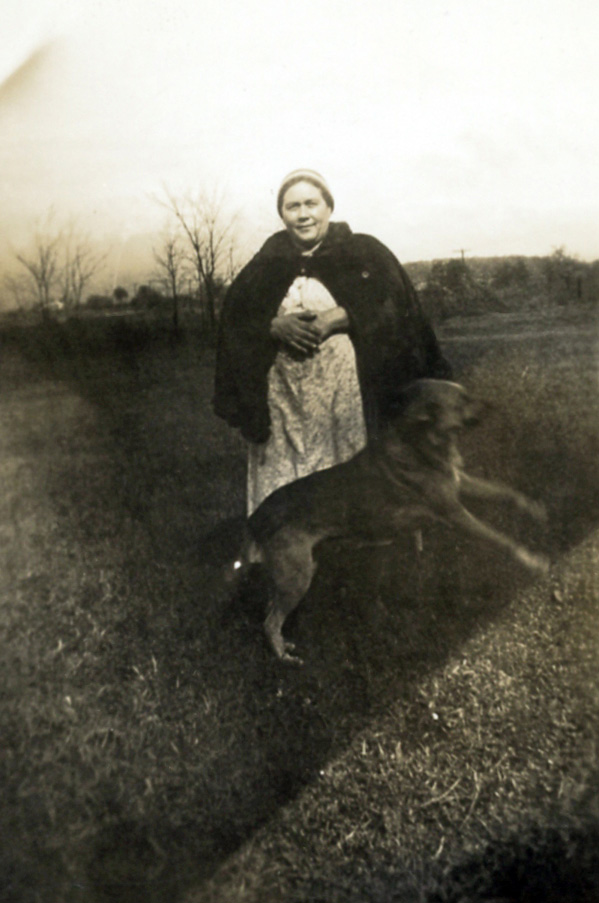
Donato (bis nonno – born 1877) Fedele and Maria Gabriele 
I popped into the chiesa to see if I could corner a padre on the matter…nobody home. Midge said to check out the al bar/ cafe in town. While grabbing an espresso I went through my basic spiel again and Lo and Behold she said someone from her family was currently in Bridgeport CT visiting family. “What? That’s my birthplace. As it turns out, almost all from Castelfranco went to Bridgeport CT. Midge, at my post trip aperitivi debrief in Benevento said it happened a lot. One goes out, writes a letter back, and the others follow the bread crumbs.
Well, I walked around the small village, snapped a few photos and headed back to the town centre. Approaching the Al Bar, I over heard the distinct accent of an Australian (am I surprised? Aussies are everywhere you least expect them). They were hanging around to see if I showed up…word had gotten around the village.  The two sisters in the bar had passed the word…relatives. Had a good chat and I learned more about Castelfranco as their nonna, a charming elderly woman, sat with us. She was born there and had lived in Melbourne for 26 years. Once her Italian husband had died she returned to Castelfranco. The Australian families had driven up to pick her up for a huge family reunion to be held in New Jersey. They were leaving to go at that moment down to Napoli to fly out to the U.S. That was a rich experience.
I wasn’t  prepared for the physical emotional effect when I first approached the little town. There must be something connecting our brain with our heart as we get close to our roots, heritage and Land-Place. It was worth the effort. I encourage anyone to take the journey! Do it while you can relay your findings and stories to loved ones still with you!

Cute Guy Finds Your Lost Ancestors!

Alexandra Rose Niedt, my incredible niece, called one day and said, “You’re buying Richie and I dinner – where shall we meet.”  Hmm, that sounded mysterious.  Alex and Rich had gone to a Performing Arts High School together.  Last I heard he was studying theater in  – well I don’t remember but some UK place or another.  Jack and I met Alex and Rich Venezia for dinner.  As Rich chatted about what he was up to, I caught the mischievous gleam in my niece’s eyes. Rich Venezia is an ancestor detective!  Give him the clues and he will track down that wayward great, great uncle Vito. Immediately I was hooked!  I wanted to hear all the stories, learn how he did what he does and the whole maghilla! richedit2

Eye Candy and Smart – A Killer Combination!

I whipped out my iPhone and went right to his website – http://www.richroots.net/.  Yes, I know I would give the mal’occhio to anyone who pulled a phone out at dinner but..  Here’s the lead in on the site;

Ever heard about that eccentric great-uncle who may or may not have spent his last years in jail? Know your family’s Italian, but don’t know whether your meat sauce should be Bolognese or Neapolitan ragù? Rich Roots Genealogy provides genealogical services to help you find your rich roots.

The reporter in me beat up the writer in me and won.  This is the interview that we shared over caffè and a sfogliatelle. Yes, the tape was rolling –
M: Cute boy – I mean Rich, how did you get started in genealogy? 
R: I was really close to my grandma – my mom’s mom.  My other grandma died when I was 7.  When I was 13, Grandma Edna passed away.  Cleaning her house we discovered the family tree she’d been working on. I was in a strange place, having lost three grandparents before the end of my first teenage year, and I thought taking up the mantle to work on the family tree would be a great way to honor both my late maternal grandmother and my father’s parents. So, from the time I started working on the “Comprehensive Camperlino Clan,” I was hooked!
M: So genealogy is a passion?
Once I started playing detective, I knew it was a role I wanted to keep on playing. I began getting more serious about genealogy as a profession, and two years ago officially started Rich Roots Genealogy.
M:  Sounds like Grandma Edna was a catalyst for your business.  Tell me more about her. R: Edna Marie Foulkes was her name. She was my only non-Italian grandparent! She was so very proud of her Irish heritage, but she was also Welsh, English, Prussian, and (recently learned) Canadian. She was kind and funny and she loved spoiling her grandchildren. I remember she had this silly fake flower pot that would play “In the Mood” when you pressed a button, and the flowers would dance. Every time I visited, we’d dance together. I remember she was silly and had a joie de vivre. I like to think I gained some of my spontaneity and passion for life from her.
M: Let’s talk about the Italian side for a second – isn’t the rest of your family Italian?
 R: Yes, ma’am! My last name is Venezia, after all! Five of my eight great-grandparents were born in Italy, and the sixth was born in Pennsylvania only a few years after her parents immigrated. They were all born in different towns, and a lot of their families had actually moved a lot before the big move, so I am up to over a dozen ancestral hometowns… and counting!
M: How much of your research, specifically into Italian records, can you really do from the USA?  
R: A whole lot, actually. The Mormon church has spent decades microfilming (and recently digitizing) records from hundreds of Italian comuni at archives all over Italy. Some of these records are online on their website, others are online on the Italian National Archives’ site, and many others are available on microfilm at the Family History Library in Salt Lake City. I’ve been very fortunate that a lot of towns I’ve been researching in lately (not my own, naturally) have been available online.
M: I know you love to travel – what about your research in Italy? What records are available there?  
R: The possibilities are endless, really. Mainly, the Archivio di Stato of the province will have the vital (stato civile) records of nearly every town in that province, as well as catasti (censuses), military records, notarial records (where one can find such amazing things as a marriage contract, land records, etc.), and all sorts of other interesting (and little-used) records. In the town itself, a visit to the church is a genealogical treasure trove. Churches in Italy were supposed to keep track of baptisms, marriages, and burials of all parishioners from 1595 onward… some started decades earlier! I am on a quest to learn about the origins of my surname (my roots are all south of Naples from what I know), so it’s on my short list to head to Atripalda and see how far Venezia goes back there.
M: How often does your work get you to Italy?   
R: I try to come to Europe at least once a year, if not more. It’s in my five-year plan to be able to offer client research in Italy, too. And now that I have a place to stay not far from Naples…
M: Any pal of Alex’s can stay with us – and give genealogical advice. What’s one bit of genealogical advice you’d give to a beginner?  
R: Never give up – because you never know where your answers may lie! Genealogy is such a multi-faceted thing. Records we’d never even think to look into may often fill in the lives of our ancestors. As well, records we may have in our home (or our close relatives may have) that we may have forgotten about could lead to some brilliant findings. Remember that dusty old shoebox in the closet, above the Christmas decorations? Time to dust if off! I firmly believe that learning about our past leads us to learning about ourselves… our ancestors’ stories are just waiting to be found. They give us – well, certainly me, at least – pride, purpose, and peace.
M: Rich, you know that I feel exactly the same way – I hope that more young people become interested in learning about their heritage as a pathway to finding out more about themselves.  Grazie mille, Rich!
Little Commercial For Our Pal – 
Since Rich began accepting clients as a professional genealogist, he has helped many others find their roots in Italy, Ireland, Lithuania, Scotland, St. Kitts, Sint Eustatius, France, Germany, The Netherlands, and of course in the USA. He is a member of local and national genealogical organizations, and has attended a number of conferences and institutes to continue his education as a professional. He recently received his Online Certificate in Genealogical Research from The Boston University for Professional Education, and is excited to be running unopposed for Vice President of the North Hills Genealogists in Pittsburgh.
Rich is based in Pittsburgh. His website is www.richroots.net.

I See My Father

IMG_2051
Dominico Manna has my father’s eyes.

The other morning I was startled when my father’s eyes peered into mine.  He hadn’t made an appearance since my sighting of him in Belize.  That day he arrived in a big old Chrysler – driving right up the beach – got out of the car and looked up at me sitting on the balcony staring at the sea.

Dad's head shot for a State Senate Run.

He did that John Wayne gun shot with your pointer finger thing and told me to stop being a wimp and to get on the f’n plane.

Did I mention that he had been dead for three years?

Cripes, I thought, what had I done to have him stare me down in a public place – Bar Elimar in Pontelandolfo?  I gulped and pulled my eyes away to see if the image stayed.  It stayed. The face was smiling – it wasn’t my father’s face. But the eyes – they were his eyes.  My woo woo moment had kinda’ sorta’ passed. My cousin Dominico peered down at me.  Rats, those are my father’s eyes.  I just met Dominico Manna a week or so ago, but when my dad’s eyes looked back at me I felt like I’ve known this newly found cousin my whole life.  Dominico is my father’s second cousin just like my Guerrera cousins back in the USA – that makes him my third cousin or second cousin twice removes or…. Well it doesn’t really matter.  He has my father’s eyes.

Part of my fantasy living in Pontelandolfo for 6 months – besides writing a best selling memoir – HA – was uncovering more cousins.  Our family tree is full of all of the names that mark homes all over Pontelandolfo – Guerrera, Rinaldi, Fusco, Perugini, Mancini etc. etc. etc.  When I look at the family tree, I start thinking that I have at least one blood cell of every single person that I pass on the streets.

Every time I actually find someone with a clear direct link to my nonna and nonno, I get smacked in the face again with how much we are all alike.  What was that Haley Mills TV show about the cousins who looked so much alike they could pass for one another?  My USA family – starting with my incredibly talented sister and niece and branching out to second and third cousins – is full or actors, dancers, writers, photographers, artists and those who love the arts.

IMG_1121

Hand Crafted by my cousin Carmella in Pontelandolfo!

Imagine my joy to discover that generations of our blood line here have danced in the towns international touring folklorico dance company, are incredible photographers, writers, visual artists etc.  Others, like me, are arts administrator types and help organize the towns events. Damn that artistic DNA!

I always remember my grandmother, Uncle Sal and Aunt Cat working their Flagtown land. Grandma taught me how to kill and pluck a chicken for dinner. Many here farm their land to produce incredibly tasting meats and vegetables. Gifts of home made cheeses and meats have graced my door.

We have family all over the world – the ones I know about are in
Argentina, Montreal, England, Spain and I can’t remember.  Jack and I will have to definitely take a trip to Argentina.

Passport 1

Our family members, when the village could no longer support them, took the risk and re-established themselves beyond the borders of Italy. Even though we had never met, live miles apart and in some cases don’t even know that parts of our blood line intersect we are the same. Hell I know this sounds like woo woo but maybe there is something about this DNA stuff.

Every market day, if I stay in one place I am sure to see more of my family. Sometimes I haven’t a clue what they are saying to me but it doesn’t matter. Other times they clearly share what is bothering them, who is driving them crazy or why today is an absolutely fabulous day. The connection that comes from sharing secrets makes me feel like I have been here my whole life. In reality I discovered this family of Pontelondolfesi a scant 18 years ago. 18 years of returning to the village of my grandparents has forged incredible bonds.

I have finally decided that this is where I want to live – it may be 6 months a year or full time. It was seeing my father’s eyes that put me over the decision making edge. Daddy visiting me through Dominico and telling me once again not to be chicken shit – life is too short.

996152_10151482123192817_774993471_n

When we get back to NJ the house will go on the market. Anyone want a farm house with a bocce court and mulberry trees?


Nonna Was In The Field

My woo woo pals will not even blink when I say that at 7:00 AM the other morning I bumped onto my grandma.  She died when I was 16 but I remember her vividly – it was her.

Grandma

Wearing the same kind of caftan I had on when I first saw Ruth St Denis, whoops that’s the mom of modern dance and she has nothing to do with this story. It’s just the magic of the caftan. So wearing this old tied died caftan, I was walking in The field across the street from my house carrying a plate of apricot peels. As I started to toss the peels into the field –  there she was.  Smiling because I hadn’t been lazy and walked way out onto the field just like she taught me.

Whew, where did that memory come from – why was she here now?  When I was a wee thing we had pasta at grandmas house every Sunday. After the locusts in my family had managed to eat everything but the mopeen – dish rag we all used to wipe our saucy fingers on –  it was often my job to take the pile of bones and other table scraps out to the field. The instruction was walk far and toss. Sometimes a lazy kid would just dump the plate at the edge of the lawn. ( Jack screams at me now because I’ve turned into a lazy kid and dump on our Flagtown lawn line.)

This was a no no and would draw rats close to the house. We didn’t have a fancy compost pile or Eco box. We had the field. Foxes loved the bones and they were soon gone. The egg shells and the veggie scraps were great for revitalizing the earth. Now 60 years later, here I am in the place where my nonna learned that doing a field dump wasn’t a trailer trash thing. It was simply keeping the cycle of growth happening.

86950-PH-GFB1-086

That morning I was doing something I know she had done. The field was a recently shorn hayfield. The feral cats and foxes still eat any meat stuff and the rest just rots back into the soil. Maybe next year this field would be a potato patch – enriched by or simple veggie scraps.

What struck me was how the simple action of tossing apricots peels brought my nonna back to me.  She was there making sure I walked out far enough and did the job right.  This had a colossal impact on me.  After a year long painful inner dialogue about selling our house in NJ, it was this moment in a field that nonna made me realize that I could.  The farmhouse was my grandma’s and is the place where I feel the presence of my elders everyday. Nonna let me know that wherever I am they are and all is OK.

Nonna Garden
Grandma and Aunt Cat are always there for me.

Grazie tante.

Yesterday Was Better Than Christmas Morning!

What a magical day I had.  The day really had nothing to do with me but it really felt like I was on a roller coaster of a journey seeing Pontelandolfo for the first time and sensing the connection to my past, present and future.  Only it wasn’t my past.  It was the past of the Domenico Mancini family.  Like many other Mancinis this family can trace it roots to a section of Pontelandolfo called Minicariello.  Whoa – let me start at the very beginning.

Last year I got an e-mail from a woman who had googled Pontelandolfo and hit upon my blog.  After pumping up my chest like the winning rooster of a cock fight – I mean someone actually googled and found my blog you’d be all proud and cheeky too – I responded to Kristen Ross’s request for help.  It seemed like her good family friend, Domenico Mancini, had left Pontelandolfo when he was 18.  When he was a tyke, his dad had died in World War II and the family didn’t know where his body was.  Check out this post to get the back story – http://wp.me/p3rc2m-dw.  Now, many months later the entire Mancini clan was coming to Italy to visit the grave and see where their dad was born.  Their first stop was the Sacrario Militare dei Caduti d’Oltremare (Military Memorial to the Fallen Overseas) near Bari.

Kristen sent me this shot of Dominico reunited with his dad.
Kristen sent me this shot of Domenico reunited with his dad.

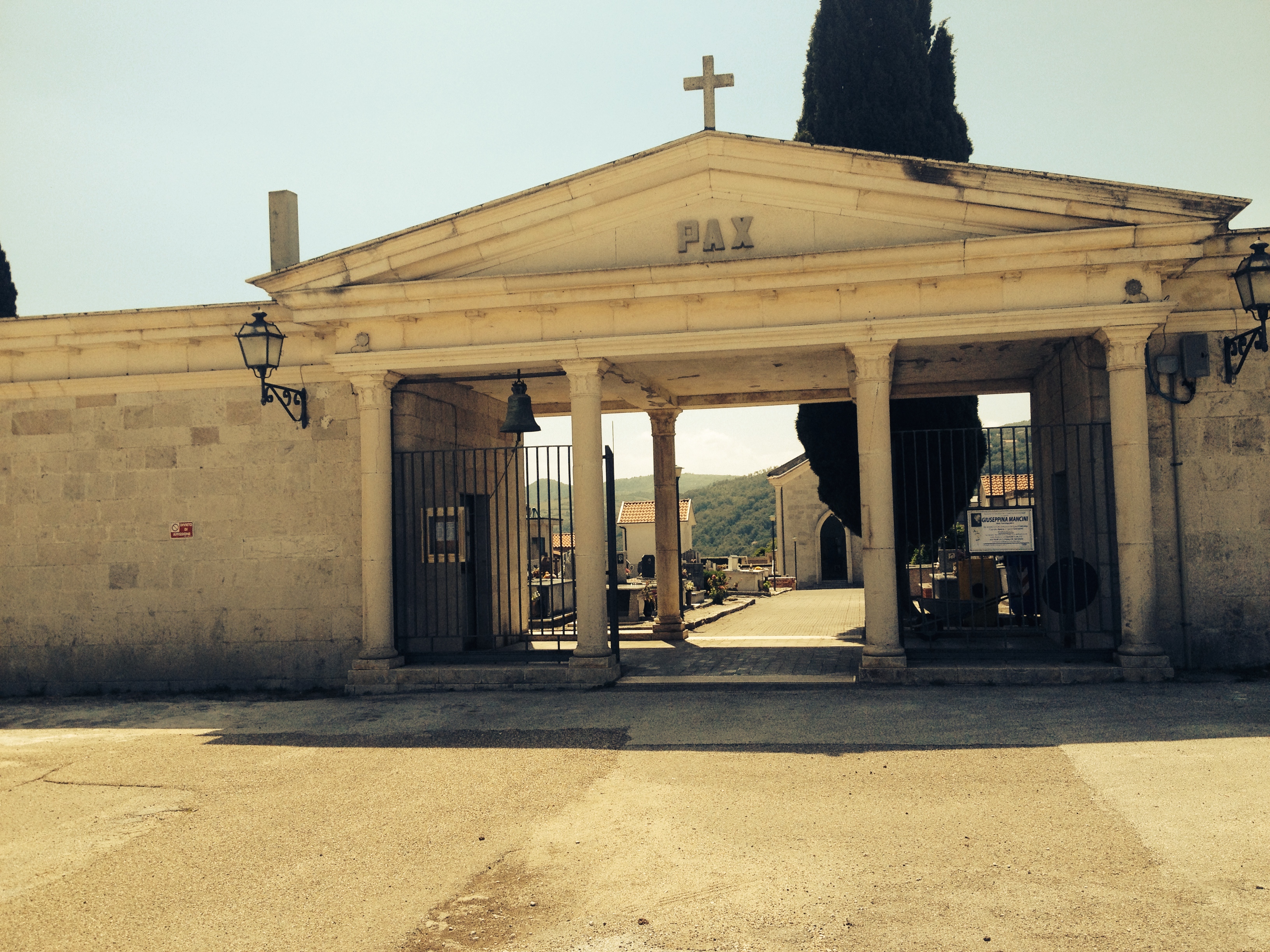
Domenico had not been back to Pontelandolfo since he left as a young man – about  64 years ago. Kristen – the point person for organizing the trip  – asked if we could meet when they got to the village.  What a magical meeting and day we had!  After getting the “we’re here” text, Jack and I pulled into the piazza and saw the biggest shiny silver mini-van/mini tour bus I had ever seen here. Pouring out of it was the Famiglia Mancini.  Never having seen these folks before or even really knowing their names I was swept into a stream of “I’m Kristen -Nancy – Domenico- Rich – Marylou – Tony”, hugs and kisses. It was as though they were my family too.  After a few seconds of where should we go and what should we do, it was decided that we visit the Cemetary so that Domenico could look for his family. Everyone – the men in the family are really tall – leaped back into the van. I, being the shortest person in the crew, had to climb, pull and crawl my way in.  The trip to the cemetery couldn’t have been better. IMG_1512

Rito Sala, the caretaker/administrator, warmly greeted the family, pulled out his trusty typed sheets of who was where and led the search.  Unfortunately, Domenico didn’t really remember the dates of when his nonna died etc.  Without the dates it is hard to truly figure out who is who.  Remember,  in this small town hundreds of people have the same last names but are not related.  Domenico had seen my blog about the boxes of bones in the cemetery chapel and wanted to see if his ancestors were there too.  We went on down and he found a number of boxes with names that he remembered.  The caretaker took us to visit the older section of the cemetery walls (see blog http://wp.me/p3rc2m-hI ) to see if Dominico could hone in on relatives.  It was a very emotional exploration.

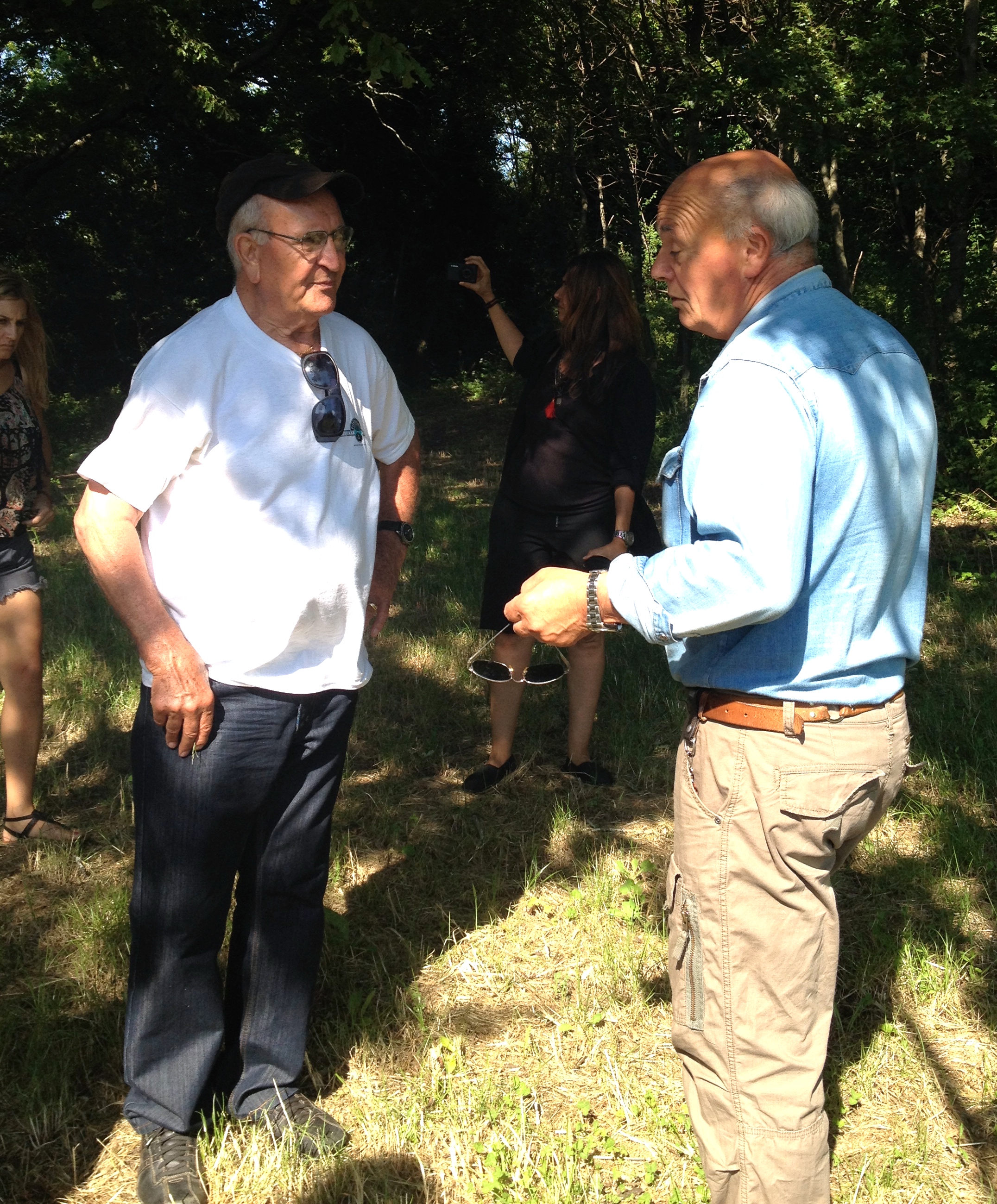
Dominico really wanted to see if he could find the house that he was born and lived in until he came to America. This section of Pontelandolfo is really off the grid.  I knew of one person who could guide us there – another Mancini!  My incredibly kind and generous cousin-in-law, Mario Mancini, was pressed into service.  With he and Jack in the lead car we wended our way, up, up and up a mountain over the kind of narrow winding roads that worked really well for donkeys.  Soon we made it to Minicariello and started climbing up to medieval ruins looking his his house.

The cutesy sign was not original.  The folks who are buying these old stone houses and restoring them for weekend joints made the sign.
The cutesy sign was not original. The folks who are buying these old stone houses and restoring them for weekend joints made the sign.

Now he hasn’t been here in a really long time. When he left there weren’t any roads and you really used donkeys to get around.  Now there are roads and some folks from Naples are buying up the ruins and redoing them as weekend houses.  Things look and feel different.  The tenacious Mancini clan would not give up.

Two Mancini men from different families discuss the strategy for finding Dominco's old home.
Two Mancini men from different families discuss the strategy for finding Dominco’s old home.

One of Domenico’s sons found a group of people sitting outside a restored house.  Tony tricked his dad into meeting them.  Dominico speaks the dialect of Pontelandolfo as though he never left and started sharing his story.  This group showed the family another group of attached abandoned ancient homes.  It was there that the family gazed upon the first home that Dominico ever had.  It was an incredibly emotional moment.

The first time I came to Pontelandolfo in the 1970’s with my Aunt Cat and cousins she had memories of an ugly place full of poverty.  We drove in, stared at the fountain and practically fled.  Dominco related similar feelings to his children.  His memories are of incredible poverty and the feeling that they were lucky to get out.

Through the eyes of the younger Mancinis, the beauty that is the Pontelandolfo was reborn for Dominico.  Everyone was overwhelmed with the incredible mountain vistas, the friendliness of the people and the sense of community that one can feel in the piazza.  During our descent, Mario surprised everyone and pulled his car over.  He made us trek through a short field to see a Roman Fountain – yes ancient Romans actually got their mountain spring water here.  Just another of Pontelandolfo’s fabulous secret spots.

We all drank from the Roman Fountain.

After a beers at Bar Mix Fantasy, I led part of the crew up the hill to the Mother Church.  Luckily, it was open and they could take a quick peek inside at the alter where their dad was baptized and nonna was married.

They invited Jack and I to join them for dinner along with Mario Mancini and Carmella Fusco.  Carmella, Dominico and Mario were real “chiacchierone” laughing and chatting away in the dialect of Dominco’s youth.  The night was filled with sharing stories, trying to figure out if we were all somehow related and feeling – well just like family.

Finding My Great Grandfather

This morning when I got up there was a line of cars outside our house.

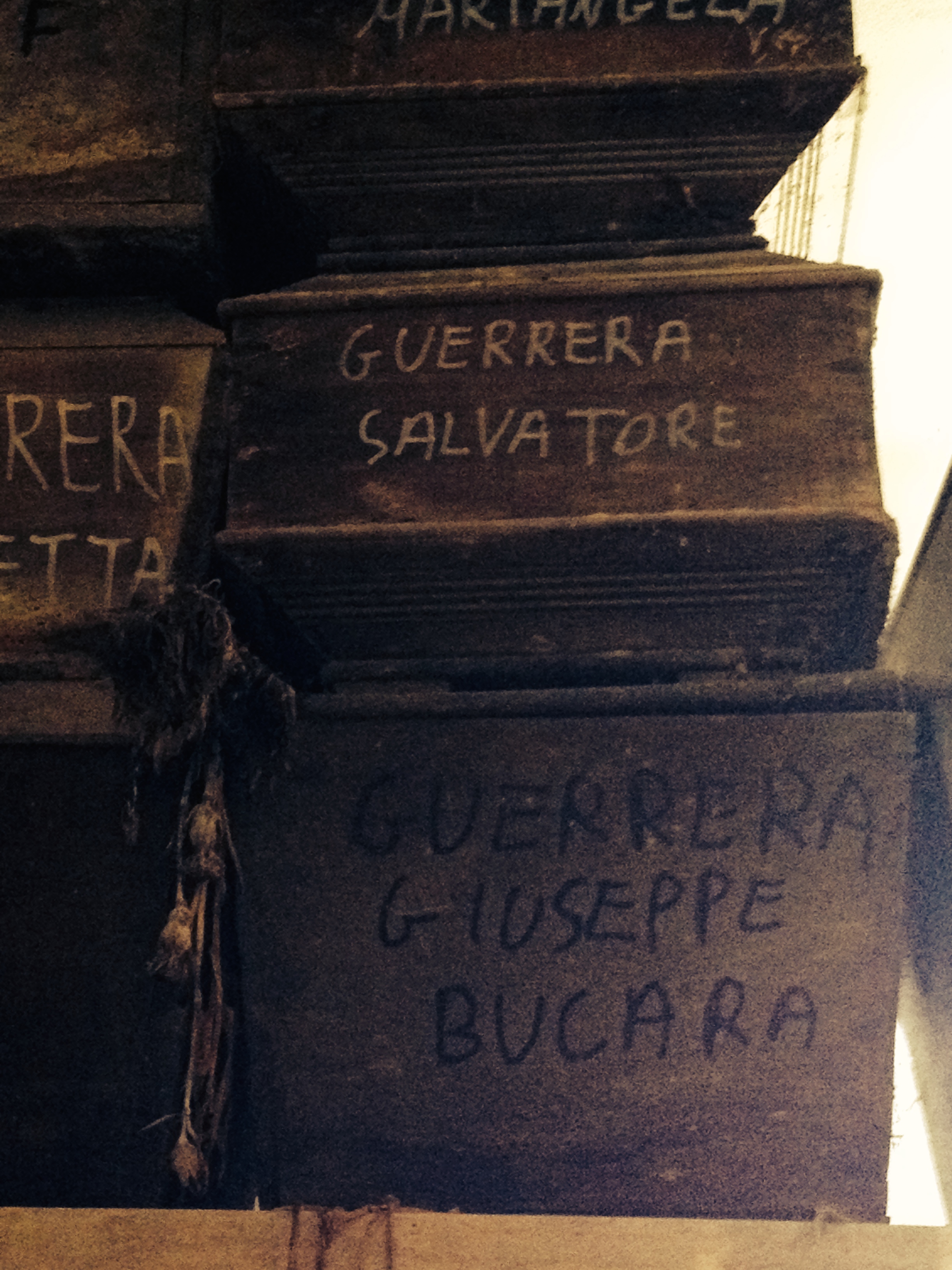
That is the line that starts the post I thought I was going to write.  You’ll get that one tomorrow or dopo domani.  It is about a funeral and the funeral/burial traditions of Pontelandolfo.  I can’t finish it today.  Because today in the basement of the Pontelandolfo Cemetary “Cappella” – Chapel, where the bones of the poor are stacked in wooden or tin boxes, I found my great grandfather.  Don’t ask me how I know it was him or how I found him.  When I saw the wooden box with the handwritten “Salvatore Guerrera” I just knew.  It doesn’t have a date – he died in the 1920’s – but I knew.

IMG_1540
There are hundreds of stacked boxes. I may be wrong, but when I saw this box – I knew.

My great friend, Nicola Ciarlo, had taken me to the cemetery to explain the rules, regulations and traditions of a Pontelandolfo funeral.  It is as unlike a New Jersey funeral as you can imagine.  The mountain is made of soil that is rocky and hard.  The cemetery has been used for generations and hasn’t grown in size.  People die – how could the cemetery not expand? Simple, after a number of years, the coffin’s are dug up, bones prepared and then placed in a little box that is placed in a nice marble drawer.  That’s if you can afford the nice marble drawer to share with your loved ones. But you’ll read that tomorrow.  Today I need to think about my bisnonno.

Nicola took me to the church basement to show me where the bones of the lost ones were housed.  The place is called “il ossario” – that is fitting because “ossa” means bone.  The lost ones either didn’t have family to reclaim their bones or they were too poor to be placed somewhere else.  In the 1920s in Pontelandolfo everyone was poor – my family was no exception.  They were contadini – farmers who worked the land for a rich dude. Back then, after World War I and the ravaging of the mountain by the troops, the poverty caused a mass exodus to the Americas. Noone had the money to come back for funerals or even knew that loved ones had died.  So, in the ossario there are stacks and stacks of wooden boxes.  Some were dated from the early 1900’s.  Most didn’t have any dates, just a name scrawled across one side.  Little white boxes held the bones of poor children.

IMG_1538
The bones of children are nestled in white wooden cradles for perpetuity.

As I covered my nose from the damp, moldy smell and looked around, I realized that the boxes had been piled in alphabetical order.  I kept walking and found a shelf containing the remains of Guerreras.  Since Guerrera is as common here as Smith, I didn’t think anything of the shelf.  Then, as though an arrow shot through my core, my entire being was pulled toward the box that said “Salvatore Guerrera.”  It has been 5 hours and I am still crying – though now I am crying in my scotch.  At first, I thought the overwhelming sadness was because the root of my family tree was tossed in a box and stacked on a shelf.  Or I was crying because of how very poor my family had been.  Then I realized that I was crying and felt an overpowering sense of loss for all the elders in my family that I didn’t know, haven’t found and haven’t taken the time to discover.  I cried from the depth of my soul.  The tears refused to stop.  Suddenly, I realized that I was mourning.  Mourning for my father, my Aunt Cat, my mommy, my Uncle Sally, grandma, Uncle Tony, Uncle Nick, cousin Roseann, Aunt Julie – mourning for all of the people I have loved, who had loved me unequivocally and died.  All of the sadness I had bottled up had been released by my great grandfather, Salvatore.  My sadness sits inside me and maybe that’s a good thing.  Maybe in order for the sadness to escape I need to start whacking away at the memoir about finding my family.

Enough about me.  Let’s talk about Salvatore Guerrera. He was born on April 5, 1848 to Giovanni Guerrera and Maria Guerrera – since women here don’t change their names when they marry seeing the Guerrera married to a Guerrera was a wee bit disconcerting.  But hey, it was a small village and Guerrera is like Jones.  The Guerrera infusion in my body is even stronger – Salvatore married Caterina Guerrera.  Writing this makes me realize that my blood must also flow in over 50% of the people that I meet.  That connection is visceral for all of us and explains why I feel so accepted here. My great grandparents had five children that lived – Francesco – my nonno,  Maria Vittoria, Anna, Nicola, and Giovanni.

Book in comune

What I discovered years ago peering through the dusty books in the town hall was that Salvatore had a whole second family! He also married Giuseppa Iannicelli and had four more kids- Caterina Maria ( who died as a baby), Caterina, Michele Nicola and Antonio.  It is interesting that Salvatore’s first wife’s name was Caterina and he named his daughters with his second wife Caterina!  I wish I could flash back in time and hear that story.

Salvatore was a small man who was larger than life – a fighter, lover, leader.  I have only met him through the tales that others have shared. It isn’t the same as seeing his face and hearing his voice but it still links me to him.  Here are stories my Zia Caterina, Daddy John, and Carmine Manna told me.

Salvatore Guerrera was Robin Hood. He stole from the rich and gave to the poor.  In those days everyone was a poor sharecroppers – like a slave – worked the fields for the rich.  They had very little food or money.  Salvatore took and gave.  No one starved.

During World War I, Salvatore was out hunting and he heard some local women screaming. German soldiers were “having their way with them.”  Salvatore shot the soldiers.  He then dressed as a soldier, took their German guns and walked past the Germans – right back through the lines.  That took amazing balls.

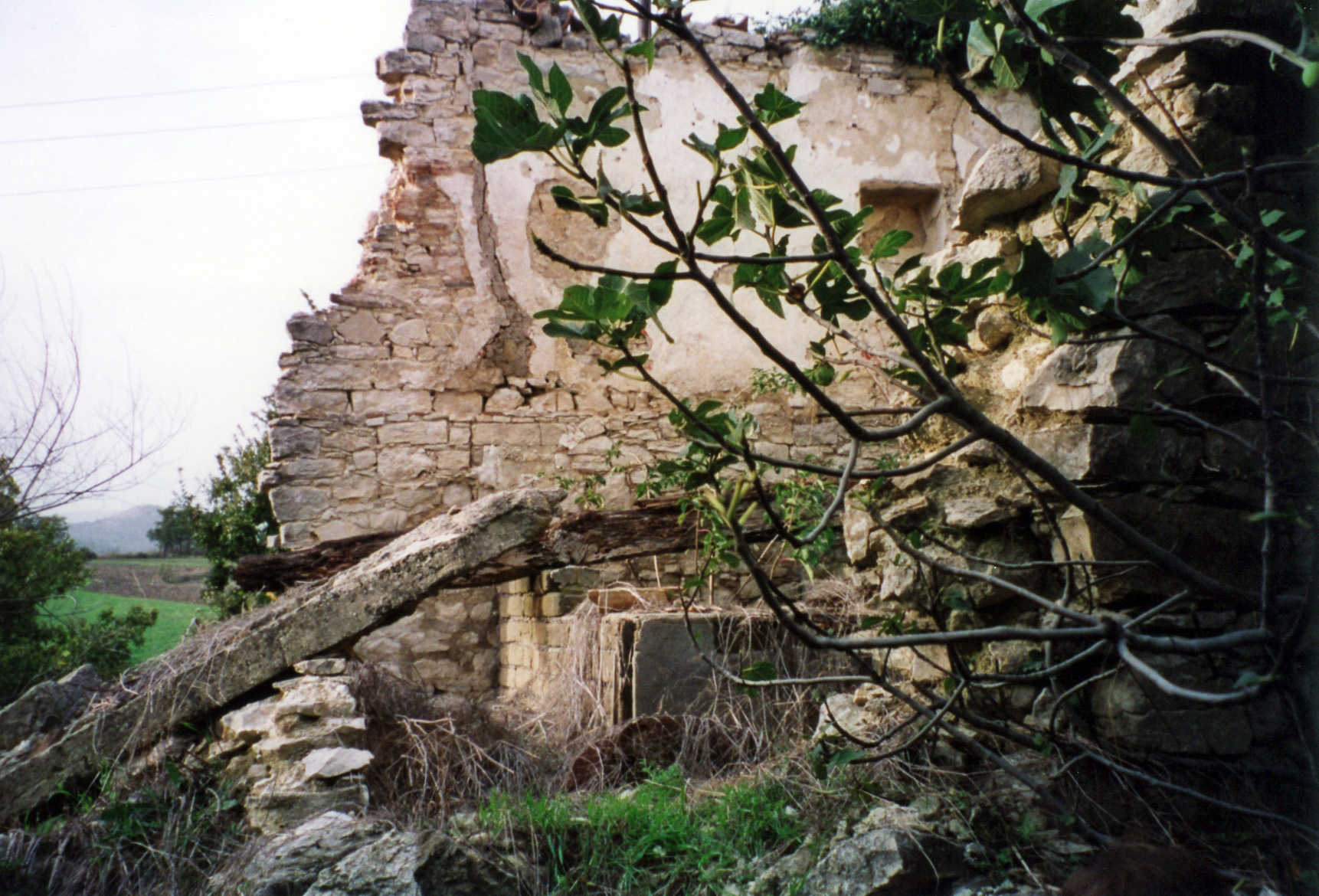
With safety in numbers, peasants then lived in stone attached dwellings. The bottom floor was used to house the family’s animals and farming tools. The heat from the animals rose and warmed the second floor which was inhabited by the family. It was one room. The space was very small and yet everyone managed to live together.  The structure still stands in the Santa Caterina section of Pontelandolfo.

86950-PH-I99-P-014
Here is the set of row houses that date back hundreds of years. Now they are empty or used as storage space.
86950-PH-I99-P-015
Here is what is left of Salvatore’s. It was the end of the row and looks like I felt today.

Zia Giuseppina Guerrera, my dad’s first cousin, told me these stories:

Salvatore needed wood for a fire to bake bread.  In this time there were no trees left for wood.  (My grandmother told me that during World War I everything was taken from them and they started to make soup from the bark of trees.)  Everyone was poor and hungry.  Salvator wanted to cut down the tree of the the padrona.  Remember, Salvatore, like many others, was a serf and worked the land for the padrona.  The tree was incredibly large and the padrona said “No, you can’t cut it.  I need to tie my donkey to that tree.  So in the dark of night Salvatore cut off the just the top of the tree and tied the donkey to the bottom!

Tobacco was grown in the fields to make cigarettes.  The police – working for the rich – said don’t take this tobacco, it is to be sold.  Of course Salvator took a leaf of the tobacco, looked at the police and said, ” Beh,  don’t talk to me about this tobacco.  I will smoke if I want to – so get the hell out of here.”  Since he was as strong as a giant, the police went away.  The next day the police came back and Salvatore was smoking.  He was so very very strong and carried himself like a man of power.  There was no arrest.  They were afraid of him.

He was so strong that he would take things from the rich man to give to the others.  The rich man would say – “I’ll give you money to stop taking things.  Salvator laughed and said – “I’ll just take it.”  The rich man too was afraid of the very strong and persuasive Salvatore.

When Salvatore was very old he told Giuseppena’s father, Antonio, to bring him his cane.  “I want the cane.  Give me the cane because I want to beat these children.”  No one would bring him his cane. He was still really strong – even as an old man and everyone knew if he got a hold of that cane…

I obviously never met Salvatore Guerrera, the father of my father’s father and the very strong root of my personal family tree.  Those traits of his I have seen – in my father, my aunt and gulp – I hate to admit it but – myself.

“L saugu t chiama,” Zia Giuseppina, my father’s first cousin, constantly tells me in the dialect of Pontelandolfo, that “the blood calls.” “L saugu t’altira.” Blood like a magnet is drawn to like blood.  My saugu, is strongly attracted to the saugu here.  She hugs me and reminds me, that I am the only one who came back from America to search for those left behind.” 

The search continues.