Cinghiale – Ugly but Yummy

Photo by Magda Ehlers on Pexels.com

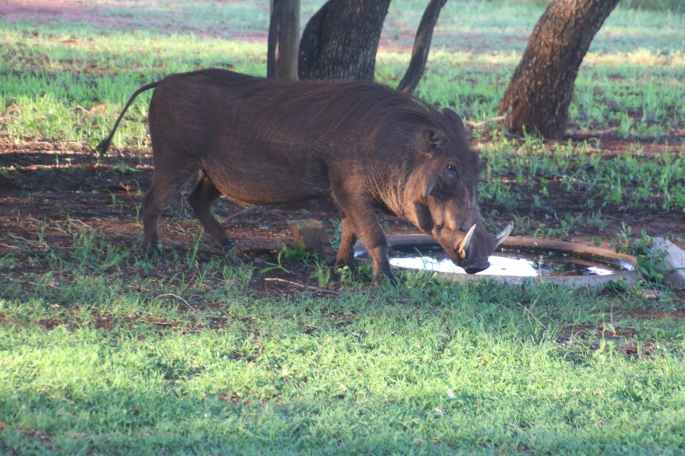
Wild Boar – Cinghiale. They dig up crops, scare the bejeeezus out of tourists, and imagine this – one year ago the Italian army was sent in and told to shoot to kill. The ugly critters, found even in the streets of Rome, were or may have been carrying African Swine Fever which threatened the pazzilion dollar prosciutto industry. Some of the wild bad boys may have been getting a little too close to the gentile domestic sow. Sigh – isn’t that always the way.

Here in Pontelandolfo, we may not like their big ugly tusks charging at us but we do love the rich sauce you can make with the meat. The amazing steak and well, the general incredible taste that only free ranging, wild things can give us. 🎶 “Wild thing, you make my taste buds sing!” 🎶

Growing up in rural agrarian Somerset County, New Jersey, venison, wild turkey, peasant and other wild critters often graced the table. My dad told me that in the dark days of the depression, ground hog – which tastes remarkably like pig when made in tomato sauce – was often part of Sunday pasta day. My nonna told me the horror stories of picking buckshot out of teeny tiny sparrows or maybe they were black birds. When a flock flew over my nonno would hauled out the shotgun and BAM. Wee birds for dinner. I remember cleaning buckshot out of peasants and that wasn’t fun. But a family has to do what a family has to do.

Here in Pontelandolfo, we still have subsistence farmers who grow and process vegetables, raise animals for milk and meat and, gulp, remind me of my grandmother. They are kind, hardworking and loving people. We’ve integrated into the village’s rural lifestyle. Nope, I haven’t planted a thing except words on a page and a good will smile. Since, everyone thinks that because I spend my time at a desk, poor Jack will die of starvation, we are often recipients of parts of harvests and hunting. NOW YOU SEE WHERE THIS IS GOING…

Thanks to a wonderful hunter, a giant chunk of cinghiale found its way to my freezer. Jack and our summer guests would not starve. Unless I was hosting a party for our contrada (neighborhood), there was too much to use for one meal. I put on my 4-H Cooking Club farm girl brain and thought – I know me thinking seems like an anomaly – but Shazam an idea. Yes! I would divide the meat and create three freezable dishes. Stew, pasta sauce and meatballs – all freeze well and will make Jack a happy cena.

First step, get out a big knife and divide the hunk. Based on no knowledge of boar anatomy, I think it was a thigh or butt. I grabbed one of my nonna’s giant stainless steel bowls – yes, I brought a few to Italy – tossed in leftover red wine, wine vinegar, apple cider vinegar and herbs. Why, you are wondering did I use a mix of vinegar. Simple, there was a little bit left in a few bottles. I also added diced garlic, fresh rosemary on the stem, thyme, pepper and salt. Plopped in the meat, covered it and left it in the refrigerator for two days. I think twice I remembered to flip it around.

Truth be told, I then had to succumb to google. Did I wash the meat after the marinade? I did. Did I mention, I throughly washed the meat before I dropped in the melange of acids. I’m glad I washed it. An important lesson was learned. Leaving boar in vinegar for 48 hours means it is tender and tastes like a hint of vinegar. Next time it will just be red wine.

I looked at the three big pieces of meat which were now no longer red. WHAT DID I DO? I was planning on taking one third to our friendly butcher and asking him to grind it. When I got there the first words were – in very marginal Italian – did my marinade wreck the meat?! He laughed. The meat absorbs the acids and changes color. I promised him some meatballs. He smiled at that too.
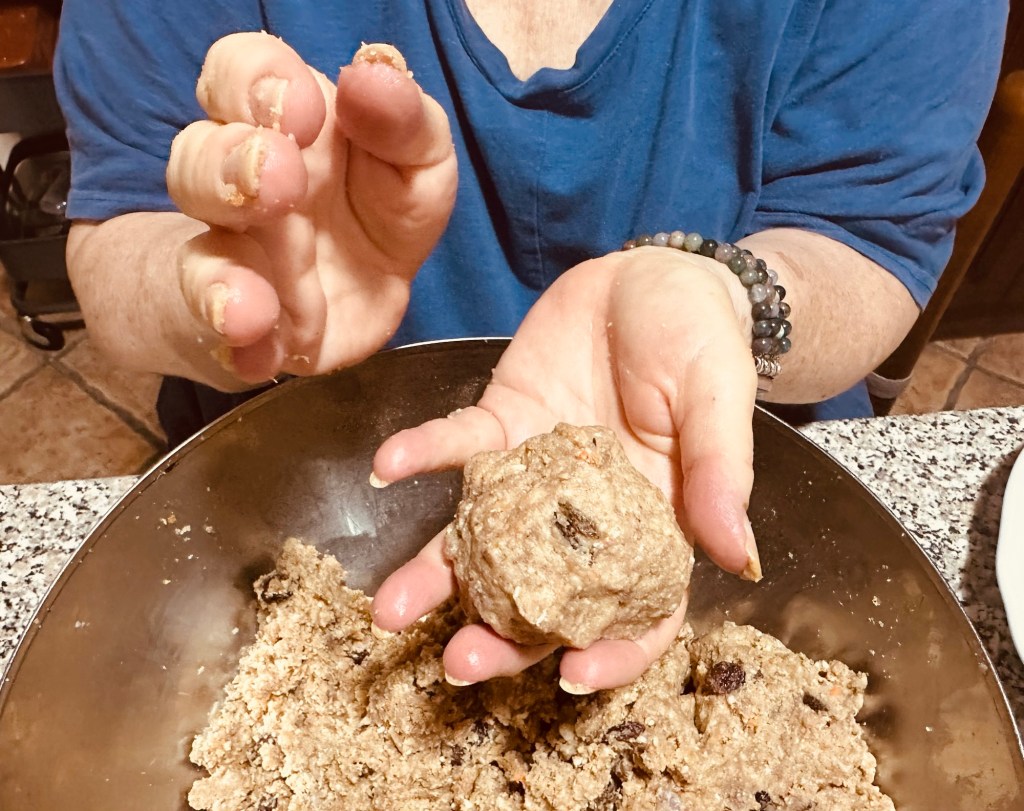
Cinghiale Balls!

There is something meditative about squishing a mixture of meat, grated cheeses, breadcrumbs, raisins, oregano, salt, pepper, basil and eggs through your sanitized hands. Because the meat wasn’t very fatty, I used more cheese and eggs than one might usually. Actually, I scooped in extra bread crumbs too. I ended up rolling about 30 balls this size.

Meanwhile on the stove, my giant stainless steel pot was hosting slow cooking freshly diced tomatoes, onions, garlic and green/red pepper. I wanted the fresh stuff to break down before I added jars of passata ( homemade tomato puree graciously left on my veranda.) In went the passata plus a couple of store bought cans of diced tomatoes. I was trying to fill the giant pot and freeze enough sauce for decades.

To make the sauce really rich, I have learned to add a mirepoix. Carrots, celery and onion were diced to almost a paste in my blender. That went into the pot then I stirred and waited. When it started to bubble, I very carefully placed each of those boar balls in the pot. Lid went on and I let the ragù slow cook for a few hours. The meat balls gave it not a gamey taste but a savory taste that one wanted to go on forever.
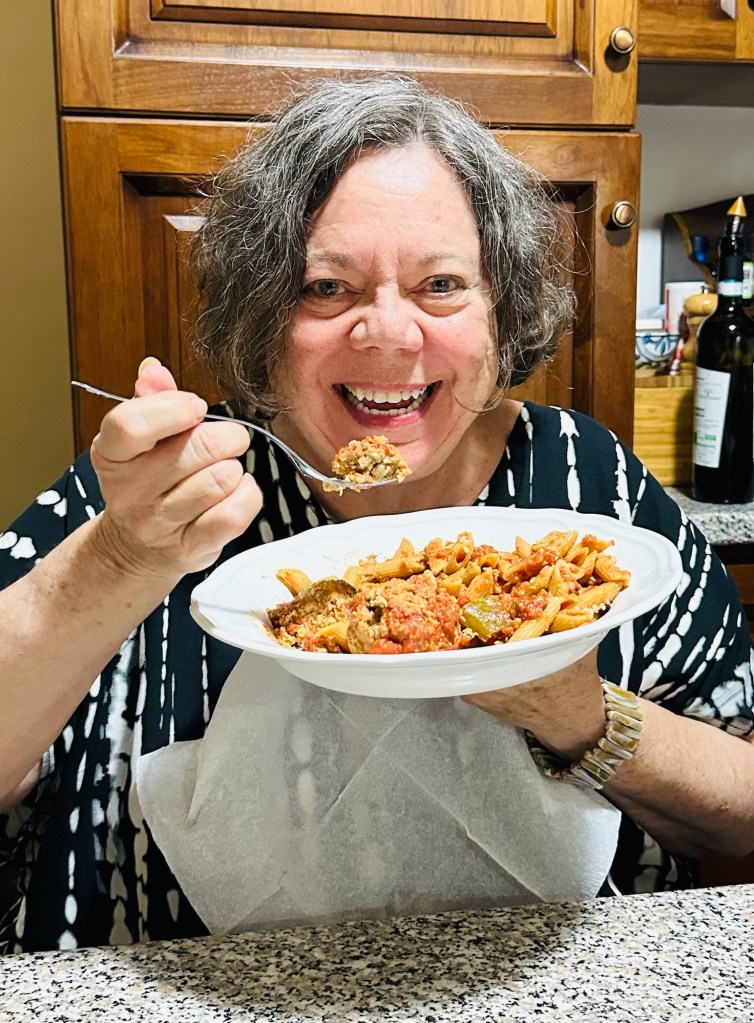
I could eat this sauce everyday!

I made enough sauce and meat balls for three of us to have a substantial meal. Nestled in my freezer are now three containers of sauce and balls for the future. Yummy. I thank the hunter who share with poor starving Jack.

We will talk about the stew another day. I am hungry and need to forage for local cheese,wine and bread.

Ci Vediamo

Midge

You too can cook, write, paint and enjoy village life in Pontelandolfo! Visit – www.cookinginthekitchensofpontelandolfo.com
The Wheat Comes From Where????

What? I queried.  You went where to buy wheat?

The well heeled Italian businessman replied, Texas.

Jack and I love to travel on Italian trains. Age brings its perks – deep discounts on business or first class tickets.   I like the “four-top” set up. Four comfortable seats surround a table. There are places to plug in your “God Forbid I forget my iPad,” and interesting folks to chat with.  For example, the two businessmen who sat across from Jack and I. After ten seconds, they realized immediately that we were Americans and proudly proclaimed that they had just come back from Texas.

Charming gabby girl said, Texas – that is a great place to visit.

We were on business.

Jack was immersed in his book when I said, What do you do?

We buy grain.  We import Texas wheat to Italy.

My mind said “what the duck” but my mouth politely spit out, Why?

For the pasta industry.

Hands started flying and words were soaring over the four-top.  Now I was not, as Jack said, being SNARKY when I bellowed – Texas!  They make Italian pasta with wheat from Texas!  I wouldn’t eat anything grown in pesticide ridden Texas.  That is when Jack kicked me under the table.  OUCH!  (Don’t you kick me too – Texas does restrict some use of pesticides – I looked it up.)

The men, being politicians at heart, explained that Italy doesn’t grow enough wheat to make all the international pasta lovers happy.  Italian companies need to import wheat to satisfy the market need.  They have been buying wheat from the USA and Canada for years.

Pasta 2.jpg

According to an October 2019 article in Worlds Top Exports,  in 2018, Italy ranked 4th in wheat importing.  They imported $1.82 billion of the heavenly grain.  The USA sold them 28.1% less than the previous year but still raked in $146.2 million.  Canada sold 81.1% less than the year before.  Why you might ask?  The answer is simple – pesticides.  I discovered an article on i-politics that talked about Barilla Pasta Company speaking to Canadian growers and explaining Italians don’t want to eat what they perceive as poison.  Italians lobbied and marched for locally sourced grains.

Italy, like other countries, legislated Country of Origin Labeling  (COOL) for food. That means you have to say where the wheat was grown and were it was processed.  That gives consumers an option.  They can decide where they want their dinner’s ingredients to hail from. I believe in eating local and shopping local.  What happens to wheat when it is shipped in big containers across the seas? Errrrggg – I can’t imagine the creepy critters that have stowed away.

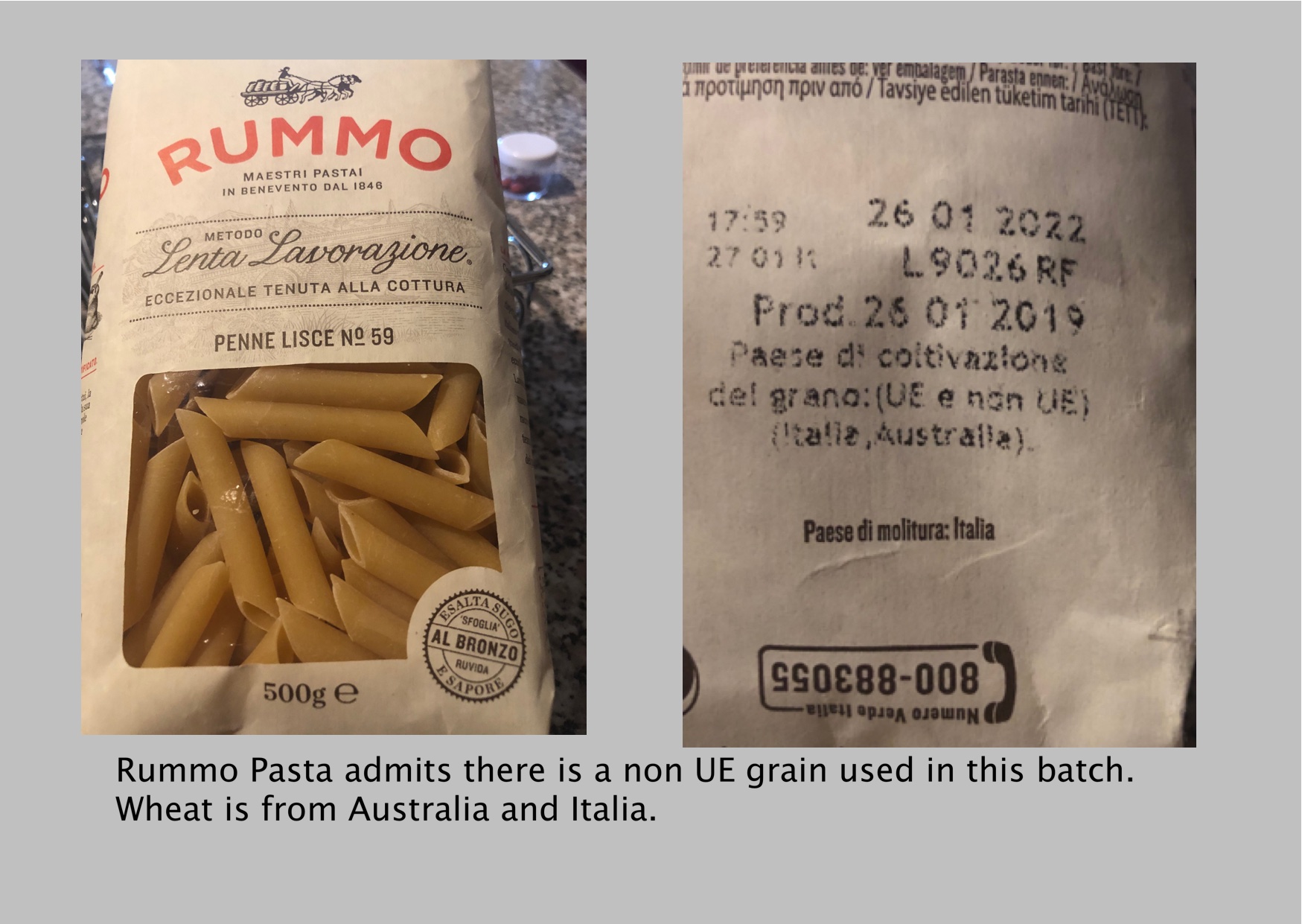
In 1846 Antonio Rummo started making Rummo Pasta in Benevento.  The wheat he used was only from the Italian regions of Puglia and Campania.  I was sad to see that they too had to import wheat to satisfy their global customers.   Rummo is a local company so I do support them – but I also always read the label.

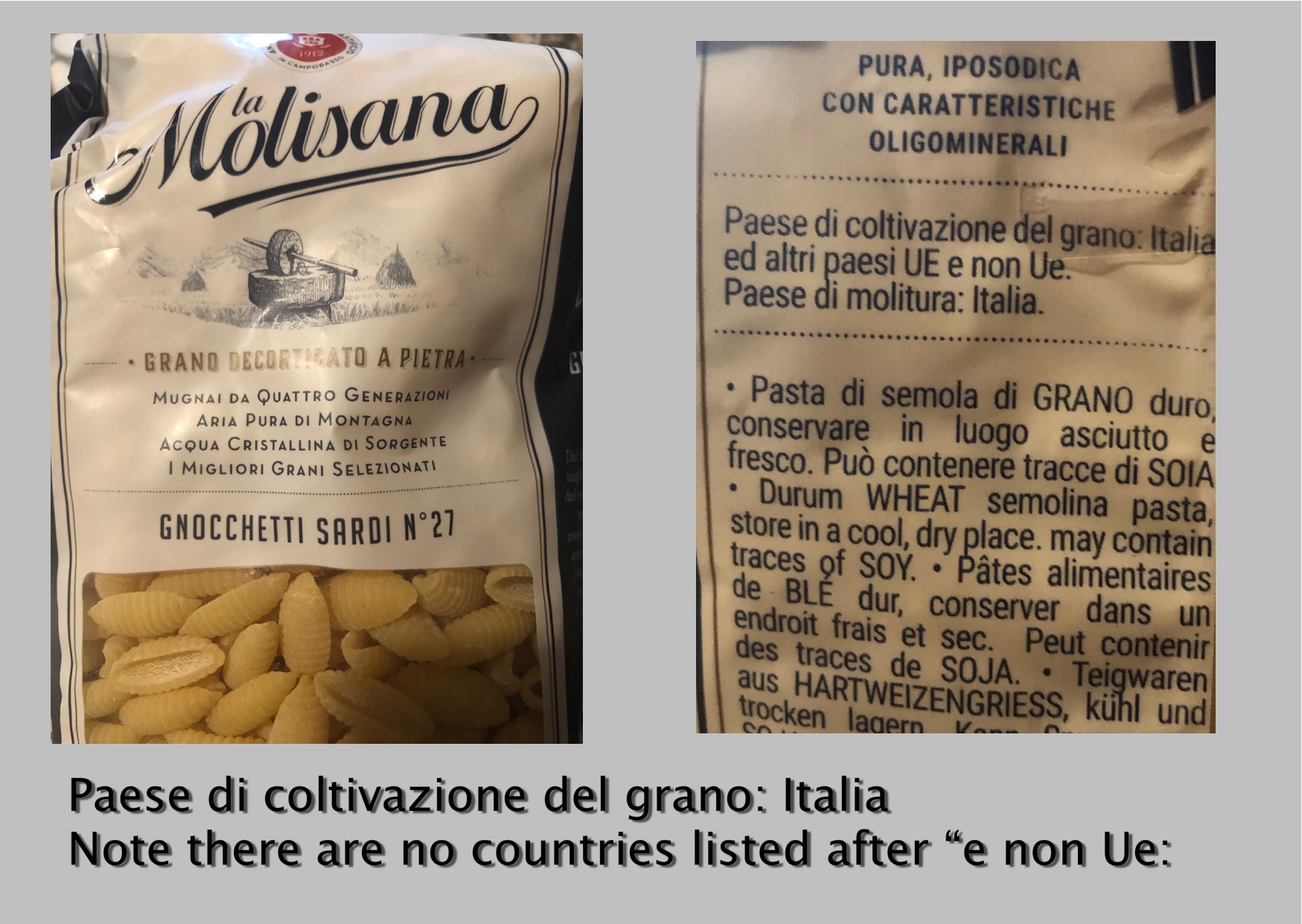
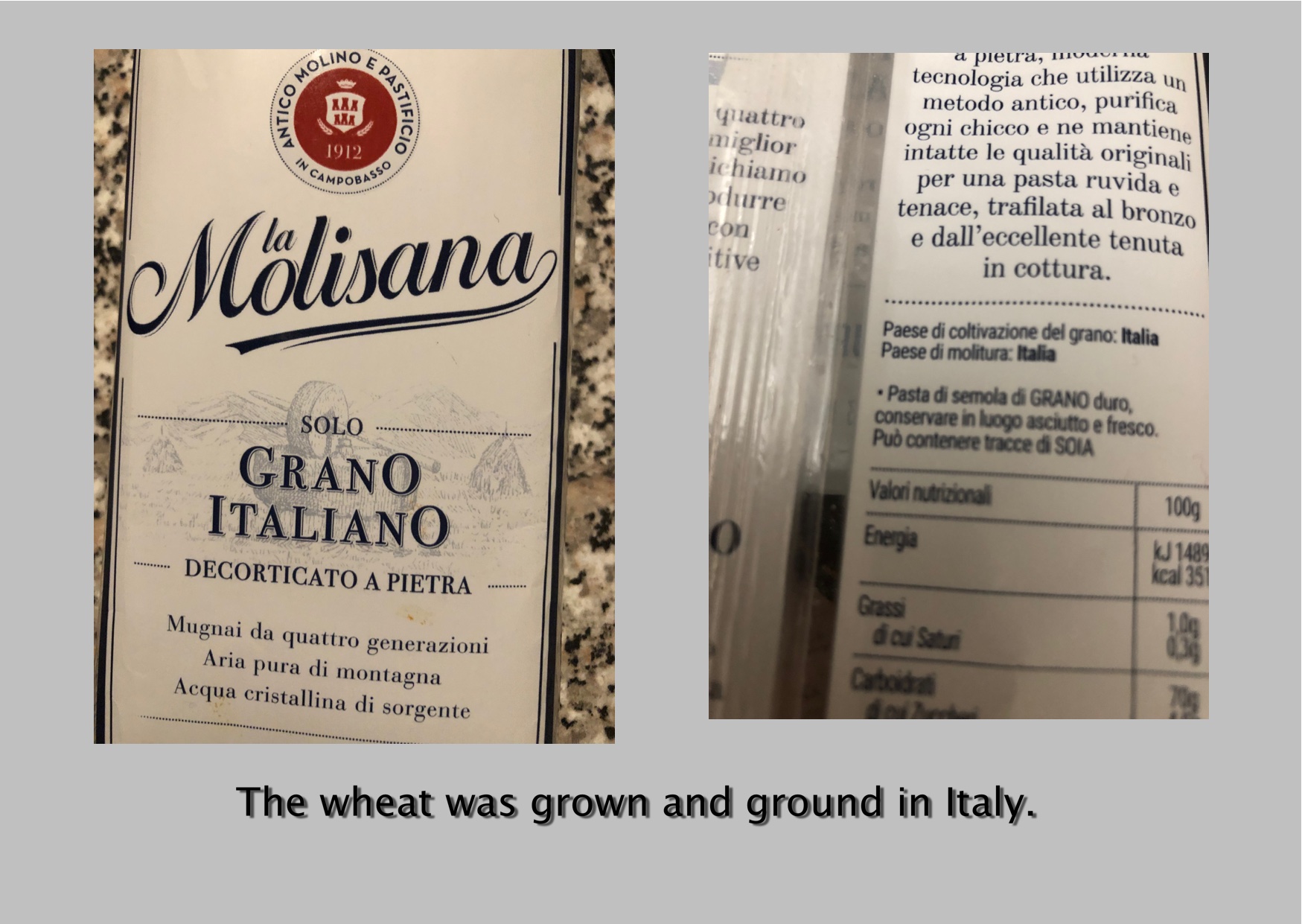
La Molisano Pasta is from Campobasso, also close to Pontelandolfo. Some of their products proudly proclaim on the front of the bag “Solo Grano Italiano.”Pasta 3.jpg

Other packages I have to turn over and put on my glasses to discover where the wheat was from.  Happily, I have only found La Molisana in our local supermarket made with Italian grain.

Pasta 1.jpg

The USA does have COOL legislation.  Those “made in China” labels are everywhere.  Are we equally concerned about food?  We have all seen the labels in supermarkets that told us where the produce was fun.  Are those signs still there?  Let me know. In February, 2016 the United States Department of Agriculture repealed the COOL requirements for Beef and Pork.   I stopped reading their website after I saw that…

Those of you are shopping in any country but Italy, please let me know if COOL is in effect on pasta, rice and dry goods.  Are the labels there? I am really curious.

It is amazing what you can learn traveling by train.

Ci Vediamo!

They Came to Cook and Conquered a Village

In a small town, like Pontelandolfo, everybody knows your name. Tweens in a dark alley getting into something that they shouldn’t, don’t think it is such a good thing. “Second act’rs” like Jack and I living in a new place, find it magical. Whenever we go into the piazza we know we’re home. Folks say salve – hi, come stai – how are you, smile and wave. When we first started staying long-term in Pontelandolfo, going to the piazza was kind of like going to the high school cafeteria on the first day of school.  Who would I sit with?  Who would talk to me?  I don’t know how it happened but we too became part of the fabric of life here.   What struck me this past Saturday, was that every time a group of adventuresome cooks come to Pontelandolfo to be part of Cooking in the Kitchens of Pontelandolfo they too quickly become part of our village’s life.

For three years the homes, citizens and businesses of Pontelandolfo have opened their doors and hearts to strangers looking for a different tourism experience. These strangers aren’t strangers very long.  Relationships are formed in nanoseconds. I know that the relationships are strong because I see the tears when folks depart. I read the FaceBook posts as connections are kept.  Love – the feeling of love is everywhere.

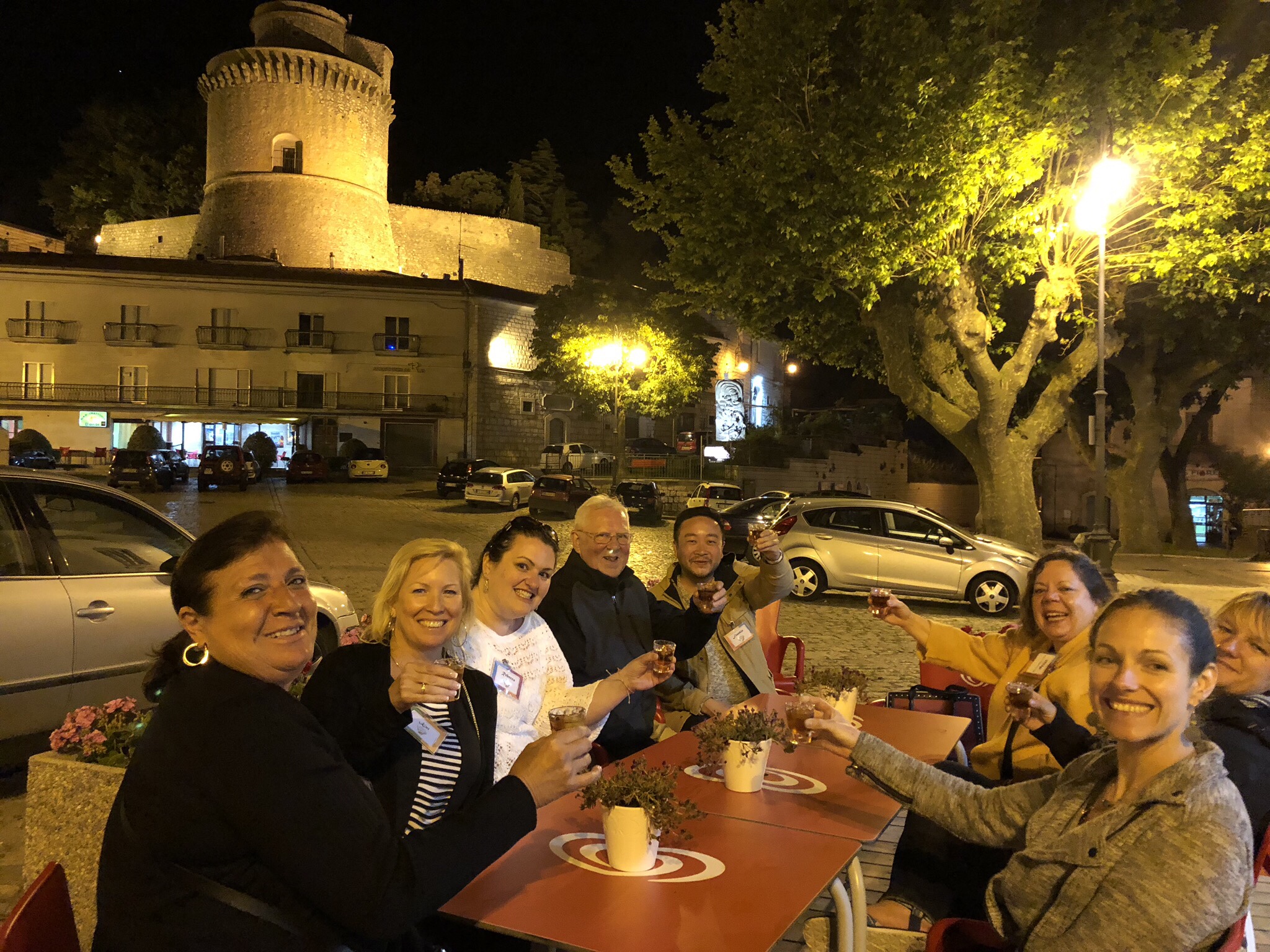
This latest group jumped right into village life with that first night “bar crawl.” They met bar owners, bar goers, politicos and curious folks. Pontelandolfese out for their evening passeggiata got a look at them. What troupers, having snacks and drinks at not one but all three bars on our piazza. It was obvious to all who met them that they were really interested in Pontelandolfo, our home town.

Tourists often pop in and out of Piazza Roma, take a picture of the iconic tower and dash off. The seven day commitment that both these latest and our past Cooking in the Kitchens of Pontelandolfo participants made,  meant that the visitors wanted to have a meaningful encounter with not only the food of Pontelandolfo but also the community. They became regulars at the bars, chatted up everyone, played with the children, cooked and ate with families, visited with our baker, cheesemaker, butcher, listened intently as an elder craftsman talked about weaving fabrics as his great grandfather did – all this endeared them to the community.

Now if you know me, you know I wear my emotions on my sleeve and tear up often. When something really touches my heart, I not only tear up but am speechless – cause talking is impossible. There were many times during our cooking programs when I couldn’t speak. I have seen love crossing economic lines, ignoring politics and breaking down cultural barriers.

Some of our guests have had a root of their family tree here in Pontelandolfo.  They came not only to learn traditional Pontelandolfo cooking but to discover more about their past.  Our first group, three years ago, visited the Contrada (little village) of their ancestors and felt the connection that only blood returning to its source can bring. One of this past week’s women had ancestors from Pontelandolfo.  At the B&B she discovered a couple that knew her  distant cousin.  They embraced her and took her to see where her family was from. She was full of stories and felt the spirit of Pontelandolfo.

The women who open their homes to these strangers are so warm and loving that it is impossible not to feel welcome.  They have been touched as these strangers, who are strangers no more, have bought them gifts from their home states or made them something special.  A young female ship’s captain just presented each teaching cook with little dream catchers she knotted and wove from one long piece of ship’s string. Those little catchers will be holding a lot of love.

Everyone always pitches in as meals are being created, parties started or excursions planned.  I can see men and women of all ages flicking tablecloths, setting places and carrying dishes.  I also saw them carry wood from outside for wood burning ovens, making brooms from the sambuca tree and washing hundreds of dishes. This May, a female Broadway sound engineer, even fixed the butcher’s sound system. That meant that music flowed during our last night party. All of these actions felt like the actions of family members not recent strangers or guests.

Some of our visitors have even made sure that children’s books in English were added to our community library.  Since everyone must study and pass an English proficiency test this was a fabulous and thoughtful gift.

Children, twittering with stage fright,  who in traditional dress, performed stories from the town in English, have been cheered like movie stars.  Our guests have loved the challenge and work that these little actors put into sharing stories about their town.

I thank all the culinary tourists over the years, for bringing a tear to my eyes and silence to my mouth. I thank them for being willing to experience a small southern Italian village. I thank them for accepting us for who we are. I thank them for being who they are. I thank them for making me understand that love and food break down barriers!

Huzzah to those who came, cooked and conquered our hearts!

Cooks 4 sessions