
Cinghiale – Ugly but Yummy

Photo by Magda Ehlers on Pexels.com

Wild Boar – Cinghiale. They dig up crops, scare the bejeeezus out of tourists, and imagine this – one year ago the Italian army was sent in and told to shoot to kill. The ugly critters, found even in the streets of Rome, were or may have been carrying African Swine Fever which threatened the pazzilion dollar prosciutto industry. Some of the wild bad boys may have been getting a little too close to the gentile domestic sow. Sigh – isnโ€™t that always the way.

Here in Pontelandolfo, we may not like their big ugly tusks charging at us but we do love the rich sauce you can make with the meat. The amazing steak and well, the general incredible taste that only free ranging, wild things can give us. ๐ŸŽถ โ€œWild thing, you make my taste buds sing!โ€ ๐ŸŽถ

Growing up in rural agrarian Somerset County, New Jersey, venison, wild turkey, peasant and other wild critters often graced the table. My dad told me that in the dark days of the depression, ground hog – which tastes remarkably like pig when made in tomato sauce – was often part of Sunday pasta day. My nonna told me the horror stories of picking buckshot out of teeny tiny sparrows or maybe they were black birds. When a flock flew over my nonno would hauled out the shotgun and BAM. Wee birds for dinner. I remember cleaning buckshot out of peasants and that wasnโ€™t fun. But a family has to do what a family has to do.

Here in Pontelandolfo, we still have subsistence farmers who grow and process vegetables, raise animals for milk and meat and, gulp, remind me of my grandmother. They are kind, hardworking and loving people. Weโ€™ve integrated into the villageโ€™s rural lifestyle. Nope, I havenโ€™t planted a thing except words on a page and a good will smile. Since, everyone thinks that because I spend my time at a desk, poor Jack will die of starvation, we are often recipients of parts of harvests and hunting. NOW YOU SEE WHERE THIS IS GOINGโ€ฆ

Thanks to a wonderful hunter, a giant chunk of cinghiale found its way to my freezer. Jack and our summer guests would not starve. Unless I was hosting a party for our contrada (neighborhood), there was too much to use for one meal. I put on my 4-H Cooking Club farm girl brain and thought – I know me thinking seems like an anomaly – but Shazam an idea. Yes! I would divide the meat and create three freezable dishes. Stew, pasta sauce and meatballs – all freeze well and will make Jack a happy cena.

First step, get out a big knife and divide the hunk. Based on no knowledge of boar anatomy, I think it was a thigh or butt. I grabbed one of my nonnaโ€™s giant stainless steel bowls – yes, I brought a few to Italy – tossed in leftover red wine, wine vinegar, apple cider vinegar and herbs. Why, you are wondering did I use a mix of vinegar. Simple, there was a little bit left in a few bottles. I also added diced garlic, fresh rosemary on the stem, thyme, pepper and salt. Plopped in the meat, covered it and left it in the refrigerator for two days. I think twice I remembered to flip it around.

Truth be told, I then had to succumb to google. Did I wash the meat after the marinade? I did. Did I mention, I throughly washed the meat before I dropped in the melange of acids. Iโ€™m glad I washed it. An important lesson was learned. Leaving boar in vinegar for 48 hours means it is tender and tastes like a hint of vinegar. Next time it will just be red wine.

I looked at the three big pieces of meat which were now no longer red. WHAT DID I DO? I was planning on taking one third to our friendly butcher and asking him to grind it. When I got there the first words were – in very marginal Italian – did my marinade wreck the meat?! He laughed. The meat absorbs the acids and changes color. I promised him some meatballs. He smiled at that too.
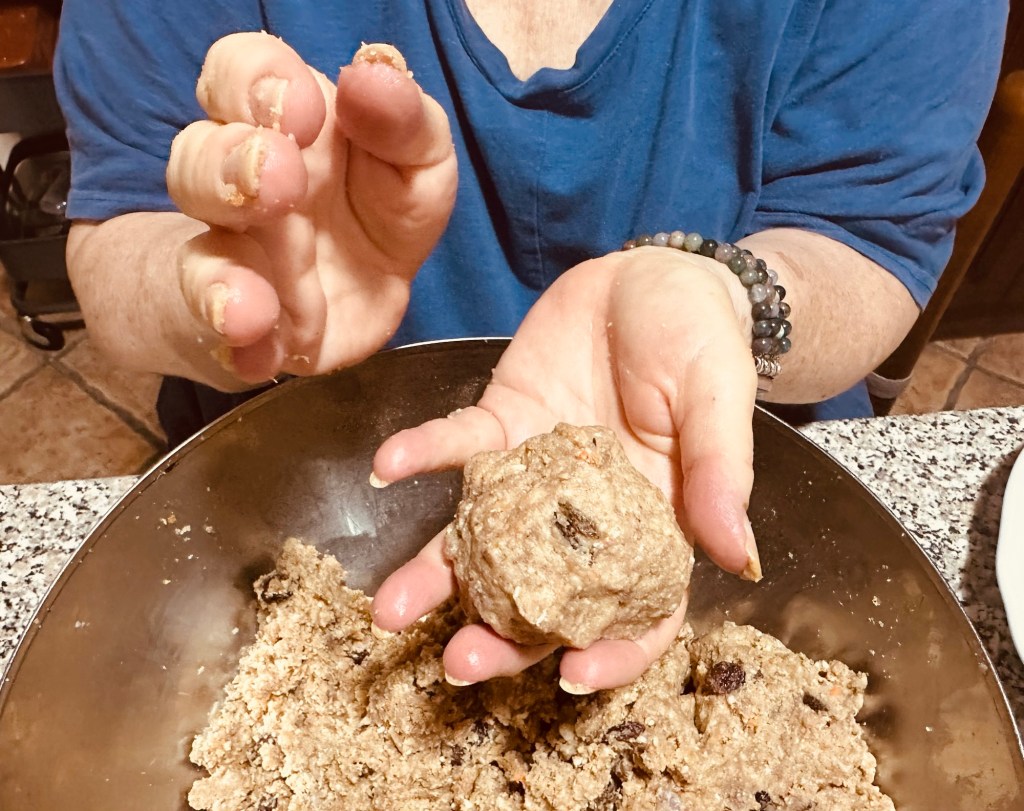
Cinghiale Balls!

There is something meditative about squishing a mixture of meat, grated cheeses, breadcrumbs, raisins, oregano, salt, pepper, basil and eggs through your sanitized hands. Because the meat wasnโ€™t very fatty, I used more cheese and eggs than one might usually. Actually, I scooped in extra bread crumbs too. I ended up rolling about 30 balls this size.

Meanwhile on the stove, my giant stainless steel pot was hosting slow cooking freshly diced tomatoes, onions, garlic and green/red pepper. I wanted the fresh stuff to break down before I added jars of passata ( homemade tomato puree graciously left on my veranda.) In went the passata plus a couple of store bought cans of diced tomatoes. I was trying to fill the giant pot and freeze enough sauce for decades.

To make the sauce really rich, I have learned to add a mirepoix. Carrots, celery and onion were diced to almost a paste in my blender. That went into the pot then I stirred and waited. When it started to bubble, I very carefully placed each of those boar balls in the pot. Lid went on and I let the ragรน slow cook for a few hours. The meat balls gave it not a gamey taste but a savory taste that one wanted to go on forever.
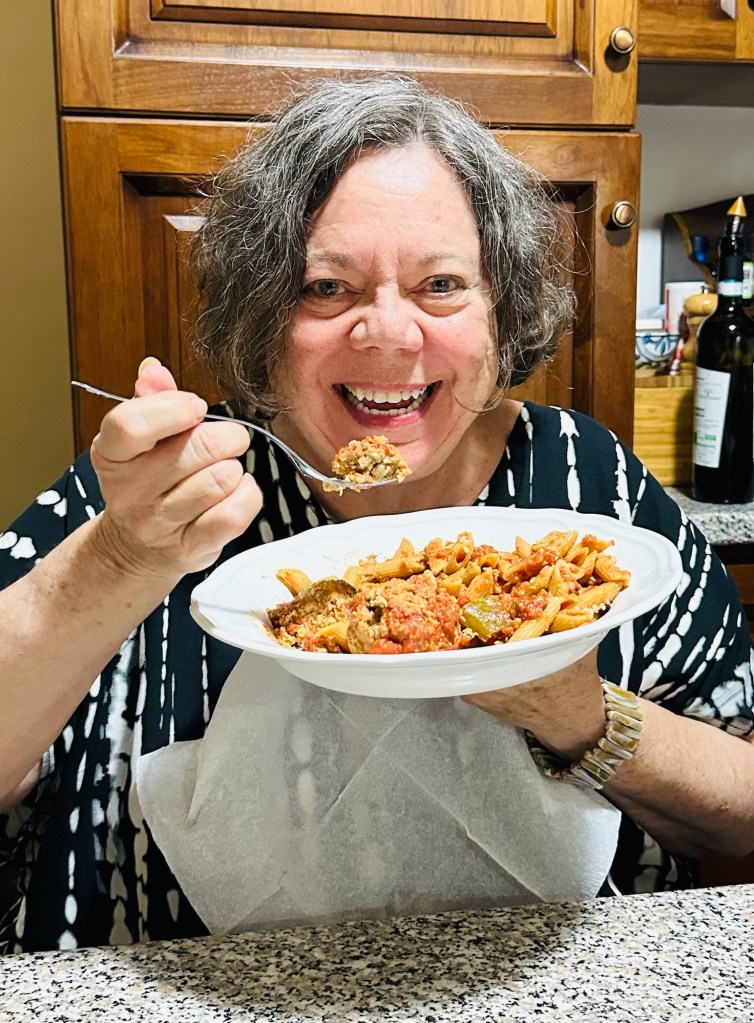
I could eat this sauce everyday!

I made enough sauce and meat balls for three of us to have a substantial meal. Nestled in my freezer are now three containers of sauce and balls for the future. Yummy. I thank the hunter who share with poor starving Jack.

We will talk about the stew another day. I am hungry and need to forage for local cheese,wine and bread.

Ci Vediamo

Midge

You too can cook, write, paint and enjoy village life in Pontelandolfo! Visit – www.cookinginthekitchensofpontelandolfo.com

Will I See You in Pontelandolfo?

Sigh, I can see the steam floating up from my perfect cappuccino at Cafe Style. My wallet is thrilled that we can go to Bar Elimar for a scrumptious homemade lunch and spend a scant โ‚ฌ15 for two people. Jack’s nose is yearning to smell the bouquet of the featured wines at Ponte Simone. We both have saved up our pennies for a night out at Tรฃwa, the glorious sushi restaurant, in Piazza Roma.

Do I sound homesick? I am, I am! Soon we will be back home in Pontelandolfo and I can’t wait.

Will we see you there? In 2025 we have two incredible opportunities for you to become a part of our village. Cook in the Kitchens of Pontelandolfo – May 17th to the 24th or September 6th to the 13th! This yummy program has been bringing smiles to the faces of culinary adventurers since 2016. (Not bragging, but last year we got a tourism award.) Check out the videos on the website – lots of food, laughter, and community. Then register and join the fans.

Follow your Creative Muse to Pontelandolfo

Our newest adventure is literally literature. Toss your laptop in a bag and participate in our 2025 Writersโ€™ Refuge in the Sannio Hills. This Writerโ€™s Retreat runs from June 21 to June 28th. Authors can soak up the atmosphere and work on their craft with Amy Scott of Scott Editorial.

All of the adventures start with a bar crawl. ‘Midge, Midge,” you are thinking, “a bar crawl is soooo sophomoric.” Nah! It is anything but sophomoric. What an incredible way to explore different parts of the village, meet locals and gain an understanding of village life.

Our very first group of writers joined the village in 2024. Playwrights organized by the New Jersey non profit – Write Where You Are. They wrote. They flourished. They conquered.

Will I see you in Pontelandolfo? Questions?

Ci vediamo!

Midge

Save Those Bottles for Sott’olio!

Spring sprang or is that sprung or had sprung ? Pontelandolfese were springing over hill and dale hunting for spring vegetables. The favorite being wild asparagi! Thin, supple, dancing in the breeze – just like my fantasy of me – these delicious wild asparagus are prized among the gatherers. When I spy a smiling forager, I know that they have filled their baskets with asparagus. Some people just seem to know where to look.

I’ve spotted pokey amounts along the side of the road. Local wisdom has it that you shouldn’t pick stuff close to the roads – unless you’re starving. Makes sense to me – exhaust fumes cough, cough – have coated the wild sprigs. Real gatherers head for the hills. Fresh air, healthy hike and yummy finds make those a great experience.

download

Did I go? Seriously? It sounds lovely but I had to wash my hair. Actually, having had Lyme Disese twice, I am afraid of ticks and don’t forage in tick land. The other reason I didn’t go was simply, my lovely neighbors and friends fear that since I am always off doing something, Jack will starve. If baskets of greens aren’t dropped near my door, they will find poor Jack on the veranda writhing with hunger. I love this myth!

My friend Nunzia appeared with not only a basket of wild asparagus picked by her charming husband, Amedeo, but also some in bottles covered in oil – sott’olio. Canning to me sounds complicated. I am afraid that I will kill people with tasty botulism or something equally gruesome. What everyone does here is not really canning but oiling. WHAT. Sounds like a spa gone wrong. This is so easy and so right that even I can do it. Folks in Pontelandolfo jar eggplant, asparagus, artichokes, sun dried zucchine and more sott’olio. I asked a couple of people to tell me how they do it. Everyone starts with uber fresh vegetables.  I mean picked today or last night.  All are washed, cleaned and chopped into little pieces. After talking to my friends and tasting what they jar, I realized there seems to be the only a few differences in the methods.

Thank you Nunzia for the jar of asparagus! Jack scoffed them down – he will not starve this week. Here is how she does it.  This technique can be used for a variety of produce including artichokes, eggplant and zucchini.  After you have prepped the asparagus, pour one liter of vinegar, half liter of water and a teaspoon of salt into a big pot.  Bring it to a boil and dump in the asparagus. Cook them for a scant 4 or 5 minutes. Drain them and them lay them out on a clean dishtowel and thoroughly dry them.  When they are dry put them in your recycled but clean jars. Leave a wee bit of room at the top.  Cover them completely with olive oil.  Then bang the jar – don’t break it – so that the vegetables move and mush down a bit.  Or with a clean fork push them down.  Make sure they are all totally covered in olive oil.  Then put the clean lid back on and put them in the cupboard until you need them.

IMG_2833

Cousin Carmella is my go to person for cooking questions.  She is one of the home cooks that the culinary adventurers for our September 7 – 14 2019 Cooking in the Kitchens of Pontelandolfo will get to cook, laugh and eat with.  Her sott’olio method for asparagus was a little different from Nunzia’s.  The prep is the same.  In a big pot bring to a boil two parts water and two parts vinegar with enough added salt to your taste.  When it is boiling, add the asparagus and push them down to the bottom.  They will rise up to the top.  When they do push them down to the bottom again.  Do this three times and drain them in a colander.  When they are cool, put them in a bowl and toss them with olive oil.  Next, put them in the jars and push them down lightly before covering them with olive oil.  Carmella’s husband Mario forages for mushrooms and she does the same process for them.  She noted that mushroom and asparagus cook in just a few minutes.  Other types of vegetables need to boil longer.  She feels that the vinegar is a better conservation method than using wine.  Wine make give it a better taste but you have to eat the items sooner

Besides the fact that we buy wine by the  five liter jug, you may be wondering why I asked her about using wine in the process.  Another great cook and lover of eating out in new restaurants with me, is my pharmacist pal, Adele.  One day she brought over a jar of artichoke hearts sott’olio.  Ha! She thought Jack would add them to his lunch time salad.  I ate every last one, they were delicious.  When the baby artichokes are plentiful in the market, she buys a bunch to put away and use in future dishes.  She had us over for her homemade ravioli stuffed with artichokes and we both loved them. Her technique for sott’olio is a different. Remember she makes a huge batch!  The first thing I noticed is that she strips away virtually all of the outer part of the artichoke and is left with the small center.  Prep for artichokes includes soaking them in water an lemon for at least an hour.  This is too keep them looking pale green and lovely. After the lemon soak, place each one upside down on a clean dish towel to drain. Her canning formula mixes 1 liter of vinegar with 1 liter of white wine and a half liter of water.  She tosses in some salt and brings it to a boil. When the liquid begins to boil again, time the cooking.  Boil the artichokes for only 5 minutes and using an colander promptly drain them.  Then put each one upside down on a clean dishtowel so that all of the liquid drains out.  Dry them too.  When they are completely cold put them in clean, sterilized glass jars and cover them with – not olive – sunflower seed oil!  Adele uses sunflower seed oil which makes her process really different.  She too uses the same process for different vegetables but alters the time.

I have been so fortunate to have met people who want to feed me.  All of the vegetables I have tasted processed like this have been a little crunchy, tangy and wonderful.  Try it this summer and let me know how it works out for you!

SPECIAL COOKING IN THE KITCHENS OF PONTELANDOLFO DEAL ALERT!!!!

We have room for two more culinary adventurers for our  September 7 – 14, 2019 Cooking in the Kitchens of Pontelandolfo session.  I want to see the session filled so I am doing something we have never done – HAVING A SALE! Send me an e-mail ASAP to be one of the two and receive a delightful discount!  HOW DELIGHTFUL?  10% OFF DELIGHTFUL! THAT IS A โ‚ฌโ‚ฌโ‚ฌโ‚ฌ SAVING! Contact me to find out just how great it is.

Info@nonnasmulberrytree.com. Do it today and have the cooking time of your life this fall. 

Ci vediamo!