Wine Tasting with Giuseppe Izza

Agronomo – in English it is an agronomist – one who studies agriculture. Dr. Giuseppe Izza has indeed developed a career based on the wonderful edibles that grow in Sardegna.  I met him – not talking about slow food or tasting the fresh vegetables brought to Alghero by local farmers – but DRINKING WINE!  The event was organized by my favorite Italian Language School – Centro Meditteraneo Pintadera.
IMG_4055.jpg

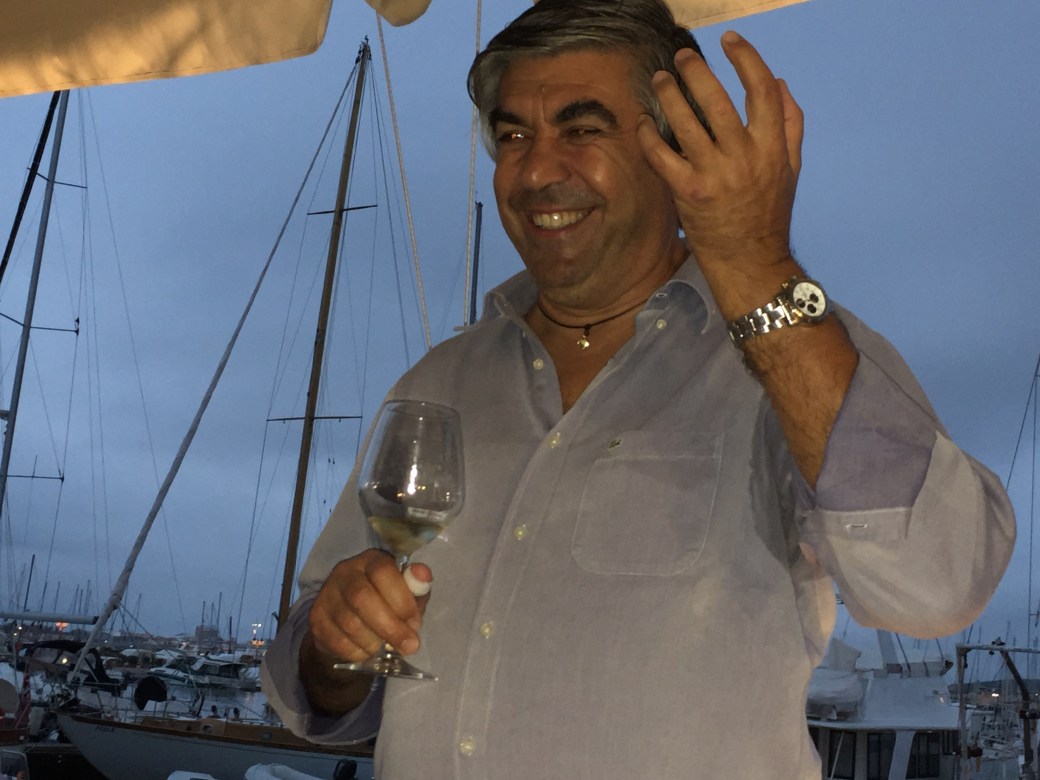
Dr. Izza conducts an incredible workshop on the wines of Sardegna, wine tasting, wine history, wine glasses, what to eat with wine – well just about everything one needs to know to appreciate a good glass of a beverage that starts in the vineyards of Sardegna. Some of those vines have lineages that go back to the Romans in 238 BC.  For example the white Nuragus goes back 3000 years!!!  Other grapes began their journeys a wee bit later and came with the different peoples who controlled Sardegna during its history. For example – the Vermentino – white – from France or the Torbato from Spain.  These grapes have lineages much more noble  than mine.

We were all chomping at the bit to start tasting the wines that Dr. Izza had brought with him.  But NOOOOOOOOO!  First we had to learn how to really taste – not just gulp down that red for a quick thirst quenching buzz.  Babies, he said, have the best sense of taste.  They don’t think about it – now he was not talking about the 3 year old who wouldn’t eat anything green.  His point was that adults are choosy.  Babies eat with their eyes, hands, noses and mouths.  They explore their food – look at it, smell it, taste it.  He encouraged us to – at the first tasting of something – to exam its look, really smell it, then slowly taste it.

IMG_4059.jpg

Look at Jack – he’s all excited.  Dr. Izzo is opening a bottle for us to taste.  What?  We have to wait?  Chill Jack – first one has to pour.  We were told to only fill a wine glass to where the glass starts to get bigger – open wider – that allows the smell to evaporate up.  Hmmm. Next, really visually examine the wine.  What is the color?  If you tilt the glass does that create “unghia” – nails in Italian but we would say legs. What are the color undertones?  Then, rotate the glass and evaluate the fluidity and arches.  We all put our glasses next to our handouts so that we could really see the color – it was hard – some of us were staring at the sunset on the Alghero harbor.

IMG_4060.jpg

We went through the process with a number of both red and white wines.  It was interesting how our individual tastes and experiences created diverse perceptions of each wine.  I might think something had undertones of oak and cherry and Jack would laugh and say – not at all.

Dr. Izza is an enjoyable presenter.  He is a great communicator and had us thinking, laughing and of course drinking. The hours whizzed by and we all left the table with a better understanding of not only the heritage of the local wines but also how we can all be more discernible tasters.  I would recommend any of Dr. Giuseppe Izza’s classes.  You can follow his food adventures on his FaceBook Page or e-mail him at g.izza@tiscali.it.  Find out where he is doing a lecture and go!  The easiest way is to work with him is to join me in Alghero, Sardegna this October on the  Nonna’s Mulberry Tree Trip!

IMG_4049.jpg

Ci Vediamo!

Riccardo Fortuna’s Graphic Novel

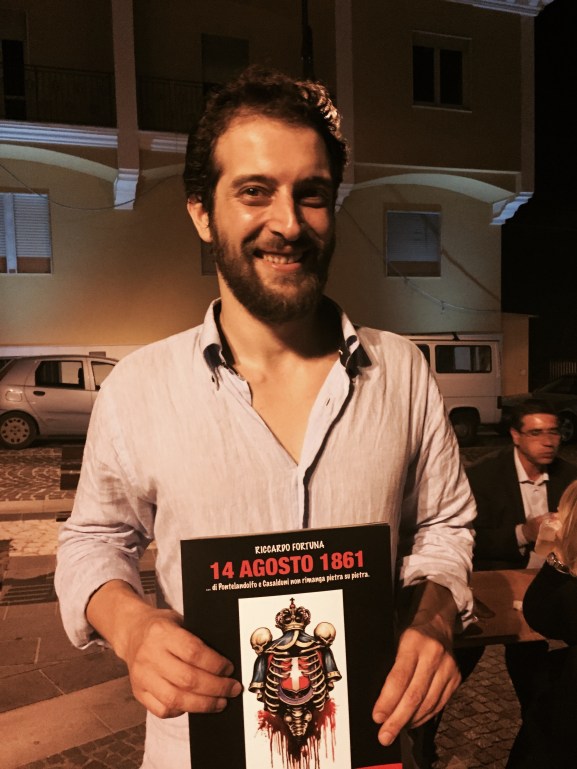
Riccardo Fortuna is a gifted artist, who has created un fumetto – a graphic novel  – that brought tears to my eyes and an ache to my heart. Last summer, Riccardo presented this graphic novel at a forum on one of the most obscure and controversial pages of the Risorgimento – the massacre of Pontelandolfo and Casalduni citizens  by the Royal Italian Army on August 14, 1861.  When I heard him speak and picked up his recently published book – yes, yes, he is awfully good looking – but that wasn’t the reason I picked up his book – I couldn’t wait to read it.

IMG_3212.jpg

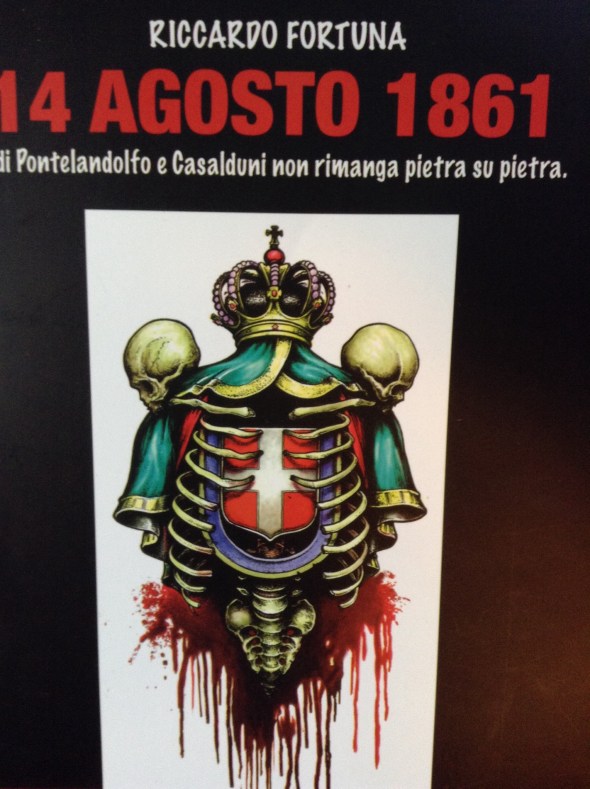
His novel, 14 Agosto 1861, tells the story of the horrific events that happened one night in the Italian villages of Pontelandolfo and Casalduni.  Not only did the incredible drawings and historic through-line resonate with my passion for Pontelandolfo but they also made me realize how little  I knew – and I’m guessing most Americans know – about the militaristic march to unify Italy.

Jack is an avid reader of history books.  I start to read Italian history and wake up with the big books crushing my belly.  Then, I read 14 Agosto 1861.  Not only did I stay awake, but I could not put the book down until, with tears sliding down my cheeks, I finished it. Fortuna, having heard the story,researched the incident and created a history book with drawings that captured the spirit and pathos of one murderous night.

On August 14, 1861, some partisans captured and killed a small number of Italian soldiers in Casalduni. Seeking revenge, Italian Colonel Pier Eleonoro Negri directed his men to launch an attack.


As Pontelandolfese calmly slept, an indignant, Colonel Negri ordered that his soldiers destroy the community. Di Pontelandolfo e Casalduni non rimanga pietra su pietra. Leave no stone left standing in Pontelandofo or Casalduni, he cried.

IMG_3196.jpg

2015 Recreation in Casalduni

Entering Pontelandolfo in the middle of the night, the soldiers, kicked in doors, leaped up stairs, raced into homes killing men, women and children. Looting and unimaginable atrocities occurred. Flames soared and the village burned. The infamy of this night will never be forgotten.

IMG_0004.jpg

The young author has published other graphic novels.  His latest –

Dio è morto: Da così parlò Zarathustra, di F. W. Nietzsche. (Italian Edition) Kindle Edition

by Riccardo Fortuna (Author), Friedrich Nietzsche (Narrator)

– can be found on amazon.com.   I hope that there is a second printing of 14 Agosto 1861.  Why not contact Riccardo  and ask him!


Ci vediamo a presto.

USA Citizens Vote While Overseas!!

With all the lunacy of the primary elections spinning and whirling around me, I knew that Jack and I had to be able to vote in this year’s New Jersey primary election.​  Since we will be in Italy in June and the mail from the United States to Italy is notoriously slow – I didn’t want to risk a mail-in absentee ballot. What is a political junky voting citizen to do?  

My pal George, who lives in The Netherlands, said that he goes to the American Consulate. Hmmm, do I have to go Naples?  Being a politically savvy chick, I knew just who to call – the Board of Elections!   What – I’m wrong?  I have to call the County Clerk?  Done. I called the Somerset County, NJ clerk’s office and discovered that U.S. Citizens who are out of the country can vote electronically!  Who knew?!

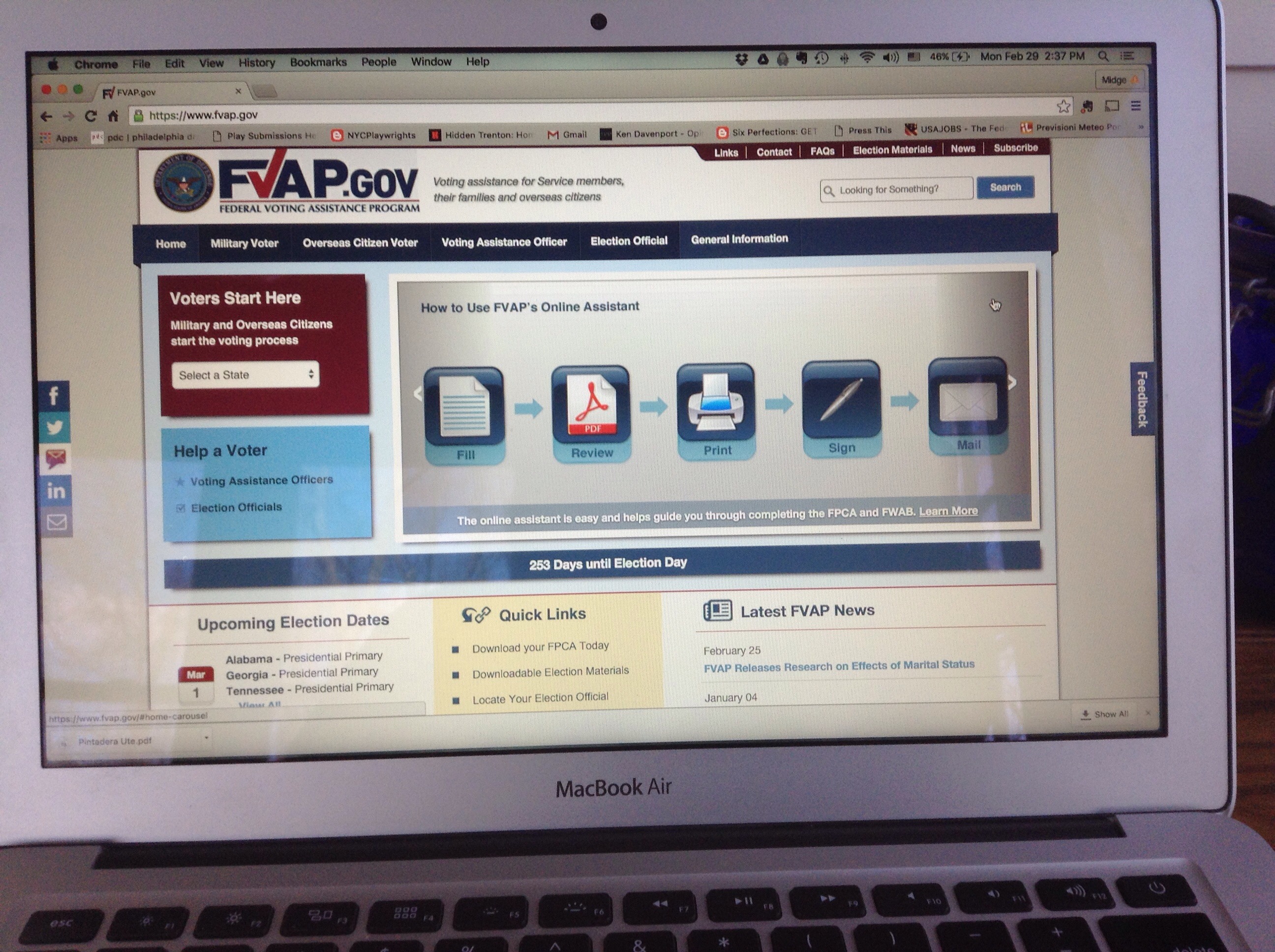
First stop –  Web site : FVAP.gov  Federal Voting Assistance Program 
A quick trip to the web site made me realize that it was not only possible but probable that I would be voting this June from Pontelandolfo!  Go Democracy – huzaah! 

Here is how it works – 

1. You must register and request an absentee ballot in your state of legal residence. Right – you can’t vote  in Oregan and then vote absentee AGAIN from Europe. You complete what is called the federal post card application – it looks nothing like a post card.  

Hmm, I thought, filling it out online looks pretty simple. POP, up came a privacy statement – click – I accepted the privacy act statement. That means people get to see who I vote for. Who cares – ask me who I voted for and I’ll tell you. 

The form took forever because once again the big zip code data base in cyberspace would not recognize my zip code. Flagtown has had its own zip code long before Hillsborough coalesced into a quasi community with a post office and zip code. I fought the system and then hung my head and used the Hillsborough zip code.

2. Print and finish your federal post card application. Easy. 

3. Next from wherever you are mail the form set to your local election office. This part was a little Squirrley.  You can only send it back on USA sized 8 1/2 by 11 paper. Then mail it in a number 10 envelope. Now, if you’re in Europe where the hell do you easily get the paper or the envelope. The directions say that using European standard paper you need to print the document at 96% of its normal size. On the website they then give you a template to make your own envelope.  You also need to note that you cannot have scotch tape on the envelope. So I’m confused, if you’re going to download an envelope and make an envelope do you have to find a recipe for paste?

Since we are still in New Jersey we will be hand delivering our 81/2 X 11 postcard. 

My ballot will be emailed to me. I hope I can email my response back. The county clerk office said I could. Wouldn’t it be great if all of us could vote electronically. 

But if you don’t get your ballot what can you possibly do? Guess what you can go online and using the federal rights in absentee ballot you are able to vote or you can pick up a hardcopy version from your nearest US Embassy or Consulate location. I got bored reading about it and hope we don’t have to do this. Apparently there are a number of questions that you’ve got to work your way through. Ugh. 

I am confident that I will get my ballot. I will do my dad proud and vote in the Democratic primary. I will do my home country proud and vote in the general election. 

Huzaah!